Home » Jazz Articles » Live Review » 2012 Thelonious Monk International Drums Competition
2012 Thelonious Monk International Drums Competition
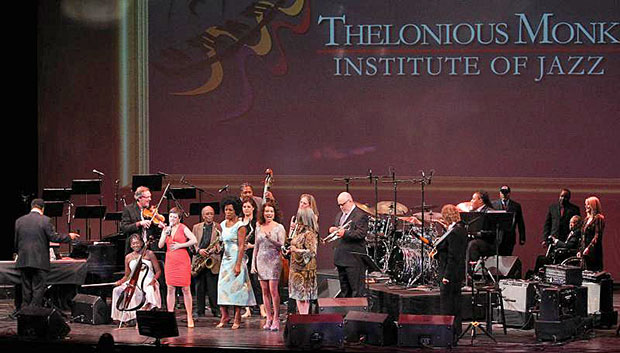

Lasting well over two hours, the event unfolded like a beautifully orchestrated tapas banquet. The feast covered not only a wide range of musical styles, but also explored, through the speeches and awards, the Monk Institute's multifaceted programs and broad international reach. As with any such affair, while you may never get enough of your favorite dish and there is always one you don't particularly like, at the end of the night you can look back on both an evening of satisfaction and new experiences.
The Competition
Dedicated to the drum set this year, the two-day competition brought 12 young drummers from around the world—including Germany, Hawaii, Israel, and Slovenia—to vie for the Institute's illustrious and lucrative prizes, which include grants for further study and a recording contract with Concord Jazz.
The drum competition proved both a fine musical display and a chance to delve into a greater theme, in this case the history and defining importance of the drums to jazz. Before introducing the finalists, pianist Herbie Hancock reminded the audience that the drum set is a uniquely American instrument fusing together components drawn from multiple cultures, the rhythms and special language of which form the foundation of jazz. T.S. Monk, Jr., who as a drummer proclaimed the evening particularly close to his heart, would return to this point throughout the night. However, nothing could more concretely underscore the special treatment that the drums received than the complex logistics undertaken by the Kennedy Center staff to allow each finalist to perform on his own set instead of simply swapping out cymbals and snare, as is so often the case for the traveling percussionist. All evening, drum set after drum set was wheeled on and off the stage in a visual reminder of how, when given the chance, drummers carefully construct their instruments to build a personal sound.
Winnowed down to three finalists who performed in front of a packed audience, each of the players performed two pieces accompanied by pianist Geoffrey Keezer, bassist Rodney Whitaker and saxophonist Jon Gordon. The three finalists took starkly different approaches.
Hailing from California, Justin Brown erupted immediately with a big, bravura sound, his sticks dancing rapid fire over the instrument. In sharp contrast, Coloradan Colin Stranahan chose to accentuate the drum set's subtler capacities. Using a combination of supple brushwork and precision, Stranahan built patient solos and provided colorful accompaniment, displaying particularly adept cymbals work.
In the end, however, neither of these approaches impressed the expert panel of judges as much as first place winner Jamison Ross' naturally swinging approach, genuineness, and solid grooves as he performed New Orleans drummer James Black's "Magnolia Triangle" and an original, "Shrimp and Grits."
Asked about taking first prize, Ross replied from behind a mile-wide grin, "I am speechless. I love music so competition is not really what it is about. I just have fun and I played with those guys like they were guys I was playing with at a club on Saturday night."
Leavened by this sense of fun, Ross's deft playing, willingness to take risks, and rhythmic strength had instant appeal and will be interesting to watch develop in coming years.
Composer's Award
In addition to the instrumental competition, each year the Monk Institute presents a composer's award designed to emphasize the importance of new compositions to the continued vitality of jazz. Considering Thelonious Monk's seminal work as a composer and the evolution of his then-controversial writing into today's standards, it is particularly fitting that the Monk Institute takes such pains to encourage new musical exploration in this way.
This year's winner, Japanese multi-instrumentalist Yusuke Nakamura, studied in both Japan and the U.S. before settling in Tokyo, where he fronts his own jazz quartet while also performing with a traditional string ensemble. Performing with drummer Masaki Imura and bassist Misaki Arai, Nakamura's winning composition, "Heavenly Seven," unfolded with sumptuous emotive color, the finely woven textures belying its complex structure.
Describing the piece, Nakamura explained his purpose with casual humor, "This year we had competition for drummers so my first goal was to make the drummer suffer. I had everything in odd time signature, which is seven...And I kinda got obsessed with this number seven so I took all the melodies either as a keynote or as a passing note of the chords, so when there is [a]chord progression going I always nailed the melody going 7th note to 7th note. The challenge was to make it sound good but also stick to my rules."

Part of that challenge included avoiding standard jazz forms, while crafting a piece that would still foster soloing. "This tune is not based on traditional chord progression. That is why it sounded [classical]," Nakamura said, "But I can say this, if you get tired of playing 'Giant Steps,' which is a hard tune to play, you can always play my piece. It's also hard to solo on!"
Nakamura and his trio-mates, who delivered well-crafted solos each in turn, aptly met this challenge. The composition and the trio's performance cast a spotlight on the Japanese jazz scene which, despite having produced many individual players of renown, according to Nakamura, still suffers from a lack of recognition. Nakamura hopes that his success will help because, he says, "if you go to smaller clubs in Tokyo, you get to find many young, talented, great Japanese musicians, but they don't get too much attention and I really feel sad that those musicians can't make their way up."
The Blues
In recent years, the Monk Institute has expanded its focus to more explicitly incorporate the blues, particularly into its educational programs. As impresario Herbie Hancock summarized, the historic and ongoing link between blues and jazz is profound and inarguable. For this reason, in 2007, the Institute launched a Blues and Jazz curriculum that acts as a companion to its already existing jazz history curriculum developed for use in public schools. The Institute has since sponsored multiple educational tours visiting public schools in Mississippi, Chicago, Kansas City, Washington, D.C. and more. The goal is to provide students an introduction to both the music and the social and historical context within which it developed.
In addition, the Institute has formed close ties with the Dockery Farms Foundation, which seeks to restore and preserve the historic plantation often labeled the birthplace of Delta Blues for use as an educational and tourist destination.
To commemorate these activities, the gala concert included a performance of "Hey, Hey the Blues is All Right," by guitarist/vocalist Joe Louis Walker, backed by an all- star cast including keyboardist George Duke, trumpeter Randy Brecker, saxophonist James Carter, bassist James Genus and drummer Vinnie Colaiuta. A rousing electric blues romp, the piece made for an energetic transition to the next segment of the show.
Women in Jazz
Designed to culminate with the presentation of the Maria Fisher Founder's Award to Madeline K. Albright for her support of jazz as a diplomatic tool, the second portion of the evening was both homage to women's historical role in the development of jazz and a platform to showcase the diversity of female contributors today.
Efforts to focus on women in jazz have been more prevalent in recent years. Building on the Kennedy Center's longstanding Mary Lou Williams festival, there have been a recent JazzTimes women's issue, the establishment of a women-focused concert at the Lincoln Center, and other similar forums highlighting women in jazz. It is clear that the jazz world is waking up to the many contributions women have made and continue to make. The Monk Institute's addition to this welcome theme was both thoughtful and reflective of their overall approach. Each performance matched a contemporary artist with an historic figure, thus tracing a loose history of women in jazz through representative figures, while simultaneously providing a cross-section of the many female artists working today across a wide spectrum of instruments and styles.
An added benefit to this innovative structure was that, as the evening progressed, the guest artists appeared multiple times, sitting in on different tunes. The result was a series of impressive individual performances, memorable surprise moments, and an overall successful reminder that women have always played a role in jazz and their impact only continues to grow, hopefully to such a degree that in the future their presence will no longer be noteworthy, but instead assumed.
The series of tunes began with singer Roberta Gambarini paying tribute to Anita O'Day, with a characteristically over-the-top delivery that served to underscore the deceased singer's talents largely through contrast. Following a moving introduction by UNESCO spokeswoman Irina Bokova, who described the direct impact she'd witnessed jazz have in the inspiration and formation of political liberation movements, singer Gretchen Parlato joined saxophonist Wayne Shorter, Herbie Hancock, bassist Linda May Han Oh and drummer Terri Lyne Carrington for a rendition of "Chega De Saudade." Parlato's understated, innovative reading transformed this look at the infusion of bossa nova into jazz into one of the evening's musical highlights. Aided by Oh's insightful bass work, Parlato's beautifully abstract vocals blended seamlessly with Shorter's saxophone into a keen of passionate seeking.
Singer Nnenna Freelon and cellist Akua Dixon took the stage next for a gratifying version of "Stormy Weather," followed by a bluesy "Rollem" that highlighted the many contributions of pianist Mary Lou Williams, on which both pianist Geri Allen and saxophonist Jane Ira Bloom lent their distinct voices. No tribute to women in jazz would be complete without an Ella Fitzgerald tune, and the Institute delivered with an appropriately out-sized, big-band take on "Lady Be Good" by singer Patti Austin and a host of guests, including saxophonist Jimmy Heath, guitarist Lee Ritenour, saxophonist Claire Daly, and many more.
With the stage now properly set, Hancock and Institute supporter Tipper Gore introduced the culmination of the evening's entertainment, a set of tunes by legendary singer Aretha Franklin, as a tribute to the many achievements of Former Secretary of State, Madeline K. Albright. In fine form, Franklin first performed "My Funny Valentine" and, following a few words of sincere affection for Albright, an ovation-inspiring version of "Respect."
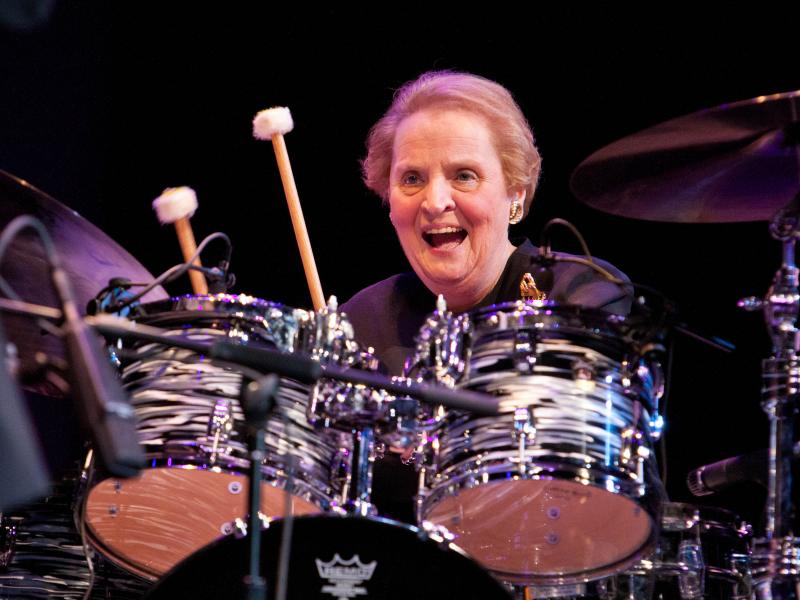
Just when it seemed like nothing more could be done, the Institute provided one more surprise. After accepting her award with signature humor and penetrating commentary, Albright indicated she would fulfill Monk Competition protocol by joining in with the assembled artists for a tune. And so she did. Perching herself on the drum stool, Albright gripped a pair of felt-head drum sticks and with only a few cues, added several cymbal rolls to a quite beautiful rendition of "Nessun Dorma" led by trumpeter Chris Botti. It was a heartwarming way to underline not only Albright's unique personality and tremendous lifetime accomplishments, but also to close the circle on the evening's multiple themes with both grace and humor.
Conclusion
Invariably and deservedly, the main focus of every Monk Institute competition is the young artists who compete for the illustrious honors and often career-making suite of prizes. This year was no different and provided a chance for audiences to experience the drums in all its many facets, highlighting the instrument's integral nature to the distinctiveness of jazz. The finalists all brought their unique style to the stage and proved just how diverse drumming can be.
But the annual Monk Institute affair goes beyond the competition. Embedded in the sometimes reductive, sometimes corny and at times eloquent speeches lay an earnest reminder of how powerful jazz can be—not only to individuals as entertainment, but also in helping to create international bonds, inspire political action, and bring together cultures through shared history and artistic experiment. Or, as Irina Bokova perhaps put it best, the concert and competition proved once again that "Jazz started in the U.S. but now belongs to the world," and its further evolution depends on the continued programs, proselytizing, and partnerships of institutions like the Monk Institute.
Photo Credits
Page 1 (top), Page 2: Courtesy of Getty Images
All Other Photos: Steve Mundinger
< Previous
Ancestors
Comments
Tags
Live Reviews
Franz A. Matzner
United States
District Of Columbia
Washington
Thelonious Monk Institute of Jazz
Herbie Hancock
T.S. Monk
Geoffrey Keezer
Rodney Whitaker
Jon Gordon
Justin Brown
Colin Stranahan
Jamison Ross
James Black
Thelonious Monk
Joe Louis Walker
George Duke
randy brecker
James Genus
Vinnie Colaiuta
Roberta Gambarini
Anita O'Day
Gretchen Parlato
Wayne Shorter
Linda Oh
Terri Lyne Carrington
Nnenna Freelon
Mary Lou Williams
Geri Allen
Jane Ira Bloom
Ella Fitzgerald
Patti Austin
Jimmy Heath
Lee Ritenour
Claire Daly
Aretha Franklin
Chris Botti
For the Love of Jazz
 All About Jazz has been a pillar of jazz since 1995, championing it as an art form and, more importantly, supporting the musicians who create it. Our enduring commitment has made "AAJ" one of the most culturally important websites of its kind, read by hundreds of thousands of fans, musicians and industry figures every month.
You Can Help
To expand our coverage even further and develop new means to foster jazz discovery and connectivity we need your help. You can become a sustaining member for a modest $20 and in return, we'll immediately hide those pesky ads plus provide access to future articles for a full year. This winning combination will vastly improve your AAJ experience and allow us to vigorously build on the pioneering work we first started in 1995. So enjoy an ad-free AAJ experience and help us remain a positive beacon for jazz by making a donation today.Near


Giveaway

Eligible winners: 15
Days remaining: 4
Days remaining: 4