Home » Jazz Articles » Interview » Dr. Lonnie Smith: But Beautiful
Dr. Lonnie Smith: But Beautiful


Born in Buffalo, New York, Dr. Smith's house and family life were full of music, including and especially singing. He sang and played some trumpet in school, and as his maturation continued, he began hanging out at a local music store. In the late 1950s, the store's owner, Art Kubera, gave him the opportunity to learn how to play a Hammond organ. "Even though I didn't know how, I was able to play right from the beginning," Dr. Smith reflects. "I learned how to work the stops and that was it. It's a passion for me, so everything else came naturally." Dr. Smith still refers to Art Kubera as "my angel."
Dr. Smith began honing his playing in Buffalo clubs, where he was soon spotted by guitarist George Benson, who recruited him into his group, and by booking agent Jimmy Boyd, who found work for Benson and Smith in New York City and Harlem. John Hammond saw some of these shows and then signed them both to Columbia Records, which released Finger-Lickin' Good, Dr. Smith's debut, in 1966.
He was soon recruited by alto saxophonist Lou Donaldson, and his contributions to the million-selling Alligator Boogaloo (Blue Note, 1967) and Everything I Play is Funky (Blue Note, 1970) put Dr. Smith on the musical map to stay. Blue Note subsequently signed Dr. Smith, for whom he released his own titles Think! (1968), and Turning Point (1969), which opens with a joyous romp through the R&B workhorse "See Saw," by Don Covay and guitarist Steve Cropper, plus other soulful jazz (if not soul-jazz) classics along the way.
In subsequent decades, Dr. Smith has recorded a wide variety of projects for several different labels, including Foxy Lady: A Tribute to Hendrix (Musicmasters, 1994), in a trio with guitarist John Abercrombie and drummer Marvin "Smitty" Smith, and Boogaloo to Beck: A Tribute (Scufflin' Records, 2003), his homage to the folk/hip-hop pastiche master featuring saxophonist David "Fathead" Newman. A long-term stay on Palmetto Records produced his funk workouts Too Damn Hot (2004), Jungle Soul (2006) and Rise Up! (2009).
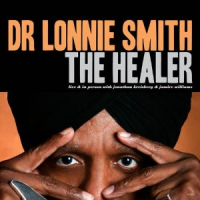
In 2010, Dr. Smith formed a new trio with guitarist Jonathan Kreisberg and drummer Jamire Williams to record Spiral (Palmetto, 2010). Dr. Smith sounds revitalized by their influx, most notably in a high-energy take on Jimmy Smith's "Mellow Mood" and a swarming, stinging buzz through Harold Mabern's "Beehive." Both tunes were reprised on 2012's The Healer, joined by Dr. Smith's own luscious "Backtrack" and soul-searching "Pilgrimage" (on which he plays and sings), plus a languid stroll across Billy Strayhorn's "Chelsea Bridge."
Comprised of live sets recorded at the Jazz Standard in New York City and at a town plaza in Hungary at the end of the trio's 2011 tour of Europe, The Healer also heralds the debut of Dr. Smith's own label, Pilgrimage Records. "If you told me back in 1966 when I recorded my first LP that I would be starting my own record label in the year 2012, I would've said, 'That's what you think!'" Dr. Smith wrote in The Healer's notes.
Dr. Smith is a member of the Buffalo Music and Jazz Organ Fellowship Halls of Fame and will bring his trio back to New York's Jazz Standard in January 2013.
All About Jazz: You have an incredible back catalog but let's start with your new record first; in fact, let's start with the band on The Healer: How did this trio come together?
 Dr. Lonnie Smith: Jonathan Kreisberg first worked with me years ago. I needed a guitarist. I heard this young man and he was quite a guitarist. He worked so fine, so well, with me. When his name came up again, the fellow handling me mentioned that Jonathan used to work with me and I quickly remembered him. We called him and it lined up perfect.
Then we heard about Jamire Williams. I listened to him and it was another perfect fit. When we got together and played, it even sounded better than what I heard in my head. It was just what I needed. It worked for me.
We enjoy each other. We enjoy playing with each other, and they're quite great musicians. They do a really wonderful job, and they add beautiful music to what I'm playing, so it's great.
AAJ: Is there a specific reason why the trio has been such a successful/popular format for organ players?
DLS: It's a great marriage. What I love about the guitar/organ trio is that, when you have a horn, it sounds fat. It sounds large-big-with a saxophone. And when they're playing, you're accompanying the horn player, but when you're playing, they're just basically standing there.
But the guitarist is there to support you just like the drummer supports you and does not stop just because I start playing. It creates great rhythms, and I love rhythm. I love great rhythm. Guitar adds a really nice tone to the organ; they kind of blend beautifully together.
In the earlier days, I used a lot of horns. I love horns also. But an organ trio leaves you more expression room: If you're soloing and you have a lot of horn players, you give the trumpet player, you give the saxophonist, you give the guitarist all something to play, and then when it's time for you to play, you don't even want to play because it's gone on for so long, you know? It gets too long. Of course, some people are just longwinded. You sometimes say, "Hey, wait a minute-I would like to get to another song tonight."
AAJ: How did that amazing, if sometimes crazy, arrangement of Harold Mabern's "Beehive" come together?
DLS: When I first heard that song, I loved it. It just came to me. I don't know what happened. I knew Harold and called him and said, "Harold, I'm going to play this tune, but it's not going to be the same way." And he said, "Oh, don't worry about it. I know it's going to be nice anyway." He enjoyed it. The original was entirely different-Lee Morgan was with Harold and it was a whole different thing. It doesn't sound like it's the same song.
AAJ: It almost gets kind of a jazz-rock fusion thing going on there. It's certainly light years removed from music like Think or Turning Point, for example.
DLS: Oh, for sure. The strangest thing about Think is that I don't even think about playing those songs. But folks really want to hear that.
AAJ: There's a very spiritual aspect to your music, even down to the title of The Healer. Since so many people were first exposed to the sound of organ through the church organ, was that where you first heard it, too?
DLS: It was in the church. It was in the church for sure. I used to hear that, and I used to hear people like Milt Buckner, Wild Bill Davis, Jimmy Smith, Count Basie-all of 'em. I heard a lot of people play organ. The organ just really touched me in a special place, really touched me. I didn't know that I was going to play organ at all, had no idea that was going to happen until Art Kubera made it happen, and that was it. My brothers and I used to play and I was a vocalist. I wanted to play, but I didn't know I was going to play organ. Didn't have any idea that was going to happen.
AAJ: Is there a connection between music and healing?
DLS: Yes, for sure. I'm going to tell you the story of a friend of mine. He played trumpet, and his name was Bucky Thorpe. He played trumpet in New York. Bucky had a bout with diabetes and lost his legs and the whole bit, but he would still go around and play. And then he had a stroke. He was in the hospital; we would go up to see him and he would just be laying there. We would talk to him but he was just laying there. He couldn't say anything.
So we took a radio up there. With the radio, we heard music, and you could see his fingers moving like he was playing trumpet. He moved his fingers like he was playing. Therefore, I know what music will do.
And I know because I've been sick to the point where I couldn't play, I couldn't walk, and I lost all my playing abilities, and my speaking. When I could walk a little bit, I'd walk past a keyboard and touch it. That's all I could do. That was it. This went on for months. I don't know how long exactly, about six months or so, but then it started to come back. And when it came back, it wasn't what I had in my head. What I had in my head, I couldn't play, it wouldn't come out. But later on, it did, because all the stuff that I had in my head was still there. You see, you have to retrain your thoughts and get it together again.
AAJ: What timeframe are you talking about here?
DLS: Well...a lot of people have all kinds of things that happen. We all have our own stuff. Like, you remember Jimmy McGriff? (Editor's Note: Jimmy McGriff died in 2008 from complications of multiple sclerosis.) Jimmy still played. It just makes you feel good. Somehow, the music will bring you...will help you so much. If you're feeling bad, or troubled with problems, playing music is the healer.
AAJ: That sounds very similar to what happened with Pat Martino, when he had to relearn all his own records.
DLS: Sure. Sure. That's what happens. It will come, but you've got to have it in your head, know exactly what you're doing, and be patient. You've got to be very patient. And you've got to believe: You can't just say that it's going to come back, you've got to believe that it's going to come back. Be patient and work toward it and it will come back.
Oh, it was rough. I remember, I'd be playing sometimes and all of a sudden my articulation and everything just wouldn't work, right in the middle of a song. But it came back, and I'm very pleased with that.
AAJ: There's a lot of Billy Strayhorn and Jimmy Smith music to choose from-why did you select "Chelsea Bridge" and "Mellow Mood" for your repertoire?
DLS: First, when I hear a tune, I hear it all ready before I play it-I hear the tune as though I was playing it. You hear the song and who's playing it, but I hear me playing it. It tells me how I'll play it already, so I don't have to do anything but sit and start playing it then.
If you recall, there was one tune I did by Horace Silver, "Silver's Serenade." (Sings the melody) It just tells me that. I told Horace I was going to do it, and I did it. So I heard "Chelsea Bridge," said, "This is the way that I want to do it," and it works for me.
Now, Jimmy Smith's "Mellow Mood": I used to play it the other way, slower and everything. But then I said, "I feel this way" and I played it that way and it worked for me. It's almost like that song should have been like that [laughs].
AAJ: What musicians on other instruments or even singers have influenced your voice on organ?

DLS: Coming up, I was crazy about a young fellow named Nat King Cole. Yeah, he was a little young kid and I was crazy about Nat. Dinah Washington. I played behind Brook Benton. I had so many great people to listen to and hear and it was beautiful: Sarah Vaughan and Carmen McRae and so many great people, Mahalia Jackson, and I just loved them all. And I also played every now and then behind a fellow named Little Jimmy Scott. I'm talking about many years ago.
AAJ: We interviewed him just last year, right before he did a few dates in the UK.
DLS: No, you did not!
AAJ: Yes sir! He played a few dates in London last October and he got on the phone with us during the summer. What a great experience that was.
DLS: You bet. And the thing about it is, if you notice, he travels like a young man. I am serious. You know, a lot of young people today, they complain all the time: "Oh, no, a ten-hour ride, a twelve-hour ride." Not Jimmy Scott. He just goes and goes and he's not a young kid. He doesn't let anything bother him. That's one of the fellows I enjoyed, one of the people I enjoyed playing behind and also learning from. Playing some of my stuff, the way I play, is like that. It's beautiful.
AAJ: He absolutely ruined "You Don't Know What Love Is" for every other singer.
DLS: I'm telling you: Nancy Wilson, Etta Jones, all of them-it was Jimmy Scott. Here's something that a lot of people probably don't know: You could play the song in any key. You'll ask most singers what key they want you to play in and they'll say, "I'll take this in B-flat"-you know, they have a key that they want it done in. He'd say, "Well, whatever key you know it in."
Andy Bey is an unsung hero, also. Horn players, trumpet players, there are so many people that I really enjoyed-Art Tatum and Phineas Newborn, Jr. and Ahmad Jamal, there's just so many people that play a part in my sound. And don't forget Thelonious Monk.
AAJ: In what ways did Monk influence your playing?
DLS: I've written some songs and even recorded one with Buster Williams on bass: It was called "Slightly Monkish," and it went (Sings a jumpy but swinging melody). You can hear it. Do you hear it? I was crazy about Monk, oh my goodness. I played opposite him a few times in concerts and in a little place called the Village Vanguard, many years ago. They used to sometimes have two bands play and Monk was on the bill.
AAJ: What is the biggest mistake most people make when they think of or hear Thelonious Monk's music?
DLS: I think what happens is that they're really not listening because he swung. He swung, and they must have missed that whole thing. He really swung. Oh my goodness-it was simple, you could hum his melodies, and it would swing, but they were missing it. It's just as plain as day, right? But they're missing it. It swung, and it was there, and that's why I loved playing those songs. I used to play all of them. "Ruby, My Dear," that's a beautiful song.
AAJ: You got to play with some of the funkiest musicians of the time in and around the time you recorded your own sessions and on other peoples' sessions for Blue Note Records. We'd love to ask you about three musicians from that period. What do you like to remember most about guitarist Melvin Sparks?
DLS: Melvin Sparks was originally from Texas. I was playing at Minton's Playhouse, George Benson and myself. We were playing at Minton's and one night a friend of ours brought this skinny young fellow by. He was really skinny. You've got small people, and you've got skinny people-he was skinny. And our friend said, "Hey, this fellow has just come to town, would it be okay for him to sit in?" He got up there and played and when I heard him I said, "That little fellow can play!" He used to play with The Upsetters. So he played and when he got done he said, "If you ever need a guitarist, I'm your man." I said okay and took his number, and he had my number. Weeks passed, and he asked me, "Don't forget me now, if you're ready." Months passed and he was still asking me.
So one day he called and said, "Hey, Jack McDuff called me and he wants me to work with him. You're not ready, are you?" I said that I was not ready and he asked me if it would be alright, and I told him to go ahead. Just go, I'll let you know. Then when I called him, he said, "I'll be there." That was it. Just like that. You're talking about a beautiful combination. A beautiful combination. Melvin Sparks.
AAJ: Melvin Sparks recently passed.
DLS: Yeah, and it's so sad because a lot of my friends are going to another place right now. But they're playing there also. He had beautiful rhythm and he gave one hundred and fifty percent, two hundred percent. You know, some guys would play but they wouldn't give you that. They would play so much into themselves: When you're accompanying someone, are you accompanying them to help make them play better, to give them something that they can play off of, or are you worried about somebody listening to you? Melvin played for you-with you and for you-and it was beautiful.
AAJ: Did you ever get the opportunity to play with Billy Butler?
DLS: I surely didn't. Once I had Melvin, and after I had played with George (Benson), that was pretty hard, to choose someone after him. When George and I were playing, he got signed to Columbia and so did I, at the same time. We were at a place called The Palm Café at 125th and 7th Avenue and John Hammond heard about it and came up. Him and his wife-you know, he was married to one of the Vanderbilts.
Lou Donaldson, that's the guy who got us-me and George-to be really heard, as far as I'm concerned. When Lou Donaldson needed someone, he called us and we went in and recorded Alligator Boogaloo with Idris Muhammad. That group felt so good when we played.
Duke Pearson and Francis Wolff from Blue Note called me and said, "We think they want you over here." Once I went there, I made a hit record (Think!), the record took off but I didn't have a group! I was playing with George Benson. But the record took off, so people were calling me to do headlining concerts and I didn't have a group. I used to take George on some of those engagements because I didn't have a group. That's when I got Melvin.
AAJ: What do you like to remember most about saxophonist Lou Donaldson?
DLS: I don't have to tell you that he's the greatest, his embouchure and everything. If you want to hear some beautiful alto playing, he still plays just like he's a young kid. Your embouchure will go after a certain age, you can't quite keep it together, but the way he plays is unbelievable.
And I enjoyed playing with Lou. We enjoyed each other. Every night we were playing, we would go home and it felt great. We went out on the road, we used to travel from the East Coast to the West Coast, up and down the highway, we would walk together, we would go eat together, we were like family. We still talk: A few days ago I talked to him and I will talk to him again in another day or two. He comes down here to Florida and we'll go eat and we're still very close. Very close. Just like me and George-we're still close. But Lou, he's a beautiful person and not only that, he has helped a lot of organists. To this day, when I go to Europe or he goes to Europe, we're asked to play "Alligator Boogaloo."
AAJ: And what do you like to remember most about trumpeter Lee Morgan?
DLS: Another great musician. Not to mention that Lee Morgan was born in the same month as me, in July. Some people play and they don't have life in their playing-they play, but that's about it. But when he played, you felt him. You felt him exactly because he was a lot of fun and happy, joyous, and that beauty came out in his playing. Plus, he could play so it was beautiful! Beautiful! So, I mean, I really miss those days. I really do.
AAJ: It's not just that the music business is different-the world is so different now.
DLS: It's different. It's different. It's definitely different. And I think what happens is, if people played life instead of just notes all the time, you'd be better off. You have to play life.
AAJ: Foxy Lady, your trio Jimi Hendrix tribute record, represents yet another aspect of your music. What do you like to remember about those sessions?
DLS: With Marvin "Smitty" Smith and John Abercrombie: That particular project was brought to my attention by another young fellow, Todd Barkan, who used to operate the Keystone Korner in Oakland many years ago, and now he's at Dizzy's at Lincoln Center. Todd has done a lot of great work. So, when this came, it was perfect. I love Jimi's music too, so...it worked for me, anyway. It really worked.
AAJ: It seems like a very different kind of trio sound for you.
DLS: I had fun doing it, also, I really had fun. You know, the hardest part, I have to tell you, is...if you know Jimi Hendrix, if you know his singing, you know, Bob Dylan and people like that, when they sing, it's almost like talking, almost like a talking tone. So you have to kind of hear your way, and make it yours.
AAJ: "Pilgrimage" is the name of a song on your new album and the name of your record label too, so this word or concept is obviously important to you. What does "pilgrimage" mean to you?
DLS: It means a lot to me. It's like all the people are coming together, going to one place, all the people, all over the world, that's what it means to me. Coming from every form, every religion, every part of their being, we're all going to that one place. We're different but we're not different. We're going for the same common denominator, coming together for that one particular thing. Just being together.
AAJ: That's the kind of thing that leads people to say that there's a very spiritual aspect to the way that you present your music.
DLS: Well, thank you.
AAJ: Musicians often learn a lot about themselves through their music. But what have you learned about yourself from starting up your own record company?
DLS: What I have learned is something that I feel. I feel a lot of freedom. Basically, there's a lot of stuff in the can that I wish had come out. A lot of friends have said to me, "You have old songs that people haven't heard. They're really nice." That's right, and people can't get them. So, I'm working on that-it's called In the Beginning. So I put out The Healer first, and I'm working on the other one. It all goes hand in hand. Young people are enjoying the old music which they didn't hear, because they always ask me about it. They can't buy it, they can't find it, so they have a chance to do that now.
I feel that, from the beginning, playing music is something that I didn't choose to do. It chose me. I feel, when I sit down at the keyboard sometimes-I play by ear-I feel that I am a man who was here before who didn't finish what he was put here to do, and if I should pass, I will return to complete my work. I'll keep on coming back and doing the same thing until I get it right.
AAJ: What advice would you give an aspiring musician in high school today?
DLS: First, I'd like to talk to them to find out just how much they really want to do it. I look for that glow in their eyes. I look for the passion that I get from them. There will be obstacles to work through. You have all kinds of musicians but the ones who stick it out really have a passion for it. Some people do it, they just go to work, they're not doing something that they really want to do, or they're looking at the clock or their watches, and then they come home and they're mad, they're angry-they're not happy.
You know, a lot of musicians want to be rich and famous. When you're playing music, you're already fulfilled. You're already rich. You have everything right there. But they get the wrong idea and try to use it for something-because they want to do this or they want to do that. Only play the music. You'll be rewarded. Just play the music.
Don't get disgusted or discouraged because there will be a lot of obstacles you will have to go through: People lying to you and saying you can't play or your stuff doesn't sound right. Sometimes you don't sound great. Sometimes you practice and you don't sound great. But that's the time you push a little harder. You don't give up. Don't throw it away.
AAJ: Who do you admire on a personal level, outside of the music business?
DLS: My parents. My mother. Oh my goodness, we would sing in the house. My cousins, my aunts, my uncles, all sang gospel music, spiritual music, so they would come over and we would crank up. We would start singing. My mother, her sisters and her mother had a mother/daughter quartet and used to sing on the radio every week. That inspired me so much. So much.
And then one fellow stuck out, really, and his name is Art Kubera. He made it happen. He made it happen, all of my dreams. He was my angel. He took the chance. He is the one who I think about all the time, him and another one of my teachers, Mazie Campbell. She had a classroom and just about everybody in that classroom played music except me. And to this day, I go see them or I call them, still today. They're living and we talk. It's beautiful. They're watching me. They're with me all the time, these people I'm talking about. Can you imagine that? Those angels are still there. Jimmy Sibly, Jimmy Boyd, those people that took a chance and stuck with me and believed in me, they're still here with me, as far as I'm concerned. Jimmy Boyd left us and Jimmy Sibly's still here. I call him. I can't forget those people. Isn't it beautiful?
That's what keeps me going. Those are the things that keep me going. Oh, it just makes me feel good to even think about it, you know?
AAJ: Is there something else that you would like to talk about?
DLS: Yes. You know how some people have something in their mind that they really want to do? This has been bothering me for years, and it's going to keep bothering me until it happens.
I'll make it happen, or somebody will. But I really want to make it happen: A retreat, a place for jazz musicians, all our old friends. I've seen them constantly play and they're going to play until they can't play anymore or some of them are told by their doctors that they can't travel. A place where they don't have to worry about rent, don't have to worry about health insurance, because we would offer internships to doctors and lawyers so they could help out.
We could have an annex where the students are, and they could pay to help keep it going. You never get too old to teach. You can teach them, put them on the right direction. Teach them not just about the music that we play but the business that they have to learn. Sometimes it's too late by then. They're beat. They've lost everything, they've been drained, they've been swindled, someone has taken everything that they've got, all their beautiful music, everything. But they're learning it from this place. You see?
Now, if you got all of our friends right there at this place, maybe they can't play the way they used to but we could still do concerts there. They can still get up and play. And people will come see them and not say, "Well, so and so is not playing the way that he used to play." They won't lose their dignity or anything because everyone knows why everyone is there in the first place. And what would make them happier than for them to see their musical family and relations right there? They could sit around and talk about years ago. Things that happened and how we can make it better. What a lovely way to go. What a lovely way to go.
AAJ: That sounds like heaven on earth, doesn't it?
DLS: It is. It is. Because you're going to play and every time they pick their instrument up you can see the smile on their face even though they know that they can't play the way they used to. That's what I want to do. I have a few organs and I'd like to donate those to the school, for starters. That's what I want to do.
Selected Discography:
Dr. Lonnie Smith, The Healer (Pilgrimage, 2012)
Dr. Lonnie Smith, Spiral (Palmetto, 2010)
Dr. Lonnie Smith, Jungle Soul (Palmetto, 2006)
Dr. Lonnie Smith, Too Damn Hot! (Palmetto, 2004)
Rodney Jones, Soul Manifesto (Blue Note, 2001)
Jimmy McGriff, McGriff's House Party (Milestone, 1999)
Dr. Lonnie Smith, The Turbanator (32 Jazz, 1991)
George Benson, Benson Burner (Columbia, 1976)
Dr. Lonnie Smith, Live at Club Mozambique (Blue Note, 1970)
Lou Donaldson, Everything I Play is Funky (Blue Note, 1970)
Dr. Lonnie Smith, Turning Point (Blue Note, 1969)
Dr. Lonnie Smith, Think! (Blue Note, 1968)
Lou Donaldson, Alligator Boogaloo (Blue Note, 1967)
Photo Credit
Page 1: Phrazz
Page 3: Michael Wartell
< Previous
Essence of Ellington
Next >
Now Here This
Comments

About Dr. Lonnie Smith
Instrument: Organ, Hammond B3
Related Articles | Albums | Photos | Similar ToTags
Dr. Lonnie Smith
Interview
Chris M. Slawecki
United States
george benson
Lou Donaldson
Steve Cropper
John Abercrombie
Marvin "Smitty" Smith
David "Fathead" Newman
Jonathan Kreisberg
Jamire Williams
Jimmy Smith
Harold Mabern
Billy Strayhorn
lee morgan
Milt Buckner
Wild Bill Davis
Count Basie
Jimmy McGriff
Pat Martino
Horace Silver
Nat King Cole
Dinah Washington
Brook Benton
Sarah Vaughan
Carmen McRae
Mahalia Jackson
Jimmy Scott
Nancy Wilson
Etta Jones
Andy Bey
Art Tatum
Phineas Newborn
Ahmad Jamal
Thelonious Monk
Buster Williams
Melvin Sparks
Jack McDuff
Billy Butler
Idris Muhammad
Duke Pearson
Jimi Hendrix
Bob Dylan
Rodney Jones
For the Love of Jazz
 All About Jazz has been a pillar of jazz since 1995, championing it as an art form and, more importantly, supporting the musicians who create it. Our enduring commitment has made "AAJ" one of the most culturally important websites of its kind, read by hundreds of thousands of fans, musicians and industry figures every month.
You Can Help
To expand our coverage even further and develop new means to foster jazz discovery and connectivity we need your help. You can become a sustaining member for a modest $20 and in return, we'll immediately hide those pesky ads plus provide access to future articles for a full year. This winning combination will vastly improve your AAJ experience and allow us to vigorously build on the pioneering work we first started in 1995. So enjoy an ad-free AAJ experience and help us remain a positive beacon for jazz by making a donation today.

Giveaway

Eligible winners: 15
Days remaining: 5
Days remaining: 5