Home » Jazz Articles » Book Review » Derrick Bang: Vince Guaraldi at the Piano
Derrick Bang: Vince Guaraldi at the Piano

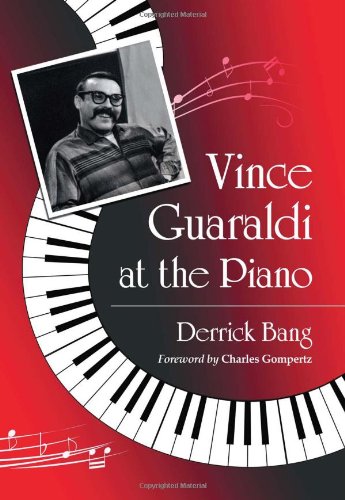 Vince Guaraldi at the Piano
 Derrick Bang
390 pages
ISBN: 978-0-7864-5902-5
McFarland Books
2012
Based on Derrick Bang's encyclopedic biography of pianist Vince Guaraldi, you can draw two perhaps surprising conclusions about the subject's contribution to jazz.
First, Guaraldi arguably hipped more listeners to this musical form than anyone else since the heyday of the big bands. He did so by means of "Cast Your Fate To The Wind," three minutes of piano-trio jazz that reached #22 on the Billboard hit-singles chart in February 1963; more decisively, Guaraldi provided the musical accompaniment to a long string of widely-viewed Peanuts television specials, first broadcast in 1965. Bang cites the testimony of New Age pianist George Winston and jazz pianists David Benoit and Cyrus Chestnut in this regard: all attest to the importance of Guaraldi's music in their dawning appreciation of jazz. And it's clear that these two musical exercises helped instill a taste for jazz in the listening habits of millions of young people.
Second, and less obviously, Guaraldi pioneered in the mainstreaming of modern Latin jazz, both into non-Latin jazz, and, thanks to his music's incredible popularity, into the tastes of his many listeners. Bang recounts Guaraldi's reasonably well-known encounters with Latin jazz. He was a key player in vibraphonist and percussionist Cal Tjader's group, which developed an excellent school of post-Dizzy Gillespie Afro-Cuban jazz, heard on classic albums such as Más Ritmo Caliente (Fantasy, 1958). Guaraldi would go on to form a productive partnership with Brazilian bossa nova guitarist Bola Sete, beginning in 1962. What's less apparent at first blush is that Guaraldi's much better-known non-Latin jazz was also Latin jazz, hiding in plain sight: "The Peanuts background scores aren't merely jazz, but more precisely Guaraldi's highly enjoyable blend of jazz and bossa nova," as Bang succinctly puts it.
Guaraldi didn't revolutionize the music's structure (Charlie Parker), nor nurture generations of talented sidemen (Miles Davis), nor develop a staggering improvisational vocabulary (Sonny Rollins), nor compile a songbook of astonishing breadth and joy (Thelonious Monk), much less do all of these things at once (Louis Armstrong, Duke Ellington). His contribution was different in degree and in kind from that of those more widely-acknowledged jazz masters. The paradox that Bang's book explores is that Guaraldi's best-known music may be as widely-known as that produced by these jazz titans.
Vince Guaraldi at the Piano is not a gossip-laden tell-all celebrity biography (although Bang allows himself to wonder whether Guaraldi's decision to be photographed embracing his long-time girlfriend Gretchen Glanzer on the cover of The Latin Side of Vince Guaraldi (Fantasy, 1964) might have set the stage for the breakup of his marriage). Instead, the objective of the book is to document Guaraldi's dense career as a musician.
As such, that career is exhaustively reconstructed: early gigs with all kinds of bands around the San Francisco Bay Area; his joining Woody Herman's "Third Herd" in 1955, whose grueling touring schedule seems to have left the pianist with a permanent distaste for the road; his association with fellow San Franciscan Cal Tjader's quintet in 1956, a laboratory for the development of Latin jazz; early records for Fantasy Records (which treated its artists and their music cavalierly), including "Cast Your Fate To The Wind"; his long-standing collaboration with Bola Sete; the composition and preparation for a Jazz Mass at San Francisco's Grace Cathedral, preceding (and in fact, according to Bang, inspiring) Duke Ellington's Sacred Concerts in a similar vein; the astonishingly successful Peanuts music; his later, ill-starred attempts to innovate with electric keyboards and free jazz in a group he called the Electric Umbrella; his death, aged 47, in between sets at a Menlo Park supper club called Butterfield's in February 1976.
Along the way, the reader is treated to the occasional brilliant set piece, recurring theme, surprising tidbit.
Most affecting is the portrait Bang paints of San Francisco and environs, beginning with Guaraldi's roots in the Italian North Beach neighborhood, through lovingly detailed descriptions of the region's night clubs: the Blackhawk, Fack's, the hungry i, Jimbo's Bop City, where the super stars of jazz gathered after hours for legendary jam sessions; the Trident in Marin County, Berkeley's Trois Couleurs. There is the heady early-1960s mix of jazz, politically-engaged folk music and innovative stand-up comedy that was a hallmark of the San Francisco scene. The leading figures of the scene, musicians, journalists, broadcasters, impresarios, are all here: Cal Tjader, Dave Brubeck, Dick Gregory, Armando Peraza, Jimmy Lyons, Ralph Gleason, Phil Elwood. A young Bill Cosby spends a month living on a houseboat in Sausalito while doing an extended gig at the hungry i in San Francisco.
When the Summer of Love ushered in new musical scene in San Francisco, Guaraldi did not retreat: he shared sidemen with Sly and the Family Stone, Big Brother and the Holding Company, Joy of Cooking and experimented with electronic keyboards, not always happily. He enjoyed an off-and-on collaboration with the Grateful Dead's guitarist Jerry Garcia (and is in the crowd pictured on the reverse of the Dead's Aoxomoxoa (Warner Bros., 1969) album cover.
Bang's chorus of witnesses insinuate, in fact, that it was Guaraldi's attachment to San Francisco and his aversion to touring that prevented him from achieving greater fame. Guaraldi himself says several times in these pages that he was happy working year-round in the Bay Area. Was his parochialism a problem? Not for his commercial success, surely; but perhaps for his artistic development.
A particularly delightful sequence in the book details how "Cast Your Fate To The Wind" became a hit record, revealing the importance of a Sacramento disc jockey and the prodding of a trade magazine. Fantasy Records would rename the album Jazz Impressions of Black Orpheus (1962), from which the single was taken, to Cast Your Fate To The Wind (without, however, removing the cover photo from the Brazilian movie cited in the original title). In fact, telling the story of the hit is more complicated than it seems, because it also includes the story of Anatomy of a Hit, a three-part television documentary made by jazz writer and journalist Ralph Gleason to tell the same story, often by means of stiffly "reenacted" scenes by the principals. The entire improbable tale provides a fascinating look inside the music industry of the time.
Even more detailed, though less riveting, is the account of Guaraldi's music for the long series of Peanuts television specials, featuring the cartoon characters created by (Northern Californian) Charles Schulz. Writer/director/producer Lee Mendelson, surely seeking the urbane but non-confrontational groove of the early-1960s San Francisco scene, approached Dave Brubeck, who, too busy to do the gig, referred him to Tjader, who led him in turn to Guaraldi. "Linus and Lucy" (a fine example of Guaraldi's surreptitious bossa nova sound) and "Christmas Time Is Here," among other piano-trio performances, would go on to be among the most recognizable jazz tunes ever. The programs' commercial success allowed Guaraldi a comfortable lifestyle and freed him from the unpleasant task of touring much. Bang details the surprising confusion regarding who actually plays on the best-known of the Peanuts records, with no fewer than three trios all claiming to have been featured.
There are less momentous details, many of them delightful. Guaraldi's uncles—his mother's brothers—were both successful bandleaders whose example inspired their diminutive nephew. Uncle "Muzzy" Marcellino, in fact, became a virtuoso whistler: you may have heard his work in the theme music to Lassie TV show and in the hit version of the theme to the movie The Good, the Bad and the Ugly.
Drummer Jerry Granelli, meanwhile, drops this bombshell:
Most people don't know this, but Miles Davis loved Vince; he even wanted Vince to come work with him. But Vince refused, saying "Naaah ... I already got a band, man." ... Anyway, Miles was down at Shelly's Manne-Hole, and he'd come in every night, and just sit there. He loved Vince's tune "Star Song." So Miles would have a drink and say, "Play that song, man." Every night! And it freaked me out, because it was Miles, man! I remember one night, Vince got hung up, talking to Miles before the set. And Miles finally looked up and said, "Hey, I didn't come here to talk to you, motherfucker; I came to hear you play. So go play."
This suggests that Guaraldi might belong to that set of commercially successful but once critically under-appreciated musicians championed by the erstwhile Prince of Darkness: Shirley Horn, Ahmad Jamal, Sly and the Family Stone among them.
Bang provides lesser-known details of Guaraldi's musical associations, including his only student, pianist Larry Vuckovich, trumpeter Conte Candoli, trombonist Frank Rosolino (who, by the way, provides the wordless adult "voices" in the Peanuts cartoons), vibraphonist Victor Feldman, vocalist Van Morrison (with whom Guaraldi toured), trumpeter Tom Harrell (featured in Guaraldi's later bands).
Bang's book is a reference work, the result of painstaking research in a multitude of media. For the casual reader, Bang's accumulation of facts can at times be too much, in fact. He provides backstory relentlessly. A random cross-section of examples: a detailed history of the storied Lighthouse club in Hermosa Beach, California, to set the stage for Guaraldi's brief appearance there in 1959; a complete list of al the animated Christmas specials (together with their corporate sponsors) that preceded A Charlie Brown Christmas (1965); the television shows against which the Peanuts special vied for an Emmy, including "heavyweight" Captain Kangaroo; a history of the Moog synthesizer, of marginal importance as an instrument to Guaraldi's musical development. A lot of this—the complete account of every repeat broadcast of every Peanuts special, the account of every cover ever recorded of Guaraldi's compositions—would be more efficiently presented in a series of tables in the book's appendix, to accompany the generous discographies already there.
These excesses can be excused in the name of their contribution to scholarship. More worrisome is the thinness of musical analysis herein.
Bang's book begins, in medias res and on the verge of its subject's fame, with a thrilling account of Guaraldi's performance with the Cal Tjader group a the first-ever Monterey Jazz Festival in 1958. (This passage has been excerpted at AAJ here.) But in spite this richly musical opening scene, Vince Guaraldi at the Piano largely pays little attention to the music itself. (One exception: Somewhat bizarrely, wherever Bang discusses Guaraldi as a sideman, he provides detailed cues, letting you know where to listen for the pianist.)
To be fair, there is some discussion of Guaraldi's music herein—usually by critic Ralph Gleason, whose insightful liner notes and newspaper reviews are generously excerpted. A few samples:
You look at his hands. Stubby, thick, tough little mitts, and you think of the cliché of artists' hands. Vince is always pulling splinters from his fingers, driven in when he claws at the wooden baseboard, behind the keys. His fingernails are perpetually split and ragged from hitting that wood.
He is not ridden by an unconscionable demon to prove something; he just loves music and loves playing and swinging. This uncomplicated approach allows him to poke fun at himself..., which is refreshing; it enables him to play simple, emotionally pure piano, as on the ballads, and to get pixieish, funky and hard-swinging, as on [his] originals and some of the standards.
What Vince has got in his playing is feeling. This is a quality that money can't buy, practice cannot make perfect and technique tends to defeat rather than enhance. Vince sings when he plays. I don't mean he grunts or hums or even makes a noise at all. I mean his fingers sing, the music sings, and he writhes and twists on the piano stool like a balancing act in the circus.
But nowhere is there a sustained analysis of Guaraldi the musician. As such, several questions are raised but not answered. What did Guaraldi take from the boogie-woogie pianists he loved as a novice musician—Pete Johnson, Jimmy Yancey, Albert Ammons, Meade Lux Lewis? ("I'm just a reformed boogie woogie pianist," he told Ralph Gleason early in his career.)
What led Guaraldi so deeply into Latin music? Bang (like more than a few critics) is broadly dismissive of Cal Tjader's Latin jazz ("monotonous," "better suited to frantic dance moves," "something primal, to excite the body, rather than melodic, to engage the mind," "little more than an interminable conga exercise"). This is a mistake. Tjader's experiments helped lay the groundwork for most of the Latin jazz that followed, and clearly resonated with Guaraldi. What did Guaraldi take from the Afro-Cuban music to his successful Brazilian adaptations?
Guaraldi's sidemen are scrupulously listed, but their musical characteristics are not. What, for example, happened to the pianist's group sound when he switched from long time drummer Colin Bailey to Jerry Granelli?
Finally, what to make of the recurring accusations by sidemen of Guaraldi's mercenary aesthetic tendencies? Longtime drummer Benny Barth: "I could see that Vince was leaning toward more pop-type music, because he could make more money doing that. I didn't have anything against it, but I played jazz." Later, bassist Fred Marshall: "I was having to play in a way I didn't want to, in a direction I didn't want to go. I got tired of it, musically, and this led to personal differences."
It's to Bang's credit that he amasses so much documentary evidence that these questions arise. It's unfortunate that he did not see fit, in this otherwise definitive biography, to provide answers. Few people, surely, have listened as closely as he has; few are better placed to complement the story of Guaraldi's life with the story of his music.
< Previous
Platform Expansion and the AAJ Road Show
Next >
In His Good Time
Comments

Tags
Vince Guaraldi
Book Reviews
Jeff Dayton-Johnson
United States
George Winston
David Benoit
CYRUS CHESTNUT
Cal Tjader
Dizzy Gillespie
Bola Sete
Charlie Parker
Miles Davis
Sonny Rollins
Thelonious Monk
Louis Armstrong
duke ellington
Dave Brubeck
Grateful Dead
Jerry Garcia
Jerry Granelli
Shirley Horn
Ahmad Jamal
Larry Vuckovich
Conte Candoli
Frank Rosolino
Victor Feldman
Van Morrison
Tom Harrell
Pete Johnson
Jimmy Yancey
Albert Ammons
Meade Lux Lewis
For the Love of Jazz
 All About Jazz has been a pillar of jazz since 1995, championing it as an art form and, more importantly, supporting the musicians who create it. Our enduring commitment has made "AAJ" one of the most culturally important websites of its kind, read by hundreds of thousands of fans, musicians and industry figures every month.
You Can Help
To expand our coverage even further and develop new means to foster jazz discovery and connectivity we need your help. You can become a sustaining member for a modest $20 and in return, we'll immediately hide those pesky ads plus provide access to future articles for a full year. This winning combination will vastly improve your AAJ experience and allow us to vigorously build on the pioneering work we first started in 1995. So enjoy an ad-free AAJ experience and help us remain a positive beacon for jazz by making a donation today.

Giveaway

Eligible winners: 15
Days remaining: 11
Days remaining: 11