Home » Jazz Articles » Live Review » Ljubljana Jazz Festival: Ljubljana, Slovenia, June 20–29, 2012
Ljubljana Jazz Festival: Ljubljana, Slovenia, June 20–29, 2012


Ljubljana, Slovenia
June 20-29, 2012
Ljubljana, with its 53rd edition, truly hosts the oldest jazz festival in Europe. Norway's Molde, also a candidate, started one year later, in 1960. The capital of the now-independent Republic of Slovenia, neighbored by Austria, Hungary, Croatia and Italy, Ljubljana is situated one hour from Trieste, two hours from Venice and three hours from Vienna, and is a city with high appreciation of the arts. With about 300,000 inhabitants the city has eleven theatres, fifteen museums, four professional orchestras and a rich musical history. The first philharmonic was established there in 1701, with Haydn, Beethoven, Paganini and Brahms as regular guests; and Gustav Mahler started his professional career there as a conductor.
Gathering in Ljubljana, the first noticeable thing was Portuguese pianist/composer Bernardo Sassetti's 2011 performance with his trio of bassist Carlos Barretto and drummer Alexandre Frazão (plus dancer Manca Dolonc). Sassetti's untimely death, after a tragic fall in May of this year, meant facing the painful fact that there will be no second time and no newly created music by this precious musician—a great loss which will be felt by the many who knew him and worked with him.
One of those people is Pedro Costa, of the Lisbon-based Clean Feed label. Costa teamed up with director Bogdan Benigar once again, this year, as co-artistic directors of the Ljubljana festival. The festival is a unique, brilliant and highly productive example of European collaboration, with four winning parties: the music, the musicians, the audience, and the European cause.
Ouverture
The four-day jazz festival is part of the all-summer long music festival of Ljubljana, and takes place during the last two weeks of June. This year, the festival commenced with a special night on Wednesday, June 20, presenting three promising young bands from different European countries: Elifantree (Finland), WorldService Project (Great Britain) and the Acropolis Quintet of Slovenian pianist Kaja Draksler, with musicians from Turkey, Rumania and Italy; a collaboration with the Dublin 12 Points Festival. Five years ago, Gerry Godley, programmer of the Irish Bray festival and director of the Dublin Improvised Music Company, began presenting a festival that featured twelve promising bands by young musicians from a variety of European countries. These bands are now sent along to other European festivals to gain further exposure. 12 Points is a successful and award-winning initiative ..."providing an important platform between the domestic structures from which these artists have emerged, and helping them on their way to the international stages to which they aspire. The festival's mission is to bring these emerging artists into a demanding performance environment, presenting their work to an international audience, in many cases for the first time. A significant part of that audience is their fellow participants and musical peers from other member states, facilitating another key objective of the festival's mission: the germination of organic networks between artists across the European Union, directly supported by many national cultural agencies."
June 28: Full Throttle
 One week later on Thursday, June 28, the core of the festival, with thirteen concerts, started to unroll in the intimate club location at the House of Cjankar (Cjankarjev Dom), the big modern music center towering above the old town of Ljubljana. The first night, there were two powerful and intriguing performances: a free improvising duo with American trumpeter/saxophonist Joe McPhee and Norwegian bassist Ingebrigt Håker Flaten; and the Full Throttle Orchestra, led by bassist Adam Lane.
The McPhee/Flaten-duo was an enduring musical partnership documented in its recent Brooklyn DNA (Clean Feed, 2012). Both players have known each other for a long time through their work in a couple of high-energy improv groups. Nonetheless, they are antipodes; players with their own contrasts. McPhee is the big yet gentle guy with openness and mystery as two sides of the same soul. Flaten is the small and agile guy with concentrated willpower, who constantly emphasizes his sound existence. They found and met each other in the big sound universe with rough edges, on bumpy, overgrown paths, winding caves and, finally, deep spiritual singing on their respective instruments.
Lane's Full Throttle Orchestra consisted of tenor/soprano saxophonist David Bindman, alto saxophonist Avram Fefer, baritone saxophonist Matt Bauder, trombonist Reut Regev and drummer Igal Foni, plus two trumpeters—Nate Wooley and, from Porto, Susana Santos Silva, replacing Taylor Ho Bynum in the lineup of Ashcan Rantings (Clean Feed, 2010).
Lane is the type of player based in improvised as well as contemporary composed music, having written works including a string quartet and a bass clarinet concerto. Some of his formative artistic references and teachers include Anthony Braxton, Wadada Leo Smith, Karlheinz Stockhausen, Klaus Huber, and the outstanding Italian bass virtuoso Stefano Scodanibbio. He worked with Darius Jones on the alto saxophonist's Man'ish Boy (AUM Fidelity, 2009); has a trio with saxophonist John Tchicai, trumpeter Paul Smoker and drummer Barry Altschul, and appears on the "Bawlers" segment of singer/songwriter Tom Waits' Orphans (ANTI-, 2006). Lane is an accomplished bassist, capable of propelling an ensemble of this format, quickly bringing about sophisticated transitions and opening up space for cutting edge improvisation. The group had a great tight/loose feeling with a classic jazz sound, well-balanced but unusual figures and solid solo work.

This festival edition had an emphasis on trumpet. The first evening introduced three of them, from different generations: Joe McPhee (1939), Nate Wooley (1974) and Susana Santos Silva (1979). Wooley is a highly demanded and ubiquitous player; Silva is a member of the outstanding Orquestra Jazz de Matosinhos, last heard on singer Maria João & OJM's Amoras e Framboesas (Universal 2011), is a member of the egalitarian Lama trio of Oneiros (Clean Feed, 2011), and released her own trio debut, Devil's Dress (2011), on the Portugese TOAP label. McPhee also performed solo the next day, along with the other trumpet-besieger of the moment, Peter Evans. Evans and Wooley then paired and teamed up with percussionists Jim Black and Paul Lytton to play the premièring concert of this brand new combination. This première would be preceded by a performance of Silva's Lama Trio. Last, but not least, new trumpet voice Ibrahim Maalouf performed on the finishing night at Križanke.
June 29: Abstract Society
This day started with Joe McPhee's solo performance in the small Štih amphitheater of Cjankar house. Standing in the middle of the audience, McPhee revealed much more than in his duo performance with Flaten the previous night, evoking plenty of curiosity. McPhee worked in two parts: first on pocket trumpet, then on saxophone. He created fascinating multiphonics, with a simultaneously sung melody coming from far and deep inside; he was able to do this whistling, too.
McPhee refuses to be restricted in his imagination, and the idea of bringing it into reality. Watching and listening to him play is a special experience. His sounds develop without waiting for or being forced into something special or sensational, whereas his efforts to open up and enter the sound domains of his playing are easy to feel. This reinforces confidence and openness, and leads to a joyful, creative listening experience.

The second solo concert was given by advanced trumpeter Peter Evans (1981). Watching Evans play, it is hard to believe that what was being heard was the sound of just one (pocket) trumpet—whether or not it was the first time experiencing him live. Evans, who started in the New York scene nine years ago, is now famous as trumpet innovator, and as a member of the bands Carnivalskin (with Klaus Kugel and Bruce Eisenbeil), Mostly Other People Do the Killing (with Jon Irabagon, Moppa Elliott and Kevin Shea), and his collaborations with other artists including Evan Parker, Nate Wooley and Tom Blancarte. Circular breathing, different kinds of multiphonics, hyper-rapid tone sequences, all kinds of loudness and whispers, it was all manifested in his dazzling playing.
Evans has been pushing the envelope since appearing on the scene a few years ago, opening up new musical territories for his instrument. He may be the most spectacular artists to seemingly emerging out of nowhere, but he is not the only one; instead, he is expanding the limits of the instrument already begun in the 1960s with Don Ellis and Bill Dixon, one that is a continuous process. Nils Petter Molvaer, Erik Truffaz, Arve Henriksen, Joe McPhee, Rob Mazurek, Greg Kelley and Nate Wolley, just to name a few wider-known musicians. Outside jazz and improvised music, Dutchman Marco Blaauw has expanded the instrument's limits remarkably with his double-bell trumpet. It is not only a question of expanded limits and new sounds, but primarily a question of new musical expression—a new idiom. Evans produced coherent pieces including stepping stones—notwithstanding his startling effect—into the exploration of a new idiom.
Ljubljana is a two-faced festival. There is the club face at the House of Cankar (Cankarjev Dom), and the face of the big semi-open air stage at Križanke Cultural Center. The House of Cankar is a state institution, created in the 1980s to foster collaboration between all art disciplines. Ivan Cankar (1876-1918) is held to be the most important writer to shape Slovenian identity: "Cankarjev dom believes that cultural, artistic and scientific creativity meets the basic condition for attaining spiritual freedom and richer spiritual lives of people and social development."

At the bigger stage Križanke there is a different, more mainstream-oriented audience which is addressed in the programming. The first evening at Križanke presented a mixed bag: two young local heroes—tenor saxophonist Jure Pukl's band Abstract Society, with pianist Kaja Draksler, drummer Damion Reid and bassist Joe Sanders opening, followed by singer Dee Dee Bridgewater.
Pukl (1977), Slovenia's most powerful saxophonist of the moment, has garnered critical acclaim with his innovative EARchitecture (SessionWorkRec, 2010) (with liner notes by pianist Vijay Iyer). His most recent album, Abstract Society (Storyville, 2012), features Iyer, Damion Reid and Joe Sanders. Reid (1979) has played and recorded with saxophonists Rudresh Mahanthappa, Steve Coleman, Greg Ward and Steve Lehman, as well as pianist Robert Glasper. Sanders has worked with everyone from saxophonist Wayne Shorter and pianists Dave Brubeck and Gerald Clayton, to saxophonist/clarinetist Oran Etkin, trumpeters Ambrose Akinmusire and Christian Scott aTunde Adjuah, singer Gretchen Parlato, guitarist Lionel Loueke, pianist Aaron Parks and saxophonist Chris Potter.
Pukl, being a self-assured guy of wide views, built long arches with lots of pending moments and tension to be resolved. He was reinforced by his combination with pianist Draksler. Nonetheless, Reid held the music intensively in motion by his fireworks, while Steve Coleman and Vijay Iyer left their marks in the creative thrust of the group. What was possible within the built structure became clear when trumpeter Jason Palmer joined for a short period. He stirred it up, set the music on fire with his horn and pushed it to a higher level; the missing element, happily, came in on time.
Bridgewater can shift her voice from jazz singing to old school soul. She is still a vivid entertainer functioning as a draw for festivals and bigger venues. Here, she came with a high caliber lineup of experienced musicians: the great saxophonist/flautist Craig Handy, pianist Edsel Gomez, bassist Kenny Davis and drummer Kenny Phelps.

Working through a varied repertoire of Billie Holiday songs, standards like "Lover Man," blues, and Mongo Santamaria's classic "Afro Blue," she did exactly what was expected. She even topped it off with a highly dramatized version of "Besame Mucho." She sang and interacted in perfect timing with her band and the audience. It was a fabricated, smooth show offering what the crowd wanted. Not thrilling; just entertaining.
June 30: Diagnostic
Saturday had the densest program, starting in the morning with a solo recital by Slovenian pianist Kaja Draksler, followed in the afternoon by the Portugese/Canadian collaboration Lama, and the première of a new trumpet and drums configuration.
The solo recital was the third turn during the festival for local pianist Draksler (1987). Draksler is not only active as pianist but also as a bandleader, composer, arranger and conductor. She studied in Amsterdam and won the prestigious Dutch Deloitte Jazz Award in 2009. That same year she released her third record as a leader, Türkü (Self Produced), with Acropolis Quartet and promising singer Sanem Kalfa as a guest. In 2007, she composed a concerto for accordion and orchestra, "Orpheus and Eurydice," recorded and performed by Janez Dovc and Slovenian Philharmonic Orchestra. Here, she delivered an impressive patchwork of classical and folk-infused miniatures, alternating with Cecil Taylor-esque percussive accelerations, competing left hand/right hand lines, and beautifully creative inside the piano passages, finishing with a Thelonious Monk-like improvisation and a brief Bach encore.
The Lama trio, with Porto-based trumpeter Susana Santos Silva, and Rotterdam-resident bassist Gonçalo Almeida and drummer Greg Smith, made its first record, Oneiros (Clean Feed, 2012). Lama played its very own form of dream-like music, effectively using various means—technically and stylistically—and demonstrated a strong command of varying dynamics. Almeida infused loops and soundscape-like electronics but also fell into a classic walking bass lines and simple, beautiful ostinatos. Smith started with a heavy bass drum beat, while switching to hand drumming at the right moments. Silva has achieved her own voice on trumpet and flugelhorn, informed by legacy artists including saxophonist Ornette Coleman and trumpeter Don Cherry, and the entire group's performance affirmed Lama as a promising one to watch.

The afternoon program ended with the première of a brand new trumpet/drums configuration instigated by curator Pedro Costa. It was the first time these four master musicians had ever met onstage together, and was recorded by Clean Feed.
Trumpets and drums make for the basic, atavistic, battlefield lineup. They had to lead the troops, stir them up and sound the retreat. Many of these musicians were killed in action, as in the famous battle of Austerlitz in 1805, when Napoleon defeated the superior Austrian-Russian alliance. Drummer Jim Black (1967) is an outstanding drummer who has a significant approach, a distinctive sound and inexhaustible musical possibilities. Paul Lytton (1947) belongs to the groundbreaking older generation of free improvisers. Here, he acted, for the first time in years, more in the foreground. It seemed that Lytton mainly served the marching function, whereas Black gave the signals to fire. Black employed electronics and small cymbals, while Lytton used large cymbals and brought in several tiny sound-making devices.
Peter Evans and Nate Wolley are highly sophisticated trumpeters who have pushed the envelope sensationally in their own right. Both are such powerful multidimensional players that their pairing and confrontation reshape and rebalanced their sound, creating a broader tone field. Every player went for his own way of sound making, such that new textures and forward sound lines emerged. It was a unique thing and great fun to watch and hear.
 The evening started with a new face entering the arena. A Frenchman of Lebanese origin, Ibrahim Maalouf (1980) is a classically trained trumpeter who is also versatile on the four-valve trumpet constructed by his father, Nassim Maalouf, which allows him to play quarter-tones directly.
He used this last skill only briefly, in just one piece. More dominant was his hard-rock and funk-infected way of playing. His competent five-piece band, also featuring trumpeter, flautist and bagpipes player Youenn Lecam, played effectively. Maalouf won the audience by addressing it humorously, putting his music in a cultural and biographical perspective. He enacted themes like "obsession" and "'split identity states" in an illustrative way, and even got the audience involved singing his gentle "Lily" in a natural manner. Maalouf left his mark as a gifted musician and sympathetic stage personality who could and would win his audience. The performance of his biographical piece "Beirut" was impressive, but not performed as intensively as on his album. In his approach, musical worlds and styles coexist. To praise it: there was no "anything goes/mixing mentality" at work in Maalouf's music.
It was a good thing that the festival programmers chose this new voice to perform, as Maalouf clearly adapted the pieces from his recent album, Diagnostic (Hamonia Mundi, 2011), to his band and a performance context. He was sometimes still a bit too much of a classical musician (demonstratively) playing rock; in the long run, hopefully, that will wash off.
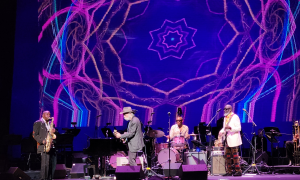
And then there was the second world premiére of the festival: The Cherrything—good old Neneh Cherry teaming up with Swedish-Norwegian power jazz trio The Thing, consisting of baritone saxophonist Mats Gustafsson, bassist Ingebrigt Haker Flåten and drummer Paal Nilssen-Love. The group just released its first album together, Cherrything (Smalltown Supersound, 2012). Ljubljana was the starting point of an extended European tour for this constellation. Cherry chose The Thing and The Thing welcomed Cherry as a sister in spirit. As on the album, they reverted to and worked through a series of classics, whether they classic songs or pieces from classic players: "Dream Baby Dream," from the proto-punk duo Suicide (Alan Vega/Martin Rey), for instance, with its conjuring qualities; or Cherry's stepfather's "Golden Heart," part of Don Cherry's Complete Communion (Blue Note, 1966).
The group performed "Dream Baby Dream" early in the show, but in no time it turned into a deafening wall of noise completely drowning out the singer, who had to play the song's central role. It could be considered as a seriously imbalanced mismatch or a conscious expressive overkill. Don Cherry's "Golden Heart" has a shining North African signature—one of the trumpeter's typically wonderful and memorably simple tunes. Sadly, not much of this experienced in The Thing's performance; this would have been no problem had new qualities emerged to create their own memorable impact. Instead, the group relied heavily on an over-the-top power play as a new and overwhelming approach that seemed to appeal to a small portion of the audience, which went wild. This new constellation did not, however, play its way into and out of the songs they were covering; this may change and develop over time, hopefully, when the group really gets inside the music.

The finale was for guitarist John Scofield and his Hollowbody Band, featuring guitarist Kurt Rosenwinkel, bassist Ben Street and drummer Bill Stewart. This was as classic as classic can be. Scofield played a wide variety of songs, crossing through the rich body of his own work but also entering into extended elaborations of evergreens like "Moonlight In Vermont." Highly concentrated, with great flow, effortless mutual understanding and unlimited collaboration Scofield and his fellow musicians traveled through the warm summer night.
Ljubljana is a smaller scale festival of high musical quality with a relaxed ambience. It is a truly music-minded festival, with daring and balanced programming that has developed a forward-looking line. Its curation was a remarkable example not only of interregional European cooperation but, above all, the care of musical quality—its visibility, maintenance and development. Ljubljana leaves precious memories—and some nice things you can buy there for a decent price. Not only delicious salty chocolate but also good clothing and design.
In memoriam: Bernardo Sassetti (1970-2012)
Photo Credit
All Photos: Henning Bolte
< Previous
New York Attitude
Next >
Twelve
Comments
Tags
Live Reviews
Henning Bolte
Bernardo Sassetti
Carlos Barretto
Pedro Costa
Elifantree
World Service Project
Joe McPhee
Ingebrigt Haker Flaten
Adam Lane
David Bindman
Avram Fefer
Matt Bauder
Reut Regev
Igal Foni
nate wooley
Susana Santos Silva
Taylor Ho Bynum
anthony braxton
Wadada Leo Smith
Darius Jones
John Tchicai
Paul Smoker
Barry Altschul
Peter Evans
Jim Black
Paul Lytton
Ibrahim Maalouf
Klaus Kugel
Bruce Eisenbeil
Mostly Other People Do the Killing
Jon Irabagon
Moppa Elliott
Kevin Shea
evan parker
Tom Blancarte
Don Ellis
Bill Dixon
Nils Petter Molvær
Erik Truffaz
Arve Henriksen
Rob Mazurek
Greg Kelley
Jure Pukl
Damion Reid
Joe Sanders
Dee Dee Bridgewater
Vijay Iyer
Rudresh Mahanthappa
Steve Coleman
Greg Ward
Steve Lehman
Robert Glasper
Wayne Shorter
Dave Brubeck
Gerald Clayton
Oran Etkin
ambrose akinmusire
CHRISTIAN SCOTT
Gretchen Parlato
Lionel Loueke
Aaron Parks
Chris Potter
Jason Palmer
Craig Handy
Edsel Gomez
Kenny Davis
Kenny Phelps
Billie Holiday
Mongo Santamaria
Cecil Taylor
Thelonious Monk
Gonçalo Almeida
Greg Smith
Ornette Coleman
Don Cherry
The Thing
Mats Gustafsson
Paal Nilssen-Love
John Scofield
Kurt Rosenwinkel
Ben Street
Bill Stewart
For the Love of Jazz
 All About Jazz has been a pillar of jazz since 1995, championing it as an art form and, more importantly, supporting the musicians who create it. Our enduring commitment has made "AAJ" one of the most culturally important websites of its kind, read by hundreds of thousands of fans, musicians and industry figures every month.
You Can Help
To expand our coverage even further and develop new means to foster jazz discovery and connectivity we need your help. You can become a sustaining member for a modest $20 and in return, we'll immediately hide those pesky ads plus provide access to future articles for a full year. This winning combination will vastly improve your AAJ experience and allow us to vigorously build on the pioneering work we first started in 1995. So enjoy an ad-free AAJ experience and help us remain a positive beacon for jazz by making a donation today.

Giveaway

Eligible winners: 15
Days remaining: 12
Days remaining: 12