Home » Jazz Articles » Live Review » Valby Summer Jazz 2012: Copenhagen, Denmark, July 6-15, 2012
Valby Summer Jazz 2012: Copenhagen, Denmark, July 6-15, 2012


Prøvehallen in Valby and The Betty Nansen Theatre
Copenhagen, Denmark
July 6-15, 2012
Good things tend to grow, at least when there's passion and dedication involved, and Valby Summer Jazz, which primarily takes place at the outskirts of Copenhagen in the suburb of Valby, is indeed a labor of love that has become so prominent that it almost outshines its big brother, the Copenhagen Jazz Festival.
The first edition of Valby Summer Jazz took place in 2010, and from the beginning the ambitions were high. At that time, names like guitarist John Abercrombie, bassist Scott Colley and saxophonists Bobby Watson and Chris Potter stopped by the festival, while the next year saw visits from the likes of guitarist Ben Monder, saxophonist David Sanchez and trumpeters Dave Douglas and Alex Sipiagin.
2012 found the festival in its boldest incarnation yet. Besides the usual venue, Prøvehallen in Valby, another stage was added: the Betty Nansen Theatre, which was located in Frederiksberg, Copenhagen. Here, performances with saxophonist Lee Konitz and drummer Brian Blade took place.
While the festival branched out to include the inner city of Copenhagen, the heart of the festival still lay in the suburb of Valby where artists like bassist Miroslav Vitous and guitarist Jim Hall worked in constellations with pianist Kenny Werner and saxophonist Benjamin Koppel, who are both musical directors and the creative forces behind the festival. In the program, the aim of the festival was described as a place where: "Musicians meet in unique and completely new ensembles with the aim to reinvent jazz and the way jazz emerges with other artistic genres." Indeed, the festival could also be seen as a manifestation of the musical friendship between Koppel and Werner. By now, the two have worked together for many years and play with telepathic understanding and prowess.
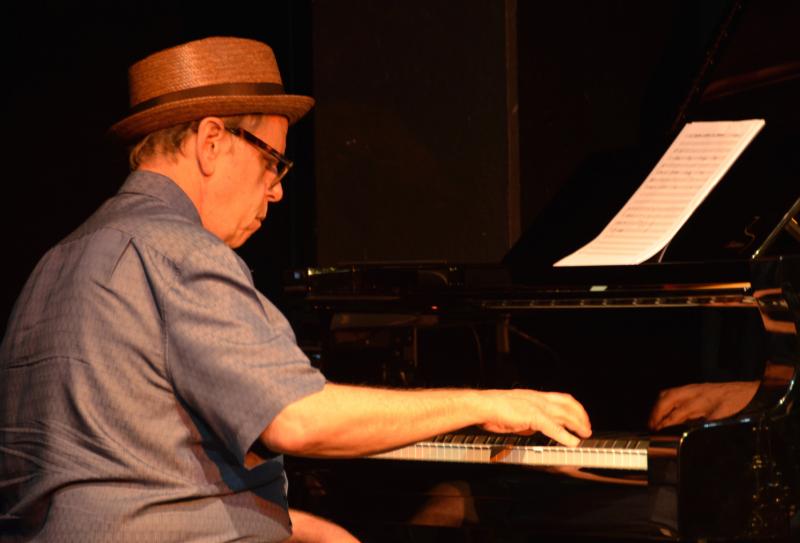
Metaphorically speaking, a festival can be seen as disparate collection of musical stories. Sometimes, there may be an overriding idea in the shape of a theme, but a narrative as such is often missing. Valby Summer Jazz was interesting because it offered a unique sense of continuity. Koppel and Werner participated in all the concerts played at the festival—except the one played by Brian Blade and The Fellowship Band. They could be seen as the main characters in a musical novel where the lineup was constantly changing, but the narrative core remained the same. Of course, this much spotlight on two musicians required a lot of stamina, but Koppel and Werner were up for the task and thankfully knew how to vary both constellations and their own playing. Listening to them, there was constantly a fountain of fresh ideas on display and they were often caught smiling or nodding at each other as the musical stories unfolded.
Chapter Index
Hammond Delight in Poetic Landscapes
The first two days of the festival presented Koppel and Werner in different settings with Hammond organ, an instrument played by no other than Koppel's own dad, Anders Koppel. Anders Koppel recently released Everything is Subject to Change (Cowbell Music, 2012)—with a quartet consisting of himself, Benjamin Koppel, Kenny Werner and percussionist Jacob Andersen—which formed the basis of a concert that found the group stretching out on epic explorations of great depth and beauty, only occasionally disturbed by a ringing mobile phone, which a careless member of the audience forgot to turn off—twice.
A superb interpretation of the title track was the blueprint for the group's sound, mixing the delicate textures of piano and organ in a free-flowing stream of notes. As an organist, Anders Koppel was almost like a painter and far from the pumping grooves of some of his predecessors. Instead, he brought out every nuance of his instrument with ethereal poetry, making the notes sing in the air. It was characteristic that every member of the group was interested in exploring the sounds of their instrument. Thus, Werner occasionally played the strings of the piano like a harp and, during the concert, Benjamin Koppel changed effortlessly between the deep growls of the baritone saxophone and the silky sounds of the soprano.

The music was informed by both the classical music of Olivier Messiaen and Dmitri Shostakovich, and a modern chamber-jazz in the vein of the German ECM label, but percussionist Jacob Andersen added a warm touch of rhythmical magic that lent an exotic flavor to a sound otherwise informed by Nordic melancholy.
One composition was called "The Philosophy of Furniture" and, in a way, it pretty much summed up the music of the group: it was both intellectual and relaxed, abstract and concrete, melodic and brooding. It was the kind of music that required contemplation—inviting deep, rather than easy, listening.
When the group announced its extra, "Poor Shostakovich," an older woman in the audience quietly remarked that she wondered if the group could play anything that would be less than fifteen minutes in length. This was said with a warm smile and not as a dismissal of the music. Instead, it was a concert where the audience clearly accepted the premises of the compositions and immersed itself in the poetic landscapes of sound.
Miroslav Vitous is another prominent painter of sound, who also has a release on Koppel's imprint, Cowbell Music, The Poetic Principle (2008), which formed the basis of the bassist's concert. The team of Kenny Werner, Jacob Andersen and Benjamin and Anders Koppel turned up again and was supplemented by Swedish drummer Peter Nilsson, and of course Vitous himself, who showed himself to be in a humorous mood during the concert, providing samples of his ability to speak Japanese.
As its title revealed, the album was inspired by Edgar Allan Poe (1809-1849), and every song title is a reference to the American writer's works. On some of the compositions, there were even congenial interpretations of the moods found in his stories. For instance, "The Man of the Crowd"—Poe's short story of a man disappearing into the hectic maelstrom of modernity—was given a musical treatment that highlighted the chaotic feeling of the city with a restless rhythm section and a feverish saxophone solo from Koppel.
The opener of the concert was "The City in the Sea," an epic composition with Koppel's fragile lines establishing a mystical mood around the slowly breathing chords of Werner's piano and Koppel's organ, while Vitous extracted all kinds of sound from his instrument, using his bass as a violin that was bowed, plucked and strummed.

The group benefitted immensely from the dual attack of Hammond organ and piano and Werner, in particular, delivered some glistening solos, carving little compositions out of the material. The two also engaged in contrapuntal playfulness and answered and enhanced each other's lines. Another successful partnership was the rhythmical team of percussionist Jacob Andersen and drummer Peter Nilsson; together, they changed easily between pulsating, funky grooves and abstract colorations.
Vitous was the one who somehow tied all the knots together. His control of his instrument was impressive, as he made his bass sigh and sing with an uncanny profundity that fit the moods of Poe's stories well. What emerged were mystical sound paintings that managed to stay vital in a constant balance between rhythmical drive and exploration of texture.
Different Shades of Blade
Drummer, composer and bandleader Brian Blade is another master of musical texture, and his concert at The Betty Nansen Theatre marked his first visit to Denmark with his Fellowship Band— saxophonists Myron Walden and Melvin Butler, pianist Jon Cowherd and bassist Chris Thomas.

Blade and his band were met with a roaring round of applause and, from the beginning of the concert, there was a feeling that this was something special. Unlike other artists at the festival, Blade didn't have a recent album to promote. In fact, his last album with The Fellowship Band dates back as far as 2008, when he released Season of Changes (Verve), which was only the third album from this acclaimed unit.
The lack of artistic promotion was underlined by the fact that Blade kept silent throughout the concert, but he wasn't introverted; instead, he spoke through the music and did so with a warm and welcoming vibe that planted itself into the audience. As he made his drums chant and roar, using bells and skin, he smiled and applauded his fellow musicians as they dug into the material.
On his albums, Blade has featured guitar prominently, but here the focus was on the interplay between the two horns, bass, piano and drums. All of the participants delivered stellar solos, and Butler and Walden, in particular, had a lot to give and complemented each other perfectly, with Butler a little smoother in his approach, contrasting the more full-of-fire Walden.
One of Blade's compositions is called "Folklore," and what he plays with his band could be called a modern kind of jazz folklore where the roots of spirituals, blues, country music and soul are present in the rhythmically pregnant and melodic compositions. While modern jazz is sometimes accused of being too intellectual for its own good, Blade's music was at once down-to-earth and unpretentious, and immensely sophisticated. With its strong emphasis on group dynamics, melody and room for individual creativity, the group embodied everything that is great about jazz, and the highly appreciative audience only enhanced the experience, which was also highlighted by the superb acoustics of The Betty Nansen Theatre.
Blade returned again the next evening for a concert in Prøvehallen, but this time as a sideman with The Kenny Werner All-Star Quartet, featuring trumpeter Randy Brecker. The concert saw Werner in the welcome role as a leader, as he led Brecker, Blade, bassist Scott Colley and Benjamin Koppel through a repertoire consisting mainly of his own compositions. With the exception of "Siena," the band played everything from Balloons (HalfNote, 2011), starting out with "Sada," followed by the title track and "Class Dismissed."
Werner is a gifted composer and his knack for writing infectious themes was highlighted on "Balloons," an arabesque melody that was a perfect point of departure for the advanced embellishments from players like Blade and Colley, who combined superior technique with the joyful discoveries of musical invention.

A special guest was introduced at the concert as a pleasant surprise. Guitarist Julian Lage brought his lightning-fast and melodic runs as a nice addition to a band dominated by Brecker and Koppel, who both played burning bop-inflected solos. While Lage had to jump into deep water without any prior rehearsal, he did exceptionally well, and his finely constructed solos were among the highlights of the concert.
Besides successful interpretations of the compositions from Balloons, there was also room for experiments of a more or less serious character. "Swan Song" was a new song—not yet documented on record, but a song Werner has played before with Koppel. As he said, "We're brothers in this now," referring to the fact that the two have played each other's compositions for a long time and gigged together both in Denmark and America.
"Swan Song" was an original composition from Werner, but the band also found time to include a somewhat redundant cover of "Hedwig's Theme" from The Harry Potter films. It seemed unnecessary to include this clumsy tune, but at least the musicians had fun playing it. However, a far more qualified example of musical fun was given when Werner sat alone at the piano and played The Beatles' "Blackbird" as an encore. Hearing Werner alone underscored just how refreshing an entire solo concert might have been, from a pianist whose approach to his instrument was nothing less than orchestral. But this was a dream that hasn't come true yet—at least not in Valby. Instead, Werner and his musical friends offered an evening of enchanting musical entertainment.
Songs for Saxophone, Voice and Guitar
While Lage represented the future hope of the guitar at Valby Summer Jazz, Jim Hall came in as representative of an entire tradition, spanning several developments of the instrument. This was also reflected by an audience that included old jazz cats, and young people who were curious to see the master in action.
Visibly marked by old age, Hall walked onto the stage using a cane and dryly remarked, "I'll soon get rid of this cane." But then, and this was important, he sat down with his guitar and continued, "But I still love playing." It was evident that Hall still loved what he has done for so many years, and while his body may be in decay, his musical mind and soul are as fresh as ever.
The concert was divided into two parts. The first was a duo session with bassist Scott Colley, playing a selection of standards that included "Bags Groove," "My Funny Valentine" and his signature, "All the Things You Are," dedicated to his wife. On all these tunes, Hall played with low volume, getting an almost acoustic and naked sound out of his guitar, changing between crisp chords and elegantly ornamented lines. At times, he almost resembled British avant-garde guitarist Derek Bailey in the way he approached the instrument as a means for exploring pure sound through melodies. In fact, Bailey also played standards in the later phase of his career.
Hall is often seen as a storyteller whose warm, graceful lines have enriched albums by saxophonist Sonny Rollins and pianist Bill Evans, but he is much more than that. He also played with reed multi-instrumentalist and free jazz pioneer Jimmy Giuffre, and has always demonstrated an open approach to his music, bringing in new partners like guitarists Pat Metheny and Bill Frisell to widen his musical horizons.

The link between Hall the traditionalist and Hall the tireless experimenter was illustrated beautifully in the second part of the concert, where the duo became a quintet, with Kenny Werner, Benjamin Koppel and drummer Jonathan Blake joining in.
The quintet covered wide ground and gave superb interpretations of Hall's "Careful" and "All Across the City," with the urbane feel and elegance that is so characteristic of the guitarist. There was also room for a couple of standards, new and old. "If I Should Lose You" was played with a fresh interpretation, as Hall humorously pondered if the song was about someone who was afraid of losing his wife, while Hall's old friend Sonny Rollins got an homage when the band played a wonderfully twisted version of "St. Thomas," leaving the infectious theme still intact.
The most surprising thing, however, was when the band played a completely free composition, simply titled "Free Piece," and, as Hall remarked, it wasn't about the musicians not getting any pay, but rather about listening to each other to see what happens. What happened was a stunning example of instant composition, with Blake's subtle colorations on the cymbals whispering among tentative melodic lines and subtle rhythms. Residing in the area between modern composition and standards, the composition was a perfect portrait of Hall as a tireless experimental traditionalist, still open to new adventures. The concert didn't show a legend resting on his laurels, but rather a musician aware of his own past and eager to tell new musical stories.
While Hall has spent a lifetime in jazz, soul and gospel singer Marie Carmen Koppel has only recently entered the jazz scene with Brooklyn Jazz Session (Cowbell Music, 2011), enlisting a group of superior accompanists, including her own brother Benjamin Koppel on saxophone, Kenny Werner, Scott Colley and Jonathan Blake. It was this exact lineup that supported Koppel for her concert at Prøvehallen.
Throughout the concert, the singer gave a fine performance and she clearly had a good connection with the audience, with a woman even throwing flowers at her.
 The band played well, but the concert was actually best when Koppel's voice was allowed to shine in duet with either Werner or Colley.
The closer, "Waiting for a Light," was written by the singer, and demonstrated qualities, not only as singer, but also as a songwriter.
The Kenny Werner Quartet played well when backing Marie Carmen Koppel at her Prøvehallen concert, but proved a better setting for legendary saxophonist Lee Konitz when he played his concert at The Betty Nansen Theatre.
Though marked by old age, Konitz was still in good musical shape and blew wonderful soft lines, backed by the vibrant and close listening quartet of Werner, Benjamin Koppel, Colley and Blake. Koppel kept himself respectfully in the background and played the baritone throughout most of the concert. Koppel's deep bass tones were a fitting contrast to Konitz's lightly singing phrases, and a reminder of the partnership between the saxophonist and his former musical partner, saxophonist Warne Marsh.
The repertoire was mainly built on free interpretations of standards, and Konitz and the quartet delivered a beautiful interpretation of the classic "Body and Soul" as well as a smoking version of "Cherokee," where Koppel changed to alto saxophone and challenged the master for a few choruses.
It was all immensely artful, but it all had to end. Konitz humorously remarked that he had to get to bed before it was too late, and so the concert wrapped up with a beautiful reading of "I Can't Get Started," played spontaneously when the two musicians didn't know what to play. Thankfully, both Konitz and the quartet got started and the concert was proof that new meetings between artists can result in wonderful music.
The joyful meeting between artists and audience was essentially what this year's Valby Summer Jazz was all about, and with their many concerts in different constellations, Werner and Koppel created a narrative that deserves to be remembered and repeated. The concert with Blade, however, proved how refreshing it was to have a musical story that didn't involve the protagonists. In the future, the challenge for the music directors might be to know when to step back before their own story gets old.
Photo Credit
All Photos: Kirstine Lykkeberg Thomsen/Cowbell Music
< Previous
Uwo in the Black
Comments
Tags
Live Reviews
Jakob Baekgaard
Denmark
Copenhagen
John Abercrombie
Scott Colley
Bobby Watson
Chris Potter
Ben Monder
David Sanchez
Dave Douglas
Alex Sipiagin
Lee Konitz
Brian Blade
Miroslav Vitous
Jim Hall
Kenny Werner
Benjamin Koppel
Myron Walden
Melvin Butler
Jon Cowherd
Chris Thomas
randy brecker
Julian Lage
The Beatles
Derek Bailey
Sonny Rollins
Bill Evans
Jimmy Giuffre
pat metheny
Bill Frisell
Jonathan Blake
Warne Marsh
For the Love of Jazz
 All About Jazz has been a pillar of jazz since 1995, championing it as an art form and, more importantly, supporting the musicians who create it. Our enduring commitment has made "AAJ" one of the most culturally important websites of its kind, read by hundreds of thousands of fans, musicians and industry figures every month.
You Can Help
To expand our coverage even further and develop new means to foster jazz discovery and connectivity we need your help. You can become a sustaining member for a modest $20 and in return, we'll immediately hide those pesky ads plus provide access to future articles for a full year. This winning combination will vastly improve your AAJ experience and allow us to vigorously build on the pioneering work we first started in 1995. So enjoy an ad-free AAJ experience and help us remain a positive beacon for jazz by making a donation today.Near


Giveaway

Eligible winners: 15
Days remaining: 11
Days remaining: 11