Home » Jazz Articles » Live Review » BMW Jazz Festival 2012
BMW Jazz Festival 2012
.jpg)
Via Funchal
São Paulo, Brazil
June 8-10, 2012
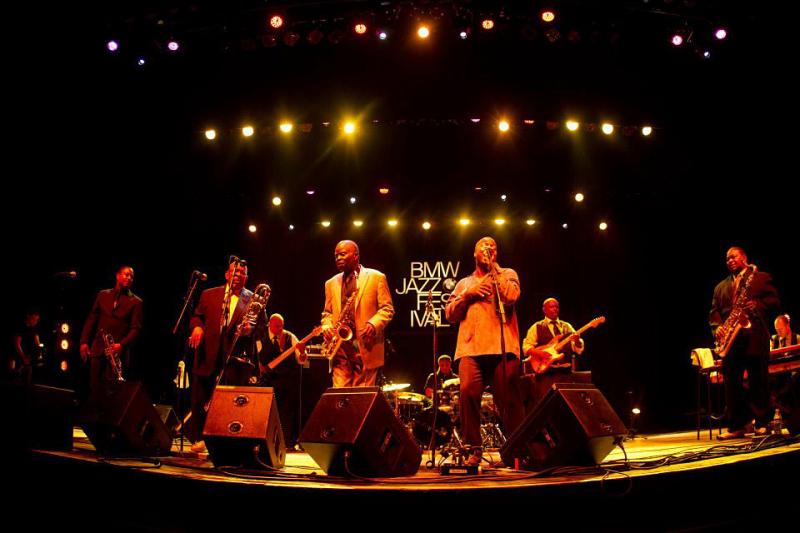
To borrow a word commonly associated with BMW cars, this is a luxury festival. The BMW Jazz Festival debuted one year ago, in 2011, in São Paulo, Brazil. With handsome funding from BMW Financial Services-Bank Group in Brazil, the young festival experienced wild success in its first year—tickets sold out within hours. The demand indicated two things: world-class music and an audience eager to hear it. The 2012 BMW Jazz Festival was largely no different.
The festival boasted a ridiculously talented and eclectic line-up: trumpeter Ambrose Akinmusire's Quintet; pianist Chick Corea, bassist Stanley Clarke and drummer Lenny White; Clayton Brothers; Darcy James Argue's Secret Society; Ninety Miles; and Charles Lloyd. To satisfy the greater public, BMW included funk legend Maceo Parker, budding pop-jazz star Trombone Shorty and Brazilian accordion duo Toninho Ferragutti and Bebê Kramer. For further promotion, the festival included a free outdoor concert in Ibiripuera Park, featuring The Clayton Brothers and Maceo Parker—fortunately, the rain took a day off. Jazz aficionados can tip their hats to the curators: Monique Gardenberg, creator of the (now past) Free Jazz Festival, journalist Zuza Homem de Mello, and producers Zé Nogueira and Pedrinho Albuquerque. The curators clearly know quality, all the while pushing a deeper intention— to both challenge with the modern, and appease with the popular.
The BMW Jazz Festival expanded this year in both scope and size. After three evenings in São Paulo, the festival brought an almost identical lineup to a neighboring Río De Janeiro. In São Paulo, a much bigger audience attended than the previous year. To accommodate more people, the festival changed venues. The move appears business-minded; the festival left the state of the art Ibiripuera Auditorium in favor of Via Funchal, a vacuous space geared better for rock bands (think B.B. King or Flogging Molly) than acoustic jazz. The change had its pros and cons. Via Funchal allowed ample seating. But unless listeners bought up prime real estate, the sound was often spotty. Seeing that the house was never completely full, BMW may reconsider its change in venue.
As its name suggests, the BMW Jazz Festival receives heavy funding from the private sector. In Brazil, private conglomerates such as SESC (Serviço Social do Comércio) give life support for Brazilian instrumental music (and thus jazz). Solid private support ensures quality and subsidizes tickets (SESC concerts are often free or unbelievably cheap). The BMW Jazz Festival operates in similar fashion, but also functions as a trendy, promotional event, attracting politicians, executives and socialites as much as the avid jazz head—something to keep in mind.
Chapter Index
- June 8: The Ambrose Akinmusire Quintet
- June 8: Toninho Ferragutti, Bebê Kramer and Friends
- June 8: Corea, Clarke & White
- June 9: The Clayton Brothers Quintet
- June 9: Trombone Shorty & New Orleans Avenue
- June 9: Maceo Parker, Fred Wesley, Pee Wee Ellis & Friends
- June 10: Darcy James Argue's Secret Society
- June 10: Ninety Miles
- June 10: Charles Lloyd Quartet
June 8: The Ambrose Akinmusire Quintet
Progressing ever forward, Emerging trumpeter Ambrose Akinmusire opened the festival with a full set of fresh material. The new resonates with the (now) old from his 2011 release, When The Heart Emerges Glistening (Blue Note). Only now, Akinmusire's music sounds freer and more unpredictable—a glimpse at what is to come from the promising artist.
Akinmusire stresses the individuality of his sidemen. In São Paulo, the quintet included the usual cast of gifted, young musicians—saxophonist Walter Smith III, bassist Harish Raghavan and drummer Justin Brown—only with Sam Harris sitting on the piano bench in place of Gerald Clayton. Harris' eccentric style fit Akinmusire's concept well. The two clicked on duet segments within Akinmusire's expansive writing.
Only a fierce drum solo by Brown enlivened a generally quiet audience, who appeared unsure of Akinmusire's music. This isn't so surprising. Freer music has little presence in Brazil and Akinmusire's music was challenging; those not up for the challenge might find the music flying right over their heads. More importantly, the music never fell into solid groove—the time was there, just disguised. Akinmusire reaches for the head and heart, not the feet, and this can be problematic in Brazil. That said, it's only good that people expose themselves to courageous artists like Akinmusire.
June 8: Toninho Ferragutti, Bebê Kramer and Friends
Two is a lot of accordion. When you get three, even four together on one stage... well, it's really a lot of accordion. Toninho Ferragutti and Bebê Kramer are each masters of accordion, only from different traditions. That's the point. On their 2011 Como Manda o Figurino (Borandá, 2011), the duo skillfully merges an array of Brazilian styles—forró, choro, samba, folk music and more. While artists everywhere reach out across oceans and borders to diversify their music, Ferragutti and Kramer capitalize on the diversity within Brazil.
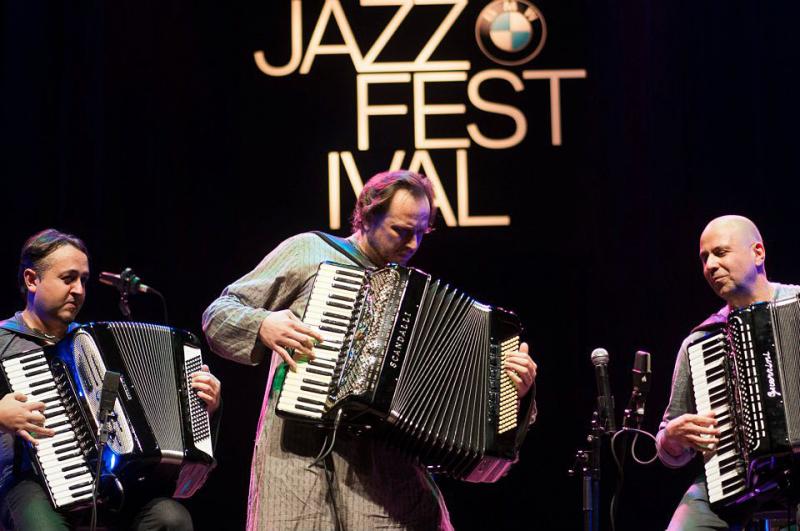
An immediate forró groove signified a sharp departure from the Ambrose Akinmusire Quintet. The audience responded in full—after all, forró is for all. A small instrumental group backed the Ferragutti and Kramer duo, at first playing a minimal supporting role. The spotlight was fixed on accordion; however, at times, the concert digressed into an accordion chops fest, especially when fellow accordionists Adelson Viana and Gabriel Levy joined in—it was just too much accordion. Though the "friends" factor added a twist, it came at the expense of Ferragutti and Kramer's beautiful duo playing. Finally, the accompaniment rested as Ferragutti and Kramer reanimated "Choro de Madrugada," an expressive song off Como Manda o Figurino. Finally, the music could breath.
"Choro de Madrugada" marked a turning point. The supporting ensemble joined accordion in the spotlight, and the group unified. Compositions sang with a fresh voice as clarinetist Alexandre Ribeiro took on melody lines. Percussionists Beto Angerosa and Amoy Ribas dug deep into their rhythmic palettes; one even unsheathed his didgeridoo as bassist Zé Alexandre Carvalho complemented in timbre by bowing. The finale, "Na Sombra da Asa Branca," fulfilled the potential of such an eclectic group. Unfortunately, as the finale neared its end, the group reconvened the accordion summit for one final tradeoff—a sensational finish, but again, a lot of accordion.
June 8: Corea, Clarke & White
Chick Corea warmed up his iconic piano trio on the Return to Forever staple, "La Fiesta." The sound was noticeably low. Fans protested, shouting for more piano, but nothing changed. The trio continued anyway, as bassist Stanley Clarke = 5737 added his own Return To Forever composition, the title track to Light As A Feather (Polydor, 1973). Corea flew up and down the piano with unbelievable lightness—proving, as always, that age hasn't slowed him one bit.

Sound remained an overarching issue. Corea and Clarke expressed continual frustration with their monitors while drummer Lenny White kept the music going. The sound issues were nothing too serious; however they seemed to disrupt the trio's chi. Again, the trio continued with a Return To Forever selection, this time rearranging the classic title track to No Mystery (Polydor, 1975), into which Corea and Clarke sparked new life by fragmenting its iconic jingle.
Corea, Clarke and White played as sharp as ever, though the house somehow lacked energy. "Ya'll are quiet tonight," White remarked early on. The crowd struggled to come together for an encore. Of course, the encore happened; however, it didn't quite feel organic. Corea, Clarke and White may have felt the same, quickly running down "500 Miles High" and departing.
June 9: The Clayton Brothers Quintet
The Clayton Brothers Quintet came out blazing on saxophonist Jeff Clayton's "Wild Man." A fresh Terrell Stafford (trumpet) was on absolute fire (enter bassist John Clayton's "stick of dynamite" metaphor), a dramatic Jeff Clayton flapping his hands to cool Stafford off. Pianist Gerald Clayton and drummer Obed Calvaire offered youthful energy and frenzied outbursts. Sound issues from the previous night appeared resolved—the band immediately filled up the venue.
The quintet moved to selections off its 2010 Grammy-nominated album The New Song and Dance (ArtistShare). "Cha Cha Charletson" stood out—sophisticated, soulful and danceable. Jeff, who rarely sits still ever, jigged to his mix of two dances: the cha- cha-cha and the Charleston. John cooled the mood with his bossa nova flavored "Terrell's Song," written to feature the unique horn blend between Jeff and Stafford. The horns struggled a bit to sync, but Stafford made up for it in his featured solo.
John Clayton refrained from any solos, instead assuming the director-overseer role. Adept in both jazz and classical worlds, the bassist only did what he does best, lyrically bowing the ballad "Emily," with tender accompaniment from his son, Gerald. The Clayton Brothers Quintet closed with Jeff's soulful "Jones Brothers"—a fitting homage to another endeared jazz family.
June 9: Trombone Shorty & New Orleans Avenue
Trombonist/trumpeter/singer Trombone Shorty is an amalgamation of everything hip since 1900. Shorty imitates the greats to the tee—Louis Armstrong, Dizzy Gillespie, Ray Charles, James Brown and everyone else—throwing them all on his stylish, rock-influenced back. As sax legend Maceo Parker later exclaimed, "Trombone Shorty is outta his mind!" Talent-wise, nobody quite compares with Shorty. He picks up just about every instrument (mind his trumpet lips!). But remember, he's 26, young and reckless. Given his concept, Shorty would probably take this as a compliment. Still, Shorty clearly has room to mature.
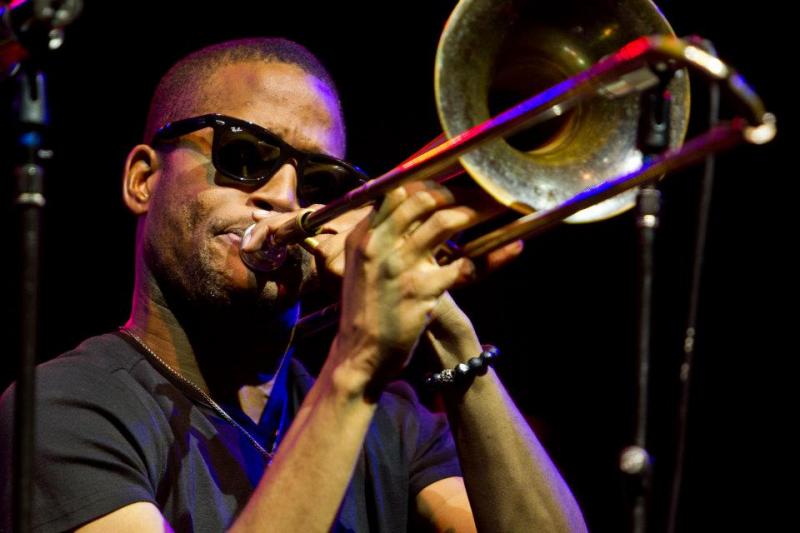
Shorty began a solo on a happy-go-lucky rock rendition of "On The Sunny Side of Street," screaming on trumpet. To start so high and loud, it's impossible to go much farther than a chorus. Shorty rounded his second and third chorus stagnating in the highest register. What can possible come next? Of course: circular breathing on a concert C for two-and-a-half choruses. The feat garnered a larger standing ovation than Ambrose Akinmusire's entire set. Shorty revealed a concerning reality—showmanship easily confounds the general audience. Shorty knows this and banks on it. The result: in the popular vote, he won the BMW Jazz Festival.
Shorty closed on drums. The drummer replaced the guitarist; the guitarist picked up the tenor sax, the tenor saxophonist the bass, the bassist the trumpet, the baritone saxophonist the trombone. Impressive—every band member is a multi-instrumentalist! But that's all. That's the final act. And the audience likely remembered the act, but will probably forget how the song went.
June 9: Maceo Parker, Fred Wesley, Pee Wee Ellis & Friends
Saxophonist Maceo Parker played the melody to Duke Ellington's "Satin Doll," then joked that he doesn't play jazz. Well, it's true. He doesn't. The most iconic funk saxophonist played funk (and not "Brazilian funk"). Fellow James Brown and George Clinton band mate Fred Wesley joined in rather casually, blowing timeless, feel-good trombone licks and enriching a countless number of hip horn riffs.
Saxophonist Pee Wee Ellis entered late to complete a JB Horns reunion. Lighting up a down-tempo soul number. His chops may have suffered, but he played with deep intention. The royalty of funk may gray, but their music is as young at heart as ever. The audience took advantage of the funk interlude to get in a full weekend's worth of dancing.
June 10: Darcy James Argue's Secret Society
"Please be nice," composer/bandleader Darcy James Argue anxiously said as his Secret Society verged on playing "Zeno"—a samba-inspired composition off its 2009 Infernal Machines (New Amsterdam). The audience cheered in anticipation. "Zeno," indeed, began in samba, but what an abstract samba. And that's just it. "Zeno" speaks to Argue's artistic mind. Samba is a starting point; a foundation off of which the imagination can build. And Argue has no lack of imagination.
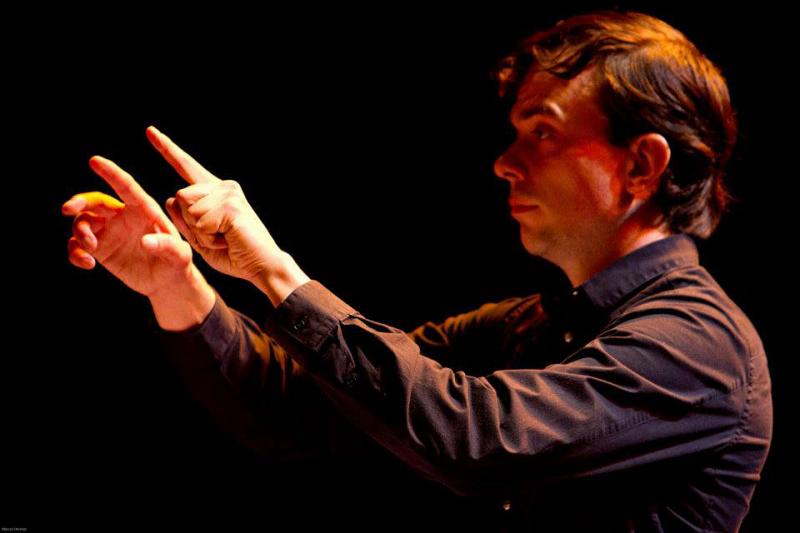
A fresher example: Argue's unrecorded suite, "Brooklyn Babylon," which narrates a (perhaps post-) modern fable about an artist's responsibility to his or her beloved community. Argue crafted a vast story through a cascade of snack-sized movements that tempted the modern-day ear. Argue's fable projected dark, yet whimsically picturesque imagery—a grand feature. The best stories have picture accompaniment, and the height of "Brooklyn Babylon" came as trumpeter Ingrid Jensen sang effects-laden lines above a gritty, droning orchestra.
Argue's writing, like other Bob Brookmeyer protégés, is bottom-heavy. Argue distinguishes his sound with personalized minimalism and heavy distortion. The distortion —created with guitar and odd timbre blends between low range horns—gives a hip rock vibe. However, distortion can be tough to manage live. Whether acoustic or electric, distortion frequently buried the soloists—the only exception being veteran Jensen, who flagged down the sound guy before each solo. At times, electric distortion buried the entire orchestra. As Argue hopefully further explores distortions and other rock elements, he'll have many more chances to work out this minor sound hurdle.
June 10: Ninety Miles
Ninety Miles is heavy. A dangerous trio of vibraphonist Stefon Harris, saxophonist David Sanchez and trumpeter Christian Scott aTunde Adjuah fronts this relatively new project, which throws heavy hard bop lines and soulful improvising over raw, Cuban rhythms. "We're trying to build bridges from jazz to all kinds of music around the world," claimed Scott, in a clinic; so far, so good. Ninety Miles constructs a solid musical bridge between the US and Cuba.
Ninety Miles escapes the common trap of compromise, which often comes at the expense of individual artistry. In performance, each core member played his role well, communicating his distinct voice, background, and accent: Harris laid down a rich modal foundation, Sánchez added percussive horn riffs and Latin-flavored countermelodies; and Scott flew high over it all, belting out his fiery, modern vernacular of the New Orleans tradition. Backing all this was a tight Cuban rhythm section. This is 90% of Ninety Miles. The changeup came with Sánchez's introspective dedication to New Orleans, "The Forgotten Ones," a well-needed deep breath—or vista. New Orleans native Scott stepped aside as Harris and Sanchez expressed their deep sentiments.
Scott had his moments too. Scott always reached for it—the emotion, the edge, the message—with intensity. He didn't always hit it. It's impossible for anybody to always hit it. But Scott always went for it. Whether he got there or not, the audience was still rooting for him. Try again! Go again! Drummer Henry Cole peaked on Harris' closer "Black Action Figure," as Ninety Miles ended in force. The bridge had been built, and people were already shouting for an expansion... or, at least, a few more lanes.
June 10: Charles Lloyd Quartet
Saxophonist Charles Lloyd gave meaningful closure to the 2012 BMW Jazz Festival. A free improviser first and foremost, Lloyd's quartet hinges on the capability of each individual member. Pioneering pianist Jason Moran, versatile bassist Reuben Rogers, and drum marvel Eric Harland joined Lloyd in São Paulo. Lloyd began in meditation. Upon his concluding thought, the quartet burst into the proudly African "Darvish Dance," as Harland's tambourine burred joyfully. A dwindling audience was smitten.
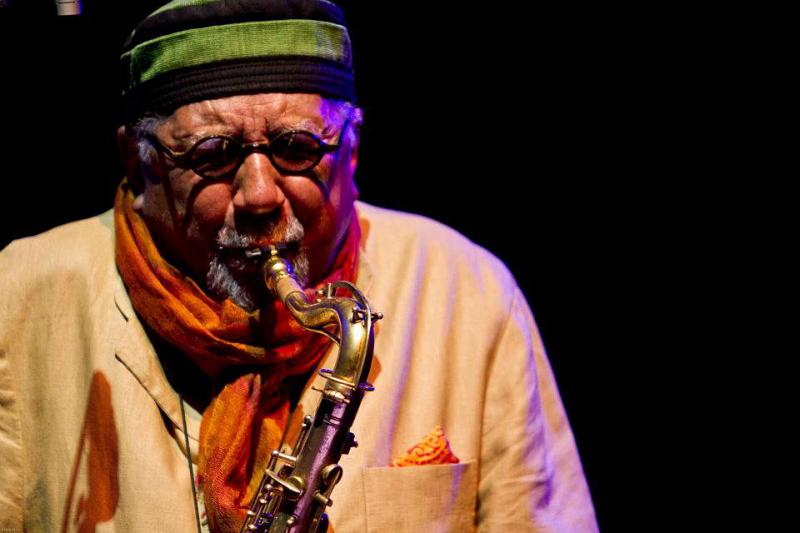
Lloyd's quartet is no conventional one. Each artist knows when to play, and when not to. Moran often pulled a Thelonious Monk, stepping out and allowing Lloyd complete harmonic freedom. In one instance, Moran sat patiently as Harland improvised alone. Moran appeared keen to accompany, hands ready, ears alert. Nothing came, and Moran again stepped out. Moran played only the worthwhile; Lloyd was the same, often leading his quartet by not playing at all, instead putting absolute faith in those with him. In another instance, Harland broke into an intense, but quiet swing as Moran finished the gospel "Lift Every Voice And Sing." Only this time, Rogers stepped out with Lloyd. After a pause, Moran began a re-harmonized "Caroline, No" in his own tempo, patiently syncing to Harland's ride—a rhythmic duet.
"We believe in deeds, not in words," concluded Lloyd after relating the generosity he experienced from the Brazilian people. Lloyd reciprocated the deed with his greatest gift: music. A small crowd fervently cheered for more. Monday morning may have been on the horizon, but those who left—a majority—truly missed out on a deeply powerful conclusion.
The 2012 BMW Jazz Festival in São Paulo well surpassed its 2011 debut. A stellar lineup truly impacted a large audience. The quality in artistry was admirable, however BMW only featured one Brazilian group. The festival might strengthen its message and appeal with a bigger presence from Brazil and neighboring countries. While Via Funchal gave a less personable atmosphere, the festival adapted, handling the vast venue quite well after the first evening. Still, the organizers may reconsider the change in venue; or, if growth warrants, take on a second, more acoustically fit venue such as Ibiripuera Auditorium. For now, the change was understandable in light of a young festival continuing to optimize itself. All in all, after a fine weekend of quality music, Brazil can only anticipate yet another luxury BMW Jazz Festival in 2013.
Photo Credit
All Photos: Marcos Hermes, Courtesy of BMW Jazz Festival
< Previous
Burning Live At Jazz AO Centro
Next >
The Bremen Concert
Comments

About Charles Lloyd
Instrument: Saxophone
Related Articles | Concerts | Albums | Photos | Similar ToTags
charles lloyd
Live Reviews
Ross Eustis
Brazil
Sao Paulo
ambrose akinmusire
Chick Corea
Stanley Clark
Lenny White
The Clayton Brothers
Darcy James Argue
Maceo Parker
trombone shorty
B.B. King
Walter Smith III
Harish Raghavan
Justin Brown
Sam Harris
Gerald Clayton
Return To Forever
Jeff Clayton
Terrell Stafford
John Clayton
Obed Calvaire
Louis Armstrong
Dizzy Gillespie
Ray Charles
James Brown
duke ellington
Fred Wesley
Pee Wee Ellis
Secret Society
Ingrid Jensen
Bob Brookmeyer
Stefon Harris
David Sanchez
CHRISTIAN SCOTT
jason moran
Reuben Rogers
Eric Harland
Thelonious Monk
For the Love of Jazz
 All About Jazz has been a pillar of jazz since 1995, championing it as an art form and, more importantly, supporting the musicians who create it. Our enduring commitment has made "AAJ" one of the most culturally important websites of its kind, read by hundreds of thousands of fans, musicians and industry figures every month.
You Can Help
To expand our coverage even further and develop new means to foster jazz discovery and connectivity we need your help. You can become a sustaining member for a modest $20 and in return, we'll immediately hide those pesky ads plus provide access to future articles for a full year. This winning combination will vastly improve your AAJ experience and allow us to vigorously build on the pioneering work we first started in 1995. So enjoy an ad-free AAJ experience and help us remain a positive beacon for jazz by making a donation today.Near


Giveaway

Eligible winners: 15
Days remaining: 6
Days remaining: 6