Home » Jazz Articles » Album Review » John Surman: Saltash Bells
John Surman: Saltash Bells

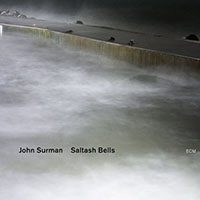
Saltash Bells is Surman's first solo recording since 1995's A Biography of the Rev. Absalom Dawe, though he's been far from inactive, releasing the quartet-based Brewster's Rooster (2009) and Rain on the Window (2008)—a sublime duo set with organist Howard Moody recorded at Ultern Kirke in Oslo, where Surman now resides with wife/singer Karin Krog—in addition to two non-ECM recordings: Cuneiforms's marvelous archival find, Flashpoint: NDR Jazz Workshop—April '69 (2011), and the large-ensemble The Rainbow Band Sessions (Losen, 2011).
Credits for Surman's previous one-man efforts cited them taking place during the course of a month; Saltash Bells, in contrast, was recorded over just two days in 2009 and one more in 2011. Surman adds tenor saxophone, and alto and contrabass clarinets to his core arsenal of soprano and baritone saxophones, bass clarinet and synthesizers...even harmonica, for the first time, on the epic "Sailing Westwards," gently layered so seamlessly with his synth patterns as to feel like a unified voice.
Loops, synthesizer sequences and multi-tracked horns suggest preconception, but in Surman's sphere these remain a means of using improvisation to create further improvisational contexts, whether it's building foundations or soaring over them, as he does towards the end of "Sailing Westwards," his soprano responding to the various layers that combine to shape this hypnotic closer of cinematic proportions.
Saltash Bells is not all layered constructs, however. The pensive "Glass Flower" features Surman a capella on bass clarinet, while baritone saxophone is the sole voice on "Ælfwin." Elsewhere, "Triachordum" is a trio baritone piece, Surman's improvisational voice adding the shifting vertical harmony to two horns separated by fifths throughout, even as he fashions melodies in the moment over the course of nearly four minutes. Surman's soprano saxophone on "Dark Reflections" seems to be on a course that orbits around a series of shifting lines more buried in the mix, while baritone and soprano saxophones evoke both lyricism and unrelenting pulse on "The Crooked Inn."
Saltash Bells is an intended reference to Surman's birthplace in Tavistock, a scenic location on the River Tavy, which runs through West Devon to the English Channel. Sounds of church bells and seagulls echoing over the landscape are but two touchstones that imbue the charmingly pastoral Saltash Bells, an album that confirms you can take the man out of the place but you can't take the place out of the man.
Track Listing
Whistman's Wood; Glass Flower; On Staddon Heights; Triachorum; Winter Elegy; Ælfwin; Saltash Bells; Dark Reflections; The Crooked Inn; Sailing Westwards.
Personnel

John Surman
saxophoneJohn Surman: soprano, tenor and baritone saxophones, alto, bass and contrabass clarinets, harmonica, synthesizer.
Album information
Title: Saltash Bells | Year Released: 2012 | Record Label: ECM Records
About John Surman
Tags
PREVIOUS / NEXT


Become a Sustaining Member

Since 1995, All About Jazz has championed jazz as an art form and supported the musicians who create it. Over three decades, it has grown into one of the world's leading jazz resources, serving hundreds of thousands of readers, musicians, presenters and industry professionals each month.
Help Build the Future of All About Jazz
Your support helps us continue building All About Jazz for the next generation—expanding our editorial coverage, preserving jazz history, developing new community features and creating better ways to discover the music and the people behind it.
Become a sustaining member for as little as $20 per year and you'll immediately enjoy an ad-free experience along with access to subscriber features and future articles for a full year.
Together, we're not simply sustaining All About Jazz—we're building its future. Thank you for being part of the journey.