Home » Jazz Articles » Interview » Arif Mardin: In Conversation
Arif Mardin: In Conversation

I was totally 'jazz.' I shunned all kinds of rock or pop music. When they paired me?with The Young Rascals...the first record we made became number one, so I said, 'Maybe I should concentrate on this.
 Arif Mardin is a mover and shaker in the music business, but at age 10, he was the one being shook. "My father was manager of a Turkish bank in Alexandria, Egypt," Mardin said. "In 1942 we were there; Germans would bomb the city. We would go down to the shelter, and at one point, famous [Field] Marshal Rommel's army was a few miles away—the famous Battles of El Alamein. I remember those vividly."
Mardin survived and went on to work in New York for Atlantic Records, enjoying one of the most illustrious behind-the-scenes careers in the music business. He helped to create such hits as Roberta Flack's "Where Is The Love," Aretha Franklin's "Respect," Average White Band's "Pick Up The Pieces," the Bee Gees' "Jive Talkin?" and the Rent original-cast soundtrack, among many others. He also has produced plenty of jazz, including platters for Charles Lloyd, Eddie Harris, Sonny Stitt, Freddie Hubbard, Max Roach, Herbie Mann, the Modern Jazz Quartet, Regina Carter and, most recently, Dianne Reeves' A Little Moonlight for Blue Note Records.
Also for Blue Note, Mardin in 2002 worked his magic for an unknown singer and pianist from New York by way of Texas. The result was Norah Jones? Come Away With Me, which earned Mardin four Grammys, including for Producer of the Year, bringing his collection to 11. Currently Mardin is working on Jones? follow-up disc as well as his memoirs, beginning with his birth in Istanbul, Turkey, in 1932; through his years at Berklee College of Music in Boston on the Quincy Jones Scholarship; and detailing his storied career at Atlantic, from 1963 to 2001. Today he works for EMI, which owns Blue Note.
I spoke with Mardin by phone a few days after the Northeast blackout, talking about the "lost" Norah Jones album, the place of jazz in top-40 music and how a hardcore jazz-snob got turned on to rock.
 All About Jazz: You produced Norah Jones? Come Away with Me. Did you expect Jones? breakthrough success in a marketplace that seems more dominated by quick-hit teen pop and hip hop?
Arif Mardin: No. We were so proud of the album, and we went with the flow. We were hoping for some modest sales, and then look out for the next album, build the artist, but—this heartfelt music reached so many people, especially after 9-11. Maybe we have awakened sort of an untapped segment of the audience who actually—rather than download—go to the store and buy records. When I go to Norah Jones concerts, you have 10-, 12-year-old, young people to 80-year-old grandmas. It's just an incredible phenomenon.
AAJ: Was it your idea to have [guitarist] Bill Frisell play on the disc?
AM: No. The story of the album is that Craig Street, who produces Cassandra Wilson, produced the album, and Bill Frisell was on some of the songs. When Blue Note and Norah thought that the album was too guitar-oriented, which went away from the original demo-feel—more piano and straight-ahead vocal—they asked me to re-record the whole thing, except that some of the songs that Craig produced remained. Bill is playing on one of them.
AAJ: What was the original conception of the album; how did the two versions differ?
AM: The original demos were like the album which is out now. It was sparse and piano-oriented. But the album that was not used was a lot of guitars.
AAJ: So there's a whole alternate guitar-album out there somewhere?
AM: Right [laughs].
AAJ: Is that ever going to see light?
AM: I don't think so.
AAJ: Do you consider Jones a jazz artist?
AM: Yes, especially in spirit. I mean "The Nearness of You" is fantastic—a jazz ballad. She does a Duke Ellington song, it will be in the [next] album, called "Melancholia," and she wrote the lyrics, fantastic lyrics. She has the spirit also of a jazz album-artist. She definitely is an improviser; I heard her play Bach songs and things like that. She also is at home with folk or countryish songs.
AAJ: Are you working on the new album with her?
AM: Yes, we have started [for Blue Note]. We're going to [record] again in maybe a month or two.
 AAJ: You also just produced a Dianne Reeves album.
AM: Yes, she has an incredible album. Her rhythm section [is] Peter Martin on piano, Reuben Rogers on bass and Gregory Hutchinson on drums. Then we have Romero Lubambo on guitar— Brazilian—on a few tracks and Nicholas Payton playing trumpet on "You Go to My Head," just a fabulous duet with Dianne [and rhythm].
AAJ: It sounds like a great band.
AM: They play to enhance the music. They don't want to shine, themselves. The solos aren't long. All the music they played is to support and make songs memorable. I'm known as an arranger and a producer who loves to add stuff, more strings, more horns, and this "less is more." It's fantastic.
AAJ: I understand people didn't expect the success of Norah Jones. Does that change the way you hope to market Dianne Reeves? Do you think she could have a similar breakthrough?
AM: I think this album is going to be very successful. The singing is so direct. I think Dianne definitely is wearing the crown of Sarah Vaughan. This album is so fantastic; her every note, it makes sense. With "Skylark" you feel like you're up there with the birds looking down into the meadows. A great version of "Lullaby of Broadway"—everybody usually goes [up-tempo, but] this is about the sadness of chorus girls. She sings it slowly; it's so beautiful. I mean really, really she outdid herself.
[At] the beginning of summer, she appeared at Alice Tully Hall at Lincoln Center. My wife and I and [Blue Note president] Bruce Lundvall, we all went to the concert, and she was singing songs from the album. It was so personal, we were kind of devastated, it was so lovely and feeling.
AAJ: Norah Jones seems like a breath of fresh air for a lot of listeners. What is the difference between pop music and art, and where does jazz, from Charles Lloyd and Sonny Stitt, both of whom you?ve worked with, and Norah Jones and Dianne Reeves more recently, fit in?
AM: I'm looking at the young people today playing, dedicated musicians. Instead of going to lucrative pop music or whatever, they play in small clubs and they just play the music they love. I hope there [is] more of an awakening of jazz with the people because obviously the sales of jazz records aren't as big as pop records.
AAJ: It's just a fraction of the industry total. How can that market be improved, how can artists be exposed to young people?
AM: Well, you have some examples [such as] Diana Krall. Maybe great videos, some concerts—I don't know.
AAJ: Some people feel worried that jazz is headed toward a nostalgic, kind of museum-piece future.
AM: You have a point there, but when an artist [such as] Dianne interprets songs, and you get into the lyrics, it's back to incredible, Billie Holiday time, or even—she was not a jazz singer, but—Edith Piaf. You get into the meat of the song, and she's acting out the persona. I worked with Bette Midler for many years, and I learned her craft, her art, that she becomes the person. When she would do a vocal, she would think, 'shall I be that person, shall I be this person?" Then she would latch on to the persona of what the songwriter is trying to say. Dianne is doing that.
Also I think it's a matter of education. Today young pop-music and hip-hop have very little to do with jazz. The basis of jazz is improvisation and freedom. If the musician is a mediocre jazz artist and the solos go on and on and on, you bore the people. But if you have a stellar instrumentalist, and he gives you an incredible solo, it will touch hearts. You see, we have to really lift the level of musicianship a little bit.
 AAJ: Speaking of great musicians, you worked on Charles Lloyd's Dreamweaver in 1966, with Cecil McBee, Jack DeJohnette and Keith Jarrett. That was a pretty "New Thing," Coltrane-style kind of record. With Jones and Reeves, they play more conventional, verse-chorus-verse songs and standards. Do you follow the avant-garde versus neo-classical controversy among jazz musicians?
AM: No, but at the same time, I'll give you an example: The "Skylark" arrangement for Dianne Reeves. It's a departure from the original chord changes, but at the same time, the feeling is there and the melody is always supported by new harmonies—but it's not distracting. It is slightly avant-garde, but at the same time, it's beautiful. Sometimes you will have ultra-, ultra-different chords piled upon each other, and, if the object is to be totally avant-garde and—devoid of melody, well maybe that's sort of a Stravinsky-like approach. But if you're playing a song, you have to also be a little true to the original melody.
AAJ: You worked with Ofra Haza [on 1989's Desert Wind].
AM: Yes. She's Israeli, but she came from Yemenite Israeli, so she spoke Arabic too. Wonderful woman. She brought in some kind of desert tradition.
AAJ: Do you listen to a lot of world-fusion jazz?
AM: A little bit, not too much. When I travel to Istanbul, because I have an apartment there—I come from Turkey originally—you turn on the radio and you hear a lot of interesting ethnic music.
 AAJ: Some of your work, such as "Good Lovin?," Aretha Franklin's 'respect? [from Franklin's 1967 album, I Never Loved a Man the Way I Love You, on which Mardin worked as arranger] and Average White Band's Cut the Cake, is considered classic. Other albums, such as your work with Hall & Oates, Culture Club or Phil Collins—people don't accord them the same kind of time-tested character. How do you assess the fickle trends in top-40 music?
AM: Well... I think the strength of the song is more important. I don't know if that is a factor. Today it is more like a handsome, young man or a very pretty, sexy, young lady dancing well and relying on videos and effects. Some of them, their voices may be pretty, but they are out of tune in many places, and they are being corrected by computer software. That's what we call today's pop music. It's really not an advancement at all. Top 40 of the '60s and '70s and '80s were totally different. [But] I'm not a person who says, 'those were the good, ol' days," because in the '70s, '80s I used to use synthesizers. Today a lot of people say, "Let's record analog." Fine, if the artist is really keen about that, fine, but give me Pro Tools anytime, because it makes my life easier. The conversions, analog-to-digital, are so much better now, that digital sounds very sweet. I remember in 1987 or ?90, I was recording with the Bee Gees, and we had one of the first digital multi-tracks, and the sound was terrible, very brittle. It's not like that today.
AAJ: You worked with the Bee Gees in the '70s also, you did "Jive Talkin?," which was a huge, smash hit.
AM: Right, but that was kind of state-of-the-art technology too.
AAJ: Some people worry that was the end of the artist-driven music market and the beginning of the producer-driven scene. Then the '80s came along, and it was sort of a dark age for pop music, with payola in the industry?
AM: [Laughs.]
AAJ: ?and overproduced, out-of-touch music, whereas jazz-rock and punk rock were pushed underground.
 AM: In the and '80s I was very happy to work with Chaka Khan for example. We made great records. [Mardin produced 1979's Chaka Khan, featuring "I'm Every Woman," and 1984's I Feel for You.] Again that was sort of a state-of-the-art fusion of rap and synthesizers. But the drummer was playing drums!
AAJ: That's real, organic drumming and not a synth drum?
AM: Excuse me, that was a drum machine. I will be giving a speech in October at the AES [Audio Engineering Society] Convention, and it is about, will technology replace the artist? I'm going to say that technology is great, you can't stop it, because people will invent new devices, new machines all the time. It is, in whose hands the technology will be, because you can use the technology to great advantage, or you can manufacture an artist, a singer from nothing. Those are the points that you have to weigh.
AAJ: Hindsight is 20/20 of course, but is Norah Jones a kind of penance for Boy George?
AM: Whoa. What did I do with Boy George?
AAJ: Some people would think he's sort of one of those produced artists who isn't relevant today.
AM: No, no, totally wrong. Boy George belongs to the punk generation. I remember, when we were doing vocals, he did one vocal, right? I said, "Can I have another one?" Because I would like to take maybe a good verse from another take. He said, "Why?" I said, "For insurance." [He said,] "You think I'm going to die?" He refused to give me another vocal. So whatever he sang, it was one take. He definitely was not a manufactured person.
AAJ: You're working on your memoirs?
AM: I am. It's a little slow, but I have four chapters finished and maybe [three more] chapters outlined. It's slow: correcting, looking at my old scrapbooks, putting photographs together and things like that.
AAJ: Can you give us a taste of what you'll talk about?
AM: It will be nothing but music and anecdotes and jokes. I don't know artists? sex lives; I'm not involved with what they do after the studio. There will be no tabloid kind of thing. It's going to be music history, who played what; also my early life in Turkey, how I was brought up, and early jazz activities.
AAJ: What would be your most memorable moment in the studio? Whom do you remember best, working with?
AM: There are so many great moments. Definitely with "I'm Every Woman," we had a feeling that this is going to be great. Of course any session with Aretha Franklin, I would go home and tell my wife: "You weren't there. She sang incredible stuff."
AAJ: Do you have any plans to work with her or any other of those artists again?
AM: Usually it happens. We always talk to each other on the phone. Being a producer my relationship with artists, it's always like family. [Aretha] picks up the phone and asks advice, this and that. We did work much later, when she was with Arista. So if she calls me, I'll work [laughs].
AAJ: Speaking of family, you have a son and a daughter?
AM: Yes, Joe and Julie. Joe is a producer-arranger-orchestrator, and he's working on many, many projects. Julie is an avant-garde artist; she creates imagery'she used to do it in the dark room, now she's scanning stuff. She creates visual art, usually it's about toys that promote war or violence against women and children. She's a very driven, young lady.
My wife [Latife] also writes novels. She's been in top-10 in Turkey. They're all historical novels, 19th century. She writes in English, and it's translated back into Turkish. She has a very interesting system.
AAJ: You did Smokey Joe's Cafe [in 1995 with the original Broadway cast]. That was a Lieber-Stoller [review]?
AM: Yes. It was their life's work actually, and it was a musical review on Broadway. We all got a Grammy for that.
AAJ: I heard the song ["Smokey Joe's Cafe"] by the Robins, who became the Coasters, in a Brendan Fraser movie set in the ?50s, and I thought it was really catchy, and I got the album and realized almost all their songs were by Lieber and Stoller.
AM: Yes. The Coasters were fantastic. That's just a few years before my time, before I joined Atlantic Records. Coasters were probably recorded ?58. I was in Berklee College of Music at that time, and joined Atlantic in ?63.
AAJ: So you heard it on the radio, but you weren't working with..."
AM: I never listened to that kind of music; I was totally "jazz." I shunned all kinds of rock or pop music.
AAJ: So how did you open up your ears to other music?

AM: When I was hired by [A&R chief at] Atlantic Nesuhi Ertegun, a true jazz fan and a great guy, I was working in the studio as an assistant, and really watching him produce jazz records—MJQ, Herbie Mann. When they paired me and Tom Dowd, a great engineer and my mentor, with The Young Rascals, I was a novice. The first record we made became number one, so I said, "Maybe I should concentrate on this." So that was like, jazz-to-back-burner a little bit, but not too much, because I still worked with jazz artists at that time.
AAJ: Eddie Harris had huge hits in the ?60s [Mardin produced The Electrifying Eddie Harris with its hit single "Listen Here" in 1967], and Charles Lloyd played at the Fillmore Auditorium [when the club was dominated by psychedelic-rock acts], Laura Nyro played on a bill with Miles Davis?
AM: Yeah, I worked with her.
AAJ: ...so that was maybe just a time when promoters put together more colorful bills.
AM: This gives me a good idea, that we should really pursue that.
Photo Credit
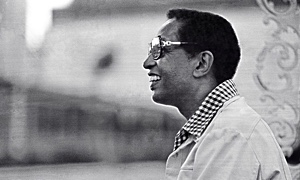
Arif Mardin Portrait by Julie Mardin
Tags
PREVIOUS / NEXT
Become a Sustaining Member

Since 1995, All About Jazz has championed jazz as an art form and supported the musicians who create it. Over three decades, it has grown into one of the world's leading jazz resources, serving hundreds of thousands of readers, musicians, presenters and industry professionals each month.
Help Build the Future of All About Jazz
Your support helps us continue building All About Jazz for the next generation—expanding our editorial coverage, preserving jazz history, developing new community features and creating better ways to discover the music and the people behind it.
Become a sustaining member for as little as $20 per year and you'll immediately enjoy an ad-free experience along with access to subscriber features and future articles for a full year.
Together, we're not simply sustaining All About Jazz—we're building its future. Thank you for being part of the journey.