Home » Jazz Articles » Jazz in the Aquarian Age » Herbie Mann: An Amalgamation of Everything
Herbie Mann: An Amalgamation of Everything


As far as where it’s all going right at this point, there’s going to be an amalgamation of everything.
By the end of the 1950s, Mann had established himself as one of the top jazz flute players around—recording with Clifford Brown, Sarah Vaughan, Kenny Burrell, and Phil Woods, among others. He moved away from bebop to Afro-Cuban jazz, and in 1959, took his band on a tour of 15 countries in African, sponsored by the U.S. State Department. Back home in New York in 1961, he recorded his first big jazz hit, "Comin' Home Baby," a straightforward medium-tempo blues in C, on a live album, Herbie Mann at the Village Gate (Atlantic, 1961). Around that same time, he took his band on a tour of Brazil—before Stan Getz and Charlie Byrd's Jazz Samba (Verve, 1962)—and returned soon after to record with Antonio Carlos Jobim and Sergio Mendes.
Later in the '60s, Mann recorded two albums of Middle-Eastern-inspired music, and on a visit to Berlin, he teamed up with an 80-piece orchestra for Concerto Grosso in D-flat Blues (Atlantic, 1968 ). He followed that with a hugely popular album, Memphis Underground (Atlantic, 1969), recorded with a top Memphis R&B rhythm section. He collaborated with Duane Allman and other top American rock musicians on Push Push (Atlantc, 1971), and he made a trip to the other side of the Atlantic to record with a group of British rockers for London Underground (Atlantic, 1974). In 1975, Mann's disco single "Hijack" was number one on the Billboard dance chart for three weeks. Not much later, he recorded an album blending jazz with gagaku, the royal court music of Japan. After working nearly exclusively as a leader of his own bands for many years, he's made two recordings as a sideman in 1978, one with Australian Barry Gibb and the Bee Gees, and the other—coming full circle back to jazz—with Kansas City legend Jay McShann. His most recent album under his own name makes another return to a place he's been before: Brazil: Once Again (Atlantic, 1978).
Jazz in the Aquarian Age: You played a bigger role than most people realize in bringing the bossa nova to popularity in United States in the early '60s. What brings you back to Brazilian music now?
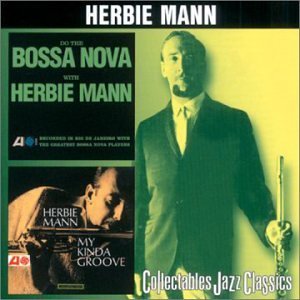 Herbie Mann: Well, the first time I got involved with Brazilian music, I had a basic Afro-Cuban band, with Carlos "Patato" Valdes and Jose Mangual Sr., Johnny Rae playing vibes, and bass and drums. It was very African or Latin—that meant vamp tunes, one or two chords. Latin music, as a lot of primitive music, is very simple harmonically but very involved rhythmically. That's where all the harmonies are—rhythmic. But it got to be kind of a bore after a while, so I went down to Brazil in '62, and, all of a sudden, not only am I hearing incredible rhythmic music, but with it very beautiful, romantic, melodic, lovely music, as well. So here is the perfect combination. It's like being married to a French mistress whose father owns a liquor store. So I did that for a while, and, you see, with me, the thing is, if I discover something, I'm very selfish about it. All of a sudden when I see it all over the place—it's like finding a clothes designer who maybe has had six or seven suits, and all of a sudden you see a copy from Alexander's. Well, you don't wear your suit anymore.
Everybody started playing bossa nova, and all those people that put it down started playing it. When I got to Brazil, Dizzy Gillespie had already heard the music; Miles Davis had already heard the music. I think, if I'm not mistaken, the Quiet Nights (Columbia, 1963) album by Miles—if not recorded before, was recorded exactly or close to the time that Stan Getz recorded "Desafinado." But they sat on it all that time. [Davis recorded most of Quiet Nights in July 1962; Getz recorded "Desafinado" with Charlie Byrd for their album Jazz Samba in February 1962.]
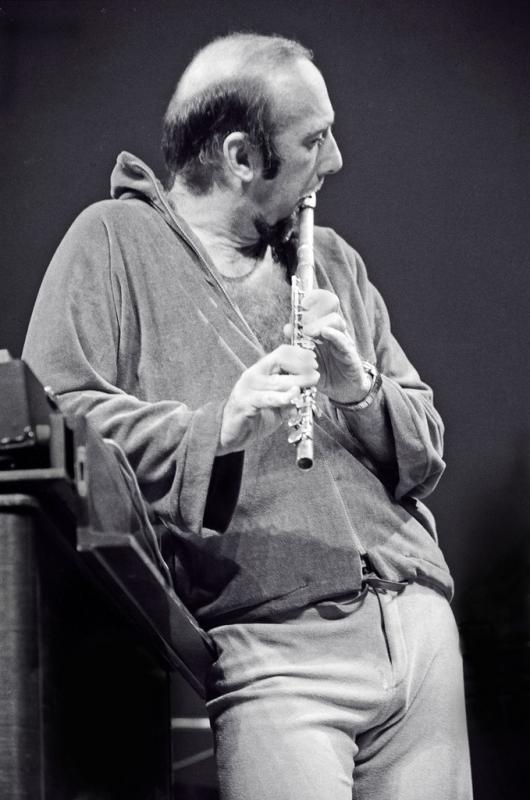 Then Brazilian music became very fashionable, and it became another opportunity for an improvising musician to find a vehicle to help broaden his appeal. A lot of jazz musicians started playing the bossa nova because all the tunes Jobim originally wrote were influenced by Gerry Mulligan and Chet Baker and West Coast kind of jazz to begin with, so it was close to a jazz musician's concept of music.
It was time to move on to other things. I changed my bands a lot and traveled quite a bit, and I found other musicians to experiment with. Then I got very involved with seeing if I could take the disco concept and combine it with improvising. I was probably the first improviser to do this. Now, it takes just as much balls to say, "Well screw the Village Voice and screw Downbeat; I have enough balls to try something that if it works is going to be very successful and is gonna be really put down by the critics."
Well, "Hijack" was a very big record. It came out at about the same time as "The Hustle." That was the very beginning of disco music. And it was the biggest single I ever had; it sold 750,000 copies. It was like number ten on the charts. Every ten minutes, I heard it on WABC [the New York City top-forty AM radio station]. Then the mistake was that I tried to follow that success by repeating it, and I did four other albums that were basically disco. Of course, again, what had happened was that everybody else, all the record companies and artists had seen that this was another opportunity to get to the masses. So here was the same thing again; it was all over the place. And now what do I do to save my head from going insane?
So, last year, I met some people from Brazil at the Montreux festival and started listening to some new music from Brazil, and I met a couple of musicians here, like Amaury Tristao, who played on the Brazil: Once Again album. I started getting some new records, and I started hearing that there's a whole new generation of people. It's been since '62—15 years. There were people that were eight and nine years old at the time who are now writing music. So, there was an opportunity, because I'm always interested in rhythmic music. I find it much more interesting than four beats to the measure. Not that we don't do that now. As a change of pace, we're playing standards, and we're playing bebop tunes, and people have never heard them. It's a whole new revelation to all these people.
JAA: Are you doing those kinds of things on your next album?
HM: Well, we just finished an album, [Sunbelt (Atlantic, 1979)]. On it there's a Richard Tee tune, there's couple of new Brazilian songs, and we redid "Watermelon Man." I wanted to get away from using a keyboard player. I find that no matter how sensitive a keyboard player is—and I've had beautiful players. Chick Corea played with me, Herbie Hancock...
JAA: You also played with Bill Evans.
HM: Right. Also, Pat Rebillot, and I recorded with Richard Tee. If I could have Richard Tee in my band, then there would be no problems. But you can't have Richard Tee in your band, 'cause he's too busy. I decided I would do without keyboards. So what we have is an airy kind of band. And I've just added a second bass player. We have Frank Gravis playing and Jeff Berlin has the freedom to do whatever he wants. The combination is extraordinary.
JAA: This is something you've done before.
HM: But I've never done it with two basses.
JAA: Didn't you record "Comin' Home Baby" that way?
 HM: Right. Ben Tucker and Ahmed Abdul-Malik. It was a little different. They were both playing acoustic basses, but it was the same kind of concept; you're right. But what they were doing was Ben Tucker was playing the basic vamp, or vice-versa, and one was just playing a fill-in vamp. Here, Jeff Berlin improvises backgrounds and figures as if he's another guitarist or a keyboard player. I told him it's probably the first time in history that a leader told a bassist, "Don't play basic. You're free to do whatever you want." Jeff has more technique than I've ever heard before. I've had Miroslav Vitous in my band. I've had Ron Carter in my band. But I must say Jeff Berlin has the most technique I've heard. I say he and Jaco Pastorius are the most creative soloists right now.
We formed the basic band in January, and we worked very hard for six months. Now we've reached a plateau where we have to move on. We've gotten into a very ethnic, primitive thing that's very similar to what I did in the '60s with my wooden flutes. We've gotten into that because Rafael Cruz has been playing berimbau, which is a Brazilian stringed percussion instrument. We have acoustic guitar, and I'm playing wooden flutes, and then at the same time, Claudio Roditi— on trumpet, flugelhorn, and trombone—has gotten an octave divider, and I have a FRAP pickup and a Roland Chorus Echo machine, so we're going in two directions. Las week somebody asked me, "Could you simplify and tell us what your band's music is like?" I said, "Well, if you could imagine two pygmies from Africa, two natives from the jungle of the Amazon, combined with two German nuclear physicists, maybe you have a basic concept of the way the band is."

JAA: I'm told that after 18 years with Atlantic Records, you're looking into completing your contractual obligations. Why is that?
HM: I don't think there's anything that can't be resolved, I hope. I think, basically, it's not so much a problem with Atlantic. The main problem right now is that there's such a potential for success in the record industry. Successful records sell more than ever before. All of a sudden, it's a ho-hum item that a record went gold. It's on page 23 of Billboard.
It takes a company to want to not only have successful groups, but also to devote some time to what I consider fringe groups selling below 100,000. Now, most major companies can't even afford to keep them on the roster, because of the amount of effort and time it takes to sell a group. Instrumental music, with very few exceptions, may sell. If it's successful, [it] may sell 200,000 or 250,000. George Benson is extraordinary . . .
JAA: He's also a vocalist.
HM: OK, Chuck Mangione. With Chuck, he had the advantage of recording for Herb Alpert. I would venture to say that nine out of ten companies would not have moved Feels So Good (A&M, 1977). Chuck has been making records like that for a long time; he works very hard. It's far easier for a record company to say, "Well, it's limited; lets' not work on it."
Bruce Lundvall at CBS has decided, or so it seems, that jazz and improvised music is very important to CBS. But not only are they interested in Herbie Hancock and in Weather Report, but they're also interested in Dexter Gordon. It takes that kind of interest to try and make that decision whether they are going to be solely profit-motivated, or at the same time leave some time open to creativity.
Now, this is not to say that all pop music is bad, because some pop music is extraordinary. I just went down to Florida and played on the new Bee Gees album. And they are very talented writers. They have been for years. I spent one day on 16 bars of one song. Of course, they probably have the greatest budget in history for their next album. But Barry Gibb is a very creative improviser. They improvise everything that they do on their records. They don't ever give anything to an arranger and say, "Make and arrangement." They do it all. They improvise the background, and when they get the backgrounds they like, then they give it to somebody.
When a record like Saturday Night Fever (Polydor, 1977) sells that much, and they're that successful, there's got to be a very good reason for it. They happen to write good music. So does Paul Simon. So does James Taylor. So does Fleetwood Mac. I would just like to have the opportunity to spend as much time and effort as Steely Dan. Listen to their album. Aja (MCA, 1977) is probably, for me, the classic fusion album of all time, because up until this point, every other fusion album has been from a jazz musician trying to cross over into pop music. Now, here you have two songwriters who, I think, have come from rock. The end result is the classic fusion album of all time. Oh, they had a budget of $350,000 or something, but it's worth it.
 Richard Tee told me that they used almost three complete rhythm sections. The only constant thing was Chuck Rainey on bass. They used Bernard Purdie on all the tracks; they used Rick Marotta on all the tracks; they used Steve Gadd on all the tracks—all with different players. And then they decided which ones they wanted. But listen to it; it's a classic.
JAA: Let's get back to you. I hear that you're playing tenor sax again.
HM: And clarinet.
JAA: The last time you played tenor on an LP was, I think, your very first album for Atlantic, The Common Ground (1961). Very early in your career you were quoted in Downbeat as saying, "Eventually I have to play jazz tenor. I have to get it out of my system." That was 1956. What took you so long?
 HM: Well, I wanted to have backgrounds on the album we did, and rather than try to teach somebody else how I wanted it phrased, I did it myself. Claudio played valve trombone, and I played tenor. And it's taken a long time to get my chops back together again. Actually, we recorded two albums together. The first album coming out I just played backgrounds, but on the second album I play tenor on a Carol Bayer Sager/Marvin Hamlisch tune, "Sweet Alibis."
I've been getting at it, and I've been working it a little bit together. In fact, yesterday I was in the studio playing on the next Jay McShann album [The Big Apple Bash (Atlantic, 1979)]. Now this is really a fusion record—coming from a different direction—Jay McShann, Milt Hinton, Connie Kay, Doc Cheatham, Dicky Wells, Earle Warren, myself, and John Scofield. And next week, it's Gerry Mulligan on Tuesday, and on Thursday the same band as yesterday. So, I'm playing tenor again, and my style is weird.
One time I stopped playing because I thought I sounded too much like Zoot Sims or Al Cohn. Now, I've developed a completely different style that's based on my flute style, so it's really strange. I've reached that point where I don't care anymore that it may not be as contemporary as my flute playing. I grew up listening to Lester Young and Coleman Hawkins.
Combine that with 20 years of not playing the instrument, and playing very contemporary jazz/fusion, whatever you want to call it. My tenor playing is a very different kind of tenor playing. It has no name to the style that it is.
Now we play standards and there's a whole audience—imagine—from the Beatles or "Comin' Home Baby" that never heard "Embraceable You." We're playing "Walkin.'" We're playing "Scrapple from the Apple." And people are saying, "Wow! What's that song? Who's Charlie Parker?"—which is really great. Now I can go as a change of pace and play some bebop, and play some swing things. What would be nicer for my first tenor record than to play with Jay McShann? Yesterday we covered "Jumpin' the Blues," which Jay wrote with Charlie Parker.
I'm at the point now where Robert Mitchum was a couple years ago, when he won an Academy Award or something like that, and took a year off and worked in a repertory company in Ireland just to do some classical things. I'm at the point where I now can have some fun. I don't have to go and play in any lofts. I don't have to play in any clubs. I have a built-in audience, and I can now start playing "Lester Leaps In" and things like that—playing on a Jay McShann record. I've only done two sideman dates in the past ten years: the Bee Gees and Jay McShann. You can't go any further apart than that.
JAA: But about five years ago, you said you didn't want to be considered a jazz musician anymore. You said jazz meant to the general public a music that was either outdated or hard to understand.
HM: At the time, I was a little adamant, mainly because critics were saying that I wasn't a jazz musician. So, I said, "You're right, I'm not a jazz musician." To the critics, jazz meant Count Basie or Benny Goodman. Electric instruments weren't jazz. They didn't understand what music is.
 But probably if I have to categorize myself, I probably have been a jazz musician all along, but improvising on a wider range of music forms than most jazz musicians. I wouldn't consider myself a rock musician. I wouldn't consider myself a symphony musician. If you have to oversimplify, I'll say I'm a jazz musician. I'd rather say I'm a musician, but if you need a category, that's it.
JAA: Very early in your career you said one of your ambitions, or maybe your biggest ambition, was to "be as synonymous with the flute as Benny Goodman is to the clarinet." Do you think you have reached that point?
HM: Oh, definitely. I think I have. To the lay public, that mass out there who don't read Downbeat—who read Playboy and other things—there was a time where every flute record they thought was me. Remember when I started, there was nobody else playing it. Now Hubert Laws is very successful, but what I'm hoping to do this year is to win the Downbeat poll again. At this point, I'd like to say, "OK all you kids, now it's my turn again." It doesn't mean anything else than pride, but I would like to, this year, go after it. I think I'm playing better than I ever have before, and I'm enjoying it more. The other thing I would like to do is to now completely reverse the whole thing and start playing clarinet, because nobody's doing that now. When I started playing flute everybody played clarinet. Now everybody's playing flute. So, now I'll play clarinet again and completely screw them up.
 JAA: Of the many different bags you've been into, I discovered there were a couple you said you would have liked to have gotten into, but never did. An example is American Indian music. Another example is East Indian music. And you once considered contacting George Harrison to do something together.
HM: Well, first of all, I found that American Indian music was both rhythmically and harmonically very simple, and there wasn't' much to do with it. I listened to a couple of things. Of course, somebody's going to say, "Well, you haven't heard the northern tribes of northern Michigan—we played bebop long before Charlie Parker." But I found that it wasn't very interesting for me.
As far as East Indian music—it was just one of the many spices that I thought I would like to get into. I would have loved to have played with somebody like Ravi Shankar, or Lakshminarayana Shankar, the guy with John McLaughlin. I would've loved to have played with Shakti. But you're talking about a modal kind of music—a one-chord kind of drone. And that does tend to get kind of monotonous, unless you're very stoned. If you're very stoned, anything sounds great.
JAA: From what I've read, it seems that you came into playing flute—as your main instrument—by accident. After you got out of the Army, you were in a big band in Brooklyn, and the drummer in the group recommended you to Matt Matthews, the Dutch jazz accordionist, as a flautist. You said you had never played jazz flute in your life. Do I have this story straight?
HM: Well, first of all, it was a small group in probably a little club on Flatbush Avenue—Flatbush Avenue and Avenue U. I think it was called the Airport Inn, or something like that. Floyd Bennett Field was right down the road. Matt Matthews was working in the next club, and Carmen McRae was the intermission singer. He was looking for Sam Most, because Sam had already made a record, Undercurrent Blues. The drummer who was in my band knew I was looking for a job because I just got out of the Army. So, I faked my way through it. I told him my flute was being repaired, and I learned the arrangements on saxophone and clarinet. I'd come home every night and try to improvise on them. I'd been playing the flute, but I'd just been playing Latin music, you know, or in the Army I played kind of classical music. I played piccolo in the marching band.
While I was in the Army, I knew I had to do something else. My feeling was, OK, if I was to the point where I was almost as good as Stan Getz or Al Cohn or Zoot Sims, so what? I'd still be just as good as Al Cohn, Stan Getz, or Zoot Sims. I wanted more for myself. I knew that I had to do something else, and then this opportunity came along, and I said, "It's worth a shot, because nobody else is doing it." The amazing thing was, as amateurish and mediocre as I played, I started getting great reviews, because it was like a freak. I played with the Pete Rugolo band, and there, in the band, was Doug Mettome, Davey Schildkraut, all kinds of players, and I used to get all the rave reviews. I didn't play anything as well as the rest of them, but nobody had heard this instrument before, so that's how it developed.
JAA: On your very first album for Bethlehem Records, Herbie Mann Plays (1954) you said in the liner notes, "A group that has a flute in it should be a light, swinging, happy- sounding one; these are the qualities of the instrument."
 HM: That was at the time. . . The reason I said it should be light and swinging was because that was all I could play— light and swinging. I had no chops. I had no sound. I had to have guitar and brushes and play that way. I say that a flute is equal to any other instrument, and depending on your moods, once you have full control of the instrument, you can play anything. And I have since then. At the time, that was merely a plea for everybody to play that quietly, because I couldn't play any stronger.
JAA: In a 1968 Downbeat interview, you quite accurately predicted the impact of the jazz/rock movement. You always seem to be on top of new trends. By coming back to a little straight- ahead jazz, do you see that as a marked trend?
HM: No, no.
JAA: The Brazilian thing maybe?
HM: It's not clear cut to me. Remember that none of those guesses of mine were ever really guesses. They were always calculated based on what I thought was just very logical. I said the same thing with the bossa nova. I said it was going to be the next big thing, and it was.
It also was logical to me when I was the first to record Chick Corea and Roy Ayers and Miroslav. I knew that they were going to be immensely successful people. I feel the same way with Ricardo Silveira, my guitarist now; he's gonna be very successful. It's weird to say this, but I have this feeling that he could be as successful as Peter Frampton in his way.
As far as where it's all going right at this point, there's going to be an amalgamation of everything. But I'll tell you right now—if Barry Gibb called me up tomorrow and said he wanted to produce me, I would be there. Because that's how talented a jazz musician he is. Just as Stevie Wonder is. Steely Dan, Stevie Wonder, and Barry Gibb—they are the top at this point. And I'd go work for any of them as a sideman.

Who knows, I may end up going to Brazil. I really don't know. There are a lot of things I want to do. This is the best band I've ever had. The idea of having two bass players is very interesting to me. I'm the perennial optimist. I always feel that the current band is the best, and I've always felt that I have all the tools to be the biggest improviser and jazz musician in history. If it'll ever happen, I don't know, but that's how optimistic I am. [Adapted from an article originally published in the Aquarian Weekly, September 20-27, 1978.]
[Herbie Mann continued working in a contemporary Brazilian vein through the '80s with his band, Jasil Brazz and America/Brazil from the '90s is an especially notable later recording. Beyond Brooklyn, Mann's last recording, was released in 2004, a year after he died, and brought him back to a solid jazz setting, teaming him up with bebop master Phil Woods. ]
Selected Discography
Herbie Mann / Phil Woods, Beyond Brooklyn (MCG Jazz, 2004) Herbie Mann, 65th Birthday Celebration (Lightyear, 1997) Herbie Mann, America/Brasil (Lightyear, 1997) Herbie Mann, Peace Pieces (Lightyear, 1995) Jay McShann, Big Apple Bash (Atlantic, 1979) Herbie Mann, Hold On, I'm Coming (Atlantic, 1972) Herbie Mann, Push Push (Atlantic, 1971) Herbie Mann, Stone Flute (Atlantic, 1970) Herbie Mann, Memphis Underground (Atlantic, 1969) Herbie Mann, Live at the Whiskey A Go Go (Atlantic, 1968) Herbie Mann, Mann: Concerto Grosso in D Blues (Atlantic, 1968) Herbie Mann, Muscle Shoals Nitty Gritty (Atlantic, 1967) Herbie Mann, The Wailing Dervishes (Atlantic, 1967) Herbie Mann, Do the Bossa Nova with Herbie Mann (Atlantic, 1963) Herbie Mann, Live at Newport (Atlantic, 1963) Herbie Mann and the Bill Evans Trio, Nirvana (Atlantic, 1962) Herbie Mann, At the Village Gate (Atlantic, 1961) Herbie Mann, The Common Ground (Atlantic, 1961) Herbie Mann, Flute, Brass, Vibes and Percussion (Verve, 1960) Herbie Mann, Great Ideas of Western Mann (Riverside, 1957) Herbie Mann, Yardbird Suite (Savoy, 1957) Herbie Man / Bobby Jaspar, Flute Flight (Prestige, 1957) Herbie Mann / Sam Most, Herbie Mann-Sam Most Quintet (Bethlehem, 1955) Sarah Vaughan, Sarah Vaughan with Clifford Brown (Emarcy, 1954) Herbie Mann, Herbie Mann Plays (Bethlehem, 1954)
Photo Credits
Page 1: Courtesy of Atlantic Records Pages 2, 6: Tom Marcello Page 3-4: Courtesy of Sutton Artists Corporation Page 5: Courtesy of A&M Records
< Previous
Upbeats
Next >
Take Five With Eric Hofbauer
Comments

Tags
Herbie Mann
Jazz in the Aquarian Age
Bob Kenselaar
United States
New York
New York City
Clifford Brown
Sarah Vaughan
Kenny Burrell
Phil Woods
Stan Getz
Charlie Byrd
Antonio Carlos Jobim
Sergio Mendez
Duane Allman
Jay McShann
Patato Valdes
Jose Mangual
Dizzy Gillespie
Miles Davis
Gerry Mulligan
Chet Baker
Richard Tee
Chick Corea
Herbie Hancock
Bill Evans
Jeff Berlin
Ben Tucker
Ahmed Abdul Malik
Miroslav Vitous
Ron Carter
Jaco Pastorius
Claudio Roditi
george benson
Chuck Mangione
Herb Alpert
Weather Report
Dexter Gordon
Paul Simon
James Taylor
Fleetwood mac
steely dan
Chuck Rainey
Bernard Purdie
Steve Gadd
Milt Hinton
Connie Kay
Doc Cheatham
Dicky Wells
Earl Warren
John Scofield
Zoot Sims
Al Cohn
Lester Young
Coleman Hawkins
Charlie Parker
Count Basie
Benny Goodman
Hubert Laws
Ravi Shankar
L. Shankar
john mclaughlin
Shakti
Carmen McRae
Sam Most
Pete Rugolo
Roy Ayers
Ricardo Silveira
Stevie Wonder
For the Love of Jazz
 All About Jazz has been a pillar of jazz since 1995, championing it as an art form and, more importantly, supporting the musicians who create it. Our enduring commitment has made "AAJ" one of the most culturally important websites of its kind, read by hundreds of thousands of fans, musicians and industry figures every month.
You Can Help
To expand our coverage even further and develop new means to foster jazz discovery and connectivity we need your help. You can become a sustaining member for a modest $20 and in return, we'll immediately hide those pesky ads plus provide access to future articles for a full year. This winning combination will vastly improve your AAJ experience and allow us to vigorously build on the pioneering work we first started in 1995. So enjoy an ad-free AAJ experience and help us remain a positive beacon for jazz by making a donation today.Near


Giveaway

Eligible winners: 15
Days remaining: 5
Days remaining: 5