Home » Jazz Articles » Behind the Lens With... » Behind the Lens With Skip Bolen
Behind the Lens With Skip Bolen
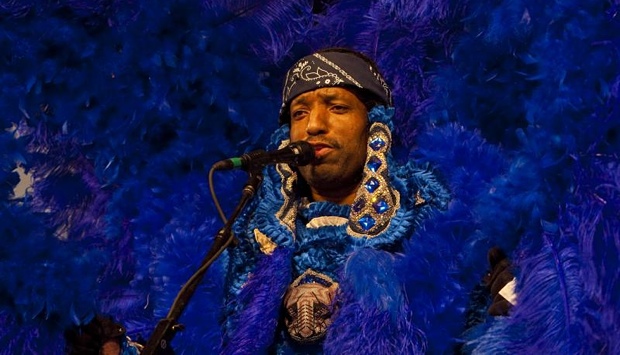
Most of my personal work lately has been photographing jazz and documenting the disappearing historic landscape of old architecture, vintage signs, old water towers, cemeteries and other points of interest in New York City, Los Angeles and across the South primarily in my hometown of New Orleans—a collection of images that embody both a sense of romance and nostalgia.
I lived in New York City years ago working as a junior art director in publishing at Conde Nast and spent many late nights in jazz clubs—these were my formative years of jazz photography. After living and working in NYC for several years when it was finally time to move on, I moved back home to New Orleans to pursue photography and became friends with Herman Leonard who became a huge inspiration. Several years later, I headed out west to Los Angeles and to work as Creative Director of the House of Blues which also offered incredible inside access to photographing musicians both onstage and backstage.
Evenings and weekends I photographed live music in clubs and at concerts and became a contributor for Getty Images and WireImage.com photographing musicians, red carpet events, actors and actresses. After living in Los Angeles for several years, I moved back home to New Orleans in 2006 to photo-document the rebuilding and recovery of New Orleans after Hurricane Katrina. Today, I'm still in New Orleans but travel regularly to New York City and Los Angeles to photograph.

My work is in public and private collections, among them the Ogden Museum of Southern Art in New Orleans and the Louisiana State Museum, and my photographs have appeared in The New York Times, Rolling Stone, Vogue, New York Post, US Weekly, USA Today, Elle, MTV, VH-1, New York Magazine, JazzTimes, DownBeat, Where New Orleans and many others. Also I'm a member of IATSE Local 600 (International Cinematographers Guild) and work as a stills photographer in the motion picture and television industry—I was the unit photographer for HBO's season two finale of True Blood and HBO's pilot Treme, by David Simon, here in New Orleans, along with Season 1 and 2 of TNT's Memphis Beat and most recently A+E's Breakout Kings. I'm represented internationally by Getty Images and WireImage.com, and European PressPhoto Agency; and a member of The National Academy of Recording Arts & Sciences and Jazz Journalists Association.
Gear:
In the past, I shot film for a long time with a Leica R7 and later a Leica R8 with 21mm f/4, 50mm f/1.4, 90mm f/2, 135mm f/2.8 and 180mm f/2.8 Leica lenses. Unfortunately, Leica abandoned the R series at the same time digital photography was really taking off and so I then switched to Canon. Today, I shoot with a Canon EOS-5D Mk II and a Canon EOS 1D Mk IV and my lenses are a Canon EF 16-35mm f/2.8, Canon EF 24-70mm f/2.8 L USM and a Canon EF 70-200 f/2.8 L IS USM.
I soon plan on getting a Canon EOS 5D Mk III and a Canon EOS 1DX for the low light capabilities—these are essential as a still photographer on movie sets. I use the Crumpler 7 Million Dollar Home Camera Bag and I'm always checking out new camera bags while still searching for the "perfect" camera bag. For editing—all my computers are Apple—my home computer is an Apple MacPro tower with an Apple 30 inch monitor and my laptop is a MacBook Pro 15 inch. I always shoot RAW and edit in Adobe Bridge, process RAW files in Adobe Bridge and Photoshop and then work with the image in Photoshop. I'm often asked why I use Adobe Photoshop versus Lightroom or Aperture—and my reply is that you have to find what works best for you. While I've used Lightroom and Aperture, I've just found that I work best in Adobe Bridge and Photoshop for my way of working and for my chosen workflow whether I'm renaming and batch-processing 1400 (or more) RAW files at a single time, or working with just a single RAW file.

I'm also a Union 600 still photographer on movie and television sets, so I shoot with a Jacobson Sound Blimp and primarily use a Canon 5D Mk II on set. My photography studio is equipped with Mole-Richardson Hollywood style lights and I use a very old Hollywood style or cinematic style of lighting when I'm shooting in my studio.
Teachers and/or influences?
Teachers: Ray Avery, Herman Leonard, and Bill Claxton. Influences: Francis Wolff, Milt Hinton, Edward Steichen, Horst P. Horst, Cecil Beaton, Henry Clarke and Philippe Halsman.
I knew I wanted to be a photographer when...
Years ago, I was a junior art director at Conde Nast (Publisher of Vogue, House & Garden, Vanity Fair, Glamour and many more) in New York City, and we would get these amazing images in from photographers all over the world (our photographers included Annie Leibovitz, Herb Ritz, Richard Avedon, etc). As an art director, my work was never complete unless I was physically at my desk working on a layout—it was there and then where I realized the photographers got to travel and go to locations to shoot while I was glued to my desk. I became jealous of the photographers and decided one day I would turn that around and eventually leave art direction behind me and become a full time photographer. And while I had a great time as an art director early on, I'm really enjoying photography these days.

Your approach to photography:
My approach to photography is to have a good time and to always be very considerate of the audience paying to see the show on stage. Bill Claxton once said to always shoot first before giving it any more thought (I don't remember the exact quote)—meaning, get the shot first before contemplating whether you should be getting the shot or not. Better to always get and have the shot rather than not having the shot and regretting it later on. So, when I walk into a club or a situation to shoot live music, I quickly try to get a few shots right away—so I know I've got several shots of what is going on and then I quickly figure out my strategy. I also had a major breakthrough one day with my digital photography where I began to treat Photoshop the same as I would a darkroom back in my film days—meaning, I use Photoshop on my photos the same way I would work with a negative in the darkroom—that RAW image out of my camera is the digital negative that I work with to dodge and burn areas within the photo, I sometimes crop, I adjust the contrast and brightness and make any and all further adjustments.
Your teaching approach/philosophy:
My first real job out of college was working as a junior designer in New Orleans where I was hired by the owner and Art Director—and I gotta say, I learned so much from him. He had a real knack at sharing information and teaching without really realizing it—and much of what I learned about design and composition way back then is what I still use now when shooting photography and composing my images. And so, any time a young photographer asks me questions, I think back to this guy that taught me so much in my early 20s and always try share as much as I can with anyone starting out in photography—especially if they're photographing jazz.
Your biggest challenge when shooting indoor (or low lighted) events:
I always enjoy good challenges and I especially enjoy shooting in extreme low light—whether it was back in my film days using Delta 3200, or now with digital—to capture an image in natural low light with just a glimmer of light has always produced some of my most favorite images. I never use flash while shooting live music—flash in my opinion completely destroys any sense of feeling and emotion found in a natural low light setting—plus flash is horribly distracting for the artist performing and the audience there to see the show. And now, with the latest generation of cameras coming out, shooting in low light at an event is hardly a challenge any more. Now, I would say my biggest challenge is just "capturing the moment" and finding that perfect moment in a live jazz performance using only available light that best reveals an image infused with the spontaneous intensity, raw energy and collaborative spirit of that live jazz performance—something that best tells the story and conveys all the feelings and emotions of that live performance or the communication between the musicians on stage.

On movie sets, I'm always competing with new motion picture cameras being used and the camera of choice lately for many directors is the Arri Alexa which has the ability to shoot in extreme low light. So for me, I always have to have the latest camera gear to stay competitive and for the increased ISO performance with as little grain as possible.
Your biggest challenge when shooting outdoor events:
Outdoor events can be tricky depending on where the sun is—if it's in front of you then you'll have glare, or if it's directly overhead then you have harsh shadows on faces, and too much sun isn't much fun. I prefer overcast cloudy skies—this produces good even light with no harsh shadows, or a setting sun with just enough stage lighting to make it visually interesting. Another challenge is often there are so many photographers in the photo pit at the same time all shooting from the same angle, and so I always try to find alternative perspectives that will give my images a completely different perspective from everyone else.
Favorite venue to shoot:
For many years, Ruth Price's The Jazz Bakery in Culver City in Los Angeles; and the original Catalina Jazz Club in Los Angeles—both places were always fun to shoot in and the talent was always spectacular—these were my favorite venues to shoot while I was living in Los Angeles. A couple times I shot at Smalls in NYC and really liked the lighting and atmosphere—I really enjoyed shooting there. I'm hoping to move back to NYC someday and really looking forward to finding new "favorite" venues to shoot in.
Favorite festival to shoot:
I have to say shooting in the jazz tent at the New Orleans Jazz & Heritage Festival is always my favorite festival to shoot jazz. But I would someday like to shoot at the Newport Jazz Festival and at the jazz festivals in Montreal, Quebec and across Canada.
Where was your first assignment location?
I was living in Los Angeles at the time and it was one of my earliest major assignments—shooting the Clayton Brothers for the cover of a special section for JazzTimes, and I was transitioning from using my Leica R8 with film to my first digital camera, a Canon EOS 10D. I wanted to rely entirely on digital with this shoot without using any film as a safeguard or backup and I knew absolutely N-O-T-H-I-N-G about shooting RAW—and I thought the shoot was going great until I got home to look at everything on my computer, it was absolutely awful! I had just finished shooting John Clayton teaching some students using natural light in a relatively low light room and had the ISO cranked up as far as I could—and then prepared for the cover shoot by setting up several of my Mole Richardson lights with some seamless for a backdrop along one wall and forgot to adjust the ISO while shooting the cover of John and Jeff Clayton together. The final images were so grainy and completely blown out in parts—I was so embarrassed to send them in and desperately tried to figure out how I could do a reshoot, but there really was no time and in the end, the Art Director managed to save an image and was able to use it for the cover. It looked ok, but it really made me realize how much more I had to learn about digital photography!
Your favorite musician(s) to photograph:
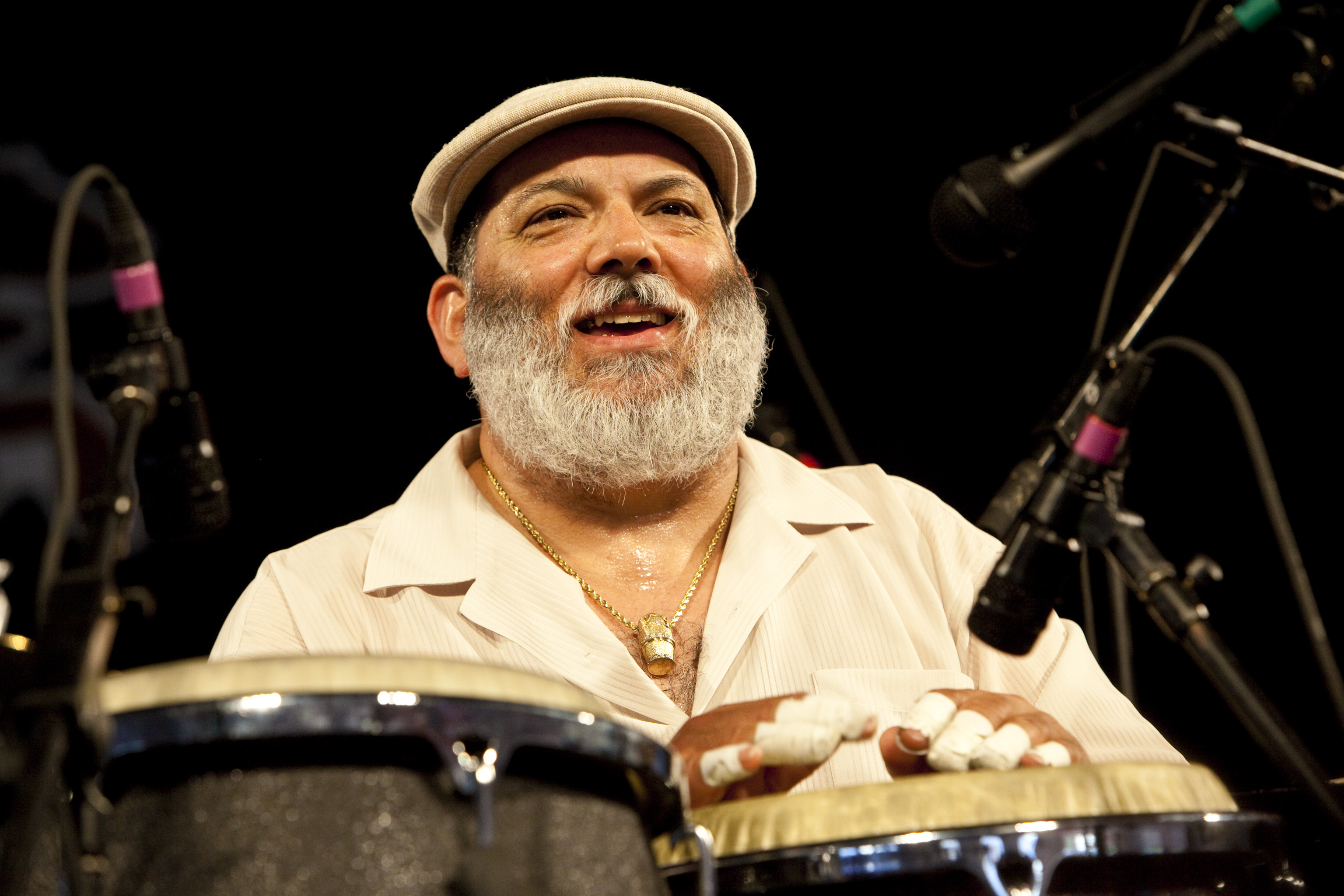
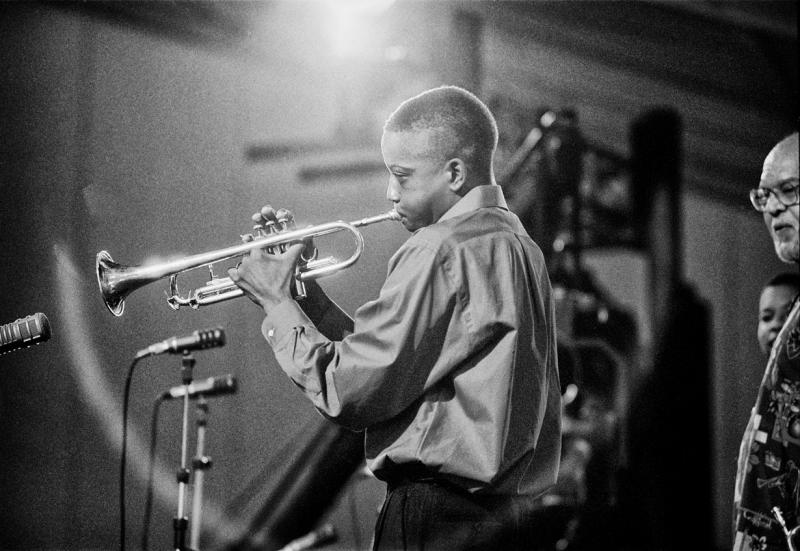
Jazz is my absolute favorite music to shoot, but to make a living, I've had to expand and so my assignments today require me to shoot every type of music from hip-hop and rap to heavy metal and rock n' roll, to classical, county and pop. One of my favorite musicians to photograph has been Troy "Trombone Shorty" Andrews because I had the opportunity to shoot one of his first public performances at the New Orleans Jazz & Heritage Festival in 2001 and he got a standing ovation—and I've photographed him every year since then. So I've enjoyed photographing him from his first performance and then throughout the years while maturing as a musician to the great musician he is today!
Another favorite musician has been the jazz vocalist Jimmy Scott—I had a chance to photograph him in New Orleans in 2001 and later while living in Los Angeles, I had the opportunity to spend almost a week with Jimmy at The Jazz Bakery photographing him backstage in his dressing room and while he was performing—I captured some amazing images during that time. Being backstage creates an opportunity to capture images that the audience doesn't always get to see—a sort of behind-the-scenes which is something I enjoy capturing. These answers might change if you ask me this same question tomorrow, because really, I enjoy photographing all jazz musicians!
Did you know...
I have a pet raccoon named Roscoe—he's got his own Facebook page!
Your favorite jazz story:
There are so many—but one in particular was when I was living in Los Angeles, and on Friday, March 21, 2003 at World Stage in Los Angeles' Leimert Park Village—I had heard an interesting and unusual story about a bassist that was presumed dead while in reality, he was still very much alive but had abandoned jazz for many, many years and was living in Southern California—and this night, he had picked up the bass again and performed—it was the story of jazz bassist Henry Grimes. World Stage was a small intimate club and another one of my favorite places to shoot photos—I was sitting along the side of the stage and shot a couple rolls of film and felt like I was capturing jazz history that night. After the performance, I went backstage and met Mr. Grimes and shot a few more photos. The next day, he was rehearsing at The Jazz Bakery in Culver City and I shot a few more rolls of film.
Afterwards, we became friends and I photographed him a few more times at Line Space Line in Silverlake in Los Angeles, and at Roccos at the Lillian Theatre—all were just absolutely amazing performances.
Another story—I had just moved to Los Angeles, and there was a little club called the Jazz Photographers Association of Southern California run by jazz photographer Ray Avery. I contacted Ray and went to a meeting where soon after, Ray and I became friends. Early on while I was a new member, Ray organized a jazz photography show at the Dorothy Chandler Pavilion in downtown Los Angeles where I was invited to show my jazz photography—and I soon found my jazz photos hanging next to the photography of Ray Avery, Herman Leonard and Bill Claxton—you can only imagine how much of a thrill that was for me. Ray Avery's motto was "Stay up late and shoot straight!"—I miss Ray, Herman and Bill and always think of them. I have a ton of favorite jazz stories!
View more Skip Bolen photos at All About Jazz
Comments
Tags
For the Love of Jazz
 All About Jazz has been a pillar of jazz since 1995, championing it as an art form and, more importantly, supporting the musicians who create it. Our enduring commitment has made "AAJ" one of the most culturally important websites of its kind, read by hundreds of thousands of fans, musicians and industry figures every month.
You Can Help
To expand our coverage even further and develop new means to foster jazz discovery and connectivity we need your help. You can become a sustaining member for a modest $20 and in return, we'll immediately hide those pesky ads plus provide access to future articles for a full year. This winning combination will vastly improve your AAJ experience and allow us to vigorously build on the pioneering work we first started in 1995. So enjoy an ad-free AAJ experience and help us remain a positive beacon for jazz by making a donation today.

Giveaway

Eligible winners: 15
Days remaining: 4
Days remaining: 4