Home » Jazz Articles » Jazz in the Aquarian Age » Dave Brubeck: The Inspired Moment of Unity
Dave Brubeck: The Inspired Moment of Unity
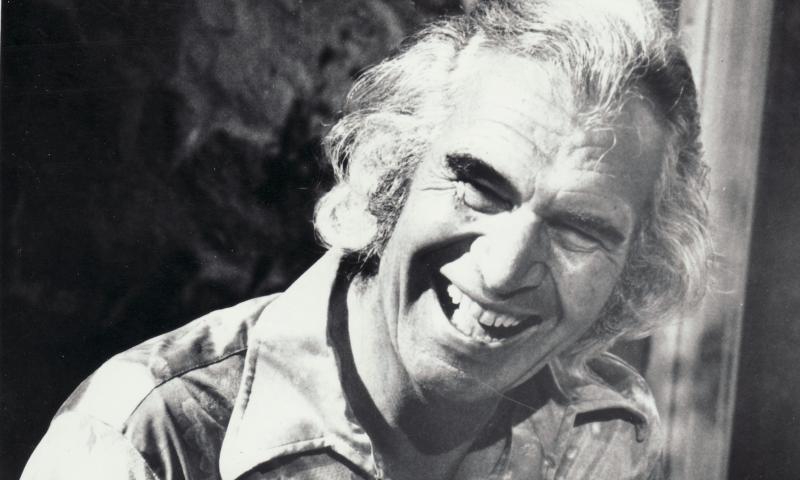

The inspired moment of unity is the purpose of jazz.”
"The first challenge of a jazz performer," says pianist Dave Brubeck, "is to unify the audience so that it becomes an entity. Once this unity of feeling is established, we can begin to share a creative experience. The improvisers become the articulate voice of the group. The inspired moment of unity is the purpose of jazz. It is the moment we may or may not find in a performance—but it is the reason we are here."
Creativity, spontaneity, inventiveness, and inspiration: these are the things Brubeck holds most important in his music—so much so that at times he admittedly has had to sacrifice technical perfection and precise swinging in order to attain his goals. Despite the ambivalence of critics, Brubeck remains one of the most well-known and publicly accepted names in jazz.
As early as 1955, the Dave Brubeck Quartet came to national prominence, and in the '60s, the group recorded the first million- selling jazz hit with saxophonist Paul Desmond's composition "Take Five." During the same time, Brubeck's piano planning became an important influence for young players, as evidenced recently by Chick Corea's musical dedication to Brubeck on his album Friends.
Brubeck's latest musical aggregation is called the New Brubeck Quartet and features his sons Darius Brubeck on electric keyboards and synthesizer, Chris Brubeck on electric bass and trombone, and Dan Brubeck on drums. With this group, Brubeck hopes to "continue the old quartet tradition" but also to strive for something fresh and new.
Jazz in the Aquarian Age: Is the New Brubeck Quartet keeping very busy?
Dave Brubeck: Oh, yeah. For the rest of the year we'll be on tour, and who knows what will happen next year. We've all got our own groups, too, and our own projects. Chris, for example, did an off-Broadway show for which he wrote the music. Danny has a group called Northwind. We're all into our own things, but each year one or two or three of my sons will probably tour with me. I don't ever know who's available, and if none of them were available, I'd go out with Jack Six and Alan Dawson from the old group. There's always somebody who wants to go. I only think about one year at a time.
 My sons and I have two new albums out right now—one on Tomato Records called The New Brubeck Quartet Live at Montreux (1977), which is a very nice live concert, and one on Direct-Disk, A Cut Above! (1978), a double album that's selling as fast as they can cut 'em—phenomenal sales.
JAA: JAA: When was the first time you played on stage with your sons?
DB: I was playing with the old group with Paul Desmond, Eugene Wright, and Joe Morello for a big audience—a full house in Poland. My sons Darius and Michael were backstage, and the interpreter asked them if they could play, and they said they could. Darius was 10, and Michael was nine or so. So, the interpreter just kind of shoved them on stage, but when they came on, I turned them around and made them leave. But then the interpreter said, "Go back!" Being little kids, they would mind the last adult that told them what to do, so they came back out.
At this point, the audience expected something, so Michael ended up sitting in on drums, and Darius sat at the right hand of the keyboard with me. We began to play "Take the 'A' Train," but Darius started improvising right away. I told him, "Play the melody, stupid!" When we were finished, there were some reporters around, and they asked Darius what his father said to him on stage. He told them, and the next day it was in the German papers, "Spielen die Melodi, Dummkopf!"
JAA: How did you start playing with your sons professionally?
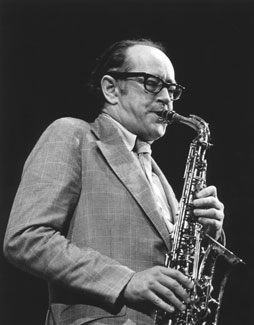 DB: We started with the group Two Generations of Brubeck about six years ago. My sons had their own groups, but they weren't getting that much work. Darius proposed that he open my concerts with the Darius Brubeck Ensemble, which made sense, and then he asked in a few years if his group could be the background for me. At the same time, Chris asked if his rock group could go on the show. It was a lot of fun to have all these great musicians—it was like a festival. Gerry Mulligan, Paul Desmond, Alan Dawson, and Jack Six were in my group, and we had Chris' rock group with excellent players, and Darius' group with fine players like Perry Robinson on clarinet. But I almost had a big band if you counted all the guys. It got to be a real burden financially, so we had to restructure. Finally, I told my sons that wherever we've played with just the four of us, it's been very successful, and we would solve all the transportations problems if we reduced it to that. It was a whole series of events that brought us to the current group. Nothing was planned.
JAA: One of the most interesting things you've done recently was the Duets (Horizon, 1975) album with Paul Desmond. The two of you had been playing together for 30 years, yet you had never before recorded in a duet context. The only thing that ever came close to that was something done long ago on Fantasy Records, called Jazz at Storyville (1955). What took you so long?
DB: Just before Paul died, we were talking about what we had recorded, and he had said that that record, Jazz at Storyville, was his favorite album, more than any of the others. He liked Time Out (Columbia, 1959) and Jazz at Oberlin (Fantasy, 1953) and Pacific (Fantasy, 1953) and other things, but that was the album he thought captured what he and I were all about. I knew at the time we were talking it was a really serious appraisal, because Paul was ill at the time. I'm glad you know about that album. It was so spontaneous, and the counterpoint that we were doing was great, and the album just flowed. Later on, we got into other things. You're forced into other areas by the times that are around you. We had to drop that kind of approach to playing when we went with a different rhythm section. Without Joe Morello and Eugene Wright, I don't think we would have had the Time Out series. But we lost something else by gaining that approach.
JAA: I've heard that you spent a lot of time playing in mining camps in California when you were very young.
DB: Angel's Camp, the place that Mark Twain wrote about, Sheep Ranch, Sutter Creek. That was where I started playing— way up in the mountains. The first time I played, I was 14 years old, and a woodchopper who was very strong went around to everybody with a hat. He grabbed their hand, and if they'd only coughed up a quarter, he'd just squeeze a little harder. And that the way I made my money that night.
 I played in those mining camps, and there were some good musicians in those hills. There was a fiddle player there who was maybe the equal of Joe Venuti. His name was Glen Herzer, and he played lead violin with Harry James when Harry added strings. Then he didn't like the road, and he came back to Angel's Camp. He's 66 years old and still living out there, in Sonoma, California. He came in to play at a joint where I was working in Stockton, below the foothills, and the two guys I was playing with knew him. He had on mining boots and dirty old overalls. And he had a fiddle case. And they said, "We're going to have him sit in." They said, "He's an old miner, but he wants to play." And I said, "Are you kidding?" And he got up and played, and he's the first guy I've ever seen take the bow apart like Joe Venuti did. That's how he started, playing four-voice chords so fast—faster than any guitarist I ever heard. That was his opening riff. He just scared me to death. I've never been any place where I hadn't met somebody who could pop out of the hills and really play.
JAA: Your earliest recordings, those with the octet, are really hard to find. I've heard that the group was very experimental. What were you trying to accomplish with it?
DB: Well, it didn't start our as my group. It was called the Jazz Workshop, and it was just a cooperative of five of Darius Milhaud's students at Mills College. We were really fortunate to be able to study with him, especially me. At the time I was studying with Milhaud, I couldn't read music, so for him to take me into graduate classes was a beautiful gift to give someone so ill- prepared. He was such a prolific composer, and he was among the very first to use polytonality and new rhythmic structures and jazz elements in classical composition.
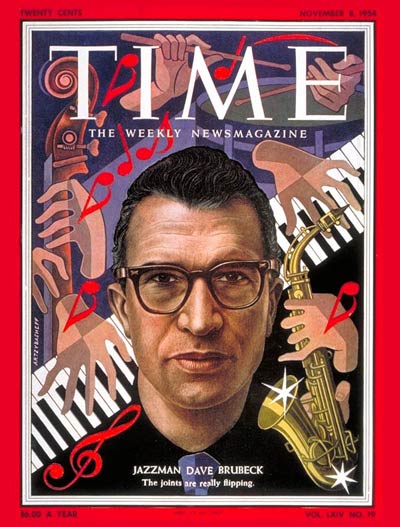 If there was a leader of the octet, it was Darius Milhaud, in a way, because the idea came from him. He said one day in class, "How many of you play jazz?" We raised our hands, and he said, "From now on, do your counterpoint, fugue, and composition assignments using your jazz instruments." We couldn't believe it, because up until that point in a conservatory, you didn't dare tell your teacher you liked jazz.
Dave Van Kriedt's "Fugue on Bop Themes" was written for a Darius Milhaud assignment, and so were Bill Smith's things. They were very avant-garde, and still are, especially Jack Weeks' "Prisoner's Song." If you want to hear something that will stand up, listen to that. We're going to reissue a lot of those old Fantasy albums.
JAA: Tell me about what went on in the studio when you recorded "Take Five." DB: One day, I told the guys that for the next album we did, I wanted everything in a different time signature, and I wanted to call it Time Out. . . . So, the next rehearsal was typical. No one had anything to speak of except me. Rightfully so— it was my group, and I had to do most of the work. I had "Blue Rondo a la Turk," "Three to Get Ready," "Strange Meadowlark," and a few other things written and ready to go.
Paul came in and said, "I've tried and I've got a couple themes in 5/4, but I can't come up with the tune." So, I said, "Play me what you've got." And he played one them, and I said, "That's great!" He said, "Yeah, but that's all there is to it."
So, I told him to play the other thing he had, and so he played the other theme. I said, "Beautiful! Play the first theme, repeat it, use the second theme as a bridge, and then go back to the first theme. Use as close to an AABA form as you can, and you've got a great tune." So, it kind of developed at a rehearsal, and it was kind of a group thing, but Paul had written the melody, and I wanted to credit him, because there were plenty of things that I wrote that Paul gave me ideas on.
JAA: Are you surprised that some of your own compositions, like "In Your Own Sweet Way" and "The Duke," have become jazz standards?
DB: Yeah, because I had been writing for years and had gotten no place to speak of except in terms of my own satisfaction. . . . It was my friends, Paul Desmond and Gerry Mulligan, who got me into writing again. And I started writing like crazy when all the musicians that I dug were playing "In Your Own Sweet Way." Miles Davis heard me playing it when we were working opposite each other, and he wanted the tune, so I wrote it out for him. But when he recorded it, he played it with an E natural at the end of the first eight bars, which surprised me, because I was always playing it with an E flat. So, I said to Miles, "Why did you play it with an E natural?" He said, "Why did you write it with an E natural?" So everybody plays it differently than I really meant it, because they've all heard Miles play it. And when I wrote it out for Miles, I made a mistake!
JAA: As a final question, where do you see your place in the overall scheme of jazz? How heavy do you think your influences have been in the jazz world?
DB: They're a lot heavier than a lot of the critics think. There are all kinds of guys out there who have played my music and listened to my records and don't mind telling me so. And they don't mind putting it in print. The critics don't seem to be able to read.
JAA: Some of those musicians have been Duke Ellington, Charles Mingus, Coleman Hawkins, and Miles Davis.
 DB: Yeah. Once Miles said, "The Brubeck Quartet doesn't swing." Man, that was quoted all over the world. But what Miles said to me one night when he hear me after the quartet had gone home—Ella Fitzgerald came in to sing and it was just Ella and me at the Blackhawk in San Francisco—he came up to me, and he said [imitating Miles' throaty voice], "Your group don't swing, but you swing." It was a nice thing for Miles to say, and those are the things that you're sorry weren't printed. . . .
Mingus and I are old friends going back to the late '40s in San Francisco. . . . I remember the first time I played with him. There was a session where these guys couldn't find any bebop piano players for a gig, so they asked me to do it. I wasn't a bebop player, and everybody in San Francisco thought I was crazy. But they asked me to go along, and they told me not to take any solos. . . . So, the first set in the club I just comped, and once in a while I'd play something behind Charlie. When we took an intermission, he said to me, "Man, you're the only guy here that can play . . . . Next set, you play more."
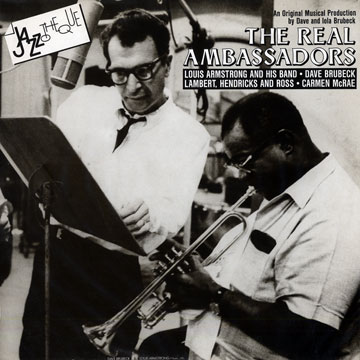 Coleman Hawkins was magnificent to me, too—right to the end of his life. Charlie Mingus, Coleman Hawkins, and I had dinner together one night before the Hawk died, and it was just great because these guys were real giants for me. Coleman had told me once, "No matter what they say, do what you're doing, because what you're doing is great." And I had idolized him for so many years.
Charlie Parker was very interested in what I was doing, too. Once he wrote in Downbeat, "Brubeck is a perfectionist, like I am." Anthony Braxton got into a fist fight once with a guy in Paris because the guy didn't like me. . . . I could mention so many guys who have said nice things. . . .
I can remember a time when Duke Ellington was getting it from the critics and when Louis Armstrong was getting it. I've seen unkind things written about Benny Goodman and Art Tatum. So, I'm not alone. As soon as you're different, you're going to be a target. The more different you get, the more alone you get, and if you're successful, watch out!
Originally published in The Aquarian Weekly, November 1- 8, 1978.
[An extraordinary archive documenting Dave Brubeck's career is held by the University of the Pacific, donated by the pianist and his wife Iola in 2000. The University offers an interesting online sampling of photos, oral histories, and other materials, in addition to hosting an annual Brubeck Festival and carrying out other programs through its Brubeck Institute. Take Five: The Public and Private Lives of Paul Desmond (Parkside, 2005), by Doug Ramsey, offers a good deal of insight on Brubeck and Desmond's work together. The pianist has been the subject of two notable documentaries, Rediscovering Dave Brubeck, and Dave Brubeck: In His Own Sweet Way.]
Selected Discography
Dave Brubeck Quartet, The Columbia Studio Albums Collection 1955-1966 (Columbia/Legacy, 2011) Dave Brubeck, Indian Summer (Telarc, 2007) Dave Brubeck Quartet Plus Special Guests, Young Lions and Old Tigers (Telarc,1995) Dave Brubeck Quartet, Paper Moon (Concord, 1981) Dave Brubeck, A Cut Above (Direct-to-Disk Labs, 1978) New Dave Brubeck Quartet, Live at Montreux (Tomato, 1977) Dave Brubeck/Paul Desmond, The Duets (Horizon, 1975) Dave Brubeck, Two Generations of Brubeck (Atlantic, 1973) Dave Brubeck, Gerry Mulligan, Paul Desmond, We're All Together Again for the First Time (Atlantic, 1972) Dave Brubeck Quartet featuring Gerry Mulligan, Last Set at Newport (Atlantic, 1971) Dave Brubeck Trio Plus Gerry Mulligan, Live at the Berlin Philharmonie (Columbia, 1971) Dave Brubeck Quartet, Buried Treasures (Columbia, 1967) Dave Brubeck Quartet, Time In (Columbia, 1965) Dave Brubeck Quartet, Jazz Impressions of Japan (Columbia, 1964) Dave Brubeck Quartet, At Carnegie Hall (Columbia, 1963) Dave and Iola Brubeck and Louis Armstrong, The Real Ambassadors (Columbia, 1962) Dave Brubeck Quartet, Countdown: Time in Outer Space (Columbia, 1961) Dave Brubeck Quartet, Time Further Out (Columbia, 1961) Dave Brubeck Quartet, Bernstein Plays Brubeck Plays Bernstein (Columbia, 1959) Dave Brubeck Quartet, Gone with the Wind (Columbia, 1959) Dave Brubeck Quartet, Time Out (Columbia, 1959) Dave Brubeck, Brubeck Plays Brubeck (Columbia, 1956) Dave Brubeck Quartet, Jazz Goes to College (Columbia, 1954) Dave Brubeck Quartet, Jazz at Oberlin (Fantasy, 1953) Dave Brubeck Quartet, Jazz at the College of the Pacific (Fantasy, 1953) Brubeck/Desmond, Jazz at Storyville (Fantasy, 1952) Dave Brubeck Octet (Fantasy, 1946)
Photo Credits
Page 1: Sutton Artists Corp.
Page 2, Paul Desmond: Ron Hudson
Page 3: Time Inc.
< Previous
Nu World Trash
Next >
Taurey Butler
Comments

Tags
Dave Brubeck
Jazz in the Aquarian Age
Bob Kenselaar
United States
Paul Desmond
Chick Corea
Darius
Chris
Dan
Jack Six
Alan Dawson
Eugene Wright
Joe Morello
Gerry Mulligan
Perry Robinson
Joe Venuti
Harry James
Bill Smith
Miles Davis
duke ellington
Charles Mingus
Coleman Hawkins
Ella Fitzgerald
Charlie Parker
anthony braxton
Louis Armstrong
Benny Goodman
Art Tatum
For the Love of Jazz
 All About Jazz has been a pillar of jazz since 1995, championing it as an art form and, more importantly, supporting the musicians who create it. Our enduring commitment has made "AAJ" one of the most culturally important websites of its kind, read by hundreds of thousands of fans, musicians and industry figures every month.
You Can Help
To expand our coverage even further and develop new means to foster jazz discovery and connectivity we need your help. You can become a sustaining member for a modest $20 and in return, we'll immediately hide those pesky ads plus provide access to future articles for a full year. This winning combination will vastly improve your AAJ experience and allow us to vigorously build on the pioneering work we first started in 1995. So enjoy an ad-free AAJ experience and help us remain a positive beacon for jazz by making a donation today.

Giveaway

Eligible winners: 15
Days remaining: 11
Days remaining: 11