Home » Jazz Articles » Interview » Amir ElSaffar: At Two Rivers' Confluence
Amir ElSaffar: At Two Rivers' Confluence
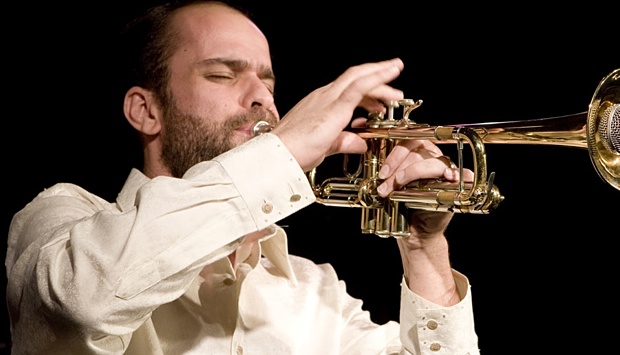

Now jazz is not just an American art form. Eventually we're going to get to something more human. I want to emphasize what's unique to each culture but also what's similar. Jazz can act as a space for other cultures to exist in one space that makes sense.
"I was supposed to spend three weeks in Iraq, but once I had gotten a taste I realized that I wasn't really getting into the tradition at all. I knew some of the notes of the melody but not a lot of the nuances. So at a certain point, during that six-month time I dedicated myself to learning the music for its own sake. I had seen only a few people in Iraq that were really taking this music seriously. Very few Arabs even knew that there was an Iraqi version of the maqam and I wondered who was taking care of this music. Part of it was me wanting to be practitioner in my generation and part of it was just falling in love with the music and wanting to understand it more. At a certain point, I was really into the tradition almost to the point of not playing trumpet and maybe not wanting to play jazz anymore, but then I would get a call from somebody like Cecil Taylor who wants to do a week at the Iridium and, of course, I'm not going to say no."
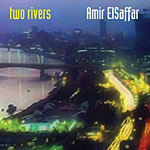
Such is Amir ElSaffar's current presence in the music world. He has been splitting his time between the Arabic music and the jazz and improvised music, immersing himself in both fields for extended periods of time. In fact, the idea of being in two musical worlds has been codified into an ensemble named Two Rivers, who debuted their first recording on Pi in 2007. "I think it was when I got the commission to write the Two Rivers suite that sort of fished me out of just being into the maqam and gave me the chance to combine it with jazz. I was really resistant to it at first but then stuff started to fall into place."
In the States, ElSaffar has been keeping both busy and diverse. This winter, he's playing with flutist Jamie Baum's Septet and is involved with bassist Mark Dresser's Telematics project, using the internet and other high-speed connections to play with musicians in Abu Dhabi via NYU. He's involved with Danilo Pérez's "21st Century Dizzy" project along with other culturally-minded musicians like saxophonists David Sanchez and Rudresh Mahanthappa, percussionist Jamey Haddad, bassist Ben Street and drummer Adam Cruz. "It's sort of recreating Dizzy's approach to incorporating different cultural traditions in jazz, the way he did with Cuban music in the bebop era," said ElSaffar.
Inana (Pi, 2011) follows up on the ideas and aesthetics of the first Two Rivers records. Praised by critics as a personal and non-clichéd exhibition of jazz and Middle Eastern methodology, ElSaffar describes Inana as the next step in the musical exploration of the maqam in jazz, using new techniques in harmony and counterpoint that weren't on the first record. The line-up has changed very slightly since the self-titled release but for ElSaffar, the personnel of the band still act a cross-section of his interests as a musician.
 "I knew immediately that I wanted Rudresh [Mahanthappa] involved; I had studied with him in Chicago. Nasheet Waits was somebody that I admired for the openness of his approach, the big sound that he has. Zaafir [Tawil] and Tareq [Abboushi] are both rooted in Arabic tradition but also very expansive in the kinds of music and instruments they play. Carlo [DeRosa] is one of the first musicians I met when I was in New York and he's just rock solid. When Rudresh told me that it was hard for him to rehearse because he was so busy, my fiancée recommended Ole Mathisen who was nailing it right off the bat. He's someone who's checked out Persian and Indian music, too. I'm always looking for people that are firmly rooted in jazz but have invested their energies into other music also."
 Long before his foray into the traditional music of Iraq, ElSaffar's first musical interest was the quintessential American tradition: the blues. Growing up in the suburbs of Chicago, ElSaffar's father helped expose him to the northern city's rich commonwealth of blues and jazz. Allegedly, ElSaffar earliest exposure to jazz came as a conscious decision by his father.
"Apparently, and I was too young to remember this." said ElSaffar, "my father had a tape of Ella Fitzgerald and Louis Armstrong's music labeled 'Amir's music' as opposed to a tape of opera that he made for my sister labeled 'Dena's music.' I'm not really sure what prompted him to make that decision. The first time hearing trumpet sound was very clear in mind. I was also really obsessed over this Blues Brothers soundtrack that I played incessantly, which I would still play even though it got worn out. When I was about nine or ten I got into music like The Beatles, which brought me to musicians like Clapton and Hendrix and then led me back to the blues."

Despite Armstrong's initial impression, getting serious about playing it didn't come as naturally. "I started playing trumpet at about nine and always hated it; I was always ready to quit, but my mom told me that I had to stick with it and that just so happened to be the time I was getting into Miles Davis. Miles was one of the first jazz musicians I was listening to at that time, the first record being Kind of Blue (Columbia, 1959), which was life changing. At the time, I was playing also playing rock guitar and actually went to the Berklee five-week program one summer playing both guitar and trumpet. After the first week, I was just playing trumpet. I was getting into a lot of the stuff from the mid-to-late fifties period, Miles but also Clifford Brown.
ElSaffar went on to study classical trumpet at Chicago's DePaul University. While his classical training was being honed at school, his training in American popular music was being molded on the bandstand, playing in blues, R&B and salsa bands around the city. A frequent musician around the DePaul area on the north side, his father's initial sponsorship in absorbing the blues also got him well acquainted with the south side.
"My dad used to take me to a blues club called The Checkerboard Lounge," recalls ElSaffar. "He would paint a mustache on me to make me look older. It wasn't really until college that I started checking out those blues clubs on my own. These clubs were in some of the rough neighborhoods on the south side of Chicago, places other people might not usually go. I always felt it was important to keep that blues foundation; all the strains of jazz I was listening to had some connection to the blues, some very strong, some a bit more tenuous. A lot of had that 'blues cry' and a lot of that I found in Iraqi music later on as well."
One of ElSaffar's first major collaborations in jazz in his post-college years was with pianist Cecil Taylor. Similar to his eventual involvement with Arabic music, the rewards embedded in working with Taylor came through patience and perseverance. ElSaffar explained the sometimes bewildering but always intriguing process of delving into Taylor's thought process.
"I was working with him almost completely concurrently while I was studying Iraqi music. I met him in 2001. I attended a great month-long workshop that had about 20 people involved by performance time (about 15 had left during the course of that time because they didn't really get what was going on). It certainly was a challenge; we'd spend a lot of time getting all 40 players to play one phrase correctly and then the next day we might come back to it, but we'd completely deconstruct it the next day or just move on to something else. I remember being confused at first, but I was enjoying it because I knew that he knew what he was doing. I remember hearing his music so differently after that. I was able to see the logical progression of the harmonic structures he was working in, each harmony getting plugged into different rhythmic formulas, right and left hand patterns working in tangent and things like that.
 "I left early the next year to go to study Iraqi music and I came back in June to play a weekend with him and other professional musicians instead of students this time. I played with the Sound Vision Orchestra with musicians like Taylor Ho Bynum. It was an ecstatic gig; I always felt like my mind was exploding every time I played with him. I kept coming back to the states to play with him over the years. That was a place I found that you could have structure and complete freedom at the same time."
 Before the conscious decision was made to study Iraqi music, ElSaffar had inkling early on that he would try his hand with it eventually. His sister, Dena ElSaffar involved herself with playing Arabic music about 10 years before he did. He had assumed that Arabic music was unavailable to him on his Western instrument, but ironically enough, it would be the discovery of another trumpet player that would draw ElSaffar into the world of maqam.
"The process had started when my sister played me music by this percussionist named Hossam Ramzy. We were listening to it and at some point I had heard a sound I'd never heard before and I asked what the instrument was. I knew it was a wind instrument but it sounded very foreign to me. She told me it was a trumpet and I was just blown away. It was a trumpet player named Samy El-Bably, an Egyptian musician. I had a chance to meet him once at a workshop in Germany that had Arab musicians and Israeli musicians coming together to play in an orchestra. I got a chance to see him play and conduct the musicians. I wanted to be able to study with him but, unfortunately, he died just a few months later. That was really where it started because the reason I thought I couldn't play Arab music was because I thought you couldn't play quartertones on trumpet. But listening to him, he was playing all of them completely naturally. I realized he was using a combination of slides and alternate fingerings."

After attending Simon Shaheen's Arabic music workshop at mount Holyoke, ElSaffar had promised himself that if he won the Carmine Caruso trumpet competition he would use the prize money to go to the Middle East. However, in the early 2000s, when the War on Terror was at its outset, money was not nearly the only obstacle in traveling to the Middle East.
"I wasn't sure if I was going to make it to Iraq because it was not long after 9/11 and they were talking about a possible invasion. I had a foresight that if I didn't go now I wasn't going to have the opportunity and I was right; I had gone in 2002 and had left the beginning of 2003. Two and a half months later the war had started. I had spent time and learned the language and I was sad to go." As it turned out, however, leaving Iraq was only the first step in his musical journey. When the Middle East was no longer an option, his peers directed him towards Europe. "People in Iraq knew the war was starting and they asked 'Why are you still here? You don't have to be in Iraq to study maqam, you can go to England to study with Hamid al-Saadi.'"
As it turned out, al-Saadi was one of the most accomplished maqam singers in the world. "He was and is only person who knows the entire maqam repertoire," said ElSaffar. "Each region has its own repertory of maqam but the Baghdadi is the most complete one. There are about 60 of them. Learning them is more than just learning the notes; you have to internalize and learn to improvise within it. He knows all of them and different variations that are possible." ElSaffar's participation in al-Saadi's tutelage often went beyond maqam and into facets of daily life. "I spent about six months studying with him. I would sit with him for about six or seven hours a day, talking about music but also other topics, going shopping with him, etc. It had that kind of mentorship feeling that I wasn't conscious of right away. He encouraged me with the santour, too, even though he couldn't teach me it himself."
ElSaffar had approached the santour, a Persian hammered dulcimer instrument, during his time in Iraq and studied it more thoroughly in Europe while he was studying with Farida Mohammad Ali, the only actively performing female maqam singer in the world. "The sound had really made sense to me. It might have made more sense to learn the nay, which is an Arabic flute, but I wanted to delve into the tradition and the nay is used in more modern interpretations of the maqam and more in Egyptian and Lebanese tradition more than Baghdadi. maqam is traditionally accompanied by the joza and santour. I also liked that it was percussive and melodic so I wanted something that dealt with rhythm."
As he anticipated, the maqam system was embedded with its own set of challenges. Delving oneself into the approach is not simply learning to hear half-flats or incorporating scales; it's a much more thoroughly integrated process. It was especially challenging for ElSaffar as an English speaker to accustom himself to the way maqam is typically studied.
"I was studying vocally so there were worries there, as I didn't grow up speaking Arabic. So having to learn poetry in a language where I didn't understand 90% of the words, it was a lot all at once. Learning these things, as a singer is different than that as an instrumentalist; it's a different process entirely. If I tried to learn some of these songs on the trumpet or santour first would be almost impossible. Once I would sing it and couple the words with the music the melody would fall into place."
There was also a whole host of challenges on a microscopic and macroscopic scale. "Sometimes these phrases or entire maqams, which is a six or seven minute piece, might be in the range of about five notes," he explained. 'There are very slight variations in each one, not dealing with equal temperament or even quartertones. There are really fine gradations. You could call some of it sliding, but it's not really about the slide; it's about landing on a very particular note in a certain way. It was hard for me to hear at first. Also, when you have everything in a small range it's sometimes difficult to keep track of where you are. When the phrases all look very similar, you're focused on a much smaller scale of possibilities. Quantifying each note is much different in this Western music versus Iraqi music. In jazz and classical, we sometimes number them in regards to what notes work over what chord, but here it's a lot more fluid. It almost makes each note feel bigger. You feel the note with more resonance and it permeates throughout your body."

ElSaffar has established himself as part of a class of musicians who've zeroed in on different cultural traditions in order to incorporate and pay respect to native traditions. ElSaffar had been in close contact with musicians like Mahanthappa and Vijay Iyer, who had approached Indian Classical music as a means to express themselves. What made their approach so unique and valid, in ElSaffar's opinion, was the level of originality they approached in their studies.
"They were a little further down the road with that kind of stuff, looking into Carnatic music. Rudresh spent some time with Kadri Golpanash, not trying to master the style per se, because he was a master of his own way of playing at that point. When studying with Rudresh, it was mostly about having the courage to do what you want to, almost to an irreverent point, not in a haphazard way but still very thought out. He also gave me encouragement and also gave me a lot of business advice of how to do things practically."
Another big influence on ElSaffar came from his musical peer Hafez Modirzadeh. Modirzadeh is best known for his "chromodal" approach, outlined in an epically proportioned dissertation. In March of 2010, ElSaffar and Modirzadeh released Radif Suite (Pi, 2010). Described by one publication as a "new grammar for composition and improvisation," the suite was separated into two parts: Modrizadeh's "Radif-e Kayhan" and ElSaffar's "Copper Suite." ElSaffar describes the album as a process based work freer of overt cultural influence than other albums they'd released.
"Radif Suite was mostly about not being stuck with any tradition at all. Hafez has melodies that are sort of maqams, but switch in a John Coltrane or George Russell kind of way, where they pivot to other modalities, which is not at all common in traditional music. I used that as a starting point but even deconstructed that so, for example, it might just be an intervallic approach. It was just dealing with sound and letting the sound represent my own thought processes. With Hafez, it was about freeing myself with my use of maqam, really being able to play with the complete freedom of a jazz musician and not sounding overtly Middle Eastern. He can play melodies that sound like Ornette Coleman but they're actually maqams."
maqam has a rich history in several Middle Eastern cultures. For ElSaffar, it has acted as means to recognize traditions and practices stretching across both time and geography. "In the context of a maqam performance, which is mostly secular, especially with instruments because you wouldn't bring those into any religious context, each maqam is its own piece," explains ElSaffar. "Once you go a little deeper, one maqam might have a connection to a religious context. For example, at the end of Ramadan, there's a certain maqam that people recognize and there are others that a read at funerals.
"This is the music of the people of Iraq, whether they're Muslim or Jewish or Christian. They share a lot of the same melodic material. There's one Christian deacon in the North of Iraq who doesn't even know the names of the maqams; he just knows the pieces by rote, but I could identify one as maqam orfa, for example. There are also maqams associated with different merchants like apple sellers and knife sharpeners, almost like they were doing maqam branding. It's something that's integrated into society and into their subconscious, not just in performance."
Given this rich cultural tradition, the absolute last thing ElSaffar wants to be caught doing is appropriating. He explained his disdain for the fusion sounds of pop musicians past and how he strived to avoid it.
 "In the '90s to into the early 2000s, the whole world music thing was at its apex with artists like Peter Gabriel, Paul Simon and Sting. Some of their music is actually really good, but what followed wasn't. It was the kind of music where you'd hear a didgeridoo here and some string instrument you've never heard there. There's kind of this novelty of using some exotic string instrument from a native culture that kind of worships it but also looks down on it, too. It's often referred to as 'orientalism' or 'exoticism.' There's a certain naïveté involved and it's also stealing in a way. This is thousands of years of tradition and you're just briefly bringing people into your music to mash these sounds together without any real thought into the history. With Rudresh and Vijay, they get the context of what they're doing. They're conscious of not just the surface but also what it means in its own cultural context, even though they didn't study in the same process I did. I think you have to a firm understanding, which is why I'm not going to do something like an 'Africa project' [laughs]. I listen very closely to these kinds of combinations."
 Inana can be seen as a union between the cultural concept of Two Rivers and the harmonic explorations of Radif Suite. Inspired by a goddess of both love and warfare, the album poetically explores the ideas of dichotomy and cultural tradition. ElSaffar's research has provided him with a deep cultural and historical understanding, even if his band mates haven't immersed themselves so thoroughly. For ElSaffar, the input of his fellow musicians is more about their own personalities rather than scholarly knowledge.
"It's funny, we'd been playing this music for a few years and Nasheet had at one point down the road asked me 'So, what is a maqam, anyway?' I actually felt bad; I probably should have explained it better. I probably discussed it more with Rudresh and Carlo because they had to get the melodic aspect of it. It's pretty much on a need-to-know basis. I don't feel the need to explain the cultural context too much because sometimes people feel weird when they're involved with music that they don't feel they're a part of and because they're self-conscious, they might get a bit off center. So I'd rather everybody feel like they're playing their own thing. It'll happen with horn players too; I'll teach them the maqam and after one or two rehearsals, they'll try to sound authentic but it's not going to happen in two days. I want them to use the material but still bring themselves. The notes and the rhythms are just the DNA or the code; it's what you do with it that makes it unique"
ElSaffar did impart one piece of cultural history, though. "I explained the story of 'Blood and Ink,' which is on the first album. It was about the massacre of Baghdad in 1258 and what that story meant. There are two rhythms that are going on, one being a march and one a folk dance, which represents a festival I had observed for the mourning of the grandsons of Mohammad. It was striking to hear these rhythms with two different purposes on the same pulse and this was also only a few days before the invasion of Iraq, so it felt very relevant"
ElSaffar feels that the modern jazz world (and the music world as a whole) is ready for the inclusion of the maqam system and the freedom of pitch. Jazz has had a few examples of musicians approaching intonation in a non-traditional approach, ranging from Jackie McLean preference for playing slightly sharp to Ornette Coleman's musings on landing on a note differently every time it's played. But ElSaffar contends that there's much more that can be explored. "For as much as has been talked about freedom of intonation in jazz, there hasn't really been a firm, codified approach to it. We're still using equal temperament for the most part. Someone like David Fiuczynski has delved into microtonal music but there hasn't really been consciously explored that's not just bending a note here or there.
However, ElSaffar noticed an inherent subversion of Western harmony in the context of African-American music. "Blues is interesting because even the idea of having a blues scale work over Western harmony is a weird phenomenon. The anomaly of the blues is the chords because the origin of the singing is not based on any equal tempered idea. It was influenced by the modes that were based in African spiritual singing. About 30 percent of the slaves were Muslim and their call to prayer was based on maqam and there are blue notes within those maqams, like the third and the seventh. Jazz is at a place where we're ready for alternate tuning systems and tuning instruments to the way they hear them. The bebop harmony was a way of abstracting pitch; even the #9 chord is a way of abstracting the major third and the minor third, playing them both at the same time. But even with that, it's still using the Western temperament, treating notes as extensions."

ElSaffar also recalls, "Even when I was young, long before I started researching this kind of music, I remember sitting at the piano and wanting to hear notes that weren't on the piano. I don't think that's unique either; I think we all hear things differently."
As the world of jazz and improvised music grows wider, more and more of the modern jazz community has accepted culturally complex musicians with open arms and attentive ears. Festivals like Winter Jazzfest and Undead Jazz Festival have featured musicians showcasing their integration of cultural traditions in spades, such as Jen Shyu (Taiwan, Indonesia, etc.), Min Xiao-Fen (China) and Dean Bowman (traditional American gospel). Amir ElSaffar is happy to be part of this space as a performer and caretaker of Arabic music in the context of modern jazz.
"That's one thing I really love about jazz: that it was a reflection of what was going on, socially, economically, etc. And now you have all these Diasporas in America and it's not just an American art form. You don't just have first or second generation but also third and fourth from these different places. And there might be people who grew up with a different skin color who didn't grow up speaking the language but still had something inside of them that belongs to a culture. Eventually—and I don't know how long it's going to take—but we're going to get to something more human. You wouldn't intuitively think of a Japanese person singing the blues, but even that's been going on for a while now. In Chicago, there was a very petite Japanese woman who spoke with a very thick accent but when she sang it sounded like Bessie Smith. You just think, 'Where is that coming from?' There's something that's a shared common human experience with the blues. I want to be able to emphasize what's unique to each culture, but also what's similar. There's this blues 'thing' about a lot of different music. And maybe somebody could tap into the rhythmic parts of these kinds of music too. Because it's improvised and composed and it's creative, jazz can act as this space for other cultures to exist in one space that makes sense."
Selected Discography
Amir ElSaffar, Inana (Pi Recordings, 2011)
Amir ElSaffar/Hafez Modirzadeh, Radif Suite (Pi Recordings, 2010)
Amir ElSaffar, Two Rivers (Pi Recordings, 2007)
Photo Credits
Pages 1, 4: Courtesy of Amir ElSaffar
Page 2, 3: Dave Kaufman
Page 6: Nicole LeCorgne
< Previous
The Eleventh Hour
Next >
Echoes of Indiana Avenue
Comments

Tags
Amir ElSaffar
Interview
Daniel Lehner
United States
Jamie Baum
Mark Dresser
Danilo Perez
David Sanchez
Rudresh Mahanthappa
Jamey Haddad
Ben Street
Adam Cruz
Nasheet Waits
Ole Mathisen
Ella Fitzgerald
Louis Armstrong
Miles Davis
Clifford Brown
Cecil Taylor
Taylor Ho Bynum
Simon Shaheen
Vijay Iyer
Hafez Modirzadeh
John Coltrane
George Russell
Ornette Coleman
Jackie McLean
David Fiuczynski
Jen Shyu
Dean Bowman
For the Love of Jazz
 All About Jazz has been a pillar of jazz since 1995, championing it as an art form and, more importantly, supporting the musicians who create it. Our enduring commitment has made "AAJ" one of the most culturally important websites of its kind, read by hundreds of thousands of fans, musicians and industry figures every month.
You Can Help
To expand our coverage even further and develop new means to foster jazz discovery and connectivity we need your help. You can become a sustaining member for a modest $20 and in return, we'll immediately hide those pesky ads plus provide access to future articles for a full year. This winning combination will vastly improve your AAJ experience and allow us to vigorously build on the pioneering work we first started in 1995. So enjoy an ad-free AAJ experience and help us remain a positive beacon for jazz by making a donation today.

Giveaway

Eligible winners: 15
Days remaining: 11
Days remaining: 11