Home » Jazz Articles » Interview » Jack DeJohnette: Time and Space
Jack DeJohnette: Time and Space


I like to mess up the rhythm--agitate it, shake it up, transform it, morph it, do different things with it--because time is space, so we're dealing with time and space; we're taking time and making it spacious, expanding it.
"That was on purpose," says DeJohnette, referring to "Enter Here." "That bell is a resonating bell that I created with Sabian, and there's a healing intention with that bell when it's played. 'Enter Here' is a perfect title: you enter here in a neutral state, you tune up, and then we take you on a traveling journey, a Sound Travel."
Though he may be known primarily as a drummer, as he approaches his 70th birthday in 2012, Chicago-born DeJohnette has been involved in hundreds (maybe thousands) of recordings across the broadest possible spectrum of jazz. He first emerged in saxophonist Charles Lloyd's renowned mid-'60s quartet with pianist Keith Jarrett, moved over to trumpeter Miles Davis in 1969 and ultimately became a defining voice on two well-known labels in particular: Creed Taylor's CTI imprint and, perhaps more significantly, Manfred Eicher's 43-year-old ECM, with which DeJohnette still shares a close relationship. But DeJohnette is also an exceptional pianist, and if he has contributed some piano to many of his own recordings, including Album Album (ECM, 1984) and The Elephant Sleeps But Still Remembers (Golden Beams, 2006), and electric keyboards to albums like Audiovisualscapes (Impulse!, 1988) and Music for the Fifth World (Manhattan, 1992), it's been literally decades since he made an album that featured his piano skills so prominently.
Chapter Index
1. Sound Travels
2. Growing Up Eclectic
3. Relationship With ECM
4. The Jack DeJohnette Group
5. Musical Mentoring and Doing Good
Sound Travels
"The catalyst for Sound Travels was Chuck Mitchell [of eOne, formerly Koch], at least for the piano aspect, though the catalyst for making a special record was my wife and business partner, Lydia. Chuck is a good friend of ours, and he's been involved in the music business, from being a radio programmer and working on television, to projects with people like Herbie Hancock. We have our label, Golden Beams, and everything being as it is in the world today [chuckles], Chuck had told us, 'If there is ever anything I can do to help, don't hesitate to ask.' He's been a big supporter of mine over the years, starting with Compost (Columbia, 1972)— he was a DJ at Princeton [University], and a lot of stuff that I was doing, he was into.
"So we had a meeting with him," DeJohnette continues. "The other catalyst was my winning the 2012 NEA [National Endowment for the Arts] Jazz Masters Award, and the ceremony happens in January, 2012, so Chuck thought it would be a good idea to do something—a special project—and have it come out in January to coincide with the event. So he said, 'OK, I know you can come up with something special, but my one request is you've got to play some piano on it.' I didn't balk, and said, 'OK, why not? We can do some of that.'"
 But unlike earlier recordings like the Japan-only Jackeyboard (Trio, 1973) and The Jack DeJohnette Piano Album (Landmark, 1985), where he either played piano exclusively—or, at least, primarily—Sound Travels almost completely balances kit work and piano. It's also a record that teams the veteran artist with a group of younger players, most of them leaders in their own right and, in one case, a rapidly rising star. "One of the goals I'd set for myself on this project was to write some pieces that had some grooves, some nice melodies and some beautiful atmospheres," says DeJohnette, "and I had a personnel in mind that I thought would be really great—people I'd enjoyed working with, younger musicians who are making their mark in the world.
 "And so I suggested the people I wanted. Chuck asked, 'Who would you like to produce?' and I said Bob [Robert] Sadin, who's a fantastic producer—he gets great results, and I've worked with him before. So Bob was great. We sat down and had a meeting, and I mentioned the names I wanted: [bassist] Esperanza Spalding; [guitarist] Lionel Loueke; Ambrose Akinmusire, the trumpet sensation; percussionist Luisito Quintero, who I've been involved with in some Latin projects that I've put together; and [pianist] Jason Moran.
"[Saxophonist] Tim Ries came on board after we'd started recording," DeJohnette continues, "because Bob and I thought the music needed another voice. Tim was in Budapest, and it was his birthday, so I called him and said, 'Hey, man, can you come and play on my record?' He said, 'Wow, that'd be great. I'm just finishing up in Budapest.' He got here as soon as he could, and did a fantastic job. I made a record with Tim—I'd met him in New York and knew of his work—and we did an album which has not come out yet, but he did some Rolling Stones things [Stones World: Rolling Stones Project II (Sunnyside, 2008)]. I really like Tim's playing; he's really well rounded and got his own voice, so I thought he would be perfect for this. And so he plays all the horns, and some exotic instruments, too.
"Then [singer] Bobby McFerrin joined, and that kinda rounded everything out—this great combination of people. The other icing on the cake was kind of a fluke—Bruce Hornsby, who I made a jazz record with [Camp Meeting (Legacy, 2007)]; he's been a big fan of Keith Jarrett and would always come around. So I said, 'Bruce, maybe we can write something together.' I'd written all these pieces on my Korg M3 synthesizer—it has a 16-track sequencer in it, so I can play all of the parts exactly and spell out what I really want, so that the producer and the musicians know what I am looking for. I played some of the pieces for Bruce, including a composition that was originally just called 'Seven-Four,' and I said, 'Do you want to write some lyrics?' He said, 'Yeah,' and he took it, worked with it, and the result is 'Dirty Ground.' Bob and our engineer, who works with Bob a lot, Dave Garlington, did a great job with production on this recording.

Sound Travels was recorded live in the studio, for the most part, with the entire group putting down its tracks together in real time. One of the album's most surprising aspects, considering DeJohnette plays both drums and piano on five of its nine tracks, is how seamless and live it all sounds, despite the necessity of overdubbing one of the two instruments. "Some [tracks] were done with the piano first," DeJohnette explains, "because we had Luisito, who could lay down a great groove for everything, and then some of them were done with drums first, like 'New Muse,' where the piano was put on afterwards. Same with 'Sonny Light'; that was one with me on piano with everybody, and then I overdubbed hi-hat and bass drum. But most of it was done live, and the solo piano stuff ['Enter Here,' 'Home'] and the track with Bobby ['Oneness'], they were done real time."
With the spontaneous nature of jazz, it's sometimes easy to overlook the importance of pre-production—or production, period. But Sadin's role was to find ways to stretch the musicians, to push them out of their comfort zone while helping them to become absolutely comfortable when recording together. "One of the things Bob did was to get us all to sit around in a room, with me at the piano, Luisito with his drums and Esperanza on her bass, to create this village kind of atmosphere, so we could get the grooves, playing the grooves over and over, to get the rhythms just right. We were sitting around, real close, to get the feel of everything with the piano.
"I wasn't thinking about having Esperanza singing on it," DeJohette continues, "but one day, when we were taking a break, Bob took Esperanza aside, spent some time with her, and got this amazing vocalese from her on the salsa ['Salsa for Luisito'], and then the backup voices. It was my idea to come up with the chants for 'Salsa for Luisito,' and Luisito gave us the Spanish lyrics to sing in three-part harmony over the drums, which is nice, 'cause it celebrates the drums, back and forth, and then you have Ambrose coming in, saying, 'OK, here I am [chuckles].
"One of the things I really would like to point out about Sound Travels is that it's a celebratory record," DeJohnette concludes. "It celebrates me hedging up on my 70th year, and it celebrates not only the piano and the drums, it celebrates the voice as an instrument. You've got Esperanza at one end, you've got Bobby on the other, and you've got Bruce, the singer/songwriter, in the middle. I've never heard Esperanza do [what she does], though it's not a surprise that she's capable; but it is different, and the quality of her voice has definitely improved—it's gotten warmer, it's got a vibe. She really has a vibe."
 DeJohnette isn't the only one who thinks Spalding has a vibe. Seeming to emerge almost overnight (though in reality it's been a gradual climb over the past five years or so) Spalding's Chamber Music Society (Concord, 2010) made such a splash that the bassist/singer won the 2010 Grammy Award for Best New Artist—not Jazz Artist, but Artist, period—beating out megastars like teen heartthrob Justin Bieber. As Spalding's own career heats up even further, with her follow-up, Radio Music Society (Concord), due out in February 2012, the only downside is she won't be available when DeJohnette's Sound Travels group hits the road. "Yeah, we talked to everybody about touring, once the recording was done," DeJohnette says, "and the only person that may not be able to make it is Esperanza, 'cause her new record is coming out (I'm on two tracks). She's a rising star, so I think she's going to be real busy. But I think we're trying to get Christian McBride to fill that spot."
 From the appropriately titled "Salsa for Luisito" to the bookending piano solos of "Enter Here" and "Home"—described by DeJohnette as "kinda church and kinda South Africa"- -Sound Travels covers a lot of territory. Afro-Cuban pulses mix with African highlife on "Sonny Light," while "New Muse" swings with a simmering, modal intensity beneath Ries' soaring soprano solo, and the pulse-laden title track provides a more intimate workout between Loueke, DeJohnette and Quintero. "Oneness," McFerrin's improv-heavy tune, with Quintero and DeJohnette (on piano), contrasts with Hornsby's singing on the funkified, irregular-metered "Dirty Ground," while a new look at an older tune, "Indigo Dreamscapes"—first heard on DeJohnette's 1990 set with Hancock and guitarist Pat Metheny, Parallel Realities (MCA), harks back to some of the drummer's late-'80s/early-'90s Special Edition recordings.
Growing Up Eclectic
All told, Sound Travels may be the most flat-out eclectic album of DeJohnette's career, and he wouldn't have it any other way. "It seems to me that people who are running around in their mid-60s or mid-70s now were around when [radio] programmers were eclectic—when FM was the new frontier," DeJohnette explains. "It was much freer that way. At this point, because of the way things are, you just don't worry about it anymore. Of course I was aware of time. You don't have to wait to get into the melodies and everything; they come right to you, right away, because most peoples' attention spans (not all peoples') are shorter.

From left: Miles Davis, Dave Holland, Jack DeJohnette
The only other record in DeJohnette's catalog that's as expansively diverse is an album he released in 1992 that has, sadly, largely fallen through the cracks. "That's Music for the Fifth World (Manhattan, 1992)," says DeJohnette, "but now no one knows about it because at that particular time, I couldn't get the personnel to make live appearances. And also, because it was electric and rock and Native American and all that, it was diverse and they [the record label] didn't know what to do with it. Because I wasn't signed to Blue Note here in the States—I had a deal with EMI in Japan, which leased its music to Blue Note or Manhattan—I was able to do it, thanks to the producer, Mr. [Hitoshi] Namekata. He was kind of a maverick, he liked the idea, that kind of stuff, and he supported me, so I had the funds to produce something like that, because that was a big production. I'm glad that was documented.
The eclecticism of the '60s/'70s— a time when it was possible to hear John Coltrane, The Byrds and Pink Floyd in the same half hour, on the same radio station—has clearly not been lost on DeJohnette. Though being born during World War II meant he was already a busy professional by that time— first in Chicago, and then in New York, to where he moved in 1966, with the support of pianist Muhal Richard Abrams, one of the key figures in the emergence of the Windy City's Association for the Advancement of Creative Musicians (AACM)—his early years were spent learning how to play in a wide variety of styles, before coming to jazz in his mid-teens. "I was getting into drums then, as well as playing the piano. Then I heard Ahmad Jamal's Live at the Pershing (Argo, 1958), and I started taking jazz much more seriously," says DeJohnette.
"I really started to apply myself to it, practicing three or four hours a day, and just immersing myself in the music—into jazz. I was playing all kinds of music at the time; I kinda dropped out of high school for about a year, and I started working professionally, playing jazz—first as a pianist, and later as a drummer. I was 18, 19, somewhere around there. There were so many great musicians and so many places to go hear the music ... and jam sessions; all the great musicians were coming through. We had an amazing array of diverse musicians in Chicago, too; we had Sun Ra, who I played with on and off when he was in Chicago; and Muhal Richard Abrams, who was really inspirational and helped me decide to go to New York. He was a mentor, and he hipped me to musical things and personal things. He created an alternative for musicians like myself and [saxophonist] Roscoe Mitchell—and, later, [trumpeter] Lester Bowie. So I had that aspect, and then regular gigs— blues gigs, show-tune gigs.
 "But back to Ahmad; Live at the Pershing was sort of a pivotal record that made me sit up and think, 'Wow, that's amazing,'" DeJohnette enthuses. "I had a trio in high school, with other classmates, playing some of the tunes, like 'But Not for Me.' Another drummer left his drums in my basement, and there was also Vernel Fournier, who really fascinated me with his brushwork, so I went out and bought a pair of brushes and started practicing. I started playing with some jazz records, because my uncle was a jazz DJ, so I had access to them. I'd go to sessions to watch the drummers, and listen to records, and eventually I developed my drumming as well as my piano playing.
 While DeJohnette eventually moved to New York—because, as he explains, "a lot of places were turning into Go-Go clubs, and I'd exhausted all the places to play, so New York, which was the Mecca, that's where you go"—he'd had plenty of memorable experiences in his hometown, like sitting in with John Coltrane. "My first encounter with Coltrane was in Chicago. I'd seen him many times, and there was one night when Elvin Jones hadn't made it back for the last set, and this was a club I'd frequently played at, sitting in at the jam sessions. I was able to hold my own pretty good, and by that time I'd been practicing with a lot of Miles and Coltrane records, like [the saxophonist's] My Favorite Things (Atlantic, 1961), which was a hit at that time.
"So the place is packed," DeJohnette continues, "and the club owner says to Coltrane, 'Listen, it's late, people are waiting, let's use Jack DeJohnette—he's good, he's a young drummer that plays at a lot of my jam sessions.' This would be early '60s, maybe 1962- 63. Anyway, John didn't question it, he just nodded his head, and I followed him up to the bandstand, and we played a few songs. And it was so great, because here I was playing with John Coltrane. I was a little nervous, but we played two or three tunes—I think we played 'I Want to Talk About You' and 'Mr. PC,' and a couple other things. We were about to play 'Favorite Things' when Elvin came in and thanked me for filling in for him. The next time I played with Coltrane was back in Chicago again, but later, in '65 or '66, and that was a totally different ball game, with [pianist] Alice Coltrane, [bassist] Jimmy Garrison, [saxophonist] Pharoah Sanders, and another drummer—the late, great Rashied Ali."
By 1965-66, Coltrane was deep into his exploration of freer territories, but as much as his reputation at the time was for playing "out there," DeJohnette disagrees with popular thinking of the time. "I think it was less out there," DeJohnette explains. "What appeared to be out there for the people was more in there, because it was about the sound of the music. A lot of people were used to playing, to hearing an established 4/4 sound; all of that was in there, and of course, I was primed for the music that John was playing, having played with Muhal and Roscoe Mitchell in Chicago prior to that, and with Sun Ra. But it was about the sound that John was talking about. I remember John saying, 'I know it sounds raw and untogether, but there's something in the sound that I'm hearing.' And it was the collective sound of it that was what was happening. But a lot of people just thought it was avant-garde—everybody just playing and not listening. But Rashied was listening, creating this amazing multidirectional sort of turbulence or atmosphere where you could go anywhere you want.
 "The thing is, most musicians who say they play free—let's take, for example, Keith [Jarrett]. When he's playing free, he's playing a structure. He knows where he's going; he's creating a roadmap. If you say it's jazz or free jazz, and you listen to something like Ornette Coleman's Change of the Century (Atlantic, 1959), and people say, 'Oh no, that's free jazz,' no it wasn't—it was organized. The first time I heard it, people were getting into arguments about Ornette, and about no chord changes, but it's obvious, if you listen to the control he had on the saxophone, that he came through Charlie Parker. He even went so far as to write some Bird-like tunes on Change of the Century. There was a pianist, Walter Norris, and it was funny, because when he asked Ornette what he wanted, Ornette said, 'Just play how you play.' [chuckles] That's all he wanted; all he wanted was for Walter to be himself."
DeJohnette even goes so far as to draw comparisons between the sound of so-called free jazz and contemporary classical music. "The thing about free jazz, and I explain this to people: people will go sit and listen to classical music—something written that sounds like free jazz, and they'll listen to it. There's a context—written versus something played spontaneously which, if it was written, people would listen to in a different way. It amazes me. 'Oh that's not jazz, it's free jazz; they don't know what they're doing.' And yet, if someone transcribed it and put it in a classical context and said, 'This is so-and-so, and it was written by so-and-so,' people would sit down and listen to it seriously."
Relationship with ECM
Between high-profile work with pianist Bill Evans, Charles Lloyd and Miles Davis—first appearing on the trumpeter's seminal Bitches Brew (Columbia, 1970) and then on a string of albums that culminated in another Davis high point, On the Corner (Columbia, 1972)—DeJohnette found himself in constant demand by the early 1970s, recording with everyone from guitarist George Benson and pianist Chick Corea to bassist Miroslav Vitous and trumpeter Freddie Hubbard. But of all the relationships that the drummer has forged, it's his ongoing partnership with ECM's Manfred Eicher that has been, perhaps, the most consistent and, in his participation on over 50 recordings for the label, the one place most representative of his broad musical concerns, from recordings with Keith Jarrett's ongoing Standards Trio with bassist Gary Peacock, the collaborative, on-again, off-again Gateway trio with Dave Holland and guitarist John Abercrombie, and work with British saxophonist/clarinetist John Surman, to lesser-known gems like pianist Richie Beirach's Elm (1979), guitarist Mick Goodrick's In Pas(s)ing (1979) and Gary Peacock's Voices from the Past: Paradigm (1982).
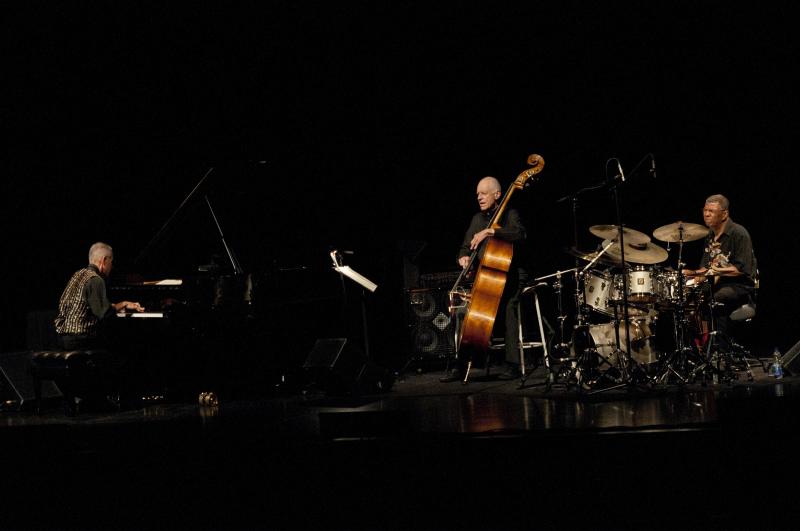
Keith Jarrett Standards Trio, from left:
Keith Jarrett, Gary Peacock, Jack DeJohnette
He's performed on ECM classics including saxophonist Jan Garbarek's Places (1978), Abercrombie's Timeless (1975) and trumpeter Kenny Wheeler's award-winning Gnu High (1976), as well as Pat Metheny's 80/81 (1980) and guitarist Ralph Towner's Batik (1978), in addition to releasing 13 albums as a leader/co-leader, including the desperately-in-need-of-CD-issue titles with his Directions band— Untitled (1976) and New Rags (1977)—and classics of his own, including Special Edition (1980) and, most recently, Saudades (2004), his Trio Beyond tribute to the late Tony Williams, also featuring guitarist John Scofield and organist Larry Goldings.
Looking back at DeJohnette's output as a leader, not all of it is on ECM, but that's the very nature of a label that doesn't sign long-term contracts with its artists—each album is a discrete, one-off contract. Instead, if a project fits Eicher's overall aesthetic, then it may end up on the label; if not, artists are largely free to release them elsewhere. It was for this reason, among others, that DeJohnette started his Golden Beams label, which has released half a dozen recordings to date, ranging from more jazz-centric albums like 2006's live duo date with Bill Frisell, The Elephant Sleeps But Still Remembers, and 2009's studio date with pianist Danilo Pérez and bassist John Patitucci, Music We Are, to recordings intended for mediation/healing, including 2009's Grammy Award-winning Peace Time and 2005's Music in the Key of Ohm.
But while it's been 15 years since he last released an album as a leader on ECM (1997's Oneness), DeJohnette still considers the door open, should an appropriate project arise. "Manfred has had a big influence on globalization and keeping the quality of the music at a high level," DeJohnette asserts. "And the creative aspect of it—he's pretty open, and has introduced a lot of new players who might otherwise not get exposed. Manfred is the most prolific producer on the planet, and he's produced a thousand records, with the New Series and the other eclectic stuff he does. The volume of what he does is overwhelming—and was a big problem for American labels when it got distribution deals, because the label had so many records coming out, and with artists from all over the world."
Jarrett's Standards Trio first came together on Peacock's Tales of Another (1977), but It was at Eicher's suggestion that they reunite in 1983 for the sessions that led to three recordings, recently collected on the 2008 Setting Standards box. And while DeJohnette, Holland and Abercrombie had all played together in a variety of contexts, it was at Eicher's suggestion that they come together as Gateway in 1975, last releasing their fourth album, the all-improv In the Moment, in 1996. "Manfred is great at putting combinations together—different people—and Gateway turned out to be a good one. To this day, people keep asking, 'When is Gateway gonna get back together again?' Dave [Holland] just lost his dear wife of many years a few weeks ago [Fall, 2011]. He's recovering from that, but we did talk about the possibility of getting together to see how it feels. Maybe we'll do something; we'll see how it goes."
 John McLaughlin and John Surman.
 "Dave and I hooked up harmonically and rhythmically," DeJohnette continues, "because Dave had been playing with pianist Chris McGregor and the Brotherhood of Breath; he'd been playing with a South African drummer [Louis Moholo-Moholo], so he'd been playing some South African music, which opened up his rhythmical concept [note: this was actually the Chris McGregor Group, also featuring Moholo-Moholo]. We immediately got into that, and extended it into when we started playing with Miles, and also with the Gateway trio, where we really have this way of staggering and playing with rhythm and time; we have a lot of fun with that [chuckles]. Time is implied, and is passed around. If you listen to Gateway, the way we break up the time—all three of us, in our own ways—is different than the way Keith [Jarrett] would do it. But one of the things I've always liked about John [Abercrombie] and Dave is that I like to mess up the rhythm—agitate it, shake it up, transform it, morph it, do different things with it—because time is space, so we're dealing with time and space; we're taking time and making it spacious, expanding it."
There are many considerations when it comes to determining whether or not a project is suitable for ECM. With relatively low budgets and a typical modus operandi of two days to record and one day to mix, larger projects like Music for the Fifth World would simply not be possible. "I was always straight with Manfred," says DeJohnette. "I'd say [referring to 1990's Parallel Realities], 'I've gotta do this project with Pat [Metheny], and I need a bigger budget than what you can give.' That way, I always let him know what my plans are, and if he's interested, then we can do it together. That's the way it's always been; I can always do a project for ECM when I want to. Manfred keeps saying, 'Let's get into the studio and do something,' and maybe we will, when something comes up that makes sense. So the door is always open. I am still affiliated with ECM—there's still an ongoing relationship with projects like Trio Beyond, where I asked if he was interested, and he said, 'Yeah,' and it came out and was successful."
The Jack DeJohnette Group
Like many of his contemporaries, DeJohnette has built, over the years, an expanding cadre of trusted musicians, on whom he can call when the project feels right. He put together the Jack DeJohnette Group in 2010, for a summer tour and the Live at Yoshi's 2010 download, bringing together some old and new friends, for a quintet that has the textural breadth, improvisational chops and big ears, to perform new music while putting a fresh face on some of DeJohnette's back catalog, dating as far back as "One for Eric," from Special Edition.

Sound Travels recording session, from left: Luisito Quintero, Jack DeJohnette,
Lionel Loueke, Esperanza Spalding, Jason Moran, Tim Ries
Among a group of outstanding players that also includes guitarist David Fiuczynski, saxophonist Rudresh Mahanthappa and keyboardist George Colligan, it's bassist/guitarist Jerome Harris who goes back the furthest with DeJohnette. "Jerome is a guitarist [in addition to being a bassist]: he has a degree in classical guitar," says DeJohnette. "He is also an accomplished vocalist—along with his wife Jezra, a helluva vocalist—which I plan to utilize a little more, as he does vocalese, sings lyrics, has a good range and can do overtones. He's so multitalented and interested in all kinds of musical genres, from Indian and Moroccan to African and Afro-Cuban. He's worked with me quite a bit, and he's worn both caps as guitarist and bassist in different situations. He's a member of a lot of groups—he's also played bass and guitar with Sonny Rollins, and he was in [saxophonist] Oliver Lake's Jump Up band. He sings, he plays percussion, he's a beautiful composer and is very, very knowledgeable about the history of many things.
"He's just a remarkable human being," DeJohnette continues. "When he first joined me, it took him a little while to get used to playing with me, to get comfortable playing with me, but now he knows exactly what to do. He's so understated, but what he does is so out there. He dialogues, he knows how to play support, he knows how to play certain grooves, he swings great; and rhythmically, he's very astute. He knows when one note is the right note. He knows how to interact as a team player, and how to step out when it's time to step out. He sometimes helps by making suggestions with some of my tunes; he's just somebody I can always count on, and I don't have to worry. I can focus on what I want to play, I can create with Jerome. George Colligan is also great—not only at being a pianist; he's also a great drummer, and plays trumpet—plays really good trumpet, as a matter of fact. I keep encouraging him to bring his pocket trumpet and play it with us.
"I've written new music as well, but this band is a great combination for revisiting some of my older music, because Rudresh and Dave and George and Jerome, they bring some new creative energy to these pieces. It's fun playing these compositions. It's a chance to learn to play them again; I had to relearn them. But they're fun to play, because the music changes moods, it changes feels, there's all these different musical stories with my compositions that are fun to play with these players."
With a reputation that, in many ways, exceeds his visibility with the larger jazz public, Fiuczynski is another collaborator in a group of players who all deserve far greater recognition, but his remarkable stylistic reach on Live at Yoshi's may surprise even those who believe they know what he's about. "Fiuczynski's very broad," says DeJohnette. "He can play bebop; he can play swing; he can do those Spanish flamenco things. He's also involved with this microtonal system [using a custom-built, fretless electric guitar]. Actually, a lot of my pieces are perfect for applying the microtonal system. So you have Rudresh [Mahanthappa], who's got his Indian concepts with quarter tones, and George [Colligan]—he has a program that can detune his keyboards. So everybody can play in microtonal mode.
 "The microtonal concept is interesting to me from a healing point of view, and from an atmospheric-frequency point of view," DeJohnette continues. "I have a relationship with a musician/composer/scientist, John Beaulieu, who makes tuning forks, and he's an amazing guy; he's into frequencies and sound because of working with his Cymatics series of tuning forks and music of the spheres. I played him the band using microtonal systems and, at first, it might sound like it's out of tune, but what it does is it realigns your whole system. You might not know it—it works in subtle ways—but it will make some kind of subconscious change in your life. You don't have to do any work; it just goes there.
 "There are people now who are making acoustic pianos that you can actually change and create different scales," DeJohnette concludes. "There is also a microtonal piano— there's a guy on YouTube, he talks in geek terms, but if you see it—instead of piano keys it's got these octagonal keys, black and white, across about five or six octaves."
Musical Mentoring and Doing Good
Coming back to Sound Travels, another aspect of the recording is DeJohnette's use of musicians who, in many cases, are half his age or less. "I think it's important to have an exchange between younger and older players. But it's a two-way street, and I think it's part of the legacy to do that; it's important.

"With Esperanza [Spalding], she's unique," DeJohnette continues. "People will argue that she's a bassist, a singer, a songwriter; she's all those things. I don't think you can pigeonhole her. She's a multitalented artist who sings, plays bass and composes. She's definitely got charisma, and she's got a good heart. She's very politically, socially and environmentally aware, and she wants to do good. She knows that aside from being a musical artist, there's also some power—like a shaman or a healer—to do that through the vehicle of music.
"Lionel [Loueke] is a very underrated musical artist who sings, plays guitar, brings his African heritage into what he does, and is very unique," DeJohnette continues. "Rhythmically, harmonically and spatially, he really has something special that he brings to the music. And Ambrose, of course. I've had an opportunity to play a little more with him and Lionel in a recording group that I toured with in France, with [bass clarinetist] Michel Portal. We did an album, Bailador (EmArcy, 2011), with [bassist] Scott Colley and Bojan Z, who produced the album and played keyboards and piano. We did about four or five concerts, so we got a chance to play together and hang out, me and Lionel and Ambrose—really great people, both of them. I wanted the opportunity to play more with them—to explore some areas of music and friendship in the future. There are quite a few young trumpeters right now, and they're all really good, but Ambrose has something that's different. His sound is amazing and his ideas are very, very challenging, in a good way. They make you take notice.
"Luisito, he's my right hand guy on percussion," DeJohnette concludes. "Danilo Pérez told me about him, and you can hear him on every track. In jazz, conga players don't usually play with drummers, but he's a team player; he knows how to color the music like I do. He doesn't get in the way; he adds to the music, especially the delicate things he does with Bobby [McFerrin]—just the way, all through the record, his presence is felt."
Any discussion of music with DeJohnette ultimately leads to his belief that there's a social responsibility, incumbent upon musicians, to go beyond the music and do good. "Harry Belafonte has a PBS documentary [Sing Your Song] and a new book out [My Song: A Memoir (Knopf, 2011)], and he's exactly what an artist as an activist is," says DeJohnette. "This man has done so much to keep this country on the right footing, and even now he's trying to work in the prisons. He's in his 80s, and he's just tireless; he doesn't stop. The documentary covers his life; he's an amazing artist and an amazing singer, and what he did and what he continues to do, it's just awesome—the power of what an activist artist can do.
"The artist's role in making a contribution to society is really important," DeJohnette continues. "You have people like Herbie [Hancock], Wayne Shorter, Esperanza and Sonny Rollins, to name a few. When you go into a place, it's important to bring some light into the situation. It turns out my wife and I are invited to the White House next weekend [December 3, 2011], but when we go there we're going to play; Herbie's going to be there, and we'll just come in and bring some light—which Washington definitely needs—and some positive energy, just to leave it there, to try and help things move to a better level of consciousness—to solve the problems that we've created.
"There's one thing that I strive for," continues DeJohnette, "to be creative, sometimes for the better, sometimes for the worse. But I think we have to decide to step up and ask the question: what kind of world do we want to live in, for our future, for our kids? Do we want to leave a world full of nuclear waste and plunder our home to create material and financial gain, or do we want to raise our consciousness and be galactic citizens? Do we want to live out lives in joy and cooperation instead of greed and separation?
"It's a great honor, a great feeling to be recognized as a Jazz Master by the NEA, for doing something that's my passion, and that I get so much joy from doing," DeJohnette concludes, with a chuckle. "It's great just to have that acknowledgement, for people to recognize my contribution, and I hope to continue. At this point, I just want to have fun and enjoy it; I've nothing to prove, I just want to do what excites me and what interests me, and have fun doing it. Hopefully I can bring some sunshine and joy to other peoples' lives, and they can pass it on like a ripple. Every day is a beautiful day."
Selected Discography
Jack DeJohnette, Sound Travels (eOne, 2012)
Jack DeJohnette Group, Live at Yoshi's 2010 (Golden Beams, 2011)
Jack DeJohnette, Music We Are (Golden Beams, 2009)
Keith Jarrett/Gary Peacock/Jack DeJohnette, Setting Standards: New York Sessions (ECM, 2008)
Jack DeJohnette/Bill Frisell, The Elephant Sleeps But Still Remembers (Golden Beams, 2009)
Jack DeJohnette/Foday Musa Suso, Music From the Hearts of the Masters (Golden Beams, 2005)
Trio Beyond, Saudades (ECM, 2005)
Jack DeJohnette, Music in the Key of Om (Golden Beams, 2005)
Keith Jarrett/Gary Peacock/Jack DeJohnette, Always Let Me Go (ECM, 2002)
John Surman/Jack DeJohnette, Invisible Nature (ECM, 2002)
Jack DeJohnette, Oneness (ECM, 1997)
Herbie Hancock, The New Standard (Verve, 1997)
Jack DeJohnette, Music For the Fifth World (Manhattan, 1992)
Jack DeJohnette, Parallel Realities (MCA, 1990)
Jack DeJohnette's Special Edition, Audio Visualscapes (Impulse!, 1988)
Jack DeJohnette, Special Edition (ECM, 1980)
Pat Metheny, 80/81 (ECM, 1980)
Mick Goodrick, In Pas(s)ing (ECM, 1979)
Jack DeJohnette, New Directions (ECM, 1978)
Ralph Towner, Batik (ECM, 1978)
Jack DeJohnette's Directions, New Rags (ECM, 1977)
Kenny Wheeler, Gnu High (ECM, 1976)
John Abercrombie, Timeless (ECM, 1974)
Miles Davis, Bitches Brew (Columbia, 1970)
Bill Evans, At the Montreux Jazz Festival (Verve, 1968)
Charles Lloyd, Dream Weaver (Atlantic, 1966)
Photo Credits
Pages 1, 4: Courtesy of Jack DeJohnette
Page 2: David Redfer
Page 3: Courtesy of Festival International de Jazz de Montréal
Page 5: Madli-Liis Parts
< Previous
Sound Travels
Next >
Road Warrior
Comments

Tags
Jack DeJohnette
Interview
John Kelman
DL Media
United States
charles lloyd
Keith Jarrett
Miles Davis
Creed Taylor
Manfred Eicher
Herbie [Hancock]
Esperanza Spalding
Lionel Loueke
ambrose akinmusire
Luisito Quintero
jason moran
Tim Ries
Bobby McFerrin
Bruce Hornsby
Christian McBride
pat metheny
John Coltrane
The Byrds
Pink Floyd
Muhal Richard Abrams
Ahmad Jamal
Sun Ra
Rosoe [Mitchell]
Lester Bowie
Vernel Fournier
Elvin [Jones]
Alice [Coltrane]
Jimmy Garrison
Pharoah Sanders
Rashied Ali
Ornette [Coleman]
Charlie Parker
Walter Norris
Bill Evans
george benson
Chick Corea
Miroslav Vitous
Freddie Hubbard
Gary Peacock
Gateway
John Abercrombie
John Surman
Richie Beirach
Mick Goodrick
Jan Garbarek
Kenny Wheeler
Ralph Towner
Trio Beyond
Tony Williams
John Scofield
Larry Goldings
Bill Frisell
Danilo Perez
John Patitucci
john mclaughlin
Chris McGregor
Brotherhood of Breath
Louis Moholo-Moholo
David Fiuczynski
Rudresh Mahanthappa
George Colligan
Jerome Harris
Sonny Rollins
Oliver Lake
Michel Portal
Scott Colley
bojan z
Wayne [Shorter]
For the Love of Jazz
 All About Jazz has been a pillar of jazz since 1995, championing it as an art form and, more importantly, supporting the musicians who create it. Our enduring commitment has made "AAJ" one of the most culturally important websites of its kind, read by hundreds of thousands of fans, musicians and industry figures every month.
You Can Help
To expand our coverage even further and develop new means to foster jazz discovery and connectivity we need your help. You can become a sustaining member for a modest $20 and in return, we'll immediately hide those pesky ads plus provide access to future articles for a full year. This winning combination will vastly improve your AAJ experience and allow us to vigorously build on the pioneering work we first started in 1995. So enjoy an ad-free AAJ experience and help us remain a positive beacon for jazz by making a donation today.

Giveaway

Eligible winners: 15
Days remaining: 6
Days remaining: 6