Home » Jazz Articles » Live Review » Enjoy Jazz, 13th Edition: Heidelberg/Mannheim/Ludwigshaf...
Enjoy Jazz, 13th Edition: Heidelberg/Mannheim/Ludwigshafen, Germany, October 27-November 1, 2011


Mannheim/Heidelberg/Ludwigshafen, Germany
October 27—November 1, 2011
It's always great to return somewhere that has become an annual port of call, but it's particularly nice to return to Germany's Enjoy Jazz, that atypical jazz festival which—rather than running for a week and concentrating a whack of shows in that short time frame—runs over the course of seven or eight weeks, giving jazz fans an opportunity to experience a wide variety of performers, but at a more relaxed pace (usually one per night) allowing them to, well, enjoy the jazz. While the 2011 edition has gone somewhat against past type (and come under some local criticism by folks who are upset at having to choose ) by often offering two or three shows in the same evening—ranging from mainstreamers like saxophonist Sonny Rollins and, moving a little away from the center, guitar icon Pat Metheny, to more electro-centric artists like Norwegian trumpeter Nils Petter Molvaer and intimate chamber jazz trios like that of bandoneonist Dino Saluzzi, his brother/saxophonist Felix and cellist Anja Lechner—Enjoy Jazz's constituents may not truly appreciate just how lucky they are to have to make so few choices. It's still only possible to see one show in an evening, since they run largely concurrently, and across the greater region that encompasses Heidelberg, Mannheim and Ludwigshafen.
It is hard not to enjoy returning to a festival staffed by hard-working people who make journalists feel at home and who, over the course of years, develop the kind of professional relationships that make it impossible to say "no," when the invitation comes each year. It's also not exactly difficult to accept being put up at the same hotel every year, especially when that hotel (the quaint Hollander Hof) has virtually the same staff and provides the same room every year, facing the picturesque, centuries-old bridge that spans the Neckar River, running through town. And when it's autumn in Heidelberg—especially old Heidelberg—it's no major challenge to enjoy the stunning surroundings, where the leaves have turned to golden yellows and vivid reds, both across the river and along the city's heralded Philosopher's Way, as well as up the hill where the centuries-old ruins of the Heidelberg Castle look down over the city of roughly 135,000 people (nearly 30,000 of whom are students at Heidelberg University, the country's oldest educational institution).
And if the hospitality of the festival and hotel isn't enough, the city of Heidelberg also welcomes foreign journalists to Enjoy Jazz, by providing the opportunity to learn about the city's 800-year history direct from a personal guide. And when the city provides the same guide as they did in 2010, it's just one more indication of the kind of continuity that makes a return trip more than a little special, and that makes wandering old Heidelberg by day as rewarding as attending Enjoy Jazz by night.
Heidelberg is home to many things old, but it is also a place of innovation. Taking a ride up the Neckar River on the largest solar- powered boat in the world is just one relatively small example. Strangely silent and completely emission-free, the boat can now accommodate up to 250 people (after a renovation more than double its capacity since 2009), with a built-in bar/restaurant and plenty of covered seating for those who want to stay out of the elements. The 50-minute ride travels from one end of Heidelberg to the other, passing under the three bridges that traverse the Neckar River and providing a great view of the city and outlying areas, including the Castle, situated about one-third the way up a hill that features nature trails and some tremendous panoramic perspectives of its own.
Having visited the castle in 2009, it was still rewarding to make a return visit in 2011, especially with the added context provided by Charlotte Frey, an expat American now living in Heidelberg who, as she did in 2010, made the history of Heidelberg come alive with vivid descriptions of past events, recounted in the present tense as if they were happening now, and making them all the more alive and real. Her ability to tie events together in the larger context of European history creates a broader and even more engaging narrative.
It's easy to forget how European royalty connected and intersected, with much of it revolving around German history, and how the conflict between Catholicism and Protestantism ultimately drove massive change across the continent, though stepping out of the funicular that travels up to the castle, the sense of history is immediate. Built at the turn of the 13th century by Elector Ruprecht III (who ultimately became King from 1400-1410), it was originally a fortified fortress made even stronger in the early 14th century, when Elector Ludwig V added the North Tower, its walls a seemingly impenetrable 20 feet thick.
The castle was more than just a defensive structure, however; it was, indeed, a place fit for a king (and a queen), with its huge courtyard and lovely wooded surroundings. When Friedrich V married Elizabeth Stuart (mother of Mary, Queen of Scots), he built an upper story to the tower that served as a theater, while an artillery garden served as the Princess' private park. That Friedrich managed to erect The Elizabeth Gate overnight in 1615—a surprise present for the princess' 19th birthday (they married at 16)—was as much a symbol of what could be accomplished by a feudal system, as it was of his clear love for her—a love that was rare at a time of arranged royal marriages that were more often done for political convenience or strategy.
Unfortunately, the idyllic circumstances were not to last, with Friedrich and Mary being forced to abandon the castle just 13 months after his coronation, triggering the 30 Years' War (1618-1648) and the first of three events that ultimately, over the coming two centuries, left the castle in ruins. Still, even in its largely non-restored state, Heidelberg Castle provides a window into a past that's particularly profound for North Americans, with their far shorter history. Even such practical matters as clean water find their way into the history of the Castle, which has (according to the Guinness Book of Records the largest wine barrel ever constructed. When the 58,000-gallon barrel was built in 1751, a clean water source was simply not available to the castle and its many workers, so a low-proof wine—the alcohol acting as an anti- bacterial agent—was used in its place.
With the weather comfortably in the late teens (Celsius) and only the faintest hints of rain throughout the weeklong visit, it provided strong evidence for the argument that music is not just fundamental to who you are, it's fundamental to where you are as well.
Chapter Index
October 27: Empirical
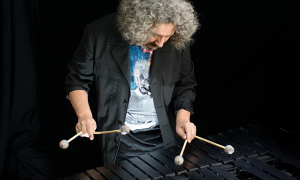
The problem with hitting a festival on the first day, immediately after a long transatlantic flight and minimal sleep, is that no matter how good the act is, there are limits on how much the body can take. Having to leave Karlstorbahnhof Heidelberg after one set was certainly no reflection on Empirical's performance. This young, award-winning British quartet on the ascendancy has just released its third CD and, in a first set that combined material from Elements of Truth (NAIM, 2011) and its previous Out 'n' In (NAIM, 2009), proved capable of handling its own series of adverse circumstances. In an introduction before the group began the first of two sets, drummer Shaney Forbes described what is becoming the standard travel story for touring musicians: flight delays and missing gear.If these problems had any impact, there was certainly no sign of it as the quartet slowly coalesced into Elements of Truth's opening track, "Say What You Mean, Mean What You Say," defining its aural space instantly. With bassist Tom Farmer and alto saxophonist Nathaniel Facey whistling an oblique melody over vibraphonist Lewis Wright's ethereal cushion, the mood shifted suddenly as Wright began an angular, repetitive pattern, signaling a contrary-motion bass line and the entrance of Forbes, a powerhouse drummer, to be sure—nearly overflowing with ideas—yet with the kind of superlative dynamic control that meant he never overwhelmed his band mates or the group's acoustic vibe.
It's rare to see a young group like this dressed out in suits and ties, but the influence of '60s-era Eric Dolphy clearly reigned over the quartet in more ways than one, with the alto/vibes/bass/drums lineup of the late innovator's groundbreaking Out to Lunch (Blue Note, 1964) a clear touchstone, even as the quartet retained its sense of modernity by incorporating elements of classical composer Olivier Messiaen and the heady cerebralism of pianists Andrew Hill and, more contemporary, Vijay Iyer. Farmer may remain largely in a supporting role—interactive, to be sure, but more about creating a firm pulse around which Forbes could orbit— but as the primary writer on Elements of Truth (writing all but three of its ten tracks, an increase from his more egalitarian split with Facey on Out 'n' In), his importance in defining Empirical's sound has become increasingly clear.
If Empirical's set leaned towards an intellectual kind of expressionism that rarely settled into a steady rhythm—Forbes' fluid approach mirroring the late Tony Williams' ability to oftentimes suggest a groove without actually playing it, even more noticeable live—it still proved capable of lighting a fire later in the set, when it delivered an incendiary version of Dolphy's "Gazzeloni," where Facey managed its broad intervallic leaps with effortless aplomb, bolstered by the strongest swing of the set from Farmer and Forbes. Liberally relying on his instrument's sustain pedal to create self-supporting atmospheric voicings, Wright's solo demonstrated the kind of restraint that is also rare amongst musicians his age, as he delivered quirky motifs where space was an equal component, while proving his virtuosity with occasional lightning-fast bursts. In his only solo of the set, Farmer's penchant for pulse remained integral, while Facey incorporated brief multiphonic moments that suggested an even more outré disposition.
Elsewhere, Facey's "A Bitter End for a Tender Giant" was a suitably dark ballad that reflected the tragic and outrageous circumstances surrounding Dolphy's death at the age of 36—collapsing into a diabetic coma while on tour in Europe in 1964, just nine days after his birthday on June 20, the reed player was left untreated in a hospital under the assumption that, as an African American jazz musician, he had, instead, overdosed on drugs. Trading fire for visceral restraint, Facey's playing here—as was the case throughout Empirical's set—reflected a more thoughtful and less recklessly unbound approach that, nevertheless, possessed plenty of heart and soul.
Already recognized at home, having won the Best Jazz Act in the 2010 MOBO Awards, Empirical has already begun to conquer the international market, with exposure at festivals ranging from Norway's Molde Jazz Festival to New York's JVC Festival and the prestigious Festival International de Jazz de Montréal. With performances like its first set at Enjoy Jazz, Empirical's slow but steady upward trajectory promises even greater things to come.
October 28: Claus Boesser Ferrari/Thomas Siffling Duo
With the limitless possibilities brought to contemporary improvised music through the integration of technology, it's now possible to work in the intimate context of a duo without sacrificing the more expansive sonics afforded by larger configurations. A simplistic look at the personnel on Duologix (Jazz 'n' Arts, 2011) might be deceptive—guitarist Claus Boesser Ferrari on acoustic guitars and electronics, and Thomas Siffling on trumpet, flugelhorn and electronics— because this duo is a far cry from the acoustic interactions of Ralph Towner and Paolo Fresu on Chiaroscuro (ECM, 2009). Ferrari is, at least to some extent, informed by Towner, but is just as influenced by Bill Frisell—Duologix even containing the duo's version of the title track to Frisell's Ghost Town (Nonesuch, 2000), which unfortunately was not part of the duo's set at Alte Feuerwache in Mannheim, a converted fire station that is now an arts venue with multiple performance spaces, studios, a restaurant and more.Ferrari, whose main instrument—a road-tested, battle-worn six-string acoustic configured with two pickups, allowing him to pitch shift the lower two strings an octave down so that he can simultaneously sound like both a bassist and a guitarist—is the electronic equivalent of American seven-string guitarist Charlie Hunter. Add to that his percussion self-support using the body of his guitar like a drum— slapping it, as well as using the nails of his right hand—and an overall rhythmic approach to his playing, and Ferrari made it possible for the duo to manage plenty that a strict acoustic pairing could not. Siffling, a busy trumpeter in the Mannheim area, used a looping device, a pitch shifter (with harmonics, at times, approaching the sound of Jon Hassell and Nils Petter Molvaer) and more, in order to broaden his own sound world, but underneath it all he was clearly a fine player who would have been able to carry it off without the aid of his outboard gear.
The capacity crowd confirmed that this duo may not be known on an international level, but it sure has an enthusiastic local following, and in a set that combined soft lyricism (Uli Wagner's "Coming Home") with more energetic expressionism (Mongo Santamaria's "Afro Blue"), Ferrrari and Siffling demonstrated an easygoing comfort level with each other and the crowd, their sometimes lengthy introductions (in German, so unfortunately not understood) clearly entertaining and funny, based on the audience's response.
The set was not without its weak points. Ferrari was an impressive finger-style guitarist, fluid and big-toned (even without the electronics), but in a jazz context his vernacular was somewhat restricted. When the duo engaged in some completely extemporaneous free play, that limitation became something of a liability, especially when contrasted with Siffling, who clearly possessed a broader linguistic command. Still, what Ferrari lacked in language he made up for in enthusiasm and willingness to try anything, from placing a thin mallet beneath the strings to using it to strike the resonator of a dobro-style guitar.
The duo also took a look at a couple of iconic pop tunes. The Beatles' "Come Together" was more successful, if only because, while the duo's approach to the verse and intro vamp of Jazz Police's "Walking on the Moon" was intriguing, its delivery of the chorus was a little obvious and heavy-handed. Siffling's use of electronics throughout the set was, perhaps, rendered somewhat less inventive in light of artists like Molvær—whose Baboon Moon is another step forward for the intrepid Norwegian trumpeter and his current trio—but his layered "trumpet choir" at the start of "Tired Tiger" was certainly appealing. Most importantly, at the core of it was Siffling's undeniable ability as a trumpeter, with a pure tone that also transferred beautifully to flugelhorn.
Ferrari's greatest skill was as an accompanist who, through the use of extended techniques and electronics, turned a single acoustic guitar into a virtual one-man band. If his acumen as a soloist was perhaps less impressive, it did little to detract from the entertainment quotient of the duo's set, which was so well received by the audience that one encore was simply not enough, the crowd clapping, hooting and hollering, compelling Ferrari and Siffling to return once more, for a more relaxed, crowd-subduing finale.
October 29: Lorez Raab :XY Band
He wasn't performing the night after his duo show with guitarist Claus Boesser Ferrari, but trumpeter Thomas Siffling was back at Alte Feuerwache, this time as head of the indie Jazz 'n' Arts label. With a surprisingly large discography which, while focusing largely on German musicians—many of them up-and-coming—includes sessions with everyone from trumpeters Randy Brecker, Alex Sipiagin, Manfred Schoof and Kenny Wheeler to pianists Kenny Werner and Wolfert Brederode, and drummer Jim Black, here at Alte Feuerwache, Jazz 'n Arts was celebrating its 10th anniversary, in collaboration with Enjoy Jazz, by hosting a performance from trumpeter Lorenz Raab and his :XY Band, which has just released its debut, Hyperdrive (2011).Even before the show began, it was clear this was not going to be a conventional performance, with a lineup featuring two bassists (Matthias Pichler and Oliver Steger, a drummer (Herbert Pirker and, most unusually, Christof Dienz on electric zither. This may be a new venture for Raab, but he's by no means new on the German scene, with a number of releases as leader or guest on Jazz 'n' Arts, and the chops to support such demand. As might be expected from such a bottom-heavy rhythm section, the group Raab has assembled trades heavily on groove, but it relies just as much on texture. With the trumpeter's seemingly endless embouchure variations and Dienz's dizzying array of pedals, there were plenty of timbral possibilities. If the group seemed to be largely weighing in on the free improv part of the jazz equation, there were plenty of indications that this was open-ended exploration revolving around some very defined structural roadmaps.
Pinker was wearing a Led Zeppelin t-shirt, which was ultimately a foreshadowing of things to come, as he blended lighter jazz-centricities with thundering, high-octane kit work on "Unterlandber Zipfeltranz," which moved from ethereal electronics to a pounding, near-metallic ostinato driven by the drummer and bassists Pichler and Steger, who managed, quite remarkably, to work together without ever getting in each other's way. Pichler seemed the more extroverted of the two, and utilized extended techniques such as putting clothespins on his strings and furiously rubbing the handle part of his bow against those same strings. If Steger seemed a tad less outgoing, it wasn't for lack of inventiveness, as he shared groove and freer melodic invention with his bass partner throughout the set.
Raab demonstrated remarkable command of his instrument—whether soaring into the stratosphere with ease, or delivering gently melodic lines, made tarter on occasion, with the use of a Harmon mute—turning into a textural player with rhythmic blasts of air and punctuating motifs. But as much as :XY Band relied on Raab for a variety of purposes, it was Dienz who shone amongst an entire group of fine players, if for no other reason than the absolute unorthodoxy of his instrument. Using both hands on this multi-stringed instrument, Dienz fed it through distortion boxes, pitch shifters, delay and reverb, and many other devices to approximate, at times, the sound of a tapped electric guitar, but often doing things that were simply not possible on its six-string cousin.
Taking place in a smaller venue upstairs from the Alte Feuerwache's main space, it was a close-to-capacity audience for a performance that ran the gamut from atmospheric to swinging, and from near-acoustic delicacy to high-powered, rock-driven grooves. That the quintet appeared to be extemporizing freely, only to suddenly coalesce in a clearly defined arrangement, only made :XY Band's show all the more exciting- -so much so, that the audience refused to let it leave before delivering not one, but two well-deserved encores. Raab's lip appeared to be bleeding when it was all over, and if the trumpeter's hard playing recalled John Lennon's famous "I've got blisters on my fingers..." line at the end of "Helter Skelter," from The Beatles' The Beatles (Apple, 1968)—a.k.a. the White Album—it's a reasonable comparison, because as much as Raab and his :XY Band are indebted to jazz for its language and freer explorations, it's equally in service to the world of rock for its high-octane, high-volume extremes.
October 30: Theo Bleckmann's Hello Earth!
A singer who, since emerging in the mid-1990s on left-of-center albums by American artists like bassist Mark Dresser, electronic percussionist Ikue Mori, guitarist Ben Monder and drummer John Hollenbeck, Theo Bleckmann has positioned himself as a singer capable of deep emotional resonance without any of the syrupy sentimental currency on which modern jazz singers so often trade. Instead, the vocalist/composer has gradually, and with unfailing inevitability, built a career predicated on an experimental mindset that's made him as comfortable in the new music arena as he is in the jazz sphere, with the two often intersecting in weird and wonderful ways.His latest project might, on the surface, seem to pander to an audience currently going through a love of all things 1980s, but ultimately it proved to be far more. Hello Earth! is both the name of Bleckmann's 2011 recording for Winter & Winter—paying tribute to the music of British pop icon Kate Bush—and the name of the band he brought to Karlstorbahnhof Heidelberg, arriving so close to show time that there was no time for a full sound check, making its gradual coalescence around one of Bush's bigger hits, "Running Up That Hill," a show- opener that suggested great portent for the set to come. Clearly Bleckmann and Hello Earth! were going to do Kate Bush better than Bush herself.
Tribute projects can be a dicey proposition, striving for the fine line between remaining literal enough to give the audience the touchstones it needs and, at the same time, delivering something new to give the music its own distinct resonance. Bleckmann's homage remained literal when it made sense to do so—where Bush's music was so key to the essence of the song as to demand greater reverence. Still, with a group capable of combining pop sensibilities with no shortage of jazz chops, Bleckmann took plenty of liberties as well. The quirky, irregular meter gave "Suspended in Gaffa" a significantly altered complexion, while Bleckmann's buoyant delivery of the verses gave it a Broadway vibe. And if "Dream of Sheep" approached near-ambient territory—with Iceland-born/New York-resident bassist Skúli Sverrisson doing a number of distinctly un-bass- like things, including the creation of resonant chords washing gently under the music—then the encore of "Violin" was delivered with unapologetic punk attitude and energy, with drummer Ben Wittman providing unrelenting support to Bleckmann, who fed his voice through a rack of processing devices to give both the feeling of multi-tracking and edgy overdrive as keyboardist Erik Deutsch upped the ante with dense organ work.
Sverrison—who, in addition to being Laurie Anderson's musical director in recent times, has played with everyone from Ben Monder to Allan Holdsworth, as well as on his own Sería (12 Tónar, 2007) and its follow-up, Sería II (Sería Music, 2010) in carving a compositional space particularly unusual for an electric bassist—his performance of some of those two discs' material was one of the highlights of the 2010 Punkt Festival in Kristiansand, Norway—managed to combine a more conventional role here with the sonic explorations he's used to build a distinct career. In addition to his own recordings, including the forthcoming Demonío Teclado (Hammer and String, 2012), Deutsch is perhaps best known for his time spent with Charlie Hunter earlier in the decade, and if he had to bring his background in extracurricular activities to bear during much of Bleckmann's performance, then his opening solo on "Saxophone Song," with Sverrison and Whittman swinging hard, made clear that his jazz chops remain unshaken.
But it's the multidisciplinary approach of everyone in the band that made Hello Earth!'s performance so strong. Bleckmann's effortless control over his electronics—layering himself in real time to great effect on "Cloudbusting" (with guitarist/violinist Caleb Burhans, of contemporary music group Alarm Will Sound, particularly key)—was just one part of a sonic arsenal, but equally, it was his tremendous range, meticulous accuracy and intrinsic sense of what works and what doesn't, from one moment to the next, that made his Enjoy Jazz 2011 performance one of the highlights of the week.
October 31: Ingrid Lukas
Catching the interest of Swiss pianist Nik Bärtsch—a rising star in the last half decade, for his three revolutionary and evolutionary ECM releases—Stoa (2006), Holon (2008) and, most recently, Llyrìa (2010)—sure didn't hurt Estonian-born/Swiss- resident singer/pianist/songwriter Ingrid Lukas' credibility, when she released We Need to Repeat in 2009 on Bärtsch's own Ronin Records label. But as much as her association undoubtedly helped give her career a bit of a kick-start, she really needed to obtain broader international distribution to push her career to the next level.The good news is, that's exactly what's happened. We Need to Repeat caught the ear of EmArcy/Universal, and two years later, Lukas' Silver Secrets is hitting the streets, demonstrating palpable growth in her writing and overall conception, as well as an attendant increase in confidence. While comparisons are not always a good thing, it's certainly serendipitous that Lukas was hooked up with Valgeir Sigurðsson—an Icelandic composer best known, on an international scale, for producing Björk's Selmasongs (Atlantic, 2000) and Medúlla (Atlantic, 2001). Lukas clearly has her own thing going on, but it's difficult for any singer her age to avoid the experimental Icelandic pop star's influence.
If there were to be any direct comparisons to Björk, it was more about an intrepid nature and an avoidance of standard pop conventions. Though the group on Silver Secrets is larger than the quartet she brought to Alte Feuerwache in Mannheim, both the recording and touring group retain a steadfast avoidance of the typical. Playing piano, harmonium and mbira (thumb piano), and joined by cellist Céline-Giulia Voser (doubling on piano), violinist/bassist Michel Gsell (also singing backup vocals and taking the spotlight for one mid-set song) and drummer Patrik Zosso (who also brought some drum programming and a wood block), Lukas' music was unequivocally pop, but with an unconventional approach.
A capable pianist, it was Lukas' voice—a combination of delicate fragility, unassuming honesty and, at times, unexpected power—that separates her from so many young singer/songwriters her age (not to mention a refreshing avoidance of the melismatic melodrama so endemic to the American Idol generation). It was impossible to deny the influence of her early years in Estonia, a country with a rich and deep vocal culture that informed her choice of traditional folk songs like "Laula," an early indication of Lukas' vulnerability that, built upon simple quarter-note chords, gradually picked up steam as Zosso's military-style kit work lent the song greater forward motion, even as it came in stark contrast to the lovely combination of Voser's cello and Gsell's violin, which brought the song to a close.
Lyrically, Lukas has been collaborating with Dave Mullan this time around—an Irish mandolinist and songwriter who has been a quiet but invaluable aid to Norwegian artists like Bugge Wesseltoft (who provided assistance to Lukas in the development of Silver Secrets' music, despite Sigurðsson getting the producer gig), his jack-of-all-trades/master-of-many skills ranging from writing content for the keyboardist's Jazzland Records site and Gube Music (a tremendous internet shop front for high quality digital music) to website design and more. His assistance in helping Lukas hone her lyrics ranges from help with "Greener Lands," one of her set's strongest songs—paradoxical given its melancholy flavor and the repetitive sentiment of being "so tired"—to more overt, yet unintended contributions to "Do Whatever You Do," which Lukas pieced together from a series of email exchanges, though its reliance on a great many voices rendered it a song that couldn't make it into the live set list.
Combining music from both recordings, Lukas' ability to feel somehow grounded in the music even as her delivery—and that of her fine band—gave it an ethereal, otherworldly quality, made for a compelling and appealing set that felt somehow like being transported to an alternate reality for 80 minutes or so. Comfortable onstage, her between-song patter is relaxed and engaging, even for those who didn't speak the language. Universal is clearly hoping that Lukas has what it takes to achieve more widespread success. Based on her Enjoy Jazz performance, there's little doubt that she's ready to take the leap.
November 1: Pat Metheny Trio 10>11
After spending a chunk of 2011 on the road in duo with bassist Larry Grenadier, the fall season finds veteran guitarist Pat Metheny on a European tour with the reunited Trio 99>00, responsible for the fine Trio 99>00 and the even better Trio Live (both released by Warner Bros. in 2000). While Metheny subsequently hit the road in 2007 with a different trio—releasing Day Trip and the live EP, Tokyo Day Trip on Nonesuch in 2008—his group with Grenadier and drummer Bill Stewart remains one of the best-loved of his non-Metheny Group projects.But a lot has happened in the past decade. If Trio 99>00 was, for the most part, a smaller, more portable unit , the renamed Trio 10>11 meets Metheny Group halfway, based on its set at Theatre im Pfalzbau in Ludwigshafen, the third of the three cities in which Enjoy Jazz programs its shows. After all, how many trios tour with a bevy of guitars, including guitar synth, and a number of acoustic and electric guitars, including the hybrid monstrosity of Metheny's 42-string Pikasso guitar? How many jazz guitar trios tour with a complex amplification system, racks of effects and processors, and a guitar tech? How many tour with an actual theatrical set that includes a variety of palm trees scattered around the stage and extensive lighting?
Even in the more intimate context of a trio, Metheny—with his long hair, jeans and standard horizontal-striped shirt—brings a kind rock and roll production aesthetic, though there's no question about its jazz cred, as the guitarist delivered a set heavy on his own originals, spanning his nearly 40-year career, as well as astute choices from past collaborations with pianist Brad Mehldau and saxophonist Ornette Coleman.
Metheny stuck with a single guitar—a hollow body electric with two outputs, allowing him to blend its natural electric sound with, amongst others, the sound of an acoustic guitar—for the first half of the set. Coming onstage with Grenadier, the duo's opening look at Mehldau's fugue-like "Unrequited" quickly established a deeply shared connection, and demonstrated just how far the bassist has come in recent years. Always a rock-steady accompanist, Grenadier's strength as a soloist seems to have made a significant leap forward, notably at his 2009 Enjoy Jazz performance with Italian trumpeter Enrico Rava's New York Days (ECM, 2009) group. Here, the easygoing and intimate rapport allowed Grenadier to be anchor, contrapuntal partner and impressive soloist.
Few guitarists possess Metheny's technical facility while, at the same time, remaining tightly aligned to the importance of melody. His ability to unfold solos with unfailing inevitability has rarely sounded this good, as one of his early Metheny Group tunes, "James"—first heard on Offramp (ECM, 1982), but also documented by Trio 99>00 on Live—brightened the pace. At this point in his career, Metheny's playing no longer grows in massive leaps and bounds, but it continues to grow just the same. He executed lines that were unmistakably him while, at the same time, stretching his own rather far-reaching boundaries just that extra bit further. Metheny may not have anything to prove to his audience or his band mates, regardless of context, but his steady evolution certainly suggests he still has something to prove to himself.
As much as "James" was impressive for its greater burn, it was the duo's look at another original, this time from Question and Answer (Nonesuch, 1990), that was the high point of this mini-duo set. "Change of Heart" was unrepentantly Metheny; possessing that Midwestern lyricism so constantly attributed to the guitarist—though, later in the show, when he was introducing the songs, he quipped that he didn't think of "Missouri," when he thought of the title track to his debut as a leader, 1975's Bright Size Life (ECM), he actually thought "Stuttgart"—it also demonstrated his rarely matched ability to write and perform music that may sound easy and accessible, but is often far more complex under the covers.
Stewart, who first came to international attention for his work with another modern guitar icon, John Scofield, remains an in-demand player whose melodic approach is well-matched with Metheny; he rarely soloed during the trio's set, but when he did, it demonstrated a similar penchant for freedom within structure, the form over which he was soloing always clearly present. Starting with the ambling "Soul Cowboy," a blues from Trio 99>00, the trio swung with effortless aplomb, ratcheting the energy up even further with a buoyant version of "Bright Size Life," but returning to softer territory with a reductionist treatment of "Always and Forever," first heard on Metheny's ambitious Secret Story (Nonesuch, 1992).
A mid-set highlight, Metheny turned to one of his most often-covered compositions, the swinging, waltz-time title track to Question and Answer. A lengthy exploration from the guitarist led to a powerful, set-defining solo from Stewart that was staggering in its ambidextrous independence and interdependence of arms and legs, and a lengthy coda vamp over which Metheny, switching to his Roland guitar synth, layered increasingly intensifying horn lines that built to a fever pitch, only to gradually fade to silence as the stage faded to black. Always a show-stopper, the capacity crowd went wild.
More than just an early climax, "Question and Answer" acted as a mid-set shift in approach, as Metheny used the second half of the show to bring a wider variety of guitars into the picture. Metheny Mehdlau's "Find Me In Your Dreams" and the always-poignant "Farmer's Trust," from an early Metheny Group milestone, Travels (ECM, 1983), brought the dynamics way down as the guitarist switched to a nylon-string acoustic guitar. With Grenadier and Stewart leaving the stage, Metheny's longtime guitar tech, Carolyn Chrzan, brought out his Pikasso guitar for an impressive solo piece where he demonstrated effortless mastery of this unwieldy combination of two necks, sympathetic strings that he also picked, harp-like, and a tuning that few but he could understand, let alone conceive.
If managing a 42-string guitar seems something beyond the capacity of the average guitarist, then Metheny's Orchestrion (Nonesuch, 2010) was even more difficult to fathom. When the guitarist toured with this robotic collection of instruments in 2010—played, in real time, by Metheny through pneumatics and solenoids triggered by his guitar and a massive foot pedal—most folks expected it to be a one-time thing, but he has always been known for introducing a new concept and continuing to use it, in some smaller capacity, as part of an ever-growing palette of instruments and sound sources. So it was good to see that the Orchestrion is to be an ongoing part of his work, as Chrzan took away two curtains at the back of the stage, to reveal a miniature version of this innovative and 21st Century expansion on the player piano concept.
Beginning solo, Metheny's partly improvised/partly structured piece ran into some trouble when, a few minutes into the piece, as he was triggering reeds, cymbals and glass bottles—each specific instrument lighting up when it was triggered by Metheny's combination of foot pedals and modified electric guitar—there was suddenly a puff of smoke and most things stopped. As complex an instrument as the Orchestrion is, Metheny's ability to take it on the road and keep it up and running still doesn't guarantee that something won't occasionally go wrong, but it was to his credit that he quickly resolved the problem and kicked the piece back into gear, with a smile and a laugh from the audience. Combining the Orchestrion with looped guitar lines, a consistent groove gradually emerged and, as Grenadier and Stewart returned, Metheny laid waste to accusations of the Orchestrion's lack of humanity, the piece loosening up even further and assuming even more defined form as the guitarist changed the key of his loops through his pedal board.
Surprisingly—and, in some ways anti-climactically—Metheny ended the show with the Orchestrion piece, but returned for the first of three encores with the trio, delivering a short but exuberant version of Ornette Coleman's "The Good Life." Returning a second time, this time on his own, Metheny covered The Beatles' "And I Love Her," a nylon-string guitar feature from his latest solo release, What's It All About (Nonesuch, 2011), and closing the evening, on baritone guitar, with Henry Mancini's "Slow Hot Wind."
As ever, Metheny knew how to structure a set, though the sold-out crowd would happily have taken more. Packing plenty into a performance that ran a little over two hours—solo, duo, trio, and Orchestrion, and using a bevy of guitars—if Trio 99>00 was one of his best groups to date, then Trio 10>11 managed to actually surpass itself. Hopefully, if a studio album isn't in the plans, then a live CD or DVD is.
Wrap-Up
Leaving for Frankfurt on the morning of November 2, there was still another couple weeks left to Enjoy Jazz, which will include performances by Mathias Eick, Henry Threadgill's Zooid, pianists Marcin Wasilewski and Craig Taborn, and Nik Bärtsch's Ronin (with a new bassist replacing the recently departed Björn Meyer), as well as an anticipated return by Jan Bang and Erik Honoré, who will be bringing Punkt to Mannheim for a follow-up to its successful one-day event there in 2009.It's always a tough call, when invited to Enjoy Jazz for a week, to choose the right one, and there are always plenty of shows that, regrettably, have to be skipped. The only way to do it is to look for a week where there's a combination of artists high on a personal "must-see" list, as well as some lesser-knowns that look intriguing. Checking Metheny, Lukas and Bleckmann off the list, this week at Enjoy 2011 was just as enjoyable for the triple-punch of Empirical, Lorenz Raab's :XY Band, and the Claus Boesser Ferrari/Thomas Siffling Duo.
Hopefully there will be an opportunity to return to Enjoy Jazz in 2012. Its commitment to artists, fans and journalists has created, with Managing Directors Rainer Kern and Christian Weiss continuing to fight the good fight for presenting a festival of tremendous artistic breadth, a context that allows everyone as a result to absorb, reflect upon and enjoy it.
Visit Empirical, Claus Boesser Ferrari, Thomas Siffling, Lorenz Raab, Theo Bleckmann, Ingrid Lukas, Pat Metheny and Enjoy Jazz on the web.
Photo Credit: John Kelman
Comments
Tags
Enjoy Jazz
Live Reviews
John Kelman
Germany
Mannheim
Sonny Rollins
pat metheny
Nils Petter Molvær
Dino Saluzzi
Anja Lechner
Shaney Forbes
Tom Farmer
Nathaniel Facey
Lewis Wright
Eric Dolphy
Andrew Hill
Vijay Iyer
Tony Williams
Ralph Towner
Paolo Fresu
Bill Frisell
Charlie Hunter
Jon Hassell
Mongo Santamaria
The Beatles
The Police
randy brecker
Alex Sipiagin
Manfred Schoof
Kenny Wheeler
Kenny Werner
Wolfert Brederode
Jim Black
Herbert Pirker
Led Zeppelin
John Lennon
Mark Dresser
Ben Monder
John Hollenbeck
Theo Bleckmann
Ben Wittman
Erik Deutsch
Laurie Anderson
Allan Holdsworth
Alarm Will Sound
Nik Bartsch
Bugge Wesseltoft
Larry Grenadier
Bill Stewart
brad mehldau
Ornette Coleman
Enrico Rava
John Scofield
Henry Mancini
Henry Threadgill
Marcin Wasilewski
Craig Taborn
Jan Bang
For the Love of Jazz
 All About Jazz has been a pillar of jazz since 1995, championing it as an art form and, more importantly, supporting the musicians who create it. Our enduring commitment has made "AAJ" one of the most culturally important websites of its kind, read by hundreds of thousands of fans, musicians and industry figures every month.
You Can Help
To expand our coverage even further and develop new means to foster jazz discovery and connectivity we need your help. You can become a sustaining member for a modest $20 and in return, we'll immediately hide those pesky ads plus provide access to future articles for a full year. This winning combination will vastly improve your AAJ experience and allow us to vigorously build on the pioneering work we first started in 1995. So enjoy an ad-free AAJ experience and help us remain a positive beacon for jazz by making a donation today.Near


Giveaway

Eligible winners: 15
Days remaining: 5
Days remaining: 5