Home » Jazz Articles » JazzLife UK » It's Our Generations
It's Our Generations


Of course, many people might talk about jazz "crossing the generation gap" at this point. But I don't buy the gap idea, especially in jazz. I routinely hear bands with players in their late-teens and their eighties, artists who name-check inspirations from the '30s and '40s as well as from this century. The Sax Massive that played at the 2011 Norfolk and Norwich Festival included mothers and daughters, and grandfathers and grandsons. I have many middle-aged friends who firmly believe that jazz is dreadful, and my sons have many friends in their early 20s who share that view. Jazz brings the generations together in numerous ways.
Much of this sharing simply happens, a by-product of the music. But when the jazz community acts deliberately to bring the generations closer together, then it can achieve some truly worthwhile things. Over the summer months, the UK scene has been full of examples of this sharing, of jazz as a genuine community of people.
Keeping It In The Family
An obvious way of spreading the word across the generations is to keep it in the family, and there are plenty of great examples in jazz. Here in the UK there's Stan Tracey and his drummer son Clark Tracey; Yes guitarist Steve Howe and his drummer son Dylan Howe; and father and son saxophonists Charlie Parker and Evan Parker (OK, perhaps not that one). Above all, there's the Dankworth dynasty: the late composer and saxophonist Sir John Dankworth; his wife, singer and actress Dame Cleo Laine; bassist son Alec Dankworth and daughter Jacqui Dankworth—singer, songwriter and actress. They don't just keep it in the family, either: Sir John and Dame Cleo have supported the development of jazz in many ways including the establishment of The Stables Theatre in Wavendon.
If the notion of the jazz community as one big family is acceptable, then there are many different examples of parents and grandparents helping their enthusiastic but inexperienced offspring. Norwich played host, during August, to one of the best examples, with some of the UK's finest jazz musicians passing on their expertise and advice to a younger generation.
The National Youth Jazz Collective Summer School At Norwich
The finest jazz has always struck me as a cooperative endeavor; musicians working together, firing off each other's playing, driving each other to greater and greater heights. Such cooperation also shows itself in the ways in which older, more experienced, musicians support and encourage the up-and-comers, the new recruits. The National Youth Jazz Collective is a fine example.
The NYJC—led by its Founder and Executive Artistic Director, composer/saxophonist/educator Issie Barratt and, with bassist Dave Holland as its President—seeks "to support the creative and educational needs of the young jazz musician." One of the NYJC's key annual events is the Summer School, which took place this year at the University of East Anglia, in my home town of Norwich.
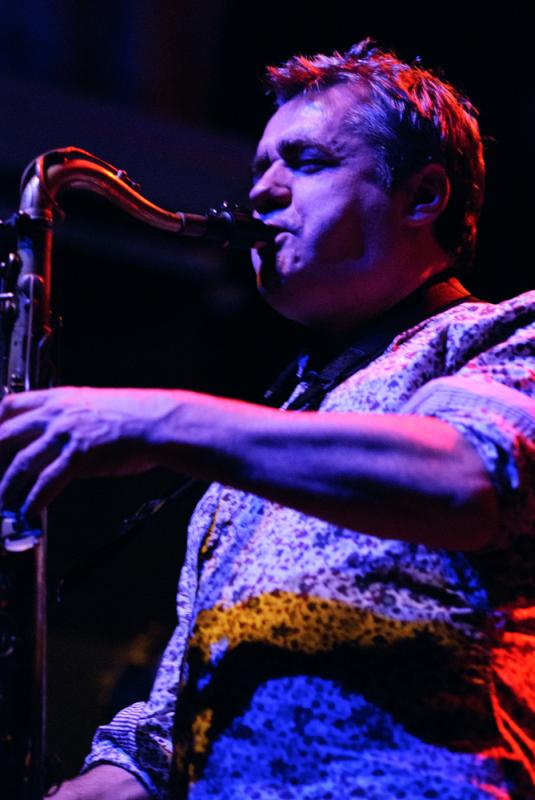 Following a series of auditions across the country, over 30 young musicians aged 14 to 18 years were selected for the week-long event, with another dozen or so attending a shorter preparatory program. The teenagers came from as far away as Cornwall in the southwest and Kendal in the northwest (about as far from Norwich as it's possible to get and still be in England). There were drummers, bassists, horn players, pianists and guitarists. The tutors included top flight British jazz musicians such as pianist Liam Noble, guitarist Mike Walker, saxophonist Mark Lockheart (pictured right) and pianist Nikki Iles.
 I was invited to the Summer School's closing concert, and when I arrived I was forewarned that there would be some "seriously good" playing—but the tutors would say that, wouldn't they? The students had spent the week working in five small combos, each under the care of two tutors, and for the concert each ensemble performed three or four tunes.
There was some seriously good playing. And it was a joy to hear.
While the young players impressed with their individual abilities, their ensemble work was, if anything, even more impressive. The musicians interacted with an easy familiarity that belied their short time together, keeping eye contact, taking cues, improvising solos and generally looking like they were having a good time. They also conveyed their enthusiasm to the audience—something plenty of far more experienced jazz musicians often fail to do.
The selection of music was also impressively broad, keeping clear of the standard repertoire in favor of an eclectic mix of classics, more contemporary tunes and even one or two new compositions that emerged from the week's activities. Compositions by Jaco Pastorius, Steve Swallow, Wayne Shorter and Gwilym Simcock all featured in the concert. The set of tunes played by the first ensemble sums up this eclectic mix perfectly: Lee Morgan's "Sidewinder," Charles Mingus' "Better Git It In Your Soul" and Nick Drake's "River Man."
The National Jazz Archive
But how do the older generations stay connected to the younger when those older players are no longer on this Earth?
Jazz is now old enough for its earliest practitioners to be no more than distant memories—faded black and white photos and scratchy old 78s offering mere hints at their greatness. These past generations are still relevant, still with something to say to the contemporary scene. We just need a bit more help to listen to what they have to tell us. In Britain, the National Jazz Archive provides that help, chronicling the music's history through its collection of books, journals, photos and ephemera (although the sounds themselves are held in the National Sound Archive).
Earlier in 2011 the Heritage Lottery Fund awarded a grant of £346,300—around $560,000 USD—to the NJA to help in the expansion of its work. The grant will be used for developments such as the creation of a "Story of British Jazz" website and the comprehensive cataloging of the NJA's holdings. The possibilities for scholars, historians, musicologists, musicians and fans alike are genuinely exciting.
Notivate
The NYJC shows what can be done when enthusiastic and talented young people are given the chance to explore jazz in the company of superb musicians and teachers. But there is also much that music can do for other youngsters.
John Bowman, a musician and manager of the recording studios at The Stables, established Notivate ten years ago. Its main activity, Bowman explains, is a singer-songwriter program aimed at children aged 9 to 13 years. More recently, Bowman has developed a jazz element to the organization's work. "The jazz started life as a one day workshop. We got four musicians—Jeff Clyne, Nick Weldon, Mark Lockheart and Trevor Tomkins—up to Northampton to run an improvisation day for young musicians who were already part of local jazz ensembles. There was a series of activities, followed by an evening performance. It was aimed as much at developing the participants' confidence as it was at bringing on their instrumental skills."
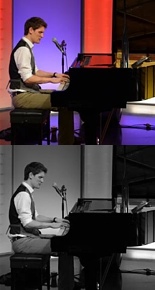
 A year after the improvisation workshop, Bowman and Weldon ran a second day, targeted at specific young players from Northamptonshire's three jazz ensembles and ending, once again, with a performance. Soon after this Bowman began to work with a young local bassist, Loz Garrett (pictured right), in the band of singer and songwriter Martyna. The bassist is a recent graduate of the Trinity College of Music in London, and also works with Chris Eldred, winner of a 2011 Yamaha Jazz Scholarship. Garrett ran a workshop for Bowman as part of his final examination at Trinity and is now planning another workshop for later in 2011.
 Bowman is clearly proud of the way in which Notivate is helping to develop the skills, and particularly the improvisational skills, of young players. He has plans for a DVD featuring Garrett, to be used as a resource for schools. He's is also taking jazz into local communities, giving the experience of live music to young people who might not otherwise have the chance to get involved. "We'll be doing performances in youth clubs, live gigs—there will be five initially, across the county. To be honest, the word 'jazz' might not even crop up. We just want to take a live quartet or quintet into these communities, play and improvise, and introduce them to that style of music." There are also plans, still at an early stage, for a "jazz youth club. Somewhere for kids to come and play, with a rhythm section, where kids can just come and enjoy themselves, have a jam, and not feel they're working towards a performance. It's a bit of an experiment."
Hopefully the experiment will reach fruition soon. Certainly, Bowman's enthusiasm and experience suggest it has a strong chance of success—he also runs workshops at The Stables, where he has already persuaded saxophonist and rapper Soweto Kinch to meet workshop participants before his own performance at the venue.
Like the NYJC, with which Bowman is in contact, Notivate's work depends on grants and donations from a variety of groups, organizations and individuals. These are not profit-making activities, but their potential social capital is huge.
What's Wrong With The British Jazz Scene This Month?
Well, yet again, the "token jazz album" didn't win the Mercury Music Prize. But no-one really expected that it would, despite the undoubtable talents of pianist Gwilym Simcock, whose Good Days At Schloss Elmau (ACT Music, 2011) was this year's jazz nominee. At least jazz albums still routinely get nominated for the award—it's been some years since a classical music album made it through, and the dear old Heavy Metal scene has never managed to get one of its own recordings into the final twelve.
If that's all that's wrong, then one mustn't grumble. But maybe that's a big "if."
Photo Credit
All Photos: Bruce Lindsay
< Previous
Speak to Me
Next >
What's Up Neighbor?
Comments
Tags
JazzLife UK
Bruce Lindsay
United Kingdom
Stan Tracey
Clark Tracey
Steve Howe
Dylan Howe
Charlie Parker
evan parker
John Dankworth
Cleo Laine
Jacqui Dankworth
Issie Barratt
Dave Holland
Liam Noble
Mike Walker
Mark Lockheart
Nikki Iles
Jaco Pastorius
Steve Swallow
Wayne Shorter
Gwilym Simcock
lee morgan
Charles Mingus
Jeff Clyne
Trevor Tomkins
Martyna
Soweto Kinch
For the Love of Jazz
 All About Jazz has been a pillar of jazz since 1995, championing it as an art form and, more importantly, supporting the musicians who create it. Our enduring commitment has made "AAJ" one of the most culturally important websites of its kind, read by hundreds of thousands of fans, musicians and industry figures every month.
You Can Help
To expand our coverage even further and develop new means to foster jazz discovery and connectivity we need your help. You can become a sustaining member for a modest $20 and in return, we'll immediately hide those pesky ads plus provide access to future articles for a full year. This winning combination will vastly improve your AAJ experience and allow us to vigorously build on the pioneering work we first started in 1995. So enjoy an ad-free AAJ experience and help us remain a positive beacon for jazz by making a donation today.

Giveaway

Eligible winners: 15
Days remaining: 5
Days remaining: 5