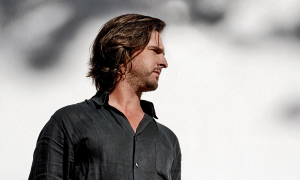
Home » Jazz Articles » Interview » John Scofield: Peaceful Pursuits
John Scofield: Peaceful Pursuits


Still, despite its largely relaxed nature and slower tempos, A Moment's Peace manages to come to a near boil at times— no surprise, given the powerful group that ultimately converged for a couple days in January, 2011, at Sear Sound in New York City: keyboardist Larry Goldings (making A Moment's Peace a recording reunion of sorts, having last worked on Trio Beyond's Saudades [ECM, 2006], in 2004); ubiquitous and ever-adaptable bassist Scott Colley; and Brian Blade, a drummer who, like Scofield, is perhaps better known for his unbridled power and sheer improvisational energy than the soft approach and subtle nuances he demonstrates here.
"This one had some bumps along the way," Scofield explains. "I started off wanting to do a record with [Norwegian keyboardist] Bugge Wesseltoft, and so I was thinking what kind of record could we do together. I thought of making a really lyrical record. I'm a fan of his solo piano stuff and the duo records he did with [Norwegian singer] Sidsel Endresen: Duplex Ride (Curling Legs, 1998), Nightsong (Curling Legs, 1999), and Out Here. In There (Jazzland, 2002), which I really, really love. And I was thinking that, rather than the groove stuff that he does, which I love too, it would be nice to do a really quiet record. Then it turned out that he couldn't tour this summer, after the record was released—because at that point the record was supposed to be released everywhere in the spring. So he couldn't do it, and that's on hold, but it's a project I still want to do sometime; I really want to do something with Bugge at some point.
"Then, I thought, I'd been playing with [pianist] Mulgrew Miller a lot," Scofield continues, "and he's so great, so I thought it would be great to use him, and make it more of a jazz ballads record. But then Mulgrew had a stroke last October—a mini-stroke, not a full stroke, a mini-stroke. He is now fully recovered, but he couldn't really do the recording in January, when I wanted to do it. So I called an old partner and really active musical associate of mine, Larry Goldings. We've played together for many years, and played a bunch together at some duo concerts in Italy the Christmas before last, so I asked him.
"Then the project started to change in my head too, because when you bring in Larry, there's a lot of stuff that he and I do together, and stuff that he does and really excels at, that I wanted to feature—and that also included playing the organ. Brian Blade on drums had always been the guy I'd wanted to play with, and Scott Colley on bass; they were always the rhythm section. But I think, in a way, having Larry was just perfect for the record; he brings so much to it."
The closest thing Scofield has done to A Moment's Peace was Quiet, his first recording for Verve in 1996, after a seven-year run on the equally prestigious Blue Note label. But while Quiet was, with Scofield limiting himself to acoustic guitar, an album of gentle beauty, it was by no means a ballads record. In addition to being a mix of originals and covers, A Moment's Peace, on the other hand, is one—though with Scofield back on his main electric axe, there are places where the temperature can't help but rise.
With the playing on A Moment's Peace never anything less than stellar, its relaxed vibe is also reflected in the way it was recorded. "We had a one-day rehearsal," says Scofield. "I thought about what tunes to do on this record for months, but as soon as I knew it was going to be Goldings—which was probably two months before we recorded—I honed the song list and sent the guys the lead sheets, and we talked about it a bit. I sent out a couple of recordings of the songs, but it was only the original stuff that I wrote—a live recording of me playing them with my trio with [bassist] Steve Swallow and [drummer] Bill Stewart. Everybody flew in to New York—Larry lives in Los Angeles, and Brian's in Louisiana [though Colley is a New Yorker]—and we had one rehearsal for four or five hours, just to play through the tunes, and then we went into the studio the next day and recorded.
"We did it in two day long days and then mixed for a couple days," Scofield continues. "I think that a lot of the success for a jazz recording has to do with how well it's recorded; that's the final touch. I'm really happy with [engineer] James Farber's work. He decided on the studio to use, Sear Sound—they have old analog equipment—and it was James who decided how to place everybody in the room. With his choice of microphones and all kinds of really subtle things I don't really understand, he really captured it."
"We had to put the Leslie speaker [for the organ] in a booth, so when we recorded with the Leslie, we had to use headphones," Scofield concludes, "but we were all in a room together. But one guy was in one corner and another guy in another. The bass and drums were not isolated in different booths; my guitar amp was in a booth, but the doors were open—they're floor-to-ceiling doors—so we were all in the same room. We still used headphones, though I think Scott and Brian were able to play with one headphone on and one off, which really helped them to maintain this kind of rhythm-section thing. And Farber thinks there's nothing wrong with a little leakage [between the instrumental tracks], unless you want to change stuff and do overdubs—and I do too; it fattens things up a bit.
Song Choices
While plenty of jazz artists have covered The Beatles, Scofield's inclusion of "I Will," from the Fab Four's The Beatles (White Album) (Apple, 1968) is both an inspired choice and a look at a far less traveled Lennon/McCartney song. "I'd just turned 12, and I got my first guitar the previous fall, when The Beatles came on The Ed Sullivan Show in the U.S., in February of '64. So I'd had a guitar for like four months—but I did know three chords, or something like that, and was way into it. The Beatles are how I learned about harmony and songs originally. I fell in love with that music, and I feel lucky that I'm of the age where I hit puberty and The Beatles came on TV, like the same day," Scofield recalls, chuckling. "Their songs were on the radio, and they swept the nation: The Mersey Beat, the British Invasion—it was all you could hear anywhere. I had all the records, and it was everywhere. So this is how I learned about music when I was 12, from The Beatles' records, and it kept going for four years; every few months there'd be this incredible new song out there as a 45, and then on an album. So it's our music, and I just loved every one of their songs. In retrospect, it turns out they were this incredible gold mine of music—I mean, what a great way to learn about music, through their catalog."My wife, Susan, is just about the same age as I am," Scofield continues, "and she also had the same experience with Beatles songs that I did. She knows their book even more than I do, and she recommended 'I Will.' It was five years ago, and she said, 'Man, you should play "I Will." That could work.' I listened to it and wrote down the music—because I liked the song too, so I had a lead sheet of it—and this is where it gets really freaky. I was trying to think of some other song to bring to A Moment's Peace that was somewhat contemporary, and I was listening to Radiohead songs and some singer/songwriters—I had my daughter helping me—and I couldn't find anything that I really wanted to play, that I just really loved. I was going to the rehearsal for the record, and a bunch of written charts fell on the floor in my studio, and 'I Will' was one of them, from five years before, and it really came to me like: 'Oh, shit, I should play this!'"
When Scofield refers to his wife, it's a unique husband-and-wife team. "Susan and I have been together for 35 years," Scofield explains."She's been my business partner since I started having my own bands around '85. She's responsible for any cool song or album titles that I have, and I must say that those titles are among the best in jazz. She's got great ears, and is my best fan and critic. She blew my mind early in our relationship, when she corrected me on the melody to 'Round Midnight'—she had it right and I was wrong.
"Good jazz managers are very rare, and she is one of the best. Many have asked her to represent them, but she declines. She runs our biz with great acumen. I might be that guy you remember who sounded pretty good 20 years ago but haven't heard of since, if not for Susan. And, most importantly she raised our wonderful kids (Jean, 30, advertising music producer, and Evan, 24, author and poet) while I was on tour breaking strings."
Another unusual song choice on A Moment's Peace is "Lawns," a rarely recorded song from a jazz composer whose material has been heavily covered. The song first appeared on pianist/composer Carla Bley's Sextet (WATT, 1987), but on A Moment's Peace it's played as a down-tempo swing tune. "I said to [bassist] Steve Swallow—who is my mentor and good friend [and Bley's longtime partner]—'Maybe Carla has something that I could play on this record,'" says Scofield. "So she sent me a bunch of lead sheets, and it was great; I still have this package of 25 songs, starting from the '60s right up until now. All I said was, 'I'm making a ballads record, so I want slow songs.' I have Sextet on vinyl, but I didn't even listen to it; I just looked through the pieces she sent, at the written music, and I came up with 'Lawns.' I just started to play it, and there may have been some dim recollection of hearing Carla's band do it, but not really, and I kind felt that it could really work as a swing tune.
"It just moved me," Scofield continues. "One thing is I could just sit down and play it; it was simple enough that I could get right into it, into the melody. But the song is incredible—I see it as a rock ballad, or a rock anthem, like [Derek and The Dominos'] 'Layla,' or [Stevie Wonder's] 'Isn't She Lovely.' Even though it wasn't a hit, it is anthemic. I just sat down and started to play it, and I couldn't stop."
Another of A Moment's Peace's highlights is Scofield's take on Abbey Lincoln's popular song "Throw It Away," first recorded in the 1980s. "I heard that one when I was riding the exercise bike and listening to the cable TV jazz channel," Scofield explains. "They played it, and I thought, 'That's something I could play.' It's just a beautiful song, and the lyrics kill me—the story about how you have to throw it away; that's an answer in life: let shit go. And I loved it. I'm an Abbey Lincoln fan; she's so special—talk about having your own sound. And she wrote a great one! Man, what a song."
Coming to Jazz via Blues ... and The Beatles
Developing a recognizable voice, a distinctive sound, is a subject that Scofield addresses directly—and simply. "I heard [bassist] Charlie Haden say— and this is really an oversimplification—that everybody has their own voice in music: it's just there. It's like having a voice when you talk; when you hear someone on the phone, you know it's them from just one word. It's like that playing your instrument; I think we just have to accept it. We're all music fans and we want to sound like our idols, and sometimes we get confused when we're trying to copy them. On one hand, you learn music by copying—I think it's the way you learn. But at the end of the day, after you do all this copying, you go to play, you go to improvise, and it's not gonna come out like your idol, it's gonna come out like you."I accepted that early on," Scofield continues. "I understood that, and it was the thing that attracted me to jazz—it was this incredibly personal art form, and the greats of jazz were great because they were individuals. It allowed for imperfection—all these great people, like Thelonious Monk, or maybe even Bob Dylan or Trudy Desmond could have idiosyncrasies that were great and endearing and wonderful, and so I accepted all that. And then the other thing, I guess, for me and certainly for Frisell and other guys our age, was that we started out as rock players, as kids, on guitar. And that kind of vocabulary and feel was just ingrained. We became jazz guys later and learned about that on top of it. It was a time in the music when it just seemed like a good idea to use those rock things in jazz. I was mainly into horn players in jazz, but when you think of the expressiveness of blues guitar and Jimi Hendrix, that is, in a way, closer to the saxophone than orthodox jazz guitar. It just seemed obvious that you should use that stuff.
"When I was 12, it was The Beatles," Scofield concludes, "but at that same time, folk music had become incredibly popular, and that sort of thing went along with guitar. There were shows on TV like Hootenanny, and folk music was a big deal, and it crossed over [into rock], so that was part of it too, and I liked that. But I'm talking about when I was 12; I mean, I wasn't a hip kid—at that point I wasn't looking for alternative culture. It was mainstream stuff, and it was great, really beautiful music. And through The Beatles and folk music, I got aware of blues and black music. I'd always loved the pop music that was black, and I remember loving Louis Armstrong and Mahalia Jackson on TV, as a little kid, so I was always aware of this soul music thing that was part of that era. A little later, in my teens— maybe 13, 14—I became a blues purist rather quickly, and that's when I got into blues and R&B. When The Cream and Hendrix and Jeff Beck came out, I was really into them, but I was also a blues snob, and I would tell my friends that Muddy Waters was better. It was really an obnoxious position, but it sort of went along with being 16."
Perhaps not surprisingly, Scofield went from being a blues snob to being a jazz snob once he enrolled in Boston's Berklee College of Music, but before that he still had a road to travel. "A funny thing happened to me—or perhaps it was pretty natural," Scofield begins. "I had been a blues purist, and into rock. I was actually into music from before The Beatles. I listened to the radio, and I loved all those songs—Ricky Nelson, doo-wop music, Elvis [Presley], The Four Seasons, and all the weird stuff that was coming out of New York—though I just kinda liked them in a kid way. I was a music maniac, and I played in a band. From 12 until 16, I played in high school bands, and we played all the top-40 stuff. And then the Cream and Hendrix and the whole San Francisco thing came in, but I was more into Cream and Hendrix, and I'd always been a soul music devotee, up until 1970. Woodstock was in 1969, and I had a ticket to go, but I had an after-school job, and couldn't go until Saturday. On the Friday, the New York Turnpike was closed down, and my father said, 'Do you really want to go to a thing you can't even get into?' So I didn't go, like a dummy."
"But I'd been to the Fillmore East—I'd heard the [Grateful] Dead, and I loved Jeff Beck; Hendrix I loved—I heard him a lot; Cream I loved, with [Eric] Clapton," continues Scofield. "But, man, I was mainly into going to hear B.B. King, Muddy Waters, Howlin' Wolf, all that stuff; I was such a blues snob. But about 1968, I started to think that I wanted to get into jazz. And it was during this time, 1968-'69, slowly on my own, through this guitar teacher in my town, [that I was] trying to learn how to play jazz music. And I was falling in love with the music too, so by the time 1970 came around, when I went to Berklee in the fall of 1970, I became a complete jazz snob and didn't listen to pop music for four years. I was too busy listening to Thelonious Monk and John Coltrane, and I devoted myself to learning music, and learning jazz specifically.
"I went for two-and-a-half years," concludes Scofield. "I started in September, 1970. I was in Boston, and there was this whole scene there, with the New England Conservatory and Berklee, and all the musicians that were there. I started to play gigs on the local scene, and stayed there until January of '75, when I moved to New York City."
Scofield caught an early break, playing with baritone sax legend Gerry Mulligan. Few emerging guitarists get one of their first recording dates at the legendary Carnegie Hall in New York, in a group that, co-led by Mulligan and trumpeter Chet Baker, also featured bassist Ron Carter, pianist Bob James and drummer Harvey Mason. It was through his work in New York that he hooked up with Japanese trumpeter Terumasa Hino, which led to a tour of Japan and not one, but two recordings as a leader in 1977: the Japan-only release East Meets West (Blackhawk, 1977), and Live (Enja, 1977)—a tremendous quartet date with pianist Richie Beirach, bassist George Mraz and drummer Joe La Barbera. It was these recordings that put Scofield on the map. "The one from Japan was first," Scofield explains, "and it wasn't called East Meets West when it was on the Japanese label; it was just called John Scofield.
"We recorded it in the summer of '77, and the Live record was recorded in November," Scofield continues. "It became East Meets West when it was reissued a few years later by Blackhawk; they bought it and felt it needed a name. It was with Hino and his brother, Motohiko, on drums. What happened was I moved to New York in '75 to join Billy Cobham's band, but I was gonna move down there anyway; I had recorded with Mulligan in the fall of '74. I met Mulligan, and he used me on some gigs and got me on that live record [Carnegie Hall Concert (CTI, 1976)], which was a big thing; it was a big Creed Taylor production. [Vibraphonist] Dave Samuels and I had been playing with Gerry, and he wanted to use his own group at Carnegie Hall, but Creed wouldn't let him—he made him use Ron Carter, Bob James and Harvey Mason as the rhythm section.
"So I did that in November, '74, and then I moved to New York," continues Scofield. "I was gonna move there anyway, but Cobham called me. I'd met him, and he hired me to be in his band, which was this incredible thing because it was the top band in the land—the Brecker Brothers [trumpeter Randy Brecker and saxophonist Michael Brecker] were in the band at that time. Anyway, I moved to New York in '75, and played in Cobham's band from '75 to the end of '76 nonstop; that's what we did. And after that, I thought, 'I'm just gonna hang out in New York and learn how to play jazz,' and then Hino discovered me in a club. He came down to Sweet Basil in '77 and said, 'I want you to come to Japan with me, and I want you to record.'
"At that point, Hino was living in New York, but he was this big name in Japan—almost like a matinee idol," Scofield concludes. "He was like the Miles Davis of Japan, but he had his own thing. He was—and is—a master jazz musician. So he invited me into the studio to make this record called May Dance (JVC, 1977), and Tony Williams and Ron Carter were the rhythm section—it was the first time I'd played with them, and I was shitting in my pants [laughs]. Then we went on tour of Japan—we did a whole month in Japan, which is a small country, but we played like 25 concerts all over the country. It was fantastic. Japan is so important to jazz, and there was such an interest in jazz there in 1975—more there than in America. During that trip, I was offered the chance to make my own record, so the personnel on that record [John Scofield] was the Terumasa Hino Quartet that was touring. And then we [Scofield and Hino] joined Dave Liebman's band the next year, or maybe it was '79—we started with Dave about a year before the first record came out [Doin' It Again (Timeless, 1980)]."
Scofield's career was on a serious upward trajectory. He followed up Live with Rough House (Enja, 1978), a barnstormer of a record that also featured pianist Hal Galper, with whom the guitarist would also record Ivory Forest (Enja) the following year. He also participated in the star-studded Passion (Capitol, 1979)—also featuring Beirach, drummer Jack DeJohnette, bassist Eddie Gomez and percussionist Nana Vasconcelos—led by Polish violinist Zbigniew Seifert, another star on the rise who, sadly, passed away later that year at the too-young age of 32 with a promise never fully realized.
Scofield moved to the fledgling Arista/Novus label for Who's Who the next year—his first recording to hint at the fusion jazz he was to pursue soon after, and Bar Talk (1980)—the first to team the guitarist with bassist/friend/mentor Steve Swallow and drummer Adam Nussbaum. It was with this trio that Scofield continued to explore on Out Like a Light and Shinola, both back on Enja, in 1981. While it might appear, from looking at his early records, that Scofield was focusing on more linear playing on Live through Who's Who, and on honing his skill as a chordal player on the trio records, there was no other reason for it than context. "On those early records, I was playing with piano," Scofield explains, "and when you have the harmonic weight of a piano, to me, it just sounds kinda wrong for the guitarist to throw in a bunch of chords, because it can clash with the piano. Plus, I'm a horn fan, and so I thought, 'Wow, I could be the horn player playing on top of the piano,' so I was playing all single lines. The other records, the trio with Swallow, really required chordal playing."
Miles Davis ... and Gil Evans
While Scofield's career was certainly off to a great start, a single event gave it its biggest liftoff yet: in 1983, the guitarist was asked to join Miles Davis' band. Guitarist Mike Stern had been working with the iconic trumpeter since he "came back" in 1981, after a five-year forced retirement, with the admittedly spotty Man With The Horn (Columbia). Scofield's first record with Davis, 1983's Star People (Columbia), was a two-guitar affair (and a much better record). But Stern left soon after, leaving Scofield as the sole guitarist for another two years, during which time he recorded two more studio albums with Davis, both on Columbia: 1983's Decoy and 1985's You're Under Arrest. While Scofield's searing combination of overdriven grit, blues connotations and soaring bebop lines continued to evolve, his tenure with the trumpeter revived his interest in music beyond the jazz purview. Most importantly, however, Scofield would become the only band member to contribute compositionally to the group, with the exception of keyboardist Robert Irving III. "I'm not even sure why it happened," Scofield begins, "but when I joined Miles, he was working with [composer/arranger] Gil Evans. Gil lived in my apartment building, on west 7th—I knew Gil before I played with Miles, and he was this towering jazz giant that was living there. I didn't know him well, but he lived down the hall, and I had access to him, got to know him some."I played some gigs with Gil's band; he was starting to do gigs at Sweet Basil around that time," Scofield continues, "and he was bugging Miles, because Miles was trying to come up with new music to play with his band. This was still when Mike Stern was in the band, before I joined, and he said, 'Miles, just improvise into a cassette player, then give it to me, and I will take your lines and they can be the heads of the songs.' So that's what Miles did; he had a cassette player that he could just turn off or on when he felt like it, when he heard some stuff on his trumpet. Gil made these lines into pieces, and they were so cool.
"So when I joined the band, Miles already had all this music. There were 10 pieces that Gil had gotten from this one cassette tape that Miles had given him, and Gil distilled these things into these 10 pieces," Scofield explains. "So Miles and Gil were in this process, and he [Davis] got me into the band because he wanted to have a second guitarist. He invited me up to his place the first time, after I'd played a couple gigs with him. And he said, 'OK, you improvise along with these chords,' and Gil had this set of chords. And so it was Gil and Miles, both on a Fender Rhodes; Miles was playing the chords and Gil was playing the bass line, and I was improvising over the top. We played for 15 minutes over this chord progression, and that became a tune called 'It Gets Better.' And I think it was really that they wanted to use me in the same way that Miles and Gil had been working on Miles' compositions—they just added me to it. had been working on Miles' compositions—they just added me to it.
"Then we went in the studio, and it was only like a couple weeks later, and there's this written music that we were playing. And Gil was there—he brought in the charts—and he said, 'You know that thing you improvised on over Miles' stuff back at his apartment?' And he pointed to the melody, and Miles said, 'Don't tell him that, Gil, he'll get a big head.' So we cut 'It Gets Better,' and I got co-writing credit on that one, because Gil busted Miles. Miles would have probably let it slide and credited it as all his tune or to Miles and Gil."
As things turned out, not only did Evans not receive co-composing credit for "It Gets Better," neither did Scofield, though he was given co-composer credit for the following track on Star People, "Speak/That's What Happened," and the trumpeter gave Scofield even greater recognition on Decoy, where he received co-writing credit on "That's Right," "What It Is" and a revisited "That's What Happened"—the album's entire second side—and sole compositional credit for the title track to Davis' Columbia follow-up, 1985's You're Under Arrest. "Gil should have gotten credit for 'It Gets Better,'" Scofield asserts, "and the stuff we did on Decoy was like that, too. Gil came up with the bass line for 'It Gets Better,' but it's a weird progression—a 12-bar blues that omits the first four bars. Miles, he was a genius, man, he'd just look at something and change it in the most basic way, but it would work, and you'd be going, 'Man, that's so simple, why didn't I think of that?' Well, that's the hallmark of genius—he's the guy who thought of it."
Still, there was likely a very strong reason why Davis didn't credit Evans—and why Evans didn't balk; for personal reasons, Evans had been having difficulties writing, so Davis lent him a tremendously generous helping hand. "Miles gave Gil an apartment on the Upper West Side, put keyboards in there and said, 'OK, Gil, now you can write.' So Gil kinda had two apartments, with one to work in, and I think, maybe, that Gil didn't say anything about the co-writing because of that."
By the time of the recording sessions for You're Under Arrest, Scofield had been on a writing spree. "I'd written a bunch of tunes for Miles," Scofield explains, "and I thought maybe he could record them. So I made a demo, where [drummer] Peter Erskine was playing, and Darryl Jones, the bassist from Miles' band, and [pianist] Don Grolnick. I played the demo for Miles, and he liked one of the tunes. He said, 'I'm gonna record the other tunes, too, sometime,' but the only one we ever did was 'You're Under Arrest.' That was Miles' title—he came up with the title —that whole thing was his concept for the record, using my tune."
No Longer a Jazz Snob: Electric Outlet
But all that material didn't go to waste. While Scofield took a break from recording his own records at the start of his tenure with Davis, he did release one record, Electric Outlet, in 1984, under contract with his new label, Gramavision. The impact of his time with Davis can be felt from the opening track—the swinging but absolutely electrified and electrifying "Just My Luck." Scofield explains, "When I came back to my own records, I was electric, man, all the way."It was an unusual record, also featuring drummer Steve Jordan and, on some tracks, keyboardist Pete Levin, trombonist Ray Anderson and saxophonist David Sanborn—in addition to expanding his sonic palette with a variety of effects devices, Scofield also played bass. "At that point, people were starting to make their own records," Scofield says. "In the early '80s, with 24-track tape recorders and the ability to overdub, nobody had home studios at the time—that was long before DIY happened—but the four-track Tascam cassette player had just come out. I had one, and was making all these demos on my own, with an early drum machine.
"One of the great things about playing with Miles was that he took me out of my orthodox, mainstream bebop world," Scofield enthuses. "Miles was all about the cool, electric pop/rock music that was happening at the time—he was really coming from there, and so I was listening to a lot of non-jazz records. I was listening to MTV; MTV had just come out, and it was this cool thing where you had access, like a radio, to all this popular music. Certainly The Police were in there, Tina Turner's big comeback record; this was stuff that Miles was into, too. Miles was also into Madonna, but I couldn't get with her [laughs] for some reason. But my wife and I, when MTV came out, we hooked up some good speakers to the TV and thought, 'This is cool.' Of course, you've gotta put this in perspective, but I learned a lot about the current stuff that was happening through MTV. But I also remember the early '80s for blues/rock like the Fabulous Thunderbirds and Stevie Ray Vaughan—this was the stuff I was digging, because it had such great guitar playing, and the blues was having a resurgence."
Electric Outlet not only grooved harder than anything Scofield had yet released, it signaled increasing sophistication in Scofield as a writer, with tracks like "Pick Hits" not exactly dispensing with conventional form, but instead turning it inside out. "Weather Report had, at that point, been around for a long time, though that was sort of the end of the group, right around that same time. There'd been lot of that kinda stuff in straight- ahead jazz, with different people saying, 'We'll have no head,' or, 'We'll have the head at the end.' Miles had done stuff like that in the '60s too, but Weather Report was using that kind of sophistication in a jazz-rock way, and they were a big inspiration."
Still, being on the road with Davis, there was little opportunity for Scofield to do any serious gigging under his own name. "I had a few gigs when I made Electric Outlet, Scofield says, "but mainly I played with Miles, so I didn't have tours of my own. I'd make the record and play just a few gigs. I remember [in support of Electric Outlet's follow-up, 1986's Still Warm (Gramavision)] playing at Seventh Avenue South [in New York], the Brecker Brothers' club, and with Don Grolnick. I think we had Erskine on drums, because [album drummer] Omar Hakim was off with Weather Report at that point, before he joined Sting. Darryl [Jones] played bass some, but I didn't have a real band until [bassist] Gary Grainger and [drummer] Dennis Chambers."
Scofield recruited Chambers and Grainger, along with keyboardist Mitchel Forman, for the successful and hugely influential Blue Matter (Gramavision, 1987), an album of such funkified virtuosity that it took the guitarist's career to the next level and established Chambers—a drummer who'd first cut his teeth in Parliament and Funkadelic—as an in-demand and ultimately ubiquitous session player.
< Previous
Two
Next >
Lost World Tango
Comments

Tags
John Scofield
Interview
John Kelman
Big Hassle
United States
pat metheny
Bill Frisell
Larry Goldings
Scott Colley
Brian Blade
Bugge Wesseltoft
Sidsel Endresen
Mulgrew Miller
Steve Swallow
Bill Stewart
The Beatles
carla bley
Stevie Wonder
Abbey Lincoln
Charlie Haden
[Thelonious] Monk
Bob Dylan
Miles [Davis]
Jimi Hendrix
Louis Armstrong
Mahalia Jackson
jeff beck
Muddy Waters
B.B. King
Howlin' Wolf
[John] Coltrane
Gerry Mulligan
Chet Baker
Ron Carter
Bob James
Harvey Mason
Terumasa Hino
Richie Beirach
George Mraz
Joe Labarbera
Billy Cobham
Dave Samuels
Brecker Brothers
Randy
Michael
Tony Williams
[Dave] Liebman
Hal Galper
Jack DeJohnette
eddie gomez
Nana Vasconcelos
zbigniew seifert
Adam Nussbaum
Mike Stern
Robert Irving III
Gil Evans
Peter Erskine
Darryl Jones
Don Grolnick
Steve Jordan
Pete Levin
Ray Anderson
David Sanborn
Stevie Ray Vaughan
Weather Report
Omar [Hakin]
Dennis [Chambers]
Mitchel Forman
joe lovano
Medeski, Martin & Wood
Eddie Harris
Idris Muhammad
Ray Charles
Vince Mendoza
wynton marsalis
Ben Street
Nigel Hall
Donny Hathaway
James Brown
Soulive
Robben Ford
For the Love of Jazz
 All About Jazz has been a pillar of jazz since 1995, championing it as an art form and, more importantly, supporting the musicians who create it. Our enduring commitment has made "AAJ" one of the most culturally important websites of its kind, read by hundreds of thousands of fans, musicians and industry figures every month.
You Can Help
To expand our coverage even further and develop new means to foster jazz discovery and connectivity we need your help. You can become a sustaining member for a modest $20 and in return, we'll immediately hide those pesky ads plus provide access to future articles for a full year. This winning combination will vastly improve your AAJ experience and allow us to vigorously build on the pioneering work we first started in 1995. So enjoy an ad-free AAJ experience and help us remain a positive beacon for jazz by making a donation today.

Giveaway

Eligible winners: 15
Days remaining: 11
Days remaining: 11