Home » Jazz Articles » Live Review » Curacao North Sea Jazz Festival: Sept. 2-3, 2011
Curacao North Sea Jazz Festival: Sept. 2-3, 2011

World Trade Center
Curacao
Sept. 2-3, 2011
The island of Curacao, in the Caribbean Sea, is an exotic place of sun and fun, and maybe the last place to expect a jazz festival. Then again, why not? Jazz music is all over the world, and festivals are global. So now there's one on this part of the globe, part of what was once The Netherlands Antilles, just about 38 miles north of the continent of South America.
Curacao North Seas Jazz festival, in fact, gets its name from The Netherlands, where the North Sea Jazz Festival is held annually. The festival was brought to Curacao and is run by the same people. (A branding thing, much like George Wein first called his spinoff festival in Saratoga Springs, NY, "Newport Jazz at Saratoga," before corporate sponsors captured the naming rights).
The 2011 version was only the second in Curacao, but it appears to be growing fast in popularity. According to the organizers, 11,000 tickets were printed and sold out for each of the two nights. It is, so far, however, a jazz festival not dominated by jazz. The headliners were Sting and Stevie Wonder, who both put on long , strong and stellar performances. Other music roamed from funk (Earth, Wind & Fire) and pop (Dionne Warwick), to Latin styles more identifiable with the island like salsa or meringue (Rubén Blades, Levi Silvanie and Juan Luis Guerra). Curacao residents are Dutch, which is also the official language, but there is equally a strong Latino influence due to its location, and their native tongue, Papiamentu, has all kinds of influences, but primarily Dutch, Portuguese and Spanish.
Even the jazz had a Latin flavor for the most part and wonderfully so. Pianist Chucho Valdes and his Afro-Cuban Messengers are always a treat, as is percussionist Poncho Sanchez and his Latin Jazz Band, which featured the superb Terence Blanchard as a guest trumpeter. Pianist Danilo Pérez played a variety of things, but the influence from his heritage was unmistakable. Ronchi Matthew, a jazz pianist from Puerto Rico, also had the Latin flavor, though he had the tough job of playing at the same time that Wonder was killing with a two-wnd-a-half-hour show. Branford Marsalis, however, brought his quartet and lit up the night with scorching mainstream jazz.
The festival has three stages, and the audience can roam freely to check out whatever they choose, the same as the North Sea festival in Rotterdam. It's well-organized, and taking in this event on this glorious island can offer a dream-like experience: fantastic beaches; the inviting waters of the sea; fine food; plenty of activities by day; and fine music in a great setting by night.
The headliners on successive nights were rock star Sting, who has a fondness for jazz and is influenced by it, and Wonder, of whom the same could be said. Both shined.
Sting didn't touch the realm of jazz, but he did bring along drummer Vinnie Colaiuta and keyboardist David Sancious. The ever-versatile Colaiuta has done major rock gigs, but has also toured with Chick Corea and Herbie Hancock, and always plays what's right— grooving incessantly. Sting opened with "Message in a Bottle" and played a succession of tunes the audience knew and often sang along with. On the funky and reggae-ish "Englishman in New York," out came Marsalis from the wings, coloring the melody with soprano sax. Marsalis was, of course, part of Sting's heavily jazz-influenced The Dream of the Blue Turtles (A&M, 1985), featuring a touring group that also included bassist Darryl Jones, drummer Omar Hakim and keyboardist Kenny Kirkland.
Sting's voice was ever-soulful and in good form—strong and assured, and properly suited to ballads like "Fields of Gold." His melodies were interesting, both as vehicles for his lyrics and for the soloists—far distanced from so much of droning two-chord rock, which is why he's a lasting star and not a flash-in-the-pan. Marsalis played on a handful of songs, but it was Sting and his infectious grooves and gratifying melodies that carried the night.
The Police material, including "Wrapped Around Your Finger" and "Roxanne," was mixed with gems from Sting's solo career, like "Desert Rose" and "If You Love Someone Set Them Free, " both featuring some hot tenor sax from Marsalis.
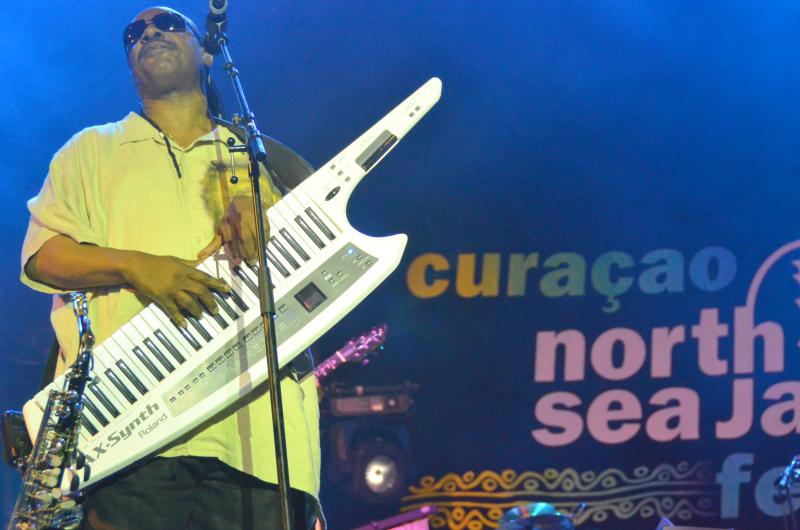
Stevie Wonder was also in great form, a consummate entertainer. He's also a terrific musician, not just a manufacturer of pop and R&B hits and hooks. He made a grand entrance playing a keytar—an electronic keyboard carried with a strap slung over the shoulder like a guitar (Hancock also uses one on occasion). As he played to a driving beat on "How Sweet It Is To Be Loved By You," he walked slowly across the stage, unassisted, wailing away. Eventually he made his way to sit at the keyboards where he played both acoustic and electric, cranking out hits but with lots of off the cuff changes and improvisations. It wasn't a carved-in stone, note-for-note hit show (can you say Earth, Wind & Fire?).
The band was tight and moved easily when Wonder decided where he wanted to go, except when he decided to sing the blues, segueing into "Further On Down the Road" and having to correct the band on its approach before he continued. Then he suddenly broke into "You Got Me Running," another blues staple that the band melded into more easily, and which featured a harmonica solo where even the uneducated had to realize that this cat can really wail, with technique and emotion. He seamlessly turned that medley into "Boogie On reggae Woman." Difficult improv stuff.
Wonder was outstanding. He demonstrated a jazz singing voice in range and approach, because it was filled with the sound of surprise. At one point he slowed, seeming to jump—and it certainly appeared impromptu—into the 1930s chestnut, "When Did You Leave Heaven"—an acoustic piano ballad recorded by folks like Jimmy Scott and Nancy Wilson—singing it with heart-melting fervor. "For Once In My Life," his own standard, was also superb.
In the two hour-plus concert, he also did a duet with Warwick on "That's what Friends Are For," sang Happy Birthday to his 10-year old son Kailand Morris, who came onstage for the rendition, and did hits like "Don't You Worry About a Thing," "Higher Ground," "Sir Duke," "Overjoyed," "My Cherie Amor" and "Isn't She Lovely."
Nearly all jazz festivals feature crossover acts and this is one that would always be welcome.
As for jazz, Danilo Perez delivered an outstanding set. Perez is a superior player, and his group, with Hans Glawischnig and drummer Adam Cruz, was right in step with every move. The music moved seamlessly from soft and reflective to intense. Sublime and intricate, the trio had all its bases covered.
Poncho Sanchez is always fun. From behind his conga drums he fronted a band that hit the clavé and swung at given moment. He performed Horace Silver's "Silver Serenade" with a distinctive Latin flavor, followed by a kick-ass tribute to the late conguero Willie Bobo, but then he brought out Terence Blanchard and the rest of the set was a tribute to Dizzy Gillespie and the conga player hired back in the 1940s who , along with the trumpet legend, introduced Latin jazz to America on a large scale, Chano Pozo.
Blanchard, of course, played the role of Gillespie for the most part, but at times he sparred with Sanchez's trumpeter, Ron Blake, a fine player with immense chops who could negotiate all the rhythmic and chord changes and also do some Cat Anderson acrobatics. The band, with Blanchard, is releasing Chano y Dizzy ( Concord Picante, 2011), hence the tour. They were hot, covering well-known tunes like "Con Alma," "Tin Tin Deo," "Manteca," and "Groovin High." It's worth noting that saxophonist Ron Hart and trombonist Francisco Torres—part of Sanchez's regular horn section—were also excellent.
Branford Marsalis has been touring with the same cats for some time, which is a reason why they are so tight and burn so hard. Joey Calderazzo is a fine pianist and Eric Revis a notable bassist. Young drummer Justin Faulkner tore it up, in the tradition of greats like Tony Williams. The band burns. Marsalis was all over the changes, with fiery statements, and Calderazzo's boppish forays were exciting. The quartet ran through the material with the kind of speed and dexterity that comes from intimate familiarity with one another. Thelonious Monk's "Teo" and Watts' "Return of the Jitney Man" were particularly good.
Chucho Valdés' band had three percussionists and two horns, and also on occasion strong vocals from his sister, Mayra Caridad Valdés. It was high-energy music, influenced by both Cuban and American sources. "Zawinul's Mambo" followed somewhat, but not always, the late Joe Zawinul's famous Weather Report hit, "Birdland," with a driving, percussion-driven exchange. Valdés exhibited his virtuoso abilities as a pianist on several songs, but his band was up to the task, playing with joy and fire, and the music moved people accordingly.
Valdés' sister's vocals were strong and packed with emotion. On "Bésame Mucho," she had the audience singing the chorus in Spanish, before she scatted her way to its close, while on the balladic "Obatala," she exhibited her dramatic sense and strong pipes, and the band's groundswell behind her was just as crucial. This was a fantastic unit.
Of the remainder, Rubén Blades' music, with a blaring horn section and tight Latin percussion, was fun and freewheeling. It was hard not to move to that kind of music, and Blades vocals were packed with feeling. He knew how to get it across. Juan Luis Guerra's band, it seemed, was an attenuate to get the same things across and was good, but lacked the excitement and expressiveness of Blades' unit.
As for Dionne Warwick, a pop star from a few years gone by, her voice has become a bit weak with age, but was still pleasant. She had a piano trio, with the addition of a couple synthesizers to replicate string sections and other instruments. Hits like "This Guy's In Love With You," "Do You Know the Way to San José," and "What the World Needs Now" were rendered, but she also had the good taste to add songs people would hear at a jazz festival, like Antonio Carlos Jobim tunes including "Wave" "Waters of March" and "Quiet Nights of Quiet Stars."
Curacao is an unheralded gem in the Caribbean. Everyone seems to know Aruba (some not-so-good press regarding Americans in recent years), yet Curacao is as luscious as can be. The jazz festival is something that might be growing, but for music fans, Latin-influenced music can be heard all over, all the time, and for jazz folks there could be more. The wonderful Eliane Elias performed there just before the festival, in fact.
And one of the hotels, the Avila, has a place called Blues Bar that hosts blues music and a jazz jam each week that has been going on for years. A tenor sax-led group on jazz fest weekend very capably improvised over Herbie Hancock and Horace Silver tunes, and these were cats that came to jam. As the quintet went to town on a stage hovering above the bar, a young lady with guitar in case patiently awaited her turn to go up the steps and join in. On the ceiling were blown-up pictures of original album covers by artists like Keiko Taylor, B.B. King and John Lee Hooker.
So, digging Curacao is something music fans—as well as those wanting a taste of an exotic island with plenty of other things to do amid the vast sea—might well consider. This seems like a festival that will move forward, and it has an organization behind it that is absolutely full of experience. It's not a bad idea to keep your eyes on it—then get your feet and ears there, too.
Photo Credit
Courtesy of Curacao Tourist Board
< Previous
Take Five With Lauren Henderson
Next >
Friends
Comments
Tags
Live Reviews
R.J. DeLuke
United States
George Wein
Stevie Wonder
Chucho Valdes
Poncho Sanchez
Terence Blanchard
Danilo Perez
Branford Marsalis
Vinnie Colaiuta
Chick Corea
Herbie Hancock
Darryl Jones
Omar Hakim
Kenny Kirkland
Jimmy Scott
Nancy Wilson
Hans Glawischnig
Adam Cruz
Horace Silver
Willie Bobo
Dizzy Gillespie
Chano Pozo
Ron Blake
Cat Anderson
Ron Hart
Francisco Torre
Joey Calderazzo
Eric Revis
Justin Faulkner
Tony Williams
Thelonious Monk
Joe Zawinul
Weather Report
Antonio Carlos Jobim
Eliane Elias
B.B. King
John Lee Hooker
For the Love of Jazz
 All About Jazz has been a pillar of jazz since 1995, championing it as an art form and, more importantly, supporting the musicians who create it. Our enduring commitment has made "AAJ" one of the most culturally important websites of its kind, read by hundreds of thousands of fans, musicians and industry figures every month.
You Can Help
To expand our coverage even further and develop new means to foster jazz discovery and connectivity we need your help. You can become a sustaining member for a modest $20 and in return, we'll immediately hide those pesky ads plus provide access to future articles for a full year. This winning combination will vastly improve your AAJ experience and allow us to vigorously build on the pioneering work we first started in 1995. So enjoy an ad-free AAJ experience and help us remain a positive beacon for jazz by making a donation today.

Giveaway

Eligible winners: 15
Days remaining: 11
Days remaining: 11