Home » Jazz Articles » Live Review » Punkt 2011: Kristiansand, Norway, September 1-3, 2011
Punkt 2011: Kristiansand, Norway, September 1-3, 2011

The Agder Theatre
Kristiansand, Norway
September 1-3, 2011
It was almost not meant to be. Plagued by a combination of airline snafus and the residual effects of Hurricane Irene—which had hit the northeast coast of the United States a few days earlier, creating (amidst other much more serious results) a backlog of people looking to cross the Atlantic that took days to sort out—what was originally planned as four days in Kristiansand, Norway was to become a mere 40 hours. Arriving in this small town of 75,000 people on Friday, September 2 at 2:00 pm and leaving on Sunday morning at the ungodly hour of 6:15 am, it was the kind of grueling schedule that would be impossible to justify, were it any other festival. But this live remix festival which has, over the course of its seven years, become the go-to destination for a variety of forward-thinking musicians across the entire spectrum of music—from classical composer Gavin Bryars to producer/ambient forefather Brian Eno; from Fourth World progenitor Jon Hassell to Led Zeppelin bassist John Paul Jones; and from pop producer/arranger Guy Sigsworth to electronic soundsculptor J. Peter Schwalm—is such a compelling and commanding event, that all physical considerations are dispensable. You can, after all, catch up on the near-zero sleep after it's over.

Punkt is, quite simply, a festival that can't be missed; there are too many one-of-a-kind performances that either happen there for the first time or, even more significantly, for the only time, that missing any year for a pathological music junkie is just not an option. The main stage performances in the Agder Theatre are invariably worth seeing—crossing, as they do, every possible realm of the musical continuum, ranging from electronic experimentation and free improvisation to contemporary classical composition and left-of-center singer/songwriting. But it's the live remixes in the Alfa Room—a smaller, more intimate laboratory, where audiences experience the show just seen in the theatre, remixed with the participation of other musicians—that define Punkt as a festival like no other.
Beyond a creative philosophy that most festivals lack, Punkt is also unique in its existence, beyond each annual festival, as a growing network of artists, writers and fans. Punkt may be the first time an artist collaborates with someone, but it's rarely the last. The festival refers to this as a constellation, and in its ever-growing size and reach, that's a better word than network. It suggests the greater scope of a festival which also transcends professional collaboration into the realm of family. People return to Punkt each year to continue the artistic work they began the first time they encountered Artistic Directors Jan Bang and Erik Honoré, but at the after-party which runs towards dawn after the final night of the festival each year (and is now running the risk of becoming too big for its venue, K35), it's the personal level on which this expanding group of people operate that is perhaps, what makes it most special. Sure, you can throw a bunch of artists together and good things might happen, but when these artists know each other—care about each other—then real magic becomes far more likely.
And it's not just musicians, because the performances in the Agder Theatre are as much about the glorious set designs and improvised visual art of Tord Knudsen—a member of trumpeter Nils Petter Molvaer's group since 1994—as they are the music. Punkt, you see, views art as multidisciplinary; this is not music with lighting, for example, this is music and lighting, the two media inextricably linked and of equal importance (a description that is, by no means, picking nits).
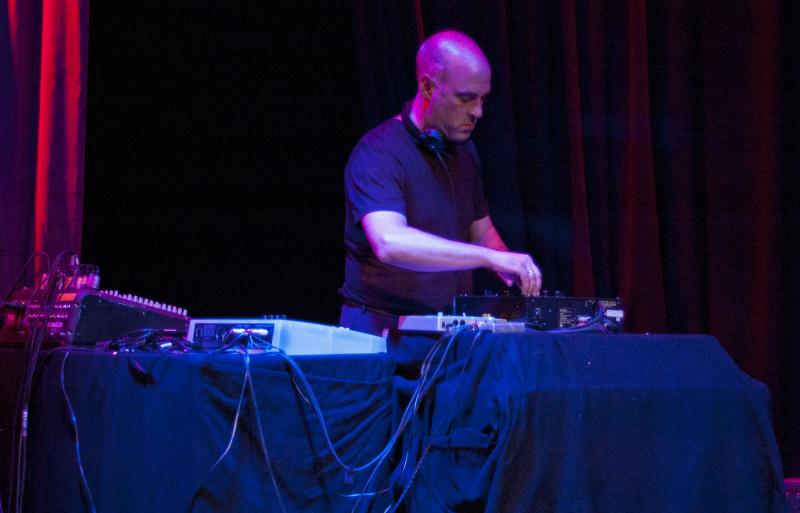
Punkt Co-Artistic Director Jan Bang
The Punkt Family began, largely, as a Norwegian affair, and the core constituents—trumpeters Molvær and Arve Henriksen, live sampler Bang, sonic sculptor/remixer Honoré, guitarist Eivind Aarset and singer Sidsel Endresen—continue to be represented each year at the festival. But over the years, in addition to other Norwegians like singers Anna Maria Friman and Maja S.K. Ratkje, drummer Audun Kleive, other members (along with Henriksen) of Supersilent, percussionist Ingar Zach and pianist Bugge Wesseltoft being added to the fold, Punkt has become an international family, with participation of artists including Fourth World progenitor/trumpeter Jon Hassell, live sampler/multi-instrumentalist Dino J.A. Deane (USA), bassist Skúli Sverrisson (Finland), Sweet Billy Pilgrim (UK) and pianist Nik Bärtsch (Switzerland). If anything, the size of the Punkt Family has expanded almost to the point of bursting the Agder Theatre at its seams.
Which makes the pending opening of Kristiansand's Kilden Performing Arts Centre in 2012 a fortuitous event. With a main hall capacity of more than double the Agder's 550 seats, and the Alfa room also more than double its current 250, Kilden will allow Punkt the opportunity for further growth, and to attract a larger international audience to this lovely seaside town at the southernmost tip of the country ("punkt," in Norwegian, means "point"). There are, of course, concerns that this far more modern/spacious venue will impact the profound intimacy that's been a signature of Punkt since its first year in 2005, but there's also confidence that Bang and Honoré, fully aware of the challenges, will find a suitable way to migrate Punkt into its new digs.
Still, Punkt 2011 was a bittersweet year of sorts, for those who've made it an annual destination. People were talking about welcoming the greater potential of Kilden, but also about how the festival will be forced to make changes in moving to Kilden. Fear of the unknown is understandable. Given the track record of Punkt—not just in Kristiansand, but in London, Tallinn and Mannheim, where its core philosophy was proven a moveable feast—there's little doubt it will have to be different. However, there's no reason to lack confidence that it will remain the cutting edge artistic event it's been since inception.
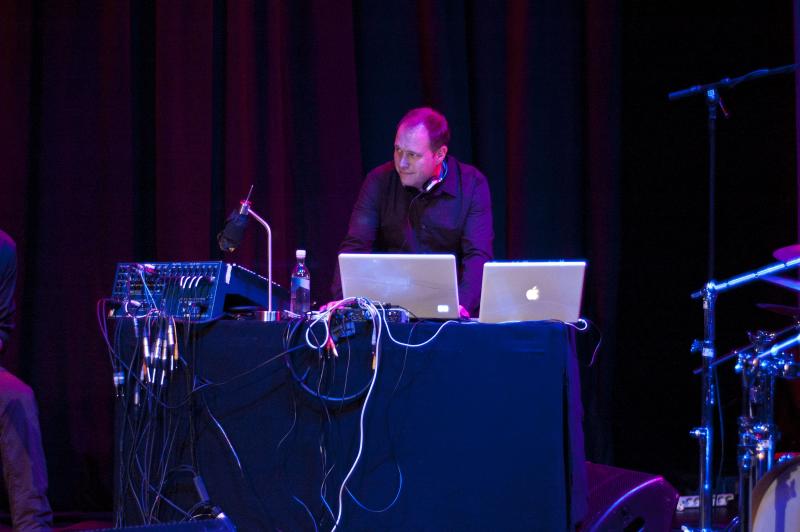
Punkt Co-Artistic Director Erik Honoré
If there was one somewhat legitimate concern about Punkt 2011, it was that there were a large number of "remixes" taking place in the Alfa Room that weren't really remixes, using the source music from the just-finished main theatre performance. Dans Les Arbres' set was strong—free improv that, at its best, was inspired by what came before—and Guy Sigsworth's collaboration with Molvær even more compelling, but clearly scripted.
But if the number of "real" remixes was proportionately smaller than usual, it was balanced out by the participation of David Sylvian, who unequivocally made 2011 a Punkt year to remember. The British singer/songwriter was all over Punkt with an installation at the nearby Sørlander Art Museum which, twice during the three-day festival, was used as the underlying context for freely improvised sets by a series of artists including saxophonist Evan Parker and Norwegian guitarist Stian Westerhus. Sylvian also participated in a special recreation of Arve Henriksen's 2008 ECM recording, Cartography, on the closing night of the festival—where, in contrast to the small duo, trio or quartet shows the trumpeter has done in the past couple of years, Henriksen was able to recruit many of its participants for a very special, one-time performance that still left plenty of prerequisite room for collective free play.
But it was Sylvian's recruitment as Artist in Residence for Friday night when, in addition to programming three shows ranging from performances of the works of classical composer Dai Fujikura to two free improv sets, he put on the first and only performance ever of his classic 1988 collaboration with Holger Czukay, Plight and Premonition (Virgin). If that wasn't enough star power, John Paul Jones, after his now-legendary impromptu collaboration with Supersilent that spread the word about Punkt to a much larger (and different) audience last year, was back with the noise improv group's leader, Helge Sten, for a new experimental electronic collaboration called Minibus Pimps.
It was another outstanding year—a transitional year, to be sure, but one that maintained and, in some cases, raised the creative high bar set by Punkts from previous years.
Chapter Index
- September 2 Concert: Works by Dai Fujikura
- September 2 Live Remix by Jan Bang/Erik Honoré/Sidsel Endresen
- September 2 Concert: John Tilbury/Evan Parker/John Russell/Okkyung Lee
- September 2 Live Remix: Dans les Arbres
- September 2 Concert: Koboku Senjû
- September 2 Concert: David Sylvian, Plight and Premonition
- September 3: David Sylvian, Uncommon Deities
- September 3 Concert: Marilyn Mazur/Jan Bang/Per Jørgensen
- September 3 Live Remix: J. Peter Schwalm/Nordic Live Electronics Network
- September 3 Live Remix: Guy Sigsworth/Nils Petter Molvær
- September 3 Concert: Arve Henriksen, Cartography, Special Edition
- September 3 Concert: John Paul Jones/Helge Sten, Minibus Pimps
- September 3 Live Remix: Molvær/Mazur/Aarset/Bang/Honoré
- Wrap-Up
September 2 Concert: Works by Dai Fujikura
Perhaps one of the most important aspects of Punkt and the Punkt Family, is its introduction of artists to audiences beyond their normal purview. He may have a strong reputation as a contemporary artist of note in the classical world, but there's little doubt that Japanese composer Dai Fujikura's career has received something of a career-boost from Sylvian—first for his participation on "Five Lines," the opening and previously unheard track from the Samadhisound compilation, Sleepwalkers (2010), but more importantly as a more active contributor to the singer/songwriter's latest, Died in the Wool: Manafon Variations (Samadhisound, 2011), where he composed, arranged, conducted and/or performed on seven of its twelve tracks.
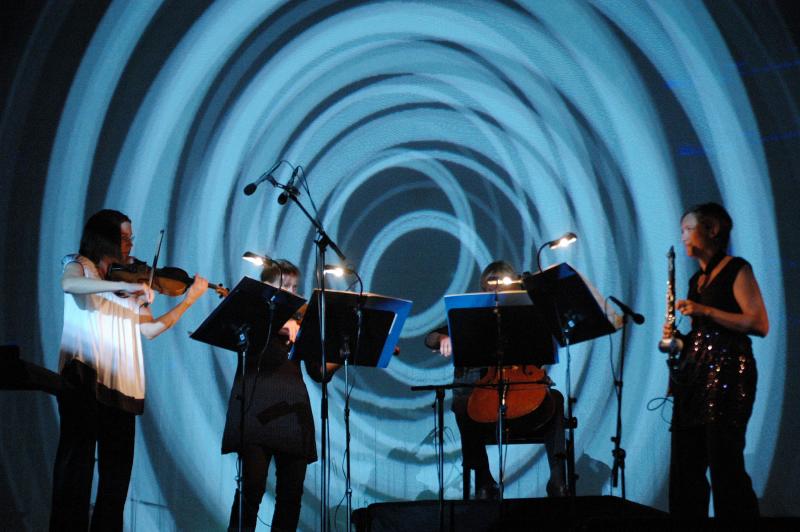
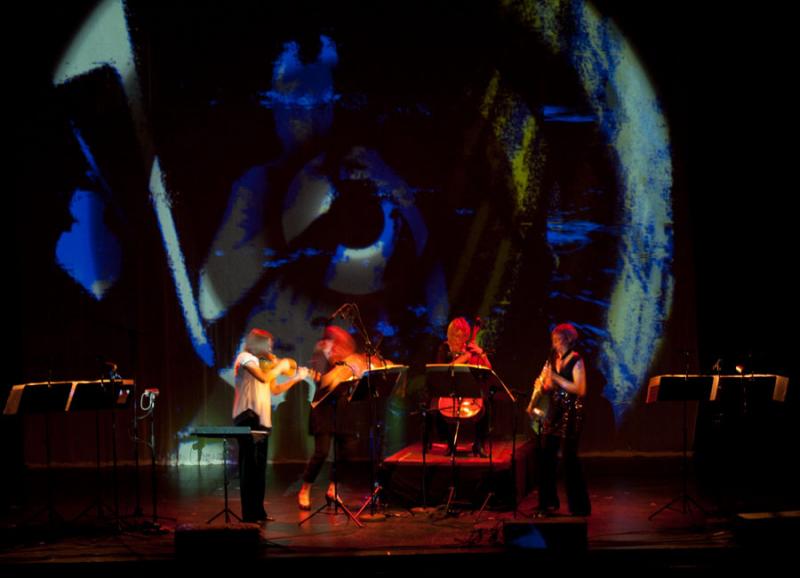 From left: Cecilia Zilliacus, Johanna Persson, Kati Raitinen, Karin Dornbusch
Here at Punkt 2011, a series of Fujikura compositions opened the festival, performed by various permutations and combinations of members of the string trio ZilliacusPerssonRaitinen—violinist Cecilia Zilliacus, violist Johanna Persson and cellist Kati Raitinen—along with clarinetist Karin Dornbusch. It was an inspired choice, with all four players, virtuosos in their own right, capable of navigating some of Fujikura's most challenging charts with deceptive ease and seemingly effortless aplomb.
Fujikura's music was not without its intrinsic beauty, but it did set the tone for an evening largely occupying a left-of-center stance, with oblique angles and corrugated surfaces. Extended techniques abounded, with Dornbusch delivering the strongest solo performance of the set by a narrow margin. Fujikura's "SAKANA" demanded much of the clarinetist, who combined circular breathing with unorthodox tonguing and embouchures in a piece that, like the three other solo features for members of ZilliacusPerssonRaitinen, was bookended by the opening World Premiere, "Scion Stems"—a special commission for Punkt, dedicated to Sylvian and written for string trio—and "Halcyon," which brought Dornbusch together with the string trio for a finale of unexpected drama and equally surprising moments of calm tranquility.
In his 2010 All About Jazz interview, Jan Bang spoke of the criteria used to select main stage performers: ..."made from a decision as to whether or not there is enough material by the artist to allow it to work in a remix session; that's our first concern." Certainly, with a combination of unique tonalities, periods of discrete lyricism, and enough space to give remixers room to move, Fujikura's opening set was a strong way to both open Sylvian's curation and develop the live remix possibilities of Punkt 2011.
September 2 Live Remix by Jan Bang/Erik Honoré/Sidsel Endresen
Speaking with Sidsel Endresen, after her 2011 Oslo Jazz Festival performance with Humcrush a few weeks earlier, she expressed some concern about the challenge of remixing Fujikura's music.
She needn't have worried. For the first live remix of Punkt 2011, Endresen was joined by festival Artistic Directors Jan Bang and Erik Honoré for what turned out to be one of the festival's best remixes...ever. Endresen's voice has always been characterized by its remarkable malleability, but to hear her open the remix alone, with a frighteningly accurate interpretation of a bow being slowly scratched across a violin's strings, was one more affirmation of a singer who is changing the landscape of her instrument, with an approach that combines an undeniably mellifluous voice with a seemingly endless array of extended techniques that allow her, at one moment, to sound like a stuttering conversation in reverse, and the next, to deliver haunting melodies with a rich, deep lyricism rooted in many musical spaces; but, ultimately, occupying just one: her own.

From left: Jan Bang, Sidsel Endresen, Erik Honoré
Those unfamiliar with the innovations that have taken place following her two outstanding albums for ECM—So I Write (1990) and Exile (1994)—and the stark electronic landscapes of Undertow (Jazzland, 2000), need only look at her solo recording, One (Sofa, 2007) and Live Remixes Vol. 1 (Jazzland, 2008), to hear the early stages of her cell-based approach to improvisation, where small vocal techniques that often seem impossible for a single, unprocessed human voice to accomplish are honed to the point of effortlessness, and ultimatley combined in endless variations.
Bang and Honoré have been working together so long that they rarely needed to look at each other. While their instruments may be unconventional—samplers, mixing boards and processors amongst them—there's little doubt that it's music they were making, as Bang not only processed sounds that Honoré was feeding him from the Fujikura performance, but Endresen's voice as well. Bang first innovated the concept of live sampling by taking musical fragments from players around him, processing them, looping them or applying other electronic modifications, then feeding then back to the stage in real time, and encouraging those same players to work off his sounds, in the mid-1990s when he was working with keyboardist Bugge Wesseltoft and, subsequently, Nils Petter Molvær. Here, after 15 years of experience, it's a marvel to hear what he hears—and what Honoré hears—in a source performance, and where both can take it, with the addition of their own musical aesthetics.
As angular as much of the Fujikura show was, Bang, Endresen and Honoré managed to find compelling melodies hidden in the nooks and crannies of ZilliacusPerssonRaitinen and Dornbusch's performances, as well as more expansive aural washes and unexpected pulses. Watching the four musicians' reactions as they sat in the midst of the Alfa Room audience, it was clear that Bang, Endresen and Honoré were taking their music to places none of them could ever have imagined, and that's precisely the value of Live Remix: to take extant performances and use them to create something new, something that's as personal to the remixers as it is those who made the original music.
September 2 Concert: John Tilbury/Evan Parker/John Russell/Okkyung Lee
Beginning in the early part of the new millennium, Sylvian began working in greater earnest with a growing collection of European free improvers. His career has been defined by increasing experimentation, even from his early days in the pop group Japan, but it was with the release of Blemish (2003), on his fledgling Samadhisound label—a stunning collaboration with guitarist Derek Bailey, positing a whole new way of songwriting—that Sylvian's career took a decided left turn into uncharted territory. For those who only knew his major label recordings, like Secrets of the Beehive (Virgin, 1987) and The First Day (Virgin, 1992), subsequent recordings like the groundbreaking Manafon (Samadhisound, 2010) were a challenge to fathom, as Sylvian took free improvisations from the likes of saxophonist Evan Parker and pianist John Tilbury, and composed song forms around them.
 From left: Okkyung Lee, John Russell, Evan Parker,
Not that they don't already have a strong audience from the free improvisation world, but there's no doubt that Sylvian has brought a different audience to the music of these intrepidly spontaneous musicians (as, equally, they brought a new set of listeners to Sylvian), and it was expected that, when his curation at Punkt was announced, he'd be bringing some of these artists to the festival. For the second main stage show, Sylvian put together a group that included Parker and Tilbury, alongside British avant-garde guitarist John Russell and experimental Korean cellist Okkyung Lee, for a continuous performance that demonstrated how, at its best, free improvisation is about intimate connections and ears aiming to find new ways to make something out of nothing.
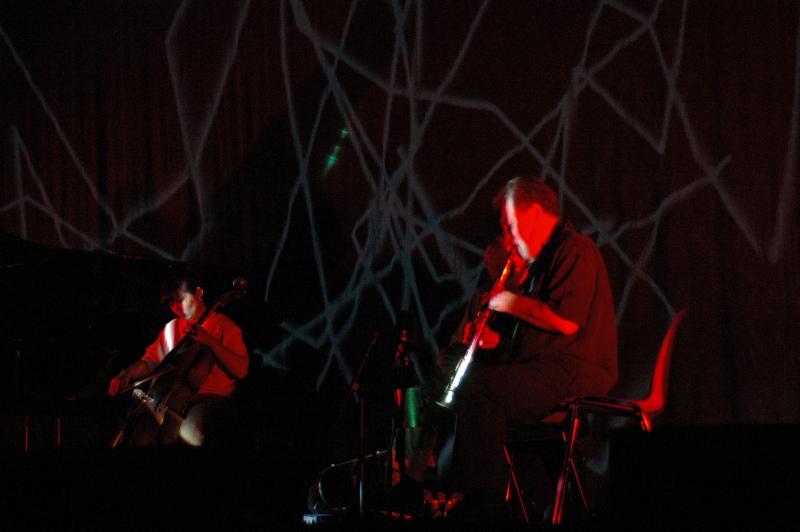
Seated in a semi-circle from left to right, with Tilbury, Lee, Russell and Parker, the improv began largely in darkness and, as Tord Knudsen's empathic visuals worked in concert with the musicians, the set began to combine passages of consonant beauty amidst more outré excursions. Russell, playing a large hollowbody electric guitar, still relied heavily on its natural acoustic sounds, even as he created softly jagged harmonies and skewed linearity. Tilbury spent as much time exploring the inside of the piano box as he did the keys, a generally gentle player whose more extreme tendencies were couched in a light touch, and an emphatic incorporation of space and decay as equal participants. Parker's by-now-legendary circular breathing was so natural that his making single droning notes or rapidly trilling flurries without pause didn't seem impressive until it suddenly dawned that he'd been doing so for minutes without pause.
While Parker, Russell and Tilbury were no strangers to each other, having intersected on various past projects, this was the first time they'd all worked together. Lee has straddled classical and jazz/improv worlds in collaboration with everyone from John Zorn and Nels Cline to Phil Minton, and has a trio recording with Parker and Peter Evans due out later this year. Her approach to cello is suitably unorthodox, but while capable of eking no shortage of surprising sounds with extended bowing techniques and just flat-out aggression, she also proved capable of a rich, appealing tone that, at times, grounded a performance which occasionally drifted into the ethereal.
For those less than familiar with the free improv scene, it was a rare window into music that's often considered unapproachable, but which clearly—in the hands of masterful artists such as these—proved to be anything but senseless, meandering or purposeless. Instead, there was no shortage of intent, and with it equal measures of collective listening that gave the 50-minute set plenty of focus and gradually unfolding direction.
September 2 Live Remix: Dans les Arbres
At the time of its Punkt 2007 performance, the free-improvising quartet of pianist Christian Wallumrod, clarinetist Xavier Charles, guitarist/banjoist Ivar Grydeland and percussionist Ingar Zach had yet to assume the name of its subsequent ECM debut, the largely introspective Dans les arbres (2008). If the group's 2007 appearance was indicative of a group still finding its way, its return to Punkt this year—ostensibly to remix the Tilbury/Parker/Russell/Lee set from the main stage—represented an ensemble ready to turn any potential limitations into advantages.
The term "ostensibly" comes to mind in describing its relatively long "live remix" set, because there was, in fact, no remixing taking place. Instead, Dans les Arbres' performance was as freely improvised as any of its sets to date—at best, inspired by what came before, if not directly informed by it. This is not the first time such a live remix slot has been handed over to a group which did not actually remix the previous show, but it did set a curious precedent for a Punkt festival where, more often than not, the live remix had little direct connection to what came before.
 From left: Ingar Zach, Ivar Grydeland
The set represented another first for the group; given the impossibility of providing a grand piano in the down-the-stairs Alfa Room, for this show the characteristically acoustic Dans les Arbres turned electric, with Wallumrød using a synthesizer and Grydeland—certainly no stranger to electric experimentation with Huntsville, most recently heard on For Flowers, Cars and Merry Wars (Hubro, 2011)—turning to a heavily processed electric guitar. The two had, in fact, recently performed in Bergen with a new improvising trio called Electric Pansori, using nearly the same gear; but whereas that show, with drummer Per Oddvar Johansen, often turned to near-ear-shattering extremes, Dans les Arbres' Punkt performance remained largely a softer, inward-looking affair, though the quartet did occasionally hit more aggressive and higher-volume stances.
Xavier Charles, a player whose command of extended techniques at times overwhelmed the lyrical potential of his instrument, was also feeding his clarinet through electronics, and while it was often difficult to delineate his contributions with eyes closed, it became much easier by watching him in action. Evoking odd chirping noises, pops and clicks, upper-register drones and soaring screams, Charles' instrument may have been the one most intrinsically disposed to being a melodic anchor but, as was the case with the rest of his band mates, his approach rendered any expectations of convention moot. Zach's equally unconventional percussion setup ensured contributions more textural than rhythmic—revolving around a massive bass drum, set flat like a timpani but often used as a base surface for other devices, including small windup or electric toys that would be set off running around the surface of the drum to create buzzing and sizzling sounds, or bells that Zach would bow as often as he would shake.
There was, in fact, very little pulse to be found amongst Dans les Arbres' work; instead, it was often about creating a weave of sonics that, in the case of Wallumrød, sometimes approached the serialism of Olivier Messiaen or microtonal densities of György Ligeti—there was even one point where, with Charles' soaring clarinet and Wallumrød dense voicings, the music recalled "Atmospheres," Ligeti's groundbreaking piece best-known as the soundtrack to the psychedelic time gate sequence in Stanley Kubrick's 1967 film 2001: A Space Odyssey. Like many of the improvising units to be heard at Punkt this year, there were as many (if not more) touchstones in contemporary classical music as there were jazz, but Grydeland's sometimes bowed, oftentimes heavily processed guitar created dense washes of sound, however, that took the music far beyond either (or, for that matter, any) purview.
One of the challenges of free improv is knowing when to stop, and if there were any single criticism of Dans les Arbres' performance, it was that it went on a little too long, despite a couple of earlier points that seemed like ideal times to conclude. Still, given the experimental, without-a-safety-net environment of the Alfa Room, it's a small quibble in a set that may well drive this normally acoustic ensemble into a new direction well worth further exploration.
September 2 Concert: Koboku Senjû
Punkt's growing constellation has created numerous contexts for collaboration by musicians from around the globe, but it's by no means the only place where such interactions take place. Still, it's part of a curious series of intersecting degrees of separation, an undercurrent of creative expansionism where it's possible to find a way in from many different angles. David Sylvian's relationship with Toshimaru Nakamura has included direct collaboration on Died in the Wool, but he's also given the no-input mixing-board experimenter his own forum on Egrets (Samadhisound, 2010). On that album, Nakamura collaborated with guitarist Tetuzi Akiyama and Arve Henriksen, but that was far from the first Japan/Norway collaboration to occur in these circles.
 From left: Eivind Lønning, Espen Reinertsen,Toshimaru Nakamura, Martin Taxt, Tetuzi Akiyama
Akiyama had also worked, very successfully, with a Norwegian trio of musicians—tubaist Martin Taxt, saxophonist/flautist Espen Reinertsen and trumpeter Eivind Lønning—on Varianter av døde trær (Sofa, 2008), and so the idea of bringing Nakamura into the picture made perfect sense, making this new group, Koboku Senjû—whose eponymous debut was released in 2010 on Sofa—a perfect addition to Sylvian's Punkt curation.
The set began deceptively with the three horns creating a lush backdrop of consonant drone, though this seeming orchestration wouldn't last long. With Akiyama eking odd angular textures out of his acoustic guitar, and Nakamura positioned centrally onstage—as if to represent a conceptual focal point for the four acoustic instruments—the set soon entered more outside territory, as everyone began to explore the kind of instrumental unorthodoxy that was, if there was one, the orthodoxy of the evening. Akiyama spent much of his time quietly working with a slide, but rather than using it to create snaking melodic lines, the guitarist evoked sustaining sonics while, head down, he continued to vibrate it over the strings with his right hand as his left moved along the neck to create slower harmonic movement. Lønning expanded his timbre by combining breathy embouchure and a right hand over the trumpet's bell, while Reinertsen approached his instrument with a similarly color-focused approach.
As seems de rigueur in the relentlessly intrepid Norwegian scene, Taxt appears committed to changing preconceptions about the place of his instrument. If Line Horntveth has made the tuba a more than credible rock instrument in Jaga Jazzist, then Taxt has made this unwieldy instrument a worthy member of the free improv circle, one of his more intriguing projects being the recently-released microtub (Sofa, 2011), a tuba trio set that explores contemporary composition and free improvisation, with emphasis on microtonality and color. Here, he integrated with the dark ambiance of the rest of the group, creating low-register sonics as often felt as heard.
Together with Nakamura's no-input mixing board—the input connected to the output, creating feedback that is subsequently manipulated— Koboku Senjû's music was, much like the Parker/Tilbury/Russell/Lee set that came before it, largely inward-looking in nature, and capable of surprising beauty at times. If there was a thread running through Sylvian's curation, it was that free improvisation may be oblique, filled with unusual sounds and a general avoidance of conventional melody, rhythm and/or harmony, but it needn't be unapproachable. Those capable of accepting this music for what it was rather than concerning themselves with what it wasn't were sure to find plenty of appeal in a set that, again, worked in concert with Tord\ Knudsen's intimate and intuitive visuals to create an often hypnotic blend of sound and sight.
September 2 Concert: David Sylvian, Plight and Premonition
Punkt's ability to draw artists who might seem too large for this relatively small festival is just one of the reasons for its growing international reputation as something far more than just an annual event in a town that, were it located in North America, would be fortunate to have a movie theater, let alone the kind of commitment to the arts that Kristiansand made a number of years back, when it instituted Cultiva—an initiative where the town's excess electricity is sold off each year, and interest earned on the resultant income is invested in the arts. All too often, when discussing Norway's remarkable commitment to the arts, the first comment made by those not in the know is, "well, they've got money," which is, of course, true. But it's equally true that if a city of similar size in North America were to come into the kind of money Kristiansand has (in the case of Cultiva, in 2006 it was worth over six million dollars), it's unlikely that it would choose to invest it in culture to the same—or even similar—extent.

David Sylvian
Norway's commitment to the arts as an important part of the overall cultural fabric began in the 1960s, and at a time when other countries are seeing arts finding chopped so heavily that few, if any, schools in even larger cities still have a music program, it remains a country with a firm belief in balancing hard skills with the enriching power of the arts—even now, when there are political shifts taking place, and some concern about cuts to cultural funding, Norway remains head and shoulders above most countries.
Norway's cultural commitment has directly resulted in international cross-pollination at many levels, but the success story of Punkt is particularly relevant. Artists like John Paul Jones had heard of the festival, and while he'd initially planned to attend the 2010 edition as nothing more than a spectator, he was so excited by what he heard that he asked if he could do, perhaps, a short opening set for one of the acts. Hooked up as opener for Supersilent, during sound check he was so excited by what he heard from the Norwegian group that he asked if he could sit in, and a performance that will go down as one of the most memorable in Punkt history was the result.
Not all the guests and unexpected guest performers at Punkt are as well-known, but when an artist like David Sylvian commits not only to an installation, as Brian Eno did a couple years prior, but to an evening's curation, it's affirmation of the festival's ongoing creative success, which goes from strength to strength, year after year. Sylvian has been an absent member of the Punkt family since first recruiting Jan Bang and Erik Honoré to do a remix on his Camphor (Virgin, 2002) compilation—Sylvian's last major label release, even as his own Samadisound imprint was ramping up. With a program that was already memorable, Sylvian elevated Punkt 2011 to the same legendary status as 2010, with its Jones/Supersilent collaboration, and Punkt 2008, with Eno's participation, by collecting an international group of musicians to deliver the first-ever performance of Plight and Premonition.
Originally a duo studio project with Can bassist Holger Czukay, it was never really intended for live performance, but with the participation of John Tilbury, Eivnd Aarset, Arve Henriksen, Jan Bang, Erik Honoré, and Philip Jeck, it became a living, breathing thing, where the overall ambiance of the original was retained while becoming music for the new millennium—the basis for free but contextually focused improvisation from a group of players who clearly respected the source material, but took it to new and unexpected places. Based on the smile on the introverted Sylvian's face at the end of the performance, it was an unequivocal success.
Aarset's sonic washes, serpentine lines and subtle textures dovetailed perfectly with Sylvian's long, hypnotic drones. In another case where the easiest way to hear what everyone was doing was to see them doing it, the voices that were the most obvious were Henriksen on trumpet, and Tilbury—who, like his earlier set with Parker, spent equal time inside the piano, but in this case with contributions suitably spare and melodic. An expansion, perhaps, of Brian Eno's Ambient Music, it was easy to get carried away by the performance's attractive tonalities and periodic emergent lyricism, but different from albums like Eno's Music for Airports (Virgin, 1978), this was a performance that could go beyond aural hypnotism, containing active components that commanded attention.
With Sylvian barely visible seated, as he was, behind a table and beneath a white baseball cap, he nevertheless contributed guitar lines that, processed, twisted and turned, remained distinguishable from Aarset's own brand of anti-guitar techniques. With Henriksen occasionally playing the celesta that hid him from much of the audience, the combination of its chiming colors with Tilbury's inside-the-box explorations created spare melodic fragments that emerged from the wash of electronic sounds that Honoré, Bang and Jeck were layering, only to dissipate into the ether. It was a truly memorable performance which, having been recorded, will hopefully see the light of day so that those beyond the fortunate few in Kristiansand can hear how, nearly 25 years later, an album initially designed as a studio construction could breathe anew in the 21st century.
 September 3: David Sylvian, Uncommon Deities
While travel woes meant missing the opening night of Punkt 2011, and the premiere of David Sylvian's installation at the Sørlander Art Museum—where John Tilbury, Philip Jeck, Evan Parker, Eivind Aarset, Sidsel Endresen and Arve Henriksen accompanied readings by poets Paal-Helge Haugen and Nils Christian Moe-Repstad (a Punkt regular), all in concert with Sylvian's audiovisual installation (visuals by Atsushi Fukui)—a second performance on Saturday, September 3, meant those unable to get a seat for the opening could still attend, and see the installation, but with the interaction of a different set of musicians.
In a stark venue where the image of a hermaphrodite rose above the end of the room, which had been set up as a performance space, Evan Parker returned for an opening solo that, combined with his work the previous evening, demonstrated just how adaptable the saxophonist can be to any context. With Sylvian's installation—founded on the 18-minute piece, "when we return you won't recognize us" that makes up the second disc of Died in the Wool, an ultimately repeating sequence moving from gentle washes to sudden punctuations—Parker's 20-minute set was an exercise in deep listening both on the part of the musician and his audience, who, largely seated on the floor in the small room (holding, at most, 100 people), watched, enraptured, as Parker slowly unfolded the narrative of his set; a story within a story.
Slowly walking away from the centre of the performance space, Parker gradually faded to black as Ingar Zach slowly assumed dominance. With the same large bass drum used in his previous evening's performance with Dans les Arbres, it was possible to see and hear his own contributions to that group more clearly. For some, a single large drum would have limited potential, but for Zach, there seemed no end to what was possible. With one end of a drumstick on the skin, with his hand wrapped around it, he slowly pulled on it, down towards the drum, creating a low end sound that, through the PA system, became a massive, in-the-gut rumble. With a series of small bells being bowed (in addition to bowing the side of the drum), plus a variety of mechanical devices skittering across the skin and his own hands and sticks, Zach's segment entered at a different point than Parker's, and consequently assumed its own shape.
Guitarist Stian Westerhus concluded the performance with his usual combination of big amps and multitude of foot pedals. The guitarist has seemingly burst onto the scene in the past couple years, despite being around for awhile—a relatively recent recruit to Nils Petter Molvær's trio, finally heard on record with the just-released Baboon Moon (Sula, 2011), in addition to working with Puma and Monolithic, releasing his own solo record, the superb Pitch Black Star Spangled (Rune Grammofon, 2010) and collaborating with Sidsel Endresen in one of the most exploratory and exciting duos happening at the moment. This is his second appearance at Punkt, following his duo performing with Endresen last year. The only predictable thing about a Westerhus solo performance is its sheer unpredictability; here, however, the guitarist was really in duo with Sylvian's installation, and so, while his unconventional playing style—bowing, scraping, scratching, slapping and hitting the strings through a massive array of effects—remained as mindboggling as ever, having a context from which to work did push him, at times, in slightly different directions than he might have gone, had he been entirely on his own.

Stian Westerhus
Westerhus' tendency to play loud—with all four amplifiers turned up to eleven—did, at times, overwhelm the installation, but for the most part he worked with Sylvian's music, proving yet again that beauty and extemporaneous extremes can coexist in the same sentence. As a kind of figurative ending to Sylvian's curation of the evening before, this trio of Parker, Zach and Westerhus did, in fact, belie certain misconceptions that this kind of music must inherently be unapproachable. Yes, some of it can reach levels of cathartic aggression, but there's absolutely no reason why it can't inhabit the same space as gentle beauty. Freedom is, after all, the ability to create in the moment, with unfettered and unconstrained abandon; but, as Sylvian and his chosen artists capably demonstrated, that very freedom allows for the creation of profound beauty and vivid lyricism, even in a context that, more often than not, eschews conventions of form and melody, harmony and rhythm,.
September 3 Concert: Marilyn Mazur/Jan Bang/Per Jørgensen
As often happens at Punkt, artists who've worked together in other combinations—or have wanted to work together but haven't found the right circumstances—are brought together in either first-time encounters or, at least, first contact in a specific lineup. Another signature of Punkt is that every year, a particular show emerges as the sleeper hit of the festival, and while some of the other high-profile shows—in particular, Sylvian's Plight and Premonition and Arve Henriksen's soon-to-come Cartography, Special Edition—were sure to impress, this year's unexpected surprise hit was the trio of percussionist Marilyn Mazur, Jan Bang and trumpeter Per Jorgensen, that opened Punkt's final evening in the main hall of the Agder Theatre.

From left: Jan Bang, Marilyn Mazur, Per Jørgensen
Perhaps it shouldn't have come as a surprise. Neither Mazur nor Jørgensen have been at Punkt before, but both have intersected with the Punkt family either directly or indirectly. Mazur performed as part of pianist Ketil Bjornstad's Antonioni Project at Molde Jazz 2010, where she played with Eivind Aarset—and Aarset has been a member of the percussionist's Future Songs group since 1994, when Small Labyrinths (ECM, 1997) was recorded; and Jørgensen was a member of Mazur's Pulse Unit, which released Circular Chant (Storyville) nearly twenty years ago, in 1994.
Jørgensen, a longtime member of Jon Balke's Magnetic North Orchestra—and, more recently, the Magnetic Book project that played one of its first gigs at the Oslo Jazz Festival, just a few weeks ago—is one of those players who can be drop-kicked into any situation, and become a complete and immediately seamless part of it. When he performed Kuara: Psalms and Folk Songs (ECM, 2010) at the 2010 Tampere Jazz Happening, with pianist Samuli Mikkonen and drummer Markku Ounaskari, he may have been the Finnish duo's invited guest at the outset of the project, but he was ultimately the trio's charismatic core, enticing and, at times, demanding of his partners and the audience in ways that were absolutely captivating. Few are able to get across the absolute joy of music-making the way Jørgensen can...and does.
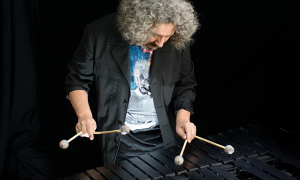
In the all-improvised context of this trio, communication was essential, and it was immediately evident from the very start, when Mazur hit a sharp punctuation that both rallied the players and grabbed the audience's attention. Surrounded on all sides by a massive percussion rig that included just about anything imaginable that could be hit with a stick or struck with a hand, Mazur could, at times, be as much a performance artist as a musician, the relatively diminutive percussionist literally leaping into the air as she attacked a large cymbal or massive drum with absolute fervor. Given that much of her rig is provided onsite, meaning that it changes with most performances, her knowledge of what was there, and where it was, was almost as impressive as the way in which she used it. The set may have begun in relative abstraction, but it didn't take long before a pulse emerged. And while there seemed, on the surface, to be a lack of melodic and especially harmonic instrumentation with only Jørgensen's voice and trumpet, Bang proved his mettle as a soundscapist by bringing both existing samples to bear, as well as manipulating real-time samples of Mazur and Jørgensen to further expand the aural landscape.
Up to this point, Bang's involvement in performances at Punkt 2011 had been considerably freer and edgier affairs, with little in the way of overt rhythm—though, as always, Bang seemed to move to his own internal time. Here, however, with Mazur and Jørgensen, while the music was no less open-ended, it was driven by strong grooves that shifted seamlessly throughout; the smile on Bang's face certainly suggesting that he was particularly enjoying the chance to work in a more decidedly rhythmic context—and, with these two players.
 Marilyn Mazur
 Or perhaps it was just the flat out fun everyone was having, as smiles were everywhere throughout the 45-minute set. Here, Jørgensen spent more time singing than playing trumpet—ranging from a high, pure falsetto singing soft melodies, to cathartic wails and near-primal screams that seemed to fit especially well in the context of this pulse-driven set, with Mazur joining Jørgensen later when a simple, chant-like melody emerged to provide even more proof that it's absolutely possible to draw form from the ether.
Elsewhere, Mazur came out from behind her large rig to play a clay pot on a stand at the front of the stage, where she had direct and unobstructed eye contact with both Bang and Jørgensen. Facing Jørgensen, who was also playing a small hand drum, the two entered an exciting trade-off, while Bang's sonic washes and real-time expansion of his band mates' music turned the set into an organic, breathing example of spontaneous composition that was a clear highlight of Punkt 2011. As is the case with all Punkt performances, this show was being recorded; and while it's true that there is a lot of material from Punkt's seven years that would be great to release—other than Live Remixes Vol. 1, the only other show to see full release was British composer Gavin Bryars' Live at Punkt (GB, 2010)—Mazur's show with Bang and Jørgensen is one that especially cries out for issue in some form.
< Previous
Chris Combs: Jacob Fred's Tulsa Tale
Next >
Le gout de neant
Comments
Tags
punkt festival
Live Reviews
John Kelman
Gavin Bryars
Brian Eno
Jon Hassell
Jan Bang
Nils Petter Molvær
Arve Henriksen
Eivind Aarset
Sidsel Endresen
Maja Ratkje
Audun Kleive
Supersilent
Ingar Zach
Bugge Wesseltoft
Sweet Billy Pilgrim
Nik Bartsch
David Sylvian
evan parker
Humcrush
Derek Bailey
John Tilbury
John Russell
Okkyung Lee
john zorn
Nels Cline
Phil Minton
Peter Evans
Christian Wallumrød
Xavier Charles
Ivar Grydeland
Huntsville
Toshimaru Nakamura
Jaga Jazzist
Marilyn Mazur
Per Jørgensen
Ketil Bjørnjstad
Jon Balke
Samuli Mikkonen
Adam Rudolph
Lawrence Butch Morris
For the Love of Jazz
 All About Jazz has been a pillar of jazz since 1995, championing it as an art form and, more importantly, supporting the musicians who create it. Our enduring commitment has made "AAJ" one of the most culturally important websites of its kind, read by hundreds of thousands of fans, musicians and industry figures every month.
You Can Help
To expand our coverage even further and develop new means to foster jazz discovery and connectivity we need your help. You can become a sustaining member for a modest $20 and in return, we'll immediately hide those pesky ads plus provide access to future articles for a full year. This winning combination will vastly improve your AAJ experience and allow us to vigorously build on the pioneering work we first started in 1995. So enjoy an ad-free AAJ experience and help us remain a positive beacon for jazz by making a donation today.

Giveaway

Eligible winners: 15
Days remaining: 6
Days remaining: 6