Home » Jazz Articles » Film Review » Miles Davis: Live at Montreux - Highlights 1973-1991
Miles Davis: Live at Montreux - Highlights 1973-1991

 Miles Davis
Live at Montreux—Highlights 1973-1991
Eagle Eye Media
2011
When Miles Davis plugged in towards the end of the 1960s, it may have been a huge shot fired across the bow of the jazz intelligentsia, who loudly cried foul and began the first of many accusations of "selling out," but for the trumpet icon, it was business as usual. In a career that ultimately spanned five decades before he passed away, all too young at the age of 65 in 1991, Davis shifted gears multiple times, from the cool jazz of Birth of the Cool (recorded in 1949/50, but not released en masses until 1957 by Capitol) through to his seminal exploration of modal music on Kind of Blue (Columbia, 1959), large ensemble collaborations with composer/arranger Gil Evans like the classic Sketches of Spain (Columbia, 1960), and the still-remarkable free bop of his mid-1960s quintet with pianist Herbie Hancock, saxophonist Wayne Shorter, bassist Ron Carter and drum wunderkind Tony Williams. But it was his move to electric music that drew the most definitive line in the sand for his fans. Albums like In a Silent Way (Columbia, 1969) eased its way across that line in relatively benign fashion, but Bitches Brew (Columbia), a year later, made it clear that Davis was turning on, and turning up.
But accusations of sell-out remain curious to this day, given the flat-out aggro of the music that Davis began to make, beginning with A Tribute to Jack Johnson (Columbia, 1970)—an album that may have featured Hancock, along with rapidly ascending up-and-comers like drummer Billy Cobham and guitar god-in-the-making John McLaughlin, but was nothing less than an in-your-face rock record. Davis' purview broadened and his vision densified by the time of On The Corner (Columbia, 1972), an album whose influences ranged from Sly and the Family Stone to Karlheinz Stockhausen, and has since been realized, decades later, for the groundbreaking record it always was. Davis of the 1970s may have grooved hard, but with little in the way of clear and obvious form, or melodic hooks on which to hang your hat, this was nowhere near the kind radio-friendly that it needed to be to even become considered a sell-out. If Miles Davis was selling out, the question was, to whom?
Even when Davis returned, after a self-imposed hiatus in the late 1970s, with albums like You're Under Arrest (Columbia, 1985)—which seemed to confirm new cries of "sell-out" by including truly radio-friendly covers of songs by Michael Jackson and Cyndi Lauper—folks who continued to frequent his concerts knew that they may have been more inherently structured than his 1970s electric excursions, but were still plenty exciting and filled with outstanding playing from new jazz stars in the making like guitarist John Scofield and saxophonist Kenny Garrett. The epic, now out-of-print 20-CD The Complete Miles Davis at Montreux 1973-1991 (Sony, 2002)—which contained complete performances by various Miles Davis groups from 1973, and a seven-year stretch from 1984-1991 (with the exception of 1987)—went a long way, posthumously, to restoring Davis' credibility in his final decade, but as compelling as listening to the audio is, there's no replacing the insight and excitement of actually being able to watch Davis in action.

Miles Davis, 1988
The good news is that the Montreux Jazz Festival's longtime curator, Claude Nobs, had the foresight to not just record the audio of these shows (and many more by other artists), but the video as well. The release of the entire set of Miles Davis performances at Montreux on DVD is still a few months off (slated for late 2011 or early 2012), but Live at Montreux—Highlights 1973-1991 not only whets the appetite for what's to come, but stands as a perfect, relatively concise synopsis of why Davis' electric years were so important—and, so often, misunderstood.
With informative liner notes from Jazzwise's Jon Newey creating a broad contextual overview, the 133 minutes of concert footage may largely come from 1980s performances, but the one 1970s date documented is given no short-shrift, as the disc begins with a whopping 27 minutes from Davis' 1973 performance, featuring a confluence of Hendrixian psychedelia, courtesy of guitarist Pete Cosey, and more definitive jazz-centricity, thanks to the participation of saxophonist Dave Liebman. With a hypnotic groove, driven by electric bassist Michael Henderson, rhythm guitarist Reggie Lucas, drummer Al Foster and percussionist James "Mtume" Foreman, this may be trance-inducing stuff, with Davis' wah wah-driven horn coming in and out of the mix as often as his dissonant organ chords—and there's no shortage of attitude in clear view, taking place across the stage—but it's the close-ups of Davis that reveal something the music alone might not. Watching Davis slowly cracking the subtlest of grins as he fires off jagged, otherworldly voicings, it becomes clear that even when he isn't playing, he's doing something just as important: instigating. Miles may spend as much time not playing as he does with mouth to horn or hands to keyboard, but he's unequivocally engaged, and a lightning rod for the group, which may often appear to be in its own world, but is absolutely all-eyes on the trumpeter for cues both subtle and overt.
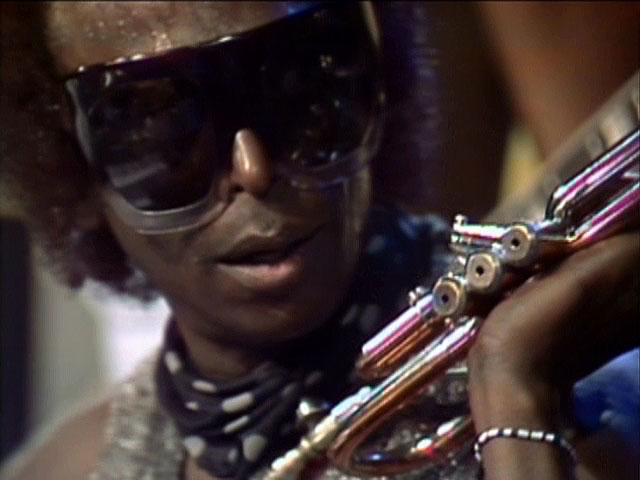
Miles Davis, 1973
From there it's a fast-forward to 1984, and a band that remained largely constant for two years, featuring Scofield, saxophonist Bob Berg and bassist Darryl Jones. The fast-funk of "Speak: That's What Happened," and two tracks from the following year—the equally fiery "Code MD" and propulsive but lyrical version of Davis alum John McLaughlin's "Pacific Express"—all find Davis at the top of his game, hitting the high notes with unbridled power, and mining the midrange with his unparalleled combination of rich tone and fragile vulnerability. Long transcending the moniker of jazz star and becoming star, period, the clothes here and throughout the rest of the DVD may have been the 1980s at their worst; still, few but Davis could actually pull it off. Scofield may have been the most conservatively dressed, but his edgy ability to bend notes with bluesman conviction while taking the harmonies deliciously out, make clear just how much he helped fuel Davis' music, from the time he joined in 1983 (co-writing some of the best material on 1983's Decoy and You're Under Arrest) until the trumpeter left Columbia Records in 1985 and made another paradigm shift with the release of Tutu, for Warner Bros, in 1986.
These Montreux performances have also—until very recently, with the release of the Deluxe Edition of Tutu (Warner Jazz, 2011)—been the only place to hear a baby-faced Robben Ford, playing with the now-wigged Davis, covering up the increasingly receding hairline of 1985. If Ford has always leaned a little heavier on the blues end of the equation than Scofield, the guitarist's solo on an increasingly incendiary "Jean-Pierre" matches, temperature-for-temperature, guest saxophonist David Sanborn's feature earlier in the tune, affirming that both players may have made specific choices about the ultimate directions of their own careers—Ford, a bluesman, albeit with a broader jazz vernacular, and Sanborn ranging from soul-driven smooth jazz to the occasional affirmation of more left-of-center concerns—but they always were (and remain) players with broad purviews, and no shortage of chops and taste where it counts.
With a year's hiatus, Davis returned in 1988 with a newly revamped band that brought saxophonist Kenny Garrett and lead bassist Foley into the fold, but it's percussionist Marilyn Mazur who's the focal point (and fulcrum) of "Heavy Metal Prelude," moving around her almost unfathomable percussion setup in ways that barely foreshadow the music she'd make on her own in her native Denmark, towards the end of the 1990s and into the 21st Century. While Tutu is overlooked on this compilation (it won't be when the full DVD box is released; Ford's solo on the title track during the 1986 show actually surpassing his playing on "Jean-Pierre"), two tracks from Amandla (Warner Bros., 1989) demonstrate how Davis could turn more programmed studio material into exhilarating live grist. Foley's roots may be even more blues-centric than Ford's, but tenor saxophonist Rick Margitza—sandwiched as a Davis alum between Garrett's first appearance in 1988 and involvement with Davis from late-1989 through to the end of his life—is evidence of a player too-often overlooked, as he solos here with a combination of musculature and focused, thematic drive.
The final electric performance, "Hannibal," from 1990, finds Garrett back in the sax chair, taking a burning outro solo, but it's Davis who owns the tune, first with a delicate mute, but then opening up the horn for a mid-section solo that demonstrates his declining health did little to distract him from playing in those final 14 months before he passed away, in September, 1991. None of these performances include his occasional speaking into his trumpet microphone, or his series of printed placards ("KENNY"), but throughout, Davis is a charismatic leader, yet one who is clearly generous in pushing (sometimes, almost literally) his band members into the spotlight.

Miles Davis with John Scofield, 1985
The final two pieces on the DVD have been seen before, on VHS tape as Live at Montreux (Warner Bros, 1993), but this represents the first time on DVD for this big band performance—conducted by Quincy Jones and featuring Garrett and trumpet protégé Wallace Roney beside Davis, alongside the Gil Evans Orchestra and George Gruntz Concert Jazz Band—doing the one thing Davis said he'd never do: look back. Performing material from Davis' 1950s collaborations with Evans, these two tracks from Sketches of Spain demonstrate both Davis' steady decline, as he passes the baton, after a short solo during "Solea," to Roney, and the indomitable strength of spirit that defined this enduring artist, regardless of his physical condition.
The bonus feature, a 27-minute interview with Carlos Santana, offers few actual insights, but there are a few amusing—and revealing—anecdotes. Of all the musicians who have lived within the Davis sphere of the early '70s, Santana is the least-versed, at least linguistically speaking, when it comes to playing jazz, but he was an insider, and it's clear that Davis' love for the guitarist went beyond simple vernacular and into the realm of spirit and attitude. Hopefully the forthcoming box will feature more interviews with those in Davis' inner sanctum, to help uncover and make sense of the complexities of the trumpeter's life.
The multi-DVD box set may only appeal to the admittedly legion of completists who are ready to sit through 20 hours of concert performances; but for those interested but less pathological, Live at Montreux—Highlights 1973-1991 provides the perfect opportunity to see why Miles Davis was unfairly maligned by jazz police during the last part of his life. It's also a chance to see, rather than just hear, his tacit ability to guide a seemingly endless stream of musicians—bringing out the absolute best in them and kick-starting careers that might well have gone differently, were it not for time spent in the company of a musician who not only changed direction multiple times during his career, but could shift the direction of a single performance with the slightest of nods.
Tracks: Ife (1973); Speak: That's What Happened (1984); Code MD (1985); Pacific Express (1985); Jean-Pierre (1986); Heavy Metal Prelude (1988); Jo Jo (1989); Hannibal (1990); The Pan Piper (1991); Solea (1991).
Personnel: Miles Davis: trumpet, keyboards; Dave Liebman: saxophone and flute (1); Pete Cosey: guitar and percussion (1); Reggie Lucas: guitar (1); Michael Henderson: bass (1); Al Foster: drums (1-2); James "Mtume" Foreman: percussion (1); Bob Berg: saxophone (2-5), keyboards (2-4); John Scofield: guitar (2-4); Robert Irving III: keyboards (2-6), Vince Wilburn, Jr. (3-5); Darryl Jones: bass (2-4); Steve Thornton: percussion (2-5); Adam Holzman (5-7); Robben Ford: guitar (5); Felton Crewes: bass (5); David Sanborn: alto saxophone (5); Kenny Garrett: alto saxophone (6, 8-10); Foley: lead bass (6-8); Benny Rietveld: bass (6-7); Ricky Wellman: drums (6-8); Marilyn Mazur: percussion (6); Rick Margitza: tenor saxophone (7); Kei Akagi: keyboards (7-8); Munyungo Jackson: percussion (7); Richard Patterson: bass (8); Erin Davis: percussion (8); Quincy Jones: conductor (9-10); Wallace Roney: trumpet and flugelhorn (9-10); Lew Soloff: trumpet (9-10); Miles Evans: trumpet (9-10); Tom Malone: trombone (9-10); Alex Foster: alto saxophone, soprano saxophone and flute (9-10); George Adams: tenor saxophone and flute (9-10); Gil Goldstein: keyboards (9-10); Delmar Brown: keyboards (9-10); Kenwood Denard: percussion (9-10); Benny Bailey: trumpet and flugelhorn (9-10); Charles Benavent: bass and electric bass (9-10); Grady Tate: drums (9-10); The George Gruntz Concert Jazz Band: orchestra (9-10).
DVD Feature: Running Time: 133 minutes. Bonus Feature: Interview with Carlos Santana (27 minutes).
Photo Credit
Stills taken from Miles Davis, Live at Montreux—Highlights 1973-1991, courtesy of Eagle Eye Media.
< Previous
Ultra Music at Pori Jazz Festival: Po...
Next >
The Good News!
Comments

Tags
Miles Davis
DVD/Film Reviews
John Kelman
United States
Gil Evans
Herbie Hancock
Wayne Shorter
Ron Carter
Tony Williams
Billy Cobham
john mclaughlin
Michael Jackson
John Scofield
Kenny Garrett
Pete Cosey
Dave Liebman
Michael Henderson
Al Foster
Bob Berg
Darryl Jones
Robben Ford
David Sanborn
Rick Margitza
Quincy Jones
Wallace Roney
George Gruntz
Carlos Santana
For the Love of Jazz
 All About Jazz has been a pillar of jazz since 1995, championing it as an art form and, more importantly, supporting the musicians who create it. Our enduring commitment has made "AAJ" one of the most culturally important websites of its kind, read by hundreds of thousands of fans, musicians and industry figures every month.
You Can Help
To expand our coverage even further and develop new means to foster jazz discovery and connectivity we need your help. You can become a sustaining member for a modest $20 and in return, we'll immediately hide those pesky ads plus provide access to future articles for a full year. This winning combination will vastly improve your AAJ experience and allow us to vigorously build on the pioneering work we first started in 1995. So enjoy an ad-free AAJ experience and help us remain a positive beacon for jazz by making a donation today.

Giveaway

Eligible winners: 15
Days remaining: 14
Days remaining: 14