Home » Jazz Articles » Interview » Patrick Brennan: Rhythms of Passion
Patrick Brennan: Rhythms of Passion


It might seem paradoxical to transfer what's convivial, collective music into the solo process. But, if you're feeling a conception, and no compatriots can go along with you at that moment--you either go on by yourself or you don't go there at all.
For the astute lay person this means moving the expressive expansiveness of trap playing and the drum choir into "the foreground of an entire orchestra's intelligence."
But none of this captures Brennan's subtle humor and wit.
All About Jazz: Please describe yourself.
Patrick Brennan: Ah, that's always a tricky one. Beats me. I did finally learn, about 15 years ago, that if you don't tell people what you're doing yourself, people can come up with the craziest descriptions (often wrong or negative) of what you do. I've learned to write highfalutin descriptions myself because you have to compete with Euro-classical music and all that just to get a door gig these days. And if you can't talk about how famous you are, you gotta talk about the music itself.
I think of myself as a composer first, then bandleader, then saxophonist, and specifically as a composer for improvisers. Call me independent. I've never been part of any group or style. I've been trying to develop something specifically my own. I don't dig stereotypes, stereotypical music or people. I like Duke Ellington's notion of "beyond category." I'm looking to get the creative most out of practices that have developed in black music—that's jazz, African, R&B, blues, Latin, whateva'—and in any other music, if the shoe fits.
I don't know what other people think, but I think of the music as avant-garde in the sense that it's different shit that stretches what people are used to, but it's not that 50 year-old style of imitating [John Coltrane's] Ascension (Impulse!, 1965) that's still called avant-garde. Just to be clear, I really like Charles Gayle, for example, but most people aren't improvising at that level. Unlike a lot of what are called avant-garde approaches, I really dig swinging rhythms, but I'm also trying to stretch that stuff as far as imagination will go.
So, the music includes what's in free music, bebop, Euro-classical concepts and African musics, but it isn't exactly any one of those things. It's my own thing, not an eclectic blend of styles, yet it is an expansion on how those musics think. In fact, it's not a style but a way. And the music sounds how it does because of the way it comes from. The way comes first, then the sound. I guess you could call it a unique or personal musical language. Another good hook might be my word metagroove, which describes the way I work with the ways that different grooves can bounce off each other. The music is drum oriented, even if there's no drummer or obvious beat. Some of the cats who've related to music in the kinds of ways I'm identifying as composer/bandleader/players who made their own musical worlds would be Duke, Thelonious Monk, Charles Mingus, Ornette Coleman, Henry Threadgill, Sun Ra, the Art Ensemble Of Chicago, Steve Lacy, and Steve Coleman.
I'm never very satisfied with describing music, so I've kept thinking over that question of how I'd "describe myself musically." Really, I pay more attention to the in betweens in music. And I'm not into fitting into a "style"—which of course makes it hard for somebody reading about a musician to get any idea at all of what she's doing—but everyone has a "way," which eventually comes out sounding like a style. I'm really more concerned with the way than the style.
 The other day I came across a description of what in science is called a "black box." Basically, from the outside, you can see what's going in and you can see what's coming out but you don't have any real idea of what's going on inside. Those are the kinds of things we accept as "realities" or "facts" or "styles," like "jazz,"' or whatever as if everyone already knows what it is, but they really don't. I think that's one reason so many musicians have said "just call it music." The thing is inside what looks like a "black box" is a whole bunch of unsettled, uncertain and diverse elements all networked together. My interests are with playing around with the connections that might lead to such a black box like "jazz." In other words, I'm attracted to working with questions and ideas that are not settled. That's where the discoveries are. What would you call that kind of music? Hard to say, but you know what it sounds like, and I think that's where most really creative shit comes from.
 There's another funny thing. A recording of Charlie Parker could sound exactly like a recording of someone doing an exact imitation of the solo with no invention at all. In theory, they could sound exactly the same, but they still wouldn't be the same music.
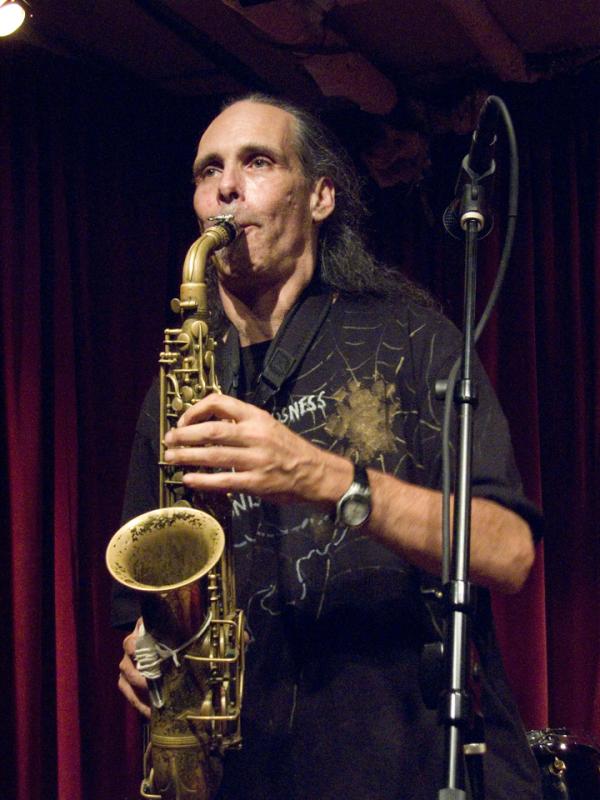 AAJ: I believe you initially came on the scene as a leader of your own band, as opposed to having done an apprenticeship with other artists?
 PB: : I suppose it was as a leader, although I was also playing with whomever I could. While there were musicians who definitely helped me as mentors and examples, I also found that if I wanted to grow at a certain level, I'd have to do that on my own. So, instead of waiting for somebody else to make that happen, I went and formed my own group, which I would have done eventually anyway.
AAJ: Are you suggesting that the musical and social environment for an avant-garde musician in New York was not very accommodating when you first arrived on the scene?
PB: No. It's hard for a musician to realistically expect accommodation. Money lives on Wall Street. Fame belongs to media. Music can only promise music. It's a real gift when any musician manages to live just through one's work. I found the scene very exciting when I arrived in New York City in 1975. Places like Studio Rivbea and the Tin Palace always let me in—broke or not. The level of creativity and musicianship I witnessed daily was both inspiring and admonishingly humbling. New York can certainly function to remind an artist just how much work one has yet to do.
AAJ: Even your website does not delve much into your Detroit beginnings; please talk about your youth in the Motor City?
PB: My father was a musical enthusiast—played good six-string thumb position rhythm guitar in the late '30s—picked up the bass in the '40s, which kept him out of combat in the military. It was at most a weekend thing when I arrived, but I heard plenty of Louis Armstrong and Count Basie recordings as a little kid.
I saw Eddie Harris on TV playing Exodus to Jazz (VeeJay, 1961) when I was six years old. That gave me saxophone fever, but I never got a horn till I was 17. I tried clarinet a couple of times in grade school, but just couldn't cover the holes enough when I was that young. A new school in 6th grade got me drafted into playing trombone. The school had a great teacher who taught me how to transpose, and they set aside daily practice time, which meant that I actually practiced and learned how to play. A couple of years after that, my father gave me his guitar, and a year later, his bass.
He lived elsewhere, so my listening sources had become primarily radio— Motown, Rock—stuff like that. I spent a whole summer listening to isolated tracks of a The Beatles LP, which taught me how music was put together, and I began composing. One piece got played by my school band, and in 9th grade I wrote something for a brass quintet that went into state competition. Also, my buddy, Mickey MacKenzie, showed up with a huge collection of Rahsaan Roland Kirk and Eric Dolphy. That became daily fare. Then I began to reach out to whatever different music I could find—the more different the better. And there was a lot of it in any genre or from any country at the time—all kinds of paradigm shifting surprises.
The years '68 to '72, after which I went to college, seem as important as Detroit itself. At that time I was no more than a big-eared, shy wallflower just discovering music and instruments. A contagious avant-garde ethic seemed to saturate the air, even if this was for sure, in retrospect, a minority attitude. "Avant-Garde," however, was more a way than the style the term seems to designate now. I was also exploring the literary, visual and theatrical arts, doing multimedia happenings, musique concrete. I was all over the place!
 Detroit was very independent-minded while accepting second fiddle to none, and continues an important attitudinal and conceptual influence on me. People did their own things their own way—take it or leave it. Drummer Bud Spangler spread Coltrane's late music on WDET with news of local music. At the Ibo Cultural Center I got invited to play at bassist Ubadiah Bey Obay's house up on North Ardmore in Pontiac— "Hey, European brother." I didn't understand what he was talking about, but we loved the music.
 This was a weekly gathering of nearly all self taught musicians who were emulating the high energy collective improvisations of Coltrane and Albert Ayler. They adopted me like family and included me in whatever they did, and we've shared that connection ever since, wherever I've gone. There was a strong devotional quality to how they were playing. They also connected with another group of Muslims doing the same thing down in the Cass corridor—equally welcoming and supportive—but more explicitly theistic, which was something I didn't fit in with quite so comfortably.
The musician-run Strata Concert Gallery had the deepest impact on me. I heard Archie Shepp there with Dan Spencer and Sadiq Abdushahid [Archie Taylor Jr.] together on traps. I've never recovered from that two drum sound. Ornette played there with Ed Blackwell and Charlie Haden—still one of the most elevated listening experiences I've ever had. The CJQ, which included [pianist] Kenny Cox, [trumpeter] Charles Moore, [tenor saxophonist] Leon Henderson and [bassist] Ron Brooks, along with Spencer, sliced Detroit's cutting edge.
Detroit's genius seems to have been time. These cats were structuring blocks of differently inflected motion. Tempos would seem to speed up and slow down. Time would flow in recurrent arcs: backward, hovering, gushing forward. It wasn't all intuitive or free. It was a self-aware, deliberate application of structure. Spencer's drumming was exuberant and volcanic, and their interaction was seasoned enough to afford an elegant egalitarianism. Of course, I didn't understand what they were doing, but I could feel it, and from that I developed even stronger appetites for deep rhythm.
AAJ: Did you have any other formal musical training? What about the bass, which you also played?
PB: I went to Thomas Jefferson College, a since closed small experimental college in western Michigan that was part of Grand Valley State—very, very inexpensive, very open and very interesting if you took advantage of what was possible there. The music department consisted of Bob Shechtman, a New York area trombonist and bassist who also practiced Euro-classical composition. He was iconoclastic and a real polymath with tremendous enthusiasm. Music was only one of many interests in my playbook at the time, but on a whim I looked into composition classes with him, which he gave one on one. I had no idea that he wasn't adding any new students at the time, but he took me on immediately.
The first assignment he gave me was to design a piece of music. I thought the man was out of his mind, but I went along with it and came back with a bunch of shapes drawn on score paper. He then made suggestions based on those shapes and through the dialogue of his weekly critiques a composition gradually evolved. About four months into that process, my mind went "pop!" I got it. I've been serious about music ever since.
He had to cajole me into his theory class, but once he got me to sit in on one, I was spellbound. We did all the basic European stuff—canonic writing, etc., but Bob explored all this outside the sanctimonious correctness so endemic in most formal music departments. In the middle of a two-hour session analyzing a single measure of Beethoven, he'd drop a needle down on a Duke Ellington record and ask everyone to listen to the bass drum—and for good reason too. For him music was music and musicians were musicians. No differences—a very liberating head.
He'd also heard me on bass trying out some jumble of Charlie Haden with Gary Peacock's way of playing with Ayler. After that, he kept me after every class to play his bass while he played piano insisting that I play the damned roots of the changes in quarter notes and "Lay back! Relax! Listen!" I did do a little bit of private study on saxophone and on the bass while I was in school as well. All in all, I left school not so much with well developed skills, but with great conceptual tools, much of which I also owe to Basil King, with whom I studied painting, that have since served me well. I've been able to study and learn on my own. And just before I left for New York, I was also strongly affected by a two-day workshop that Muhal Richard Abrams and Roscoe Mitchell presented at Kalamazoo College.
In New York, I did a year at Jazzmobile with John Stubblefield, Frank Foster, Jimmy Heath and Frank Wess. When I hit a wall in my development some years later, I went to Stubblefield for a lesson about twice a year for a couple years—a great mentor, a generous man and a fantastic musician. I was lucky to know him. And that's all the formal study I've done. But the informal learning from musicians on and off the bandstand has been even more informative and important.
The bass fed me through school; got me most of my paying work in New York and introduced me to lots of musicians. Saxophonist Marvin Blackman, who was my most important informal teacher and mentor, hired me quite a bit, usually for the bottom dollar gigs, but I was an apprentice who was learning so much that that didn't matter. I love rhythm sections and I adore the instrument, but I can understand why Mingus would want to slug a sideman: it's very hard to lead a band from a bass. The instrument is also physically very unforgiving, and you need to practice a lot just to keep your strength available.
When my gigs narrowed down to piano bar gigs playing massacred standards, and the neck snapped on the bass in '84; I thought twice about investing in the repair. However, every time I've dropped one activity, the others have become stronger. I'd stopped painting about five years before, which opened up a lot more concentration for music; and putting the bass aside, for me, opened up more space for the composing and the saxophone. I've never stopped hearing the bass in my hands though, nor thinking like a painter for that matter.
AAJ: Why did you move to New York City?
PB: New York's the center of the world, right? Or so I thought at the time. Its reputation is mythical. All the heroes had gone there (almost)—painters as well as musicians. I wanted to grow. I wanted to be challenged. And most of all, I needed to associate with as large a pool of musicians as possible to have a better chance of playing the music I've really wanted to play, which is still a reason for being in New York— all its heavier problems aside.
AAJ: Have you and are you able to support yourself solely from the music?
PB: Money. Money. Money. Money. Money. Almost never in New York—on the road when it would happen—in Europe, just barely. But that's been the plan all along, and I'd really love to. It is a bit contradictory to practice a labor intensive art while playing hooky from it to pay one's way. But this isn't a particularly unique circumstance. If enough people are unwilling or unable to pay what adds up to living wages for musicians, this is going to define both a musician's options as well as a band leader's relationships with collaborating musicians. I've gone on strike quite a few times over the years because of this, but as yet to little effect.
 AAJ: Can you go into detail regarding what "strike" situations you attempted to bring about?
 PB: Well, there's real irony in conducting what amounts to a one person "strike." Like any strike, it's a matter of refusing to work unless certain conditions are met. But by oneself in a freelance situation, it can simply mean that you just don't work. Sure, you could work for free, for the door or for cheap. You can also refuse substandard offers all you want, which is what I'm talking about. But during phases—which can be amazingly long, where you can't stir up better conditions— it can mean what might be an honorable inactivity, but one spiced with a growing chunk of invisibility that can also edit your future possibilities.
Most businesses develop with other people's money, i.e. loans. But the arts are unique in that the artist is expected to supply all startup capital out of pocket, even though artists need income to live like anybody else. But this is because the art's not really a commodity. It happens and people pay attention to it for different reasons. And they're going to do it regardless of whether it's sellable. Selling your work means having enough perceived value that people are willing to pay for it. My ambition has been to earn this status on the basis of the quality of the music alone, but so far, it doesn't seem to have accrued enough of that kind of value. The power of "no" seems to have its limits.
AAJ: In your web bio. it says that you developed the first version of Sonic Openings Under Pressure. What conceptually is that moniker all about?
PB: I love to cook. I love to savor food, and I love to ruminate while eating. A lot of the time I'd be practicing while cooking, or composing while eating, turning ideas over and over. I'd be cutting up vegetables, cooking them into a soup—good, solid low budget fare.
Collage has long been one solution to incorporating disparity in an artistic synthesis. Many musicians in the late '70s were responding to colliding diversities in our soundscape. A good number surfed on eclecticism, while at the same time, presentations of more conventional jazz devolved toward pick up bands composed of "stars." John Zorn's initiatives, for example, interested me. A piece like Cobra (Hat Hut, 1991) energetically spun sudden changes between radically dissimilar sound bodies. That's what I liked. What I didn't want to do was organize music through a centralized command structure, and I wasn't interested in fragmented pastiche or caricature.
What was really important to me was keeping the logic of collaborative composing audible, as with Ellington, Ornette, and Coltrane's early '60s band, the CJQ or the Art Ensemble. I was wondering how to develop a shared matrix for multidirectional thinking in a band; how each improviser could be consciously operating with a number of contrasting musical strata simultaneously, but still be so in sync that the band could stop on a dime or switch directions like a flock of birds. How could I incorporate disparity, contradiction and frequent shifts of direction? How could I embody what it feels like to move that way?
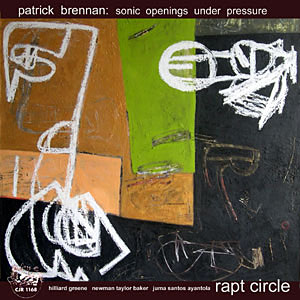
I initially called the group SOUP when I first formed it in '79. The notion of slicing up and discovering new wholes suits that metaphor. Fishing around for something else in the 90s and blindly reaching for an anagram, I blurted out "Sonic Openings Under Pressure." Hmmm. That turned out to stick and has found some meanings too.
Once you put something like this into motion, it develops a broader evolutionary rhythm, and you become responsible to that as much as to whatever's on your mind that week. In this case, I'd become involved with growing a language that coded multiple rhythmic strata with multiple themes. These interface structures—what people usually call "forms"—are hinged shape shifters that can behave cyclically, as do conventional "tunes," or act like vamps, or be developed in less easily mapped ways—freely or whatever.
 This interface structure is what people call a "composition" when related to collective improvisation, which is already a mode of composition in itself. I'm more interested in interaction among reciprocating collaborators who think and do differently than I do. I like the movement. I imagine my own role as a composer who happens to voice through a saxophone. I'm not looking for solos over accompanists. And one more very important distinction of this project is featuring and developing the rhythm section as the absolute core of the music, which is also where many of my ideas begin.
 The "pressure" is the composition, which functions not only to link and spur collaborators, but also to push improvisation away from its entropic attraction to habit and cliché (my own included), and invoke some, well, OK, some "sonic openings." It's as much about the thinking and the relationships as the sound.
AAJ: One of my first memories of your music was your recording Soup (Deep Dish, 1983), and pianist James Weidman being part of the group's photo. He was and you were both so young looking; would he be a good example of someone bringing a contrasting style to that group?

From left: Patrick Brennan, Lisle Ellis
PB: Weidman's a very intelligent, well informed, capable musician, with an acute understanding of compositional form and wicked musical wit. A lot of people might not know that he's also very well versed in Euro-classical music. We met in the '70s as occasional members of Jo Jones Jr.'s rhythm section at his weekly jam session at Barbara's on West 3rd Street. James would also come over all the time to play at my loft on West 25th Street, which took advantage of a 24/7 potential for jam sessions, rehearsals and working out original music. The bands that recorded my first two albums formed around people there who could both enjoy and hang with my compositional experiments. Weidman could take anything I'd come up with and run with it. He plays like James Weidman, which is what he's supposed to do.
AAJ: Your website has elements of what amounts to a musical manifesto, in that it contains some of the basic ideas that form your musical approach. One of the statements which you make reflects almost your mixed emotions about playing "free." Please elaborate?
PB: I wasn't there, but I've often wondered if one of the underlying reasons that so many musicians, such as Roy Eldridge, got so upset with Ornette Coleman's music at first was that it took away a freedom. It did away with a lingua franca that, for more than 30 years, had potentially allowed any capable musician to sit in with any band on the spot. That was the shared matrix of standard tunes and their repeating chord cycles. I think they functioned, not as "compositions" (because improvising is the actual compositional decision process at play), but as interactive matrices that gave an ensemble a common web of convergence points. Ornette's band composed as would any other jazz ensemble, but its matrix was much more particularized. Not just anybody could play that music. It required a more specialized knowledge, and in that sense his music seems to me to be much more compositional than it is jam session.
Technically, to "play free" means to compose without a chordal or modal grid, and there's an awful lot of music that can be arrived at only that way. Opening up a wider palette of options for each individual deeply changes how ensembles coordinate themselves; and the communication networks within a band can't be quite so easily assumed as in standard formats. The extended languages of Cecil Taylor, Sam Rivers or Steve Lacy developed through very gradual evolutions; and it's more complicated still to construct this level of coherence as an ensemble. These relationships within an ensemble aren't at all trivial. The connective tissue in Ornette's early groups grew through a combination of the concepts he shared with each player and their common experience with bebop. The Art Ensemble of Chicago's collective improvisations are rooted in routines of very intensive rehearsal. And even a regular ensemble of free improvisers develops its own compositional matrix out of an accumulation of shared experiences. Each of these is a very distinct musical setting with its own very unique kind of order.
What I'm ambivalent about is crossing free improvisation and the jam session within an assumption that this is all you'll ever need. Ensemble free playing can gather around lowest common denominators every bit as clichéd and stereotyped as other standardized formats, and to adopt this as a compositional default mode leaves out possibilities that I'd prefer to keep in play—such as unison textures and more intricate sonic and conceptual interlocks. An endless context where absolutely anything could conceivably happen anytime gets a little wide for my attention span. It doesn't really push me enough to outdo myself. I'm more drawn to the tensions and suspense of tighter weaves of probability and the creative alertness this invokes in collective improvisation. There's something special about a group stretching into a very particular sonic spectrum and thought stream together.
I'm also fascinated by multiple rhythmic levels: by long thoughts developing over years that intersect with immediate interactions and then splay across more gradually unfolding ideas. This mixes long deliberation with instant spontaneity. Purely free playing tends toward shallower horizons than that, but so much depends on the people involved. If I'm working with somebody else's initiative, I'll go with whatever that may be. But on my own, I tend to find mixed strategies much more interesting to work with, which I also hope are more transparent for listeners.
 AAJ: Let's delve into some of your Cadence/CIMP recordings for what they revel about some of your under lying musical concepts. saunters, walks, ambles (CIMP, 1999), with bassist Lisle Ellis, reflects an outré take on the Monk cannon. What makes his music so endearing to you?
 PB: Monk is one of the four composers, along with Ellington, Mingus and Ornette, who showed me how to compose for improvisers (and Threadgill came in later to always remind me not to settle for too little). I always bounce what I'm doing off of their examples.
In '82, after releasing Introducing:SOUP (Deep Dish), I was unemployed and seriously considering giving up on all this composer/bandleader silliness. I ran over to hear Steve Lacy and Roswell Rudd playing duo one night at Lush Life on Bleecker Street. They were playing nothing but Monk. It was so viral that I went home, closed the door, and practiced nothing but Monk for weeks on end. Somehow, something worked out
There's something so deep about Monk's music, so tied in with the will to live (and to really live beyond just surviving). Strong feeling for anything or anybody sends important gravitational signals, not the least of which is a special call to pay attention. Asking why you like or love something—to inquire into what it is that's drawing your attention—starts to take you beyond what you already know into new understandings.
Monk's interfaces (what jazz musicians call "tunes" or compositions) are exceptionally durable, as are Ornette's. They're extremely dense with suggestion. You can take a Monk or Coleman melody and beat it up, play it out of order, dice it like Osiris, and it still keeps its identity and integrity. The sequence of intervals, the melodic curves and the way the phrases talk to each other contribute to their distinctive strengths. This isn't a common quality either. An Ellington, Charlie Parker, Mingus, Coltrane or Miles Davis melody is more likely to melt away into its chords or modes. They don't travel as far.
This resilience offers improvisers unusual freedom, because the motifs don't fall apart, no matter how hard you work them. It's strong enough to test the growth of your own identity. If you can meet the material, which is an exercise in attention and detail all on its own; and speak with that in your own voice, something's going on. This is what my friend, sculptor M. Scott Johnson, calls "the ecstasy of resistance."
What I admire so much about Monk is that he didn't appropriate, imitate or take short cuts. If something was already in the tradition, he'd reinvent it all over again in his own terms—and I mean even the swinging pulse, chords, overtones, blue notes, anything. Nothing seems accepted as a given. He worked from deep, pre-stylistic, even pre-musical understandings. He didn't tell me that or anything. It's there in the music for anybody to get to. Monk's contributions are a paradigm of a composer raising the level of his community. Once you engage that Monkian labyrinth, you're never the same.
AAJ: When and why did you tour Europe playing solo, and how did that lead to duets with bassist Lisle Ellis?
PB: It was more than touring. I was offered a footing in Lisbon and lived in that area with my family from '92 to '99. I'd been hesitating about doing solo performances for a good while because of how high Roscoe Mitchell and Steve Lacy had already set the bar. However, I grew into it and eventually proposed a solo recording to CIMP, and they suggested I do a duo recording.
I'd met Lisle Ellis in '82 when he was living in Montreal and I came through with my band. After that, whenever he came to New York, my house was his house. In Europe, I'd heard him absolutely burning on a recording with Glen Spearman, so I knew where his ear had gone. I also knew I could trust him personally as well as musically and that he had lightning hearing and reflexes, which I needed for this because, as he was coming from San Francisco and I was crossing the Atlantic to do this, there wouldn't be very much time to prepare. We recorded that album and then picked up the thread in a number of different collaborations since he moved to New York in about '05.
 AAJ: How does the CIMP/Cadence recording process work for you in terms of the sonic outcome—both of the duo context and your regular working band?
 PB: I like it more in theory than in practice. It's perfect for absolutely ideal circumstances.
AAJ: That answer is very vague. I am sure "The Crew" is receptive to positive and negative feedback. Let's hear it from the gut?
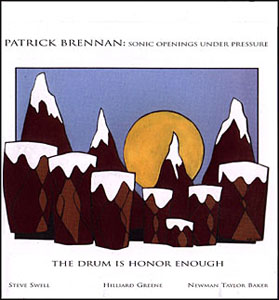
PB: saunters, walks, ambles is an interesting snapshot of a couple days of musicking, and I come across people who enjoy that more than anything else I've recorded, although for me it's overly long; and it, on the whole, wanders around from track to track. It feels like an assemblage or a collection of events. I don't usually feel an urge to, "wow," play it again and again. Ironically, the drum is honor enough (CIMP, 2004) is the only sonic openings recording that would really benefit from some corrective surgery, which is a solution outside of CIMP's aesthetic.
As for the literal recorded sound, it's hard to be more accurate than CIMP, but I wish it was an accurate recording of a different room. And, while the sound is vividly present on high class equipment, the bass disappears on the radio or on the kind of junk that most of us listen to recordings on, which matters to me because, for me, the bass is a front line instrument. So, even technical excellence and integrity encounters limits. There's not any perfect way to resolve the built in artificiality of recorded music. You also need a very thick skin to pursue "artistic freedom" in the shadow of any producer's attitudes, opinions, presence and pressure, which almost unavoidably infiltrates the music as well.
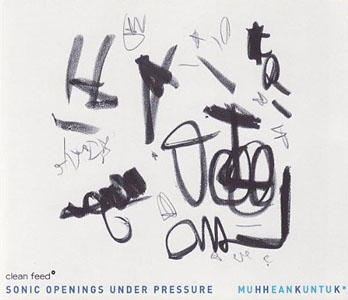
CIMP is a very brave and admirable initiative, and they stand behind their artists' recordings with consistency while accomplishing all of this on a shoestring. Not small things at all. But in my case, the records seem to function better as documentation than representation; which is what you need to expand audiences and access to venues so that you can continue developing the music. It turns out that the recordings I've produced myself, such as muhheankuntuck (Clean Feed, 2006), which way what (Deep Dish, 1995) or Introducing: SOUP have ended up more successfully representing what I've been after. But in each case, the variables have also been wider than how the music was recorded.
AAJ: How did you meet the Gnawa musicians of Morocco with whom you have collaborated both in performance and on record?

From left: Patrick Brennan, Lisle Ellis
PB: While living in Portugal in the '90s, I woke up to the opportunity that Africa was only a couple days travel away if Morocco was the destination. I'd heard recordings of Gnawa music which had deeply impressed me, and I'd noted some maybe not so distant parallels with some of Coltrane's early '60s modal music. The Sahel aspects of both the Gnawa and the blues sound were one thing—Metallic polyrhythmic percussion was another. And the kinship between the gut string sound of the sintir or guimbri and Jimmy Garrison, a major hero in my bass pantheon, was just uncanny. But I'd also read that Gnawa were not easy to come across in public, and, not being the pious sort, I was just a bit intimidated that theirs is an explicitly mystical and possibly exclusive practice. So, I carried no expectations; and being suspicious of cultural tourism, I left my horn behind too.
But Morocco circulates a completely different attitude than either America or Europe, which you can feel as soon as you step off the boat. This is Africa, and music means more than entertainment, spectacle or decoration. I'd meet Gnawa performing in public squares or in their shops and homes, nearly always open, warm, down to earth, full of a playful humor. Over and over, I was encouraged to come back and play, which is exactly what I did on my second visit. So, here's this ethnically Irish-American guy meeting comments from serious musicians, "How come you know our music so well?" This was profound. I didn't know their music the way they knew it. I was just playing out of the ethics of our own sonic community and surprised that my contribution was more than welcomed. That gave me a lot to think about and says a lot about the extraordinary reach and depth of Pan-African musical attitudes.
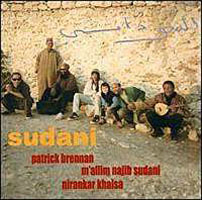
AAJ: When you recorded with Najib Soudani and Nirankar Khalsa on Sudani(Deep Dish, 1999). What was their experience in spontaneous music?
PB: Khalsa, of course, was born in Chicago and comes from what I call musical aristocracy: generations of blues, gospel and jazz musicians. His father, William Henderson Jr., drummed for Ahmad Jamal. And Nirankar was later a regular member of Horace Tapscott's Pan-African Peoples Arkestra in L.A. He's lived in Madrid for a good while, which is where we met. And that was the just part of the good fortune. He's a superb, multifaceted musician who plays traps, bamboo flute and sang impromptu blues with Najib during the session. I couldn't imagine anyone more perfect for that situation.
Some of my new friends in Essaouira had been urging me to get together with this Gnawi, Najib Soudani. He was supposed to be something special. They were right. Previously, I'd been careful to respect the mostly pentatonic sonic palette I'd been hearing in the singing and playing of the Gnawa I'd met. Najib's rhythm, however, was hotter, with a different funk to it; and I was hearing all these un-tempered tritones, flat 9s and major 7ths, which resonated a lot closer to my own hearing. That, by itself, took me out, and I followed those sounds. And soon enough I was playing more and more from my own personal sound sense. The more "out" it got, the more he smiled. That was something else—and the beginning of a strong and continuing mutual friendship.
One time, Najib and his compatriots took me down the coast to a shrine at Sidi Kouki, where we spent the night playing together. I was watching closely how he led his band in relation to my contributions—dynamics, tempos, changes of direction—and had to wonder just how different this really was from Count Basie. They're playing Black Music, and we're playing Black Music. There's call-and-response, rhythmic pocket and an intent to "lift the bandstand." A Gnawi m'allem has to correspond with dancers who become inhabited by spirits during the Lila. Spontaneous flexibility is a part of the relationship as it is in our musical practices.
Since that core aspect of the tradition is intact both here and there, it's simply been a matter of meeting on that common ground. While I was hoping that the recording might, among other things, help Najib to get more work outside Morocco, I was bemused by the exoticism buzz that gathers around a "world music" collaboration. Nothing I've recorded called "jazz" has ever received that much attention. And I mean, Gnawan people are not exotic to themselves. Then this exoticism tag gets tied into this popular mythology of "fusion," which presupposes fixed "styles" that find a new life in recombination. But musicians fuse ideas and sounds all the time. There's nothing new about "fusion" at all. We weren't playing styles or trying to affect a new one. Nobody was pretending to be somebody else. It was an interaction, not a stylization. Najib brought something into my musical world, and I brought something to his, and likewise with Nirankar. Each of us spoke with the others in terms of our own distinctive histories, experience and imagination.
Comments
About Patrick Brennan
Instrument: Saxophone, alto
Related Articles | Concerts | Albums | Photos | Similar ToTags
Patrick Brennan
Interview
Ludwig vanTrikt
United States
Wadada Leo Smith
Duke [Ellington]
John Coltrane
Charles Gayle
[Thelonious] Monk
[Charles] Mingus
Ornette [Coleman]
[Henry] Threadgill
Sun Ra
Art Ensemble [of Chicago]
Steve Lacy
Steve Coleman
Charlie Parker
Louis Armstrong
Count Basie
Eddie Harris
Beatles
Rahsaan Roland Kirk
Dolphy
Albert Ayler
archie shepp
[Ed] Blackwell
[Charlie] Haden
Kenny Cox
duke ellington
Gary Peacock
Muhal Richard Abrams
Roscoe Mitchell
John Stubblefield
Frank Foster
Jimmy Heath
Frank Wess
john zorn
James Weidman
Jo Jones
Roy Eldridge
Cecil Taylor
Sam Rivers
Lisle Ellis
Roswell Rudd
Miles Davis
Jimmy Garrison
Ahmad Jamal
Horace Tapscott
For the Love of Jazz
 All About Jazz has been a pillar of jazz since 1995, championing it as an art form and, more importantly, supporting the musicians who create it. Our enduring commitment has made "AAJ" one of the most culturally important websites of its kind, read by hundreds of thousands of fans, musicians and industry figures every month.
You Can Help
To expand our coverage even further and develop new means to foster jazz discovery and connectivity we need your help. You can become a sustaining member for a modest $20 and in return, we'll immediately hide those pesky ads plus provide access to future articles for a full year. This winning combination will vastly improve your AAJ experience and allow us to vigorously build on the pioneering work we first started in 1995. So enjoy an ad-free AAJ experience and help us remain a positive beacon for jazz by making a donation today.

Giveaway

Eligible winners: 15
Days remaining: 7
Days remaining: 7