Home » Jazz Articles » Live Review » Montreal Jazz Festival, Days 4-6, July 2-4, 2011
Montreal Jazz Festival, Days 4-6, July 2-4, 2011
Festival International de Jazz de Montréal
Montréal, Canada
June 25-July 4, 2011
Montréal is a city in transition, and in a move that's absolutely uncharacteristic of other Canadian cities, is planning a downtown renovation driven, in no small part, by the arts. Place des Arts has been undergoing renovations for the past couple years, both internally and externally, in conjunction with the expansion of the TD Festival International de Jazz de Montréal that has not only seen the opening of the Maison de Festival in 2009—business headquarters, but also a press room, a museum and a year-round club, L'Astral—but the creation of La Place des Festivals, a 7500 square meter space for large outdoor events that sports the biggest installation of animated fountains in the country, with 235 water jets, four lighting tours, and room for restaurant facilities.

Artist's Conception: La Place des Festivals
But there's so much more. FIJM 2011 has been marred, but only slightly, by the still-unfinished work on Rue Ste-Catherine, but when it's completed, it will be well worth it, as it will be better designed for its pedestrian only status during major festivals like FIJM. Reflecting a rare commitment to culture on a municipal level, Montréal is growing into a city like none other—not just in Canada, but in the world, and one that could only be possible through the cooperation, vision and growth of major festivals like FrancoFolies, the world-famous Just for Laughs comedy festival—and, of course, FIJM.

Artist's Conception: Sainte-Catherine Axis
And with the opening of Adresse Symphonique , the city's new home for the L'Orchestre Symphonique de Montréal, Place des Arts will expand to six venues in September, 2011. FIJM is not the only organization in Montréal that thinks big, but it's been one of the major contributors to a cultural rebirth and evolution in the city that will only become even more exciting as the major expansion and revamp of the area now called "Quartier des Spectacles" is completed. Chapter Index
- July 2: Anouar Brahem: The Astounding Eyes of Rita
- July 2: Eivind Aarset Sonic Codex
- July 2: In the Country
- July 3: Christian McBride's Inside Straight
- July 3: Béla Fleck and The Flecktones
- July 4: Black Dub, with Leif Vollebekk
July 2: Anouar Brahem: The Astounding Eyes of Rita
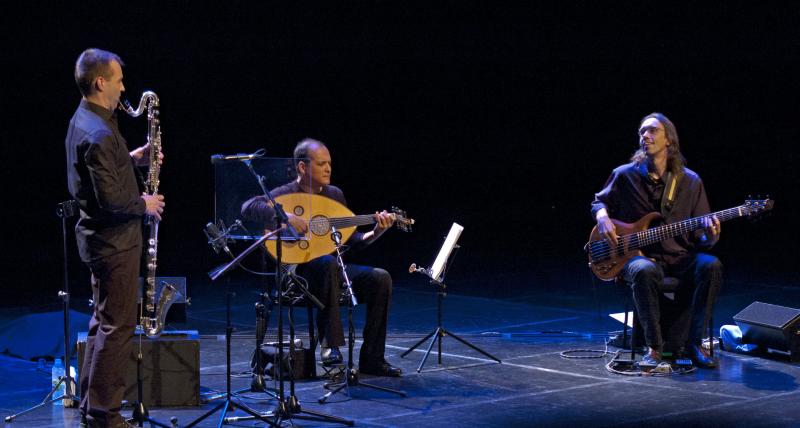
When the lights went down on Anouar Brahem's final night of a three-evening run in FIJM's Invitation series, and a voice filled the hall to announce that percussionist Khaled Yassine would not be making the show, as originally scheduled, it was, at first, disappointing that the entire quartet responsible for the Tunisian oudist's The Astounding Eyes of Rita (ECM, 2009) would not be available to perform the music in Place des Arts' 750-seat Théâtre Jean-Duceppe. Those fortunate enough to have seen the group—which also includes bass clarinetist Klaus Gesing and electric bassist Björn Meyer—know that the group's gentle pulse as due, in no small part, to Yassine's contributions on darbouka and bendir. So, without the drive of hand percussion, how would The Astounding Eyes of Rita sound, especially when it was only learned that Yassine would be unable to attend, due to visa problems, the day before the show?
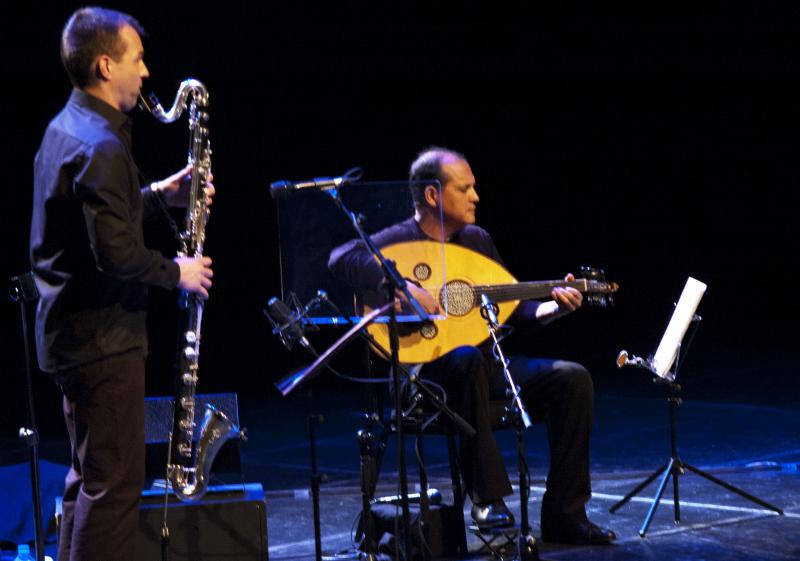 From left: Klaus Gesing, Anouar Brahem
 If Brahem's previous two evenings at FIJM taught his audience anything, it was to have the same level of trust that the oudist clearly has for the musicians with whom he chooses to surround himself. Whether it's the Thimar group—a trio with reed player John Surman and bassist Dave Holland that hadn't played together on more than a decade—or his more recent Le Voyage De Sahar trio, with pianist Francois Couturier and accordionist Jean-Louis Matinier,a common thread was the comfort level that existed amongst the players. Not the kind of comfort that breeds complacency; instead, the complete trust that, if one player goes out on a limb, he can do so with the knowledge that his partners will be right there with him, without hesitation or even conscious thought.
A knowledge that Gesing confirmed immediately after a performance where the group may have been short a percussionist, but made clear that, in addition to demonstrating Brahem's tremendous diversity and virtuosity, also highlighted the consistently high level of all his various projects. While there were some moments of extreme magic that made the first evening, with Surman and Holland, particularly special, the truth is that all three of Brahem's shows were inspired and inspire
As with the other groups brought for his Invitation series, Brahem's partners on The Astounding Eyes of Rita are no strangers to fans of the ECM label. Gesing has been a partner with singer Norma Winstone and pianist Glauco Vernier for nearly a decade, last heard on Stories Yet to Tell (2010), though in that context he can be heard on soprano saxophone in addition to the bass clarinet he brings, alone, to The Astounding Eyes of Rita. Meyer has been a longtime member of pianist Nik Bärtsch's evolving Ronin group, heard most recently on Llyrìa (2010), an album that found the masters of Zen Funk introducing more space into their distinctive approach to interlocking melodies and grooves. Both players are honing individual voices, but when they come together with Brahem, their extracurricular experiences are somehow subsumed in the very specific demands of the oudist's work—in this case, a group defined by lower registers, yet often focusing in the upper realms of their instruments.
Not that Gesing didn't venture into the bottom end of his bass clarinet, combining gentle thematic accompaniment with percussive tonguing that, in Yassine's absence, became even more crucial to the forward motion this music requires, in contrast to the sometimes more ethereal environs of Brahem's Le Voyage de Sahar trio. But when Gesing took to soloing, his soaring lines transcended conventional approach to the instrument, as did an occasional predilection for a grittier tone that combined in curious elegance with the buzz of Brahem's oud when he struck the strings with greater force. Also introducing the occasional tinge of multiphonics—more a point of tension and release than a means of creating aggressive dissonance—Gesing's solos, as the set progressed, seemed to open up and take even greater risk, to the clear delight of the audience and his band mates.
 Björn Meyer
 Meyer is also stretching the electric bass, in a context where overall dynamics are low, though there were points, during the 95-minute set, when the trio achieved a kind of gentle density, the combination of instruments with intrinsically rich and robust qualities. Whether combining gentle bass harmonics with Gesing's lush melodies (the near-static opener, "The Lover of Beirut") or adopting a parochial role (the more propulsive "Dancing With Waves")—periodically ventured beyond groove and pulse, his supporting lines intertwining briefly with Brahem and Gesing—Meyer's ears were keenly attuned and his choices impeccable. Combining hammer-ons with right-hand tapping, in this more intimate context, it was easier to discern Meyer's strengths than in the larger group context of Ronin.
After two nights experiencing the unique enthusiasm of a Montréal audience, Brahem seemed even more relaxed, smiling often and playing with a different kind of enthusiasm. In contrast to Le Voyage De Sahar's more ethereal, rarefied nature, this was a set even more grounded than Thimar, two nights prior. Without the quartet's percussionist, it would be easy to compare the two shows—both trios, both featuring bass and bass clarinet (though Surman also played soprano sax), but beyond surface similarities, the two projects could not be more different, even though they share, of course, a common thread in Brahem's writing, playing and gentle singing. But as much as Holland is an undeniable groove-meister, and Surman a master of soaring lyricism, it was of a completely different complexion; much of Astounding Eyes of Rita is characterized by a joyous positivism and, even without Yassine, an often persistent forward motion, as the group demonstrated on the up-tempo "Al Birwa."
Brahem's three evenings were superficially constructed chronologically, moving from his oldest project to his newest. But beyond that, there was an arc to the three shows that started with the excitement of rediscovery, turned more romantically lyrical, and ended with buoyant optimism. Each show stood on its own, with its own strengths and defining qualities, but for those who invested the time in attending all three of Brahem's dates, the reward was even greater, as FIJM brought one of the more memorable Invitation series to the festival in recent years.
July 2: Eivin Aarset Sonic Codex
While he's something of a regular in Montréal, it's been almost a decade since Eivind Aarset has brought one of his own projects to FIJM. Finishing up a brief tour that saw the Norwegian guitarist hitting festivals in four cities across the country, Aarset has been traveling with the same Sonic Codex group that played at Natt Jazz in Bergen last year—the twin drum team of Wetle Holte and Erland Dahlen, along with electric bassist Audun Erlien. The focus may have been on much of the same music, but the group has come a long way since that 2010 Norwegian date, and also benefitted, in Montréal, from having a few dates under its belt, not to mention a couple much-needed days off, after back-to-back shows in Vancouver and Ottawa.
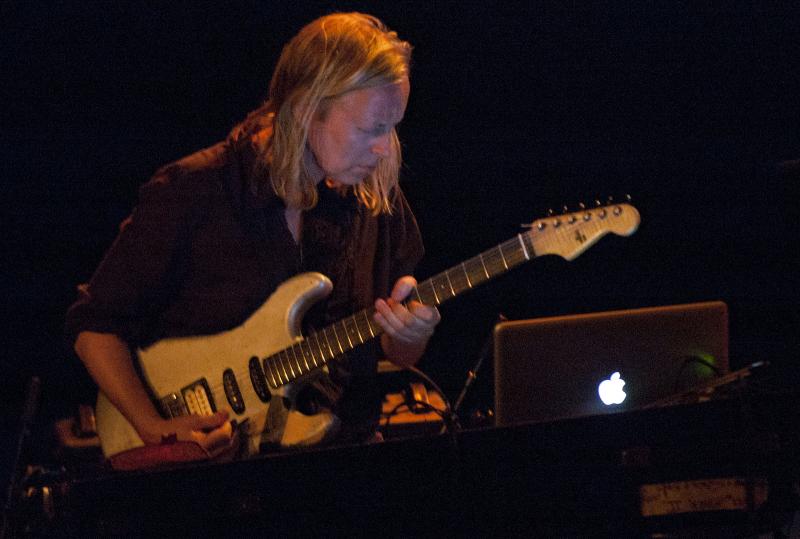 Eivind Aarset
Perhaps the biggest evolution in the group is the inclusion of a variety of other percussion instruments, beyond Holte and Dahlen's drum kits. The two drummers laid a thundering groove on "Electromagnetic," which moved from a whisper to a roar as Holte and Dahlen demonstrated almost frightening telepathy, playing unison parts but each contributing individual expanding parts that never once conflicted with what the other was doing. This may have been scripted music, but with the freedom of interpretation that's been a part of Aarset's music since he released the groundbreaking Electronique Noire (Jazzland) in 1998, a seminal time in Norway that also saw artists trumpeter Nils Petter Molvaer, noise improv group Supersilent and keyboardist Bugge Wesseltoft change the landscape of improvised music in ways that continue to be felt to this day.
Dahlen and Holte also brought a variety of tuned percussion instruments to the table: Dahlen, with a series of hand bells on a rack so he could hit them with the palm of his hand, in addition to a steel drum, xylophone and tunes wood block; Holte some electronics, and small bells that managed to cut through the sometimes dense nature of the music, thanks to Johnny Skalleberg, a sound engineer who has been doing live show mixes for Aarset, Molvær and others, in Norway and on the road, for years. Unlike many North American acts that rely on festival engineers to handle their sound, most Norwegian groups travel with their own, viewing them as integral members of the band—something that became clear, not just from the understanding Skalleberg had of the music in terms of actual mix, but with the addition of processing that, for example, gave the drums extra weight on "Electromagnetic" and, in particular, the head-banging, King Crimson-esque "Sign of Seven," which closed the set to enthusiastic screams from the nearly full house at Gésu.
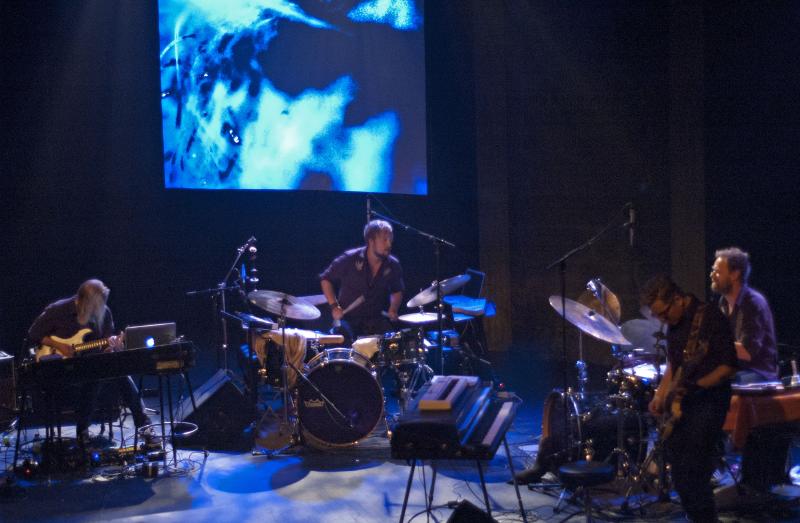 From left; Eivind Aarset, Wetle Holte, Audun Erlien, Erland Dahlen
Like Dahlen and Holte, Erlien did double duty, with a Fender Rhodes and small synth set-up nearby. And while his sometimes delicate Rhodes work helped flesh out the gentler material, it was on his main axe where he demonstrated his greatest strengths. More than a timekeeper or riff-master, Erlien was, at times, a melodic front man to Aarset's soundscapes, including one of the downright ugliest distorted electric sounds since guitarist Jeff Beck's vomit-inducing tone on "You Shook Me," from his 1968 debut, Truth (Epic). Still, with Aarset's expansive soundworlds as much about texture as they were creating melodies (that role left just as often, in fact, to Holte and Dahlen's tuned percussion), Erlien was fundamental to maintaining an anchoring forward motion, and it's no surprise that he's also the bassist of choice for artists like Mathias Eick, heard most recently on the trumpeter's Skala (ECM, 2011) and in performance at Jazzahead 2011.
In a world of guitar posturing, Aarset remains a refreshing alternative. It's not that he doesn't have the chops to stand front and center, he just chooses not to—but, unlike King Crimson's Robert Fripp, Aarset was clearly engaged in the music, swaying back and forth to the beat and pulling his guitar back and forth as he created swirling sonic colors. He demonstrated an almost unparalleled ability to layer densely distorted chords—sometimes played gently, other times strummed furiously—with serpentine EBow lines and, at the end of "Sign of Seven," a rare sojourn into a near-solo, albeit still more concerned with being part of a larger whole than in any kind of "look at me" pyrotechnics, even as it was clear just how much Aarset could do, were he to choose to.
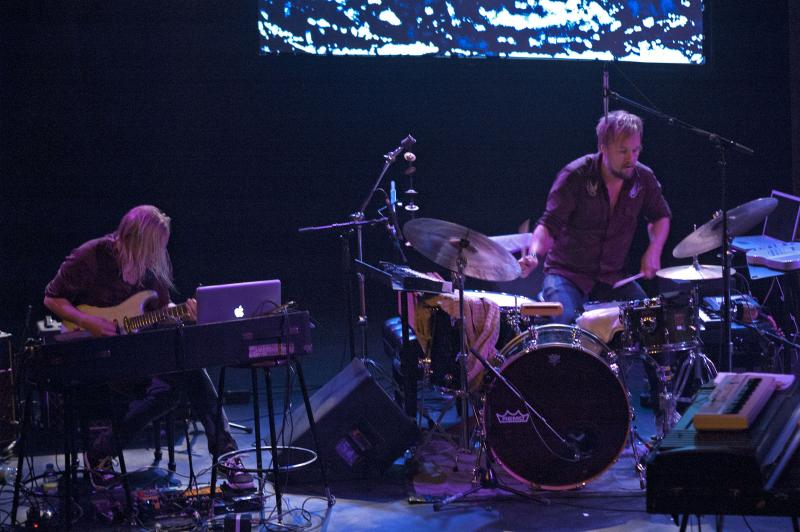 From left; Eivind Aarset, Wetle Holte
 Instead, in a set where improvisation was intimately tied to the structure of Aarset's writing, but more collective and interpretive rather than delineated, the members of Sonic Codex shone without ever once doing anything to explicitly draw attention. The only shame was that, because this late night show at Gésu was a double bill with another Norwegian group, In the Country, Aarset had to perform a slightly abbreviated set. Still, with a group that is evolving in concept an execution, it was a welcome return to Montréal for Aarset, and one that was clearly hotly anticipated by fans of the festival.
July 2: In the Country
In the Country also suffered from being scheduled as part of a double bill—though more so, perhaps, than Aarset. With the set change between the two groups taking longer than the scheduled 15 minutes, and extending well past 1:00AM, the performance was marred by a number of people leaving throughout the set—no doubt for the simple reason that public transportation was ending before In the Country's set did. This was a trio whose 2005 debut, the beautifully (and aptly) titled This Was the Pace of My Heartbeat, was described by the label as its first "jazz record," but it was clear from the first moments of its set that this was not your typical piano trio. Even comparisons to groups like The Bad Plus are both inept and inapt; other than its configuration, there's very little to connect pianist Morten Qvenild, bassist Roger Arntzen and drummer Pål Hausken—friends who met in university and, while involved in other projects, always come back to In the Country as a priority—with the quirkier, high volume and high octane American trio.
 From left: Morten Qvenild, Roger Anrtzen, Pål Hausken
Not that In the Country didn't get loud—there were moments in the hour-long set where the collective volume took a leap as they trio headed for freer territory—but those moments felt all the more loud for the near-silence that was an equal part of the group's sound. With a new CD/DVD package just out—Sounds and Sights (Rune Grammofon, 2011)—the group continued its strange love affair with song, even as it twisted the form and introduced strangely skewed ideas and textures, equal parts Qvenild's electronic manipulations, Arntzen's effected double-bass and Hausken's fluid use of mallets on his kit rather than conventional sticks. The set culled material from its three previous records, including a song introduced as the title track to Whiteout (Rune Grammofon, 2009) but actually the countrified "Doves Dance," from the same album, though the tumultuous middle section certainly felt more like a whiteout than birds in flight.
A feeling that confirmed In the Country's cinematic approach to music, though the group is equally disposed to greater intimacy—in particular on the vocal tunes, where Qvenild's almost whispered melodies combined with Arntzen's and Hausken's equally soft delivery to create harmonies of fragile vulnerability.
Sights and Sounds, in addition to being the trio's first live recording, also represents the first time, In the Country has interpreted music from other sources. A closing version of guitar hero Mark Knopfler's title track to Dire Straits' massive hit record, Brothers in Arms (Warner Bros., 1985) was curiously idiosyncratic, yet retained the melancholy power of the original, as Qvenild combined light touch and a temporal elasticity that created a near-swirl of sound. Arntzen played with Charlie Haden-like simplicity, while Hausken kept his touch so light during the verses that, much like fellow Nordic drummer Jarle Vespestad, he seemed almost to be breathing on the skins rather than hitting them. Dynamics were so impeccably controlled that when the trio began to ratchet up the volume, mid-song, the result was even more dramatic, highlighted even more when the trio brought the song back down to near-silence.
 Morten Qvenild
The last date on a North American tour that saw the trio in Rochester, Washington (DC), Oakland, Portland, Seattle, Vancouver and New York before making its way to FIJM for the first time, this isn't the first time In the Country has played in North America, but it's the longest tour to date, and if CD sales are any reflection, the fact that the group had sold out all its copies of Sounds and Sights before arriving in Montréal means that it's gradually building an audience, on this side of the Atlantic, to mirror its growing reputation beyond Norway and into the rest of Europe. The audience had diminished by the end of its set, but those who toughed it out into the wee hours of the morning were rewarded with a performance of gentle honesty and conviction that was a perfect ending to yet another great day at Festival International de Jazz de Montréal.
 July 3: Christian McBride's Inside Straight
It's been a couple years since Christian McBride released Kind of Brown (Mack Avenue, 2009) with his new Inside Straight quintet, but the in-demand bassist ((Pat Metheny, Chick Corea, Terri Lyne Carrington has been getting a lot of mileage out of it ever since. And why wouldn't he? Paying homage to the great 1960s era of Blue Note, with a lineup that's especially reminiscent of collaborations by vibraphonist Bobby Hutcherson and saxophonist Harold Land, Inside Straight is, well, straight-down-the-middle mainstream jazz; but, played with a vigor and relaxed camaraderie, it's perfect jazz festival fare.
With a slightly altered lineup—longtime musical partner, pianist Peter Martin replacing Eric Reed, and firebrand young drummer Ulysses Owens, Jr. replacing Carl Allen—McBride's quintet still retained two of its biggest strengths: saxophonist Steve Wilson and up-and-coming vibraphonist Warren Wolf, Jr. If Kind of Brown smokes, then McBride's 6PM performance at Gésu positively caught fire from the get-go, with a more in-your-face version of "Brother Mister," a blues that was one of a half dozen songs culled from the album but which, blowing session that it was, McBride liberally stretched, giving everyone in the band a chance to warm up and flex their individual and collective muscles.
Wilson, who's appeared on hundreds of recordings by artists like Dave Holland, Chick Corea and Dianne Reeves, not to mention a small but strong discography as a leader for Criss Cross, Stretch and MAXJAZZ, brought his own combination of head and heart on alto and soprano, co-leading the frontline with Wolf, who first emerged with trumpeter Jeremy Pelt in 2005 on Identity (MAXJAZZ), and appears poised for greater things. McBride cited The Huffington Post when introducing the vibraphonist, who called him "the Mike Tyson of the vibraphone," and with a two-mallet approach that, at times, seemed more like a blur than two arms hovering over the keys, they were absolutely right.
 Ulysses Owens
Owens is another relative youngster, with only a couple of recordings under his belt—most notably singer Kurt Elling's tribute to John Coltrane and Johnny Hartman, Dedicated To You (Concord, 2009). He's also a member of Elling's current touring band, but has had to sub out on the singer's recent dates, in order to play with Inside Straight; a tough choice, but for a drummer who clearly wants to let loose and blow, an easy one to understand. And while some of McBride's tunes have their share of challenge—in particular the encore, "Stick and Move," with its series of stops and starts, and ultimately a solo vehicle for Owens, who drew huge rounds of applause from the packed house—they were ultimately little more than appealing context-setters for the group to get loose and kick it.
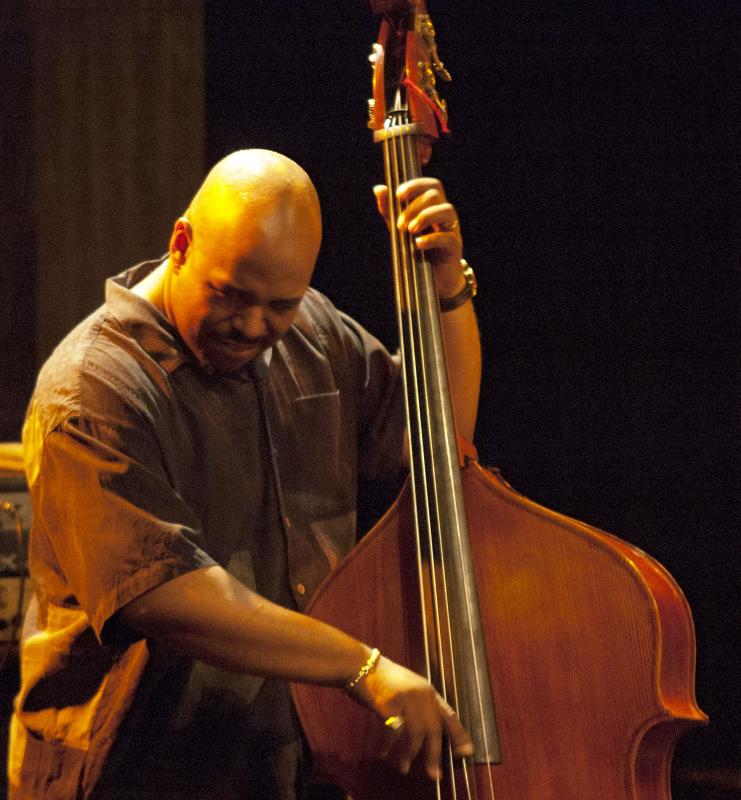
McBride was, as ever, a powerhouse with a huge sound and the kind of frightening dexterity that's made him such a double threat on electric bass as well, but here it was acoustic all the way—mostly pizzicato but, on the set's sole ballad, proving equally capable with a bow. As ever, an affable spokesperson who doesn't read from a script, McBride made constant reference to the late Montréal Expos baseball team—"Do y'all miss The Expos," he asked at one point, garnering hoots and applause from the audience, but losing them later when, as he was introducing the band, he revealed, "I'm from Philadelphia—that's why I miss The Expos," which got him his only "boos" of the evening, but all in good spirit, of course.
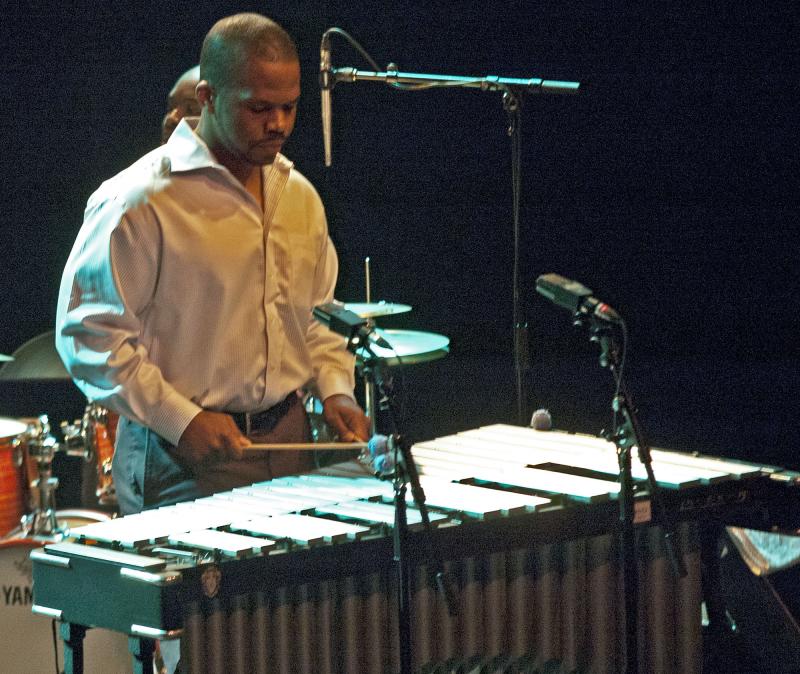 Walter Wolfe, Jr.
Closing the set with a far more energetically soulful version of Used 'Ta Could" than on Kind of Brown, McBride proved that it's possible to look back at the jazz tradition without shtick—remain absolutely reverential and respectful without losing modernity. Martin's solos were largely centrist, but the occasional skewed harmony gave them tremendous lift, as McBride picked up on them to provide additional push on the low end. With the musicians amiably wandering the stage when they weren't playing, it was almost like being in a living room with a bunch of friends just having a good time running down some tunes—but at the highest level possible.
Nearing the three-year mark, McBride's inside Straight may be nearing the end of its shelf life—unless McBride decides to release another recording with the group, and if he does, he'd be best off to use this current incarnation—but it's not showing any signs of fading away. If anything, the band has, with touring over the past couple years, honed itself to a lean, mean mainstream machine, and if straight-ahead jazz has a future, it's with groups like Inside Straight, retaining all the reasons that made this music great in the first place. Swinging like a mofo, it was an exciting set that McBride's FIJM audience won't soon forget.
 July 3: Béla Fleck and The Flecktones
It's been nearly 20 years since Bela Fleck toured with The Flecktones lineup that lifted him, from an already growing reputation in the world of newgrass and new country, into far greater visibility in the jazz world and beyond. While later incarnations of the group have released a series of fine albums and become one of the darlings of the jam band scene, there was something special about the group's first lineup. Maybe it was as simple as this: when the group came onto the scene with its first record, Béla Fleck and The Flecktones (Warner Bros., 1990), it was young and hungry, and through relentless touring for the first three years—with sets often running three hours or more—it was still in the process of discovering what it was and what it could be.
By the time original Flecktone Howard Levy left the group in 1992, the foundation of the group had been set, and while Levy's ultimate replacement, reed multi-instrumentalist Jeff Coffin, had no shortage of talent, he never pushed Fleck, über-bassist Victor Wooten and his brother, percussionist Roy "Future Man" Wooten), the same way Levy, and—back in the fold for Rocket Science (E1, 2011) and a lengthy North American tour that started at the end of May and continues to the end of November—clearly still can.
In a quick chat with Fleck the afternoon of his FIJM performance at Place des Arts' Théâtre Maisonneuve, the man who has done more than anyone to bring the banjo into virtually every musical context possible—ranging from an upcoming classical banjo concerto to 2009's Grammy Award-winning exploration of the instrument's African Roots, Throw Down Your Heart (Rounder)—alluded to this difference between Coffin-era Flecktones ("we got things down so smoothly") and the band's early days with pianist/harmonicist Levy ("he lights a different kind of fire").
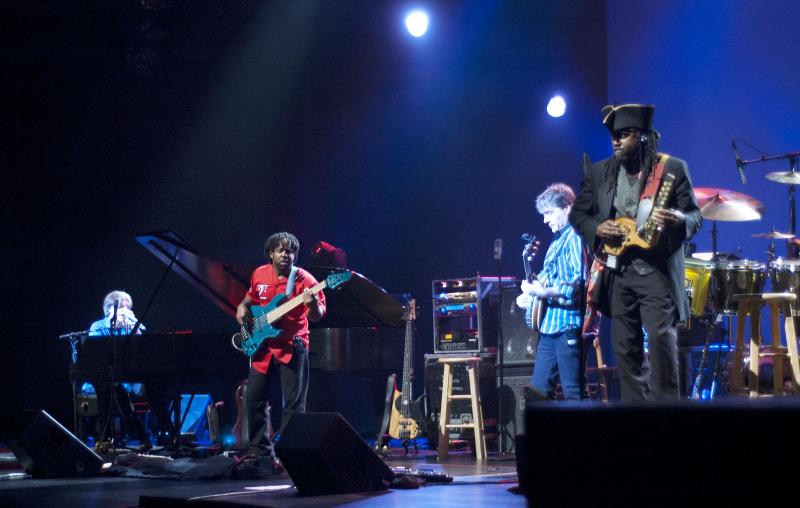 From left: Howard Levy, Victor Wooten, Béla Fleck, Futureman
 The band hit the stage to tremendous applause at 9:30pm and, in a set that ran a little over two hours with one encore—the perennial favorite, "The Sinister Mister," with Wooten's by-now iconic bass solo, where he flips the bass around his back while delivering mind-boggling mix of right hand slapping/popping and blinding left-hand speed —the group covered a lot of ground, pulling five tracks from Rocket Science, but digging back into the group's early repertoire with Levy, from Béla Fleck and the Flecktones through to UFO Tofu (Warner Bros., 1992). Time has passed, and there were a few signs that everyone's getting a little longer in the tooth—Fleck's hair peppered with gray; Wooten's dreadlocks displaying a growing bald spot; and the tall, lanky Levy revealing the start of a paunch when he opened the buttons on his shirt—but what made the performance (and the new album) so strong was that, while they easily recaptured the vibe of their early days together, it was in no way a backwards-looking trip down nostalgia lane.
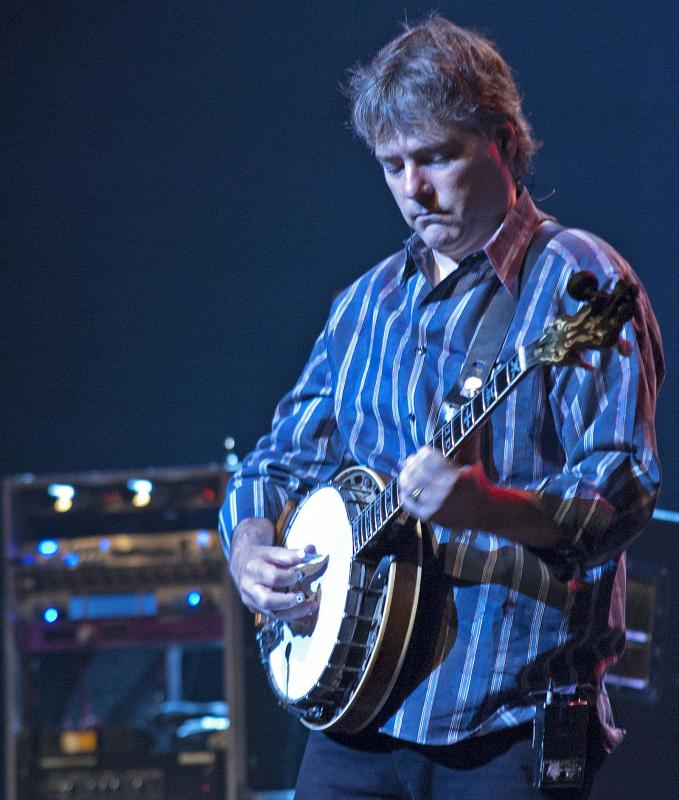
Instead, everyone in the group displayed the evolution that's happened over the past two decades .Increased virtuosity is a given, but Fleck's become an even broader player stylistically, demonstrating no shortage of classical chops on an instrument that's never been considered for the context. In some ways paralleling guitarist Pat Metheny—who was certainly an influence on Fleck in his early days—the banjoist has always looked for new technological applications for his instrument, bringing in MIDI with the group's first post-Levy album, Three Flew Over the Cuckoo's Nest (Warner Bros., 1993). In Montréal, Fleck switched between acoustic banjo, his longtime electric/MIDI instrument, and another electric banjo that, wireless, allowed him to roam the stage freely during the only tune culled from a non-Levy Flecktones record, "New Country," from Left of Cool (Warner Bros., 1998)—also featuring one of two guests appearances by Casey Driessen, a violinist capable of matching anyone in The Flecktones, chop for chop.
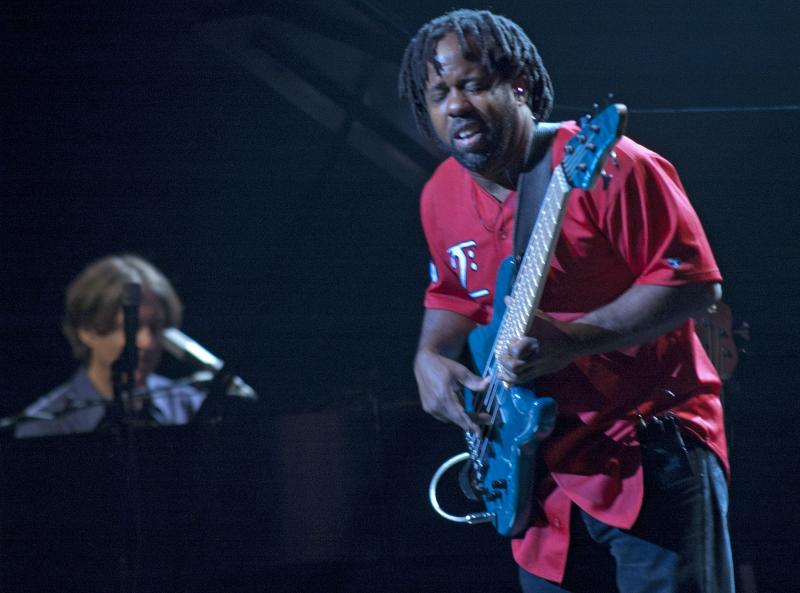 From left; Howard Levy, Victor Wooten
 Wooten has, over the years, become one of the new faces of electric bass, following in the footsteps of Stanley Clarke and Marcus Miller in his ability to bring out the funk—even referencing a couple of Clarke tunes, "Lopsy Lu" and "School Days," in his closing solo during "The Sinister Minister"—but it's his remarkable two-handed tapping that has set him apart from those two players, with whom he toured in 2009 as part of the S.M.V. tour, including a in Ottawa that summer. His own recordings as a leader are impressive, but it's the chemistry of The Flecktones—and, in particular, this original lineup—that clearly pushes Wooten to get past his monster chops into a realm where, as evident as they are, the end result is always unfailingly musical.
Futureman first made his name with his drumitar—a hybrid instrument that looks like, well, a futuristic guitar but is, in fact, a two-handed instrument with finger pads triggering all kinds of percussive (and other) sounds. There are those who haven't liked the electronic nature of his drum sounds, but over the years, not only have the samples become better (when they're intended to be drum tones, that is), but Futureman has also introduced acoustic percussion to the mix—though, as might be expected with a player who has adopted the Futureman name and has dressed, since the beginning, in some strange hybrid pirate costume, this is no conventional kit. Instead, Futureman was facing into the group from stage left, his left foot triggering a bass drum far over on his right, while a series of tub drums, going from small to large, along with a variety of cymbals, allowed him to mix and match true acoustic textures, along with his drumitar. And, during his solo segment, he also proved himself to be a fine cajón player.
Levy has always been a fine pianist but, like his band mates, he's almost redefined the potential of his other instrument, the harmonica. Often called "the man with two brains," it's true that watching him play piano and harmonica is impressive, but it's his use of a simple, diatonic harmonica to play chromatically that's the true mind-boggler—along with, at one point during a solo feature, managing to create seemingly simultaneous contrapuntal lines. Over the years, he's clearly become better at both instruments, but again it was the clear and special telepathy that he shared with the rest of The Flecktones that made the show exhilarating, as he pushed his band mates, and they pushed right back.—but always in a spirit of camaraderie and friendly competition.
As staggering as some of music was, it somehow managed to breathe and retain a degree of accessibility that's hard to imagine in a tune aptly titled "Life in Eleven." The early part of the set was continuous, as the group wound its way from Rocket Science's "Bottle Rocket," and a steroidal version of UFO Tofu's "Nemo's Dream," through to the new disc's "Prickly Pear," complete with Levy's barrelhouse piano middle section, a faster than usual version of Béla Fleck and The Flecktones' "New Frontier" and, finally, Wooten's funkified "Sex in a Pan." Another fan favorite, the ambling "Sunset Road," was reinvented, with a singing Futureman wordlessly doubling the melody, but then bringing some actual lyrics into the mix. Rocket Science's "Sweet Pomegranates" was a feature for Levy exclusively on piano, with Wooten engaging in some outrageous free play in tandem with Levy, before coalescing back to its main theme, while on the same album's "Falani," Levy returned to harmonica and Driessen returned to the stage for some exhilarating interplay with The Flecktones.
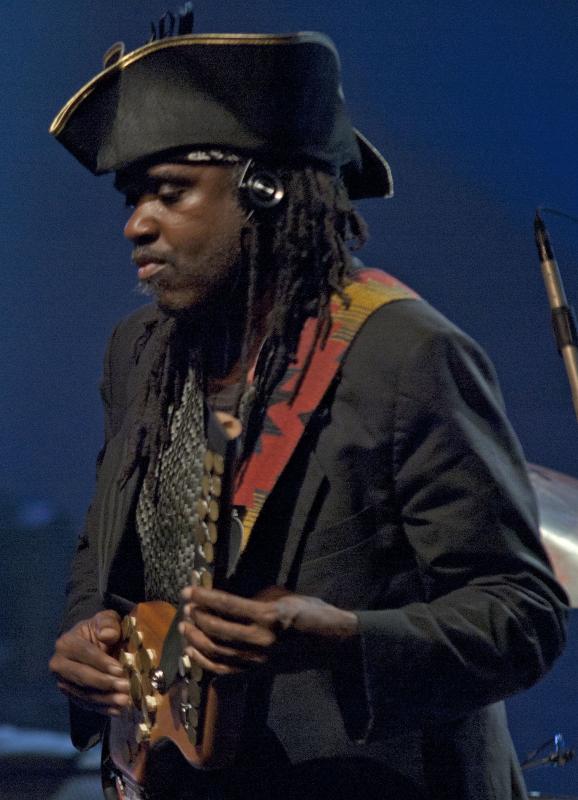 Outside of band intros halfway through the set, there was no additional stage banter, other than Fleck announcing the final tune, "Blu-Bop," though he got it wrong when he said it was from UFO Tofu—it's actually the opening track to Flight of the Cosmic Hippo (Warner Bros., 1991). But if the group didn't engage the audience directly through speech, it did in its comfortable way of moving around the large stage and acknowledging the audience throughout. During the final trade-offs between Fleck and Levy (on piano), the Wooten brothers stood between the two players, turning together to face whoever was playing, lifting the already thrilling exchange to even greater heights.
 With Fleck planning two extracurricular projects in 2012, and Coffin now a member of the Dave Matthews Band, it's anybody's guess how long this reunited original Flecktones will last. Certainly, with the group not touring as relentlessly as it once did, taking long breaks between albums and tours, it's possible that this may not be the end. But whether or not it is, for FIJM who crowded Théâtre Maisonneuve, it was an opportunity for more recent converts to experience the magic of the original lineup, and a chance for those who saw the band back in the day to relive the group's special vibe. And, as reunion tours go, this was anything but retro; instead, Fleck and The Flecktones proved—as Futureman has been doing all along—that you can travel back in time, be unequivocally in the present, and push forward into the future—all at once.
July 4: Black Dub, with Leif Vollebekk
FIJM 2011 has shrunk from 11 days (sometimes 12) to 10; a sign, no doubt, of the same belt-tightening that festivals around the world are experiencing. But while reducing the festival by a day no doubt saves the festival on overhead, they're not pulling back on programming. Normally the final day of the festival is reserved, almost exclusively, for one of three large-scale outdoor shows that, in the past, have drawn as many as a quarter million people to the streets of downtown Montréal. This year, the final day sported a full day of indoor programming to go along with a massive outdoor show featuring '80s superstar group The B-52s, with jazz shows including Swiss trumpeter Erik Truffaz, France-based pianist Yaron Herman and his trio, Montréal vibraphonist Jean Vanasse and singer Kellylee Evans, alongside performances by singer/songwriter Ron Sexsmith, singer Marianne Faithfull, and Black Dub, the brainchild of Canadian expat singer/songwriter/producer Daniel Lanois.
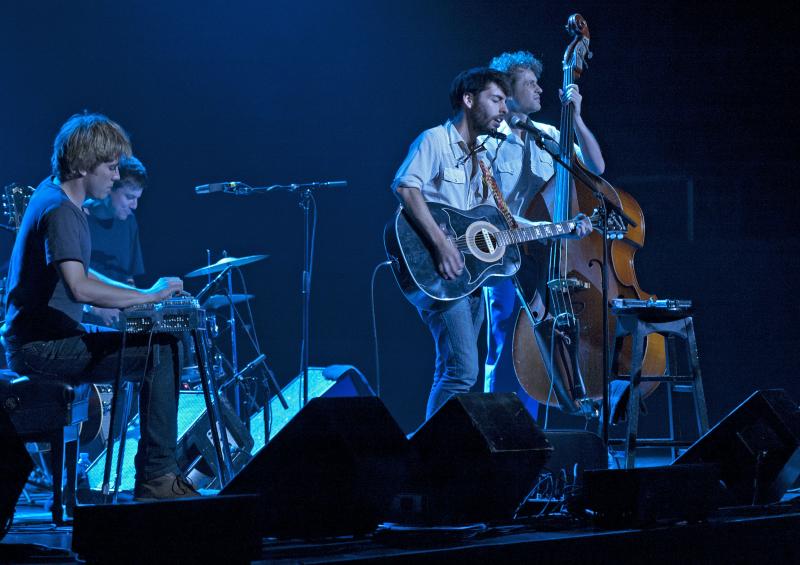 Leif Vollebekk
But before Black Dub hit the stage, Canadian singer/songwriter Leif Vollebekk warmed up the near-capacity crowd, backed by a three-piece that featured upright bass, drums and, for most of the short set, pedal steel guitar. Culled largely from his debut, Inland (Nevado, 2010), Vollebekk turned up the energy a tad, a little less chilled than his alt-folk album, but still by no means anything even resembling a simmer, let alone a boil.
Playing acoustic guitar with a harmonica strapped around his neck, it was impossible not to draw comparisons to a clear touchstone, Bob Dylan. Vollebekk possesses a better voice—more melodic, with a soft vibrato that often came in as his lines tricked away—but it's not as distinctive, and whether or not that's a disadvantage has yet to be seen. The Montréal-based singer/songwriter also doesn't have Dylan's attitude, and it was clear he was thrilled to be opening up for Black Dub.
His set was capably supported by his band, who was competent if not particularly inspired, but it was when Vollebekk let the group go for the last song of the set that things got a little more interesting. Picking up an electric guitar, he bobbed and weaved as he created a soft guitar loop, and then put the instrument down, grabbing a violin and creating additional layers, before returning to the electric guitar and getting to the heart of the song. Not quite as outrageously impressive as Norway's Bernhoft, who creates far more complex music based on real-time looping in performance, it was still a shift from the relatively predictable groove-driven folk music of the rest of Vollebekk's set and, using more expansive soundscapes, a direction that might work better to establish some differentiation in Vollebekk's music.
 From left: Brian Blade, Daniel Lanois
After a short break, the lights went down, and Lanois came onstage with longtime drummer of choice, Brian Blade. He's one of the busiest and broadest drummers of his generation, whose cred in the jazz world—playing with artists like Wayne Shorter, Chick Corea and Charlie Haden—is as strong as his reputation in the larger rock/pop world for his work with everyone from Joni Mitchell and Faithfull to Emmylou Harris and Dylan—and for good reason. The Shreveport, Louisiana-born drummer can clearly do just about anything, and regardless of the context, plays with a fluid expressionism that keeps things spontaneous, unpredictable—and, sometimes, on the edge of falling apart, but never actually doing so.
Given Black Dub has but a single album of material with which to work, Lanois—the group's de facto spokesperson and leader—fleshed the 80-minute set out with a couple of instrumentals that started as duos with Blade, but ultimately became trios with the addition of bassist Jim Wilson (substituting for the album's bassist, Darryl Johnson). Coming onstage in a jean jacket, a scruffy beard and a beige toque, Lanois' playing was gritty and, not unlike Neil Young, completely unfettered and spontaneous; the volume just on the edge of the cliff and so hot that it responded to the slightest touch, so when Lanois went after it more aggressively, it was absolutely huge. Given the heavy production, editing and overdubs on the group's eponymous 2010 Red Ink debut—and that in concert, it was largely a power trio of guitar, bass and drums—the group had to take a different tack to its material, one where Lanois' guitar was as much a frontline voice as singer Trixie Whitley, who came onstage after Blade, Wilson and Lanois had finished working its way through a dark and gritty instrumental opener.
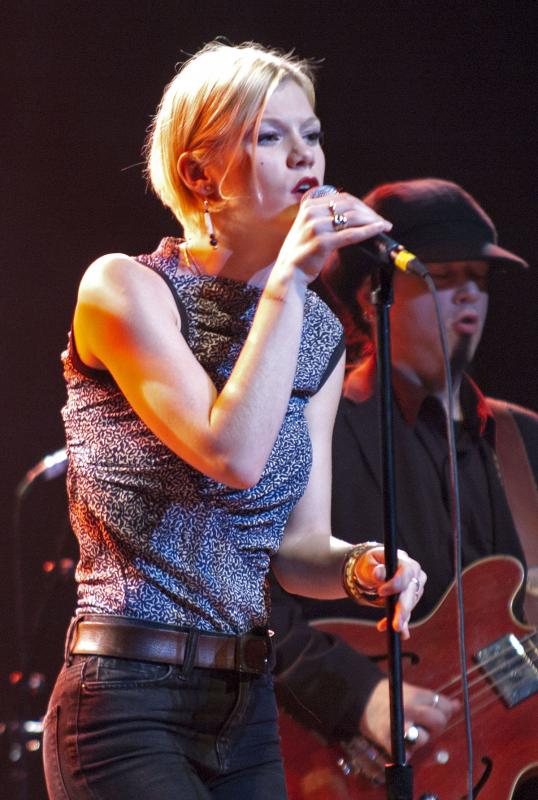 Previous to Black Dub, most of Whitley's work was with her dad, the late singer/songwriter Chris Whitley, but based on her FIJM performance, she's more than ready to take the front position, though in this case she shared it with Lanois and Wilson, though once the group kicked into the album opener, "Love Lives," she was, more often than not, the lead voice, showing great range, a gutsy, soulful delivery, and a stage presence that was charismatic but completely natural. A multi-instrumentalist who, when she wasn't front and center, sat beside Blade, behind a smaller drum kit, to create even thicker grooves. She also played some keyboard on an extended, red-hot version of the set-closer, "Ring the Alarm," and some edgy electric guitar on a mid-set feature, her own "I'd Rather Go Blind," from her 2009 EP debut, The Engine (Self Produced). In a time of American Idol melisma, it was refreshing to see a rock singer who could be emotive without going over the top, even on the gospel-tinged funk of "Last Time," which Lanois introduced by referring to the impressive hall as "a church without a steeple."
 It was a set of unassuming power and, at times, unbridled energy that grabbed the audience from Lanois' first jagged notes and kept it engaged right through to an encore, starting with Lanois alone, singing the Acadia-tinged "Jolie Louise" before the group returned to give him the chance to use some powerful three-part harmonies on a moving version of "The Maker," an early hit from the same album, his debut as a leader, Acadie (Opal, 1989). As commanding as the entire group was, Lanois was the clear focal point. With a kind of unassuming presence—not unlike diminutive bassist Meshell Ndegeocello, who can stand at the back of a stage in the dark and still demand attention—it was hard not to watch Lanois, whether he was singing center stage with Wilson and Whitley; facing Blade on stage right, as the two connected on a deeper level; or stage left playing pedal steel guitar with the same loose, unorthodox approach that he used on his gold top Les Paul, during a second instrumental that became one of the set's many high points.
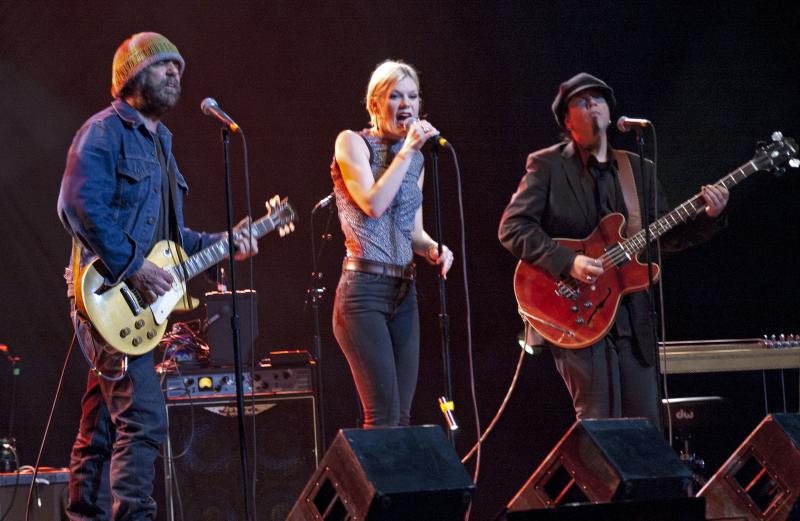 From left: Daniel Lanois, Trixie Whitley, Jim Wilson
Hopefully Black Dub won't be a one-off project, as this is a group that clearly has plenty of still-untapped potential. And as big a name as Lanois has become—producing or co-producing everyone from Dylan and Emmylou Harris to The Neville Brothers, Peter Gabriel and U2—onstage he's a relaxed and humble performer who made a point, more than once in the set, to thank FIJM's André Menard for the vision he's brought to the city and for his commitment to supporting Lanois' career.
With Black Dub's set over, there was a little time left to hit the streets, where well over 100,000 people were crowding Rue Ste-Catherine and La Place des Festivals for the B-52s. By that time, it was impossible to get anywhere close to the action, but as ever it was clear just how well FIJM manages large crowds. And with the slowly transforming Quartier des Spectacles, it's even better designed to handle both the large crowds that come for these events, while making it easy for those looking to get in or out of the grounds. As always, FIJM's outdoor spectacles are big parties for the city of Montréal, but in the most positive way possible. It's hard to believe that, with 100,000-plus people in such close quarters—drinking and, in some cases, enjoying a little herbaceous enlightenment—there's never any trouble, and FIJM is always staffed with enough security to handle it. But it never seems to happen, as the crowds are there for a good time, and to enjoy being part of a large crowd of people there for good music and good times.
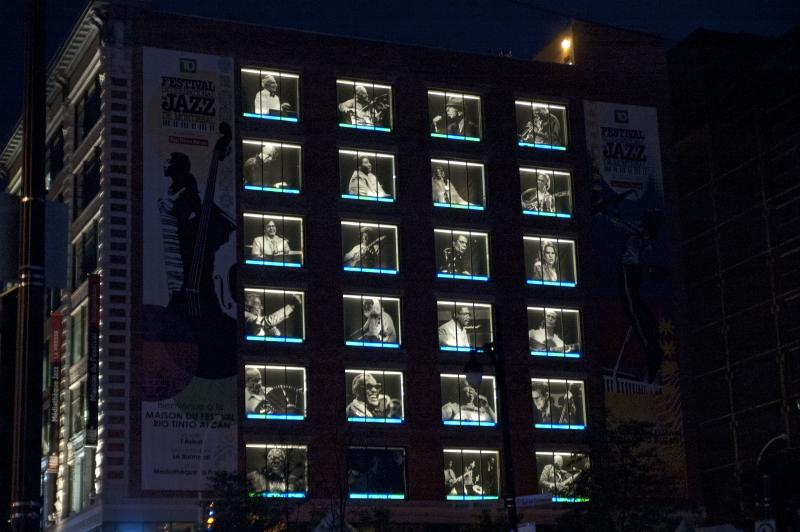 Le Maison de Festival
Leaving the Quartier des Spectacles, one of the last sights was the Maison de Festival, lit up at night with images of jazz stars past and present. FIJM may have a broad program of mixed acts, but at its core it's still a jazz festival, as the past six days have made clear. If the litmus test of a jazz festival is its ability to provide a tremendous variety of jazz acts, each and every day, even if there is some extracurricular activity, then Festival International de Jazz de Montréal remains unequivocally a jazz festival. With the completion of downtown renovations set for 2012, and the dates for next year's festival already set, the 33rd edition will, no doubt, be something else—a place where, for ten days, it'll be possible to forget about everything in the world and just bask in a planet of music.
Visit >, Anouar Brahem, Eivind Aarset , In the Country , Christian McBride, Béla Fleck and The Flecktones, Black Dub, TD Festival International de Jazz de Montréal on the web.
Photo Credit
Page 1, Artist Conceptions of Montréal: Daoust Lestage, architecture design urbain
All Other Photos: John Kelman
Days 1-3 | Days 4-6
 FOLLOW John Kelman
and get notified whenever a new article published.
FOLLOW John Kelman
and get notified whenever a new article published.
With the realization that there will always be more music coming at him than he can keep up with, John wonders why anyone would think that jazz is dead or dying.
Tags
PREVIOUS / NEXT
Become a Sustaining Member

Since 1995, All About Jazz has championed jazz as an art form and supported the musicians who create it. Over three decades, it has grown into one of the world's leading jazz resources, serving hundreds of thousands of readers, musicians, presenters and industry professionals each month.
Help Build the Future of All About Jazz
Your support helps us continue building All About Jazz for the next generation—expanding our editorial coverage, preserving jazz history, developing new community features and creating better ways to discover the music and the people behind it.
Become a sustaining member for as little as $20 per year and you'll immediately enjoy an ad-free experience along with access to subscriber features and future articles for a full year.
Together, we're not simply sustaining All About Jazz—we're building its future. Thank you for being part of the journey.