Home » Jazz Articles » Live Review » Montreal Jazz Festival 2011
Montreal Jazz Festival 2011

Festival International de Jazz de Montréal
Montreal, Canada
June 25- July 4, 2011
After a hiatus in 2010, in order to take a three-week Norwegian road trip, it's great to get back to the festival that the Guinness Book of Records calls "The biggest jazz festival in the world." But for those who think such a designation has to mean a populist-driven festival, geared towards accessibility and big names, they'd be right...and they'd be wrong.
Sure, Festival International de Jazz de Montréal has the cachet to bring the biggest names in jazz, blues, world music and beyond, and one look at the 2011 roster is enough to support that, with names including Robert Plant, Diana Krall, Return to Forever IV and Tony Bennett. But the festival's massive size doesn't preclude more intimate performances by artists such as pianists Kenny Werner and Brad Mehldau—the latter, a star in his own right, but here performing solo at the lovely, 425-seat Gésu. The festival also brings international acts that deserve greater North American exposure, like Norwegians Eivind Aarset, In The Country and Jaga Jazzist; Swiss trumpeter Erik Truffaz; and the trio of French pianist Jean-Michel Pilc, expat French bassist Francois Moutin and American drummer Ari Hoenig, who put on a tremendous show in Ottawa, earlier in the week.

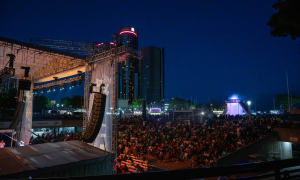
While the center of the festival, on St. Catherine Street between St Laurent and Bleury, remains under heavy construction, forcing the festival to work around it and place some of its outdoor stages elsewhere, it still has the core of the city closed down for its 10-day run, making it an otherworldly experience. Keep the TV off and skip the newspapers, and it's possible to bask in a world of jazz, with everything you'll ever need contained within a six square block radius, from hotels and restaurants to shops and more. And, with the festival's headquarters opened two years ago for its 30th Anniversary, there's a new club (L'Astral), a much improved press room, and the Médiathèque, a jazz resource center with all the archival information a festival now in its 32nd year has accumulated, and much more.
There are some new things as well. Across the street from Maison du Festival Rio Tinto Alcan, there's an outdoor bar, with a small stage, and much larger merchandise tent than the festival has ever had before, all in the space where one of Montreal's institutions, the Spectrum club, existed for nearly three decades before closing its doors in 2007. Renovations to Place des Arts—the city's arts center and home to a number of venues, ranging from a few hundred to three thousand—are complete, and the interior is home to a multimedia installation and a number of new facilities.
And for a festival that accredits over four hundred journalists, FIJM knows how to treat the media, picking them up as they arrive by train or air, driving them to their hotels, where another representative is there to ensure the check-in process is as smooth as possible and that any questions are answered. The new Press Room offers a place to hang and have a drink (gratis), a place to work, and a place to attend press conferences, in the festival's Stevie Wonder Room, where Jeff Beck was interviewed in 2009, prior to his kickass show at Place des Arts.

It was, quite simply, a real pleasure to return to Montreal for FIJM, a festival that, with 475 concerts, has it all, and continues to bring it, each and every year, to the two-and-a-half million people who come through its gates.
Chapter Index
- June 29: Darcy James Argue's Secret Society
- June 29: Dave Holland Quintet
- June 29: Apex: Rudresh Mahanthappa and Bunky Green
- June 30: Anouar Brahem Invitation: Thimar
- July 1: Anouar Brahem Invitation: Le Voyage De Sahar
- July 1: Jaga Jazzist
June 29: Darcy James Argue's Secret Society
Catching a first show at the intimate Gésu Centre de Créativité—situated beneath a church on Rue de Bleury, just around the corner from the Maison du Festival—was the perfect way to kick off six days of coverage that will include thirteen indoor shows. While his first album, Infernal Machines (New Amsterdam, 2009) is nearly two years old, composer/arranger/bandleader Darcy James Argue's 18-piece Secret Society continues to gain traction as a large ensemble of the most modern kind. Now in his mid-thirties, Argue has been slowly building a reputation, but seemed to burst onto the scene with Infernal Machines, winning a place on many critics' "best of" lists for the year—and for good reason. This ain't your granddaddy's big band (something that will be a bit of a running theme this year at FIJM); instead, Argue brings in references from many sources, including the energy and tonalities of rock music, minimalist pulses and an approach to coloration that make his band, not unlike the award-winning Maria Schneider Orchestra, something more expansive than a conventional jazz big band.
For Argue's first appearance at FIJM—in the middle of a Canadian tour that saw him in Vancouver and Ottawa on previous nights, wrapping up on June 30 in Toronto—he focused largely on material from Infernal Machines, though he did also include a sneak peak at his next project, a multimedia affair with artist Danijel Zezelj, called Brooklyn Babylon. Intended to be a modern fable, Argue's "Chapter One: The Neighborhood" introduced a number of elements that are expansions on ideas from his first record. Pianist Gordon Webster's repetitive, Steve Reichian pulses acted as the rallying point for the opening of a piece that felt like an overture of things to come, even as it worked as a self-contained unit that episodically moved from one interconnecting section to another.

Darcy James Argue conducting his Secret Society
Drummer Jon Wikan—no stranger to Montreal, the husband of trumpeter Ingrid Jensen, who was also onboard for the evening—opened the set-starter, "Phobos," with a cajon solo as he did on the record, but with even more copious delay. Clearly Argue's a forward thinker, unafraid to "tarnish" the jazz tradition with contemporary ideas and sound worlds. As the band entered, it became even clearer that Argue's personal touchstones range far and wide, with guitarist Sebastian Noelle creating orchestral swells and gritty power chords, Matt Clohesy pushing the time on electric bass and Wikan driving the groove with plenty of spontaneous action. The serpentine melody of "Induction Effect" wound its way over the polyrhythmic interlocking of Holober's 5/4 pulse on Fender Rhodes and Wikan's ¾ groove, its middle section demanding many of the winds and horns to circular breathe, creating a hypnotic underpinning to Matt Holman's impressive flugelhorn solo.
A highlight of the early part of the set came during Infernal Machines' "Jacobin Club"—introduced, as were all the pieces, by Argue, who's clearly as deep a thinker in other areas as he is a composer—when saxophonist Sam Sadigursky and trombonist Mike Fahie entered into a lengthy exchange that demonstrated the kind of chemistry that can only come from playing together on a regular basis. It's hard enough to keep a small group together for the long run, but with monthly gigs in and around the New York City area for the past three years, Argue has managed to not just keep Secret Society together as a vehicle for his innovative writing, but as a means for its musicians to develop a language and a familiarity with each other that's clearly paying big dividends.
 June 29: Dave Holland Quintet
 Speaking of longevity and chemistry, the music world can often be a fickle place. Bands emerge to great acclaim, for breaking new ground, but as time goes on, interest wanes as the group settles into comfortable familiarity, "damned if you do, damned if you don't": criticized for staying true to its original vision, but equally lambasted for too much change. Fortunately, in the jazz world, that's less of a problem. Sure, groups emerge and have a period of greater visibility, but even when things settle down, they're often able to continue for the long term, and still create plenty of excitement, even if they're afforded less attention in the media.
The current incarnation of bassist Dave Holland's 14 year-old quintet has been around long enough now that even drummer Nate Smith (who replaced original drummer Billy Kilson) is no longer the new kid on the block he was when the quintet performed at Montreal's Outremont Théâtre in 2004. The quintet has released only one disc since that time, Critical Mass (Dare2, 2006), but it's remained at the core of both the Dave Holland Big Band, last heard on Overtime (Dare2, 2005), and the Dave Holland Octet's Pathways (Dare2, 2010). The excitement of a new sound and a new approach may be over, but based on the quintet's performance at Place des Arts' 750-seat Théâtre Jean- Duceppe, there's still plenty on offer from a group of players clearly at the absolute top of their game.
Trombonist Robin Eubanks and saxophonist Chris Potter are monstrous enough players on their own—each, a leader in his own right, with Eubanks' Live Vol. 1 a stunning set from his EB3 trio that would be impossible to believe, were it not for the DVD included, where it was possible to actually witness Kenwood Dennard playing keyboard bass and drums simultaneously; and Potter's Ultrahang (ArtistShare, 2009), another great set from his electrified and evolving Underground group. But the collective language these two players began honing with their first appearance together on Holland's Prime Directive (ECM, 2000) has only grown with time, their in-tandem soloing on the bassist's set-closing "Lucky Seven" (from Critical Mass), so absolutely energizing as to get the capacity crowd on its feet for an enthusiastic standing ovation, even before Holland announced that this was, indeed, the end of the set.
A set that the crowd was not ready to let go with just one encore, as Holland's "Easy Did It" simply kept the energy level too high to encourage folks to vacate the premises sated, as vibraphonist Steve Nelson's head-tilting harmonies interlocked with Smith and Holland's ability to create unshakable, booty-shaking grooves in any meter. The vibraphonist's balladic "Go Fly a Kite," from Not for Nothin' (ECM, 2001) sent everyone on their way on a more relaxed note.
A new piece, "Walk the Walk," opened the set, with Eubanks taking a first solo that set the bar high, but Holland raised it with a solo that saw the bassist more physically engaged than usual, lifting onto one leg as he pulled muscular lines out of the ether. Clearly this was going to be a good set for a quintet that may tour less regularly than in previous years, but whose chemistry remains intact, the way it does for good friends who may not see each other all the time, but pick up where they left off, when they do, as if no time has passed. Eubanks opened his own "The Sum of All Parts"—first heard on Holland's Pass It On (Dare2, 2008), a sextet album with a revamped lineup, with Eubanks the only holdover from the core quintet—with an a capella solo that demonstrated why he's Holland's trombonist of choice, his seamless integration of multiphonics creating compelling harmonics that, coupled with unerring accuracy and vocal-like tonalities, was another high point in a set filled with them.
 Dave Holland Quintet, from left:
Steve Nelson, Dave Holland, Robin Eubanks, Nate Smith, Chris Potter
Nelson's a less overtly virtuosic performer, but Holland's expression said it all during the vibraphonist's solo on "Lucky Seven"—the epitome of economy, as he built a solo of gradually unfolding harmonic layers before Eubanks and Potter turned the heat up to full-blast. Potter's one lengthy solo of the set was as thrilling as ever—muscular, built on a foundation of motivic constructs that gave him latitude to build a solo of tremendous narrative value, even as he moved across his tenor's register with the kind of effortless aplomb that has made him one of his generation's most important players.
And Holland? With more solo space than usual (not that he's ever light on it, but he seemed particularly ready to play here), he not only made prefect use of the extra time to demonstrate an approach and tone that may be instantly recognizable, but is still (thankfully) an ongoing work in progress, as he pulls in his experiences in other contexts to continually build his own projects. How does a band get past its own reputation for breaking ground, to stay in it for the long haul? Well, according to the Dave Holland Quintet's exhilarating performance, it's equal measures commitment, mutual friendship and respect, and an ongoing search for new ways to mine the same context.
June 29: Apex: Rudresh Mahanthappa and Bunky Green
If Darcy James Argue's Infernal Machines was one of the surprise hits of 2009, then saxophonist Rudresh Mahanthappa's Apex (Pi, 2010) was the equivalent in the following year. Mahanthappa—a unique altoist bringing the Indo-Pakistani tradition into a jazz context through a series of recordings with pianist Vijay Iyer, in addition to his own records including Apti (Innova, 2009), with his Indo-Pak Coalition—has helped rescue alto saxophonist Bunky Green from relative and criminal obscurity with Apex, and if there were no other reason but that, his show at Gésu would have been worth attending.

From left: Matt Mitchell, Carols De Rosa, Bunky Green, Damion Reid, Rudresh Mahanthappa
Mahanthappa's always been a cerebral writer with a penchant for quirky melodies and complex harmonies, but with Apex, he's upped the energy quotient, on a set that burns from the opening "Welcome," a modal blast where both saxophonists move in and around a turbulent underpinning, before the quintet rallies around an Indo-centric line that repeats and speeds up, hailing the start of Mahanthappa's up-tempo "Summit." The quintet opened its show with the same two tunes—the rest of the 90-minute set also culled from the album—and if the album is hot, the group's live performance was positively nuclear. Swinging with, at times, unbridled energy, Mahanthappa's group delivered music clearly inspired by the latter days of John Coltrane's classic quartet, combining modal fire with expressionistic freedom.
With only drummer Damion Reid on tour from the album (sharing the drum chair with Jack DeJohnette in the studio), Mahanthappa recruited bassist Carlos De Rosa in place of François Moutin, who's on tour with Jean-Michel Pilc, and Matt Mitchell, described by the altoist as a hidden treasure of New York, in place of Apex's higher profile pianist, Jason Moran. And he was right, as Mitchell—back largely to the audience as he faced into the group—played with a style as imbued with contemporary classical concerns as it was the jazz vernacular; a patient player who built his solos with care, eschewing the overt virtuosity that's a clear foundation, for focused construction. De Rosa—whose Cuneiform debut, Brain Dance, was released earlier in 2011 and is clearly getting him some attention—is a very different player to Moutin, though both clearly have an ability to think freely in any context. Still, his solos demonstrated both lithe dexterity and tangential thinking, finding ways to move out of the box while ultimately finding his way back in.
Of course, everything about Mahanthappa is about thinking outside the box, as he incorporated Indian microtonality into his melodies, and soloed with unfettered ferocity, bobbing up and down as he created cascade after cascade of long, flowing lines, bolstered by Reid's tumultuous support. The more diminutive Green may have been less physical than his saxophone partner, but he was just as passionate— lyrical, even, on a beautiful version of his "Little Girl I'll Miss You," written for and performed by the late Abbey Lincoln, even as this reading took greater liberties and, at times, went to unexpected, angular places.
It may have been a late night show, starting at 10:30PM, but the crowd was not just alert, it was positively invigorated, as it applauded loudly during the solos, in particular for Reid, who—with a sharp snare drum cutting through the entire group throughout the set—proved as deserving of greater recognition as Mitchell, De Rosa, Mahanthappa...and, of course, Green. A player whose respect amongst musicians has never wavered—his music performed by none other than Dave Holland, who recorded "Little Girl" both solo on Ones All (Intuition, 1995) and in duo with saxophonist Steve Coleman on Phase Space (DIW, 1994)—Green's career has clearly been revived by Mahanthappa and, based on Apex and their outstanding FIJM set, it's a match made in heaven, and one that will hopefully continue, as there's clearly plenty more potential.
June 30: Anouar Brahem Invitation: Thimar
In a rare move—if not the first time in the festival's history—FIJM managed to program its Invitation series so that one artist passed the baton to the next. Dave Holland's quintet performance, the previous night, was his second performance at Théâtre Jean-Duceppe—the first being on June 28, in duo with pianist Kenny Barron—and so his participation in the first show by the next invitee created the perfect transition.
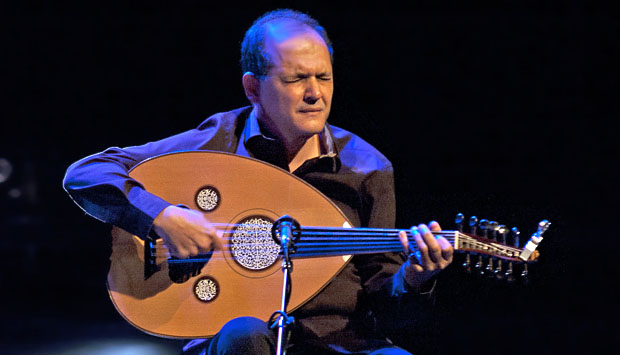
Tunisian oudist Anouar Brahem has, in the last twenty years, released a wealth of significant music for his instrument, on the ECM label, and for his three-night Invitation Series, he'll be bringing two of his more recent projects: the piano/accordion trio of Voyage De Sahar (2006); and his most recent, the percussion/bass clarinet/electric bass quartet of The Astounding Eyes of Rita (2009). But for this, his first evening at FIJM 2011, the oudist reunited one of his most critically acclaimed groups, a trio that has released just one album to date, Thimar (1998). The passing years sometimes melt away almost immediately, as a sold-out Montreal audience quickly discovered, when mutual respect, appreciation and trust are as strong and unconditional as they were between Brahem, Holland, and saxophonist/clarinetist John Surman.
In a bit of stressful last-minute craziness that is the regular experience (and bane) of festival programmers everywhere, travel delays meant that Surman touched down in Montreal an hour or so before the show, resulting in a 45-minute delay to the start of the show. But if there was any stress happening amongst a trio that was about to perform for the first time in a decade, it was internalized completely, as the 80-minute set began, creating a tranquil island in the venue, with Holland's lyrical arco and Surman's pastoral soprano. The opening piece gradually assumed shape, with Holland putting down his bow and turning to an ever-remarkable ability to build slow, gentle grooves while remaining a strong unison foil for Brahem's serpentine melodies. The oudist took his time to enter, but when he did, there was that sound— a deep, dark confluence of strings, with reverb (both from the hall and the soundboard) giving it a three- dimensional quality that filled the room, even when it was clear that Brahem was barely touching his instrument, whisper-light.
As instantly compelling as the trio was—Holland, the flexible anchor, Surman's bass clarinet a particularly strong interactive partner to Brahem's evocative oud work, as well as orbiting around his partners in empathic support—something suddenly happened, about thirty minutes into the set. In the midst of an already strong solo, imbued with a lyricism that demonstrated just how well Holland has absorbed the music of other cultures into his own vernacular, the bassist began a repetitive series of lines, liberally playing with tempo. It was as if a fire was lit, with both Surman and Brahem smiling and, looking to each other and to Holland. A change was in the air, as the trio suddenly took music that may not have been played in a decade, but was clearly still a part of its collective DNA. More than just a homecoming, this was the affirmation of a relationship honed so strongly, the first time around, that the music has remained as meaningful and filled with possibility as it was when it was first recorded, in the spring of 1997.

From left: John Surman, Dave Holland, Anouar Brahem
From that point on, the music went from peak to peak; often transcendental and, with the trio rarely breaking a sweat, evidence that great emotional power can come, sometimes, from the quietest of places, the deepest recesses of the mind and heart. As the trio revisited music from Thimar— largely written by Brahem, but with contributions from Surman and Holland also—there was a palpable sense of discovery, as each player brought individual growth of a decade to bear, pushing individual envelopes while, collectively, taking the music to places it had never gone before: music of antiquity, and decidedly Middle Eastern in its complexion; but music, also, of timeless modernity.
In the set-closer, Surman combined circular breathing and note-bending to create visceral soars and swoops, Holland responding in kind as the trio dissolved into a brief period of complete freedom— fluttering saxophone, rapid-plucked bass, and tremeloing oud—before reuniting in form to take the set out on a high note. An enthusiastic ovation and encore ended an evening that—the first of just three scheduled dates, including North Sea Jazz and Molde Jazz festivals—was memorable in more ways than one. It would have been enough, had Brahem, Surman and Holland performed well; but with a set this closely knit, where it was possible to feel that moment in time when the music suddenly leapt to another level, it was the kind of memorable concert experience of which artists and audiences often dream, but rarely achieve.
July 1: Anouar Brahem Invitation: Le Voyage De Sahar
Brahem's second Invitation series performance may not have reached quite the same transcendental high as the prior evening's show with Dave Holland and John Surman, but it came close. With a house about 80% full, Brahem presented the trio responsible for Le Pas du Chat Noir (ECM, 2002) and Le Voyage De Sahar (ECM, 2006), featuring two French artists who are no strangers to the oudist's record label: Francois Couturier, whose Un jour si blanc (ECM, 2010) continues the pianist's exploration of music inspired by the films of Andrei Tarkovsky; and accordionist Jean-Louis Matinier—who, in addition to being a member of the quartet responsible for Couturier's Nostalghia—Song for Tarkovsky (ECM, 2006), also played on clarinetist/saxophonist Louis Sclavis' Dan La Nuit (ECM, 2002). It was another evening where the compelling power of silence and subtlety trumped more overt demonstration, though everyone in the trio was an unmistakably masterful performer.
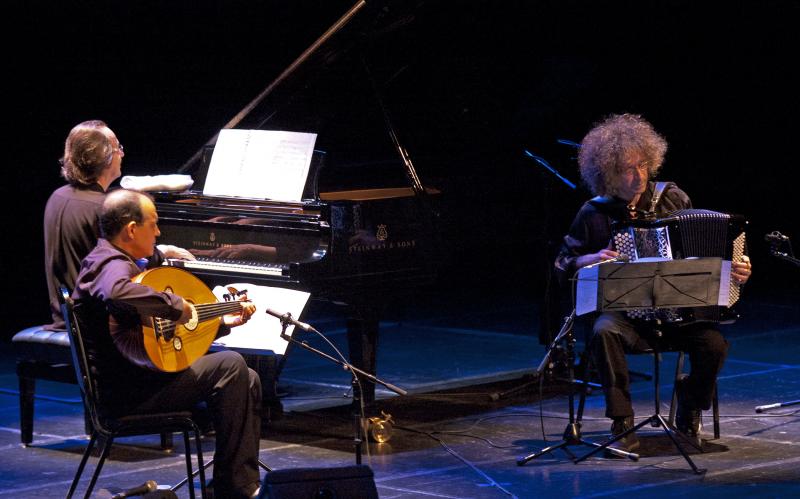
From left: François Couturier, Anouar Brahem, Jean-Louis Matinier
Interacting with Couturier and Matinier on as deep a level as he did with Holland and Surman the night before, Brahem's music for this trio leaned more to a kind of European romanticism, though he didn't desert his Tunisian roots entirely. But the compositions were less linear in nature, in no small part because every instrument in the group was capable of more orchestral harmonies. That there were no clashes anywhere during the set was a testament to each player's acute perception of his band mates, and a mature restraint that encouraged a "listen first, play later" approach.
The music ranged from the neoclassical leanings of "Vague / E la nave va," which could have easily fit in a concert by Brahem's Norwegian label mate, pianist Ketil Bjornstad, to the brighter, almost folkloric "Nuba," where Brahem's shifting of the pulse gave it a slightly idiosyncratic complexion that belied an inherent melodism that imbued the entire performance, as Brahem doubled his theme with soft, wordless singing. Effortless mastery was endemic to the performance, whether it was Brahem's relaxed but always perfect articulation, Couturier's gentle cascades of notes or Matinier's similarly lithe ability to play Puckish call-and-response. Brahem didn't exploit the possibilities of his fretless instrument often, but at one point his own smooth glissandi were matched by Matinier, on an instrument not normally disposed to note- bending.
With music that, even when it was exciting, was somehow not of its time—where everything seems to be noisy and fast-paced—Brahem clearly struck a deep chord with his audience, which wouldn't let the trio go until it had satisfied them with not one, but two encores, both separated by enthusiastic standing ovations. Ovations that were both well-deserved in an evening of music that, along with his other two Invitation series shows, contextualized Brahem in a much broader sense. Populated with numerous a capella solos, as well as passages where the trio broke down into subset duos, Brahem's merging of form and freedom in the context of genre and culture-transcending beauty was clearly the thread that ran through the three projects being presented at the festival, making his final performance, with his current The Astounding Eyes of Rita band, one to be as eagerly anticipated as the other two shows in his Invitation series.
July 1: Jaga Jazzist
Touring North America is tough for any group, but it's even more of a challenge for Norway's Jaga Jazzist. Being a nonet would be enough, but when you're bringing enough instruments to open a small music store, and an additional three people (including front-of-house sound, monitor board and road manager), it starts to sound a little more like rock and roll. And, despite Jaga's left-of-center music- -largely composed by reed man/guitarist Lars Horntveth, an irresistible combination of minimalist tinges and Frank Zappa idiosyncracies, rock-heavy beats, complex harmonic underpinnings and knotty but unmistakable, anthemic melodies—its tours are rock and roll...well, at least, sort of.
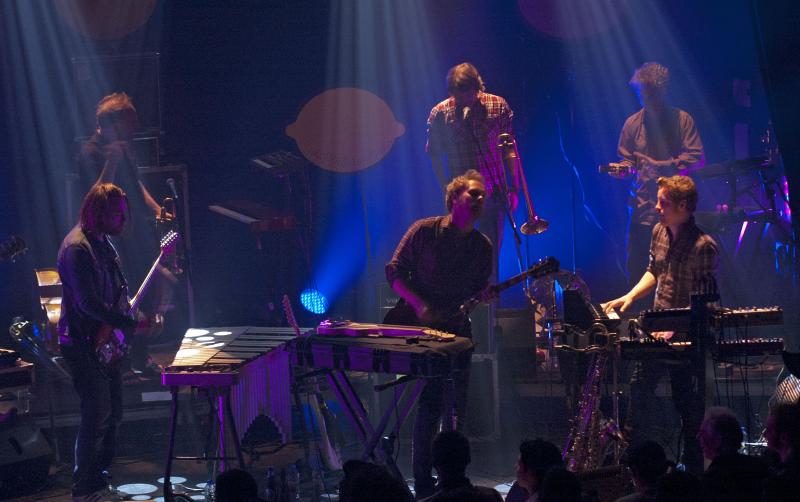 Jaga Jazzist, from left: Andreas Mjøs, Mathias Eick, Lars Horntveth
Erik Johannessen, Peder Simonsen, Øystein Moen (missing: Martin Horntveth)
Certainly the sold out Club Soda, with a standing room capacity of about 700, leaned heavily on a younger demographic, though there was no shortage of gray/no hairs, most of them from the progressive rock crowd that has come out in increasing support of the group since the release of One-Armed Bandit (Ninja Tune, 2010). Drummer/spokesperson Martin Horntveth (Lars' brother) spoke, after the 100- minute set, about people driving as much as eight hours to catch one of Jaga's shows—some, even, who were making the trek to catch the group on multiple shows in a 10-city tour that has crossed the continent from west to east, starting in Los Angeles and ending in New York City, with stops in San Francisco, Seattle, Vancouver, Minneapolis, Chicago, Toronto, Montreal and Ottawa along the way. There simply aren't many acts in the jazz world where you can find such committed fans.
But as much as a Jaga Jazzist show is a rock and roll experience—loud and powerful, driven by Martin Horntveth's thundering combination of John Bonham power and Billy Cobham virtuosity—there's so much going on beneath the covers of Lars Horntveth's writing that its almost hard to believe, at times, that the group is as popular as it is. Not that the group makes a lot of money (not, at times, as if they make any money), but while Jaga's lineup has gradually shifted over the years, it still retains its core constituency, artists who make Jaga a priority whenever the Horntveth siblings—include sister/tubaist/flautist/singer Line, who had to skip this tour as she's a couple of months away from having a baby—figure it's time to reconvene. Trumpeter Mathias Eick, for example, is a star on the ascendancy, with two albums on ECM including the recent Skala (2011), but when Jaga calls, he's there.
And why wouldn't he be? His own performance at Jazzahead in Germany, earlier this year, was certainly enthusiastically received, but little compares to the kind of craziness Jaga stirs up in its fans, but especially in Montreal, where audiences are world-renowned for their over-the-top enthusiasm. With 700 people on their feet, screaming, whistling and treating Jaga like rock stars, it's hard to deny that what Jaga doesn't recoup financially on a tour like this, it more than makes up for in "feeling the love."
Focusing heavily on music from One-Armed Bandit, Jaga opened with the "Steve Reich meets Bernard Hermann" vibe of "Toccata," also provikng its mettle at constructing sets filled with peaks and valleys, but mostly peaks, where the lighting was surprisingly well-synched, given that it was a house engineer at the club (this is the first time Jaga has toured without their own lighting man). The use of green laser light beams, sent out from the stage into the crowd and tying in, beat-for-beat, with the music, demonstrated the kind of in-the-moment decision-making Jaga can make when on the road, to adapt to the venues in which it finds itself.
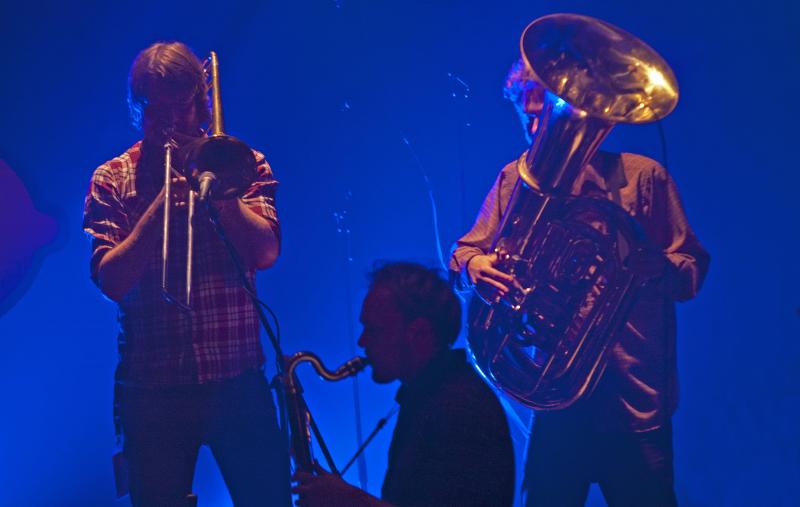
From left: Erik Johannessen, Lars Horntveth, Peder Simonsen
While the music is finely detailed—and no small challenge to perform, given that, with 18 arms and legs at most Jaga has to translate the 96 tracks used in the recording of One-Armed Bandit- -there is also enough space provided to focus on soling from some of the band members. Eick got an extended solo, late in the set, which drew screams of approval from the audience—though he proved equally powerful when he put down his trumpet and picked up a double-bass—while Øystein Moen's synth tones were, in a word, nasty, drawing from the same outrageous sound worlds that he explores in his more avant improvising trio, Puma, with guitarist Stian Westerhus and drummer Gard Nilssen. The two Horntveth brothers were constant focal points: Martin, beyond his absolute engagement on the kit, a great spokesperson who whipped the already energized crowd into a greater frenzy; and Lars, who took a soprano saxophone solo, mid-set, that belied his general tendency to focus more on structure than freedom.
Andreas Mjøs never took an actual spotlight, but remained quietly charismatic—sharing center stage with Lars Horntveth, and moving constantly between guitar, synth and, in particular, the vibraphone that is particular marker for the group's sound—while trombonist Erik Johannessen (picking up some of the absent Line Horntveth's vocal lines on "Book of Glass"), Even Ormestad (spending almost as much time on keys as he did electric bass), guitarist Marcus Forsgren (no longer new, having been with the group for over a year now, performing last year at the Konsgberg Jazz Festival), and Line's unnamed replacement all contributed to a sound that can be described in terms of its many influences, but is ultimately best described, simply, as Jaga Jazzist music.
This ain't your granddaddy's jazz, but with no shortage of jazz references in spirit if not letter, this is music that fits within the broader sphere of jazz for a younger audience. On a roll after its brief hiatus following What We Must (Ninja Tune, 2005), it's clear that Jaga Jazzist has fully recaptured its momentum and continues to build its audience.
Visit Darcy James Argue , Dave Holland , Rudresh Mahanthappa , Anouar Brahem, John Surman, Jean-Louis Matinier, Jaga Jazzist and TD Festival International de Jazz de Montréal on the web.
Photo Credit
John Kelman
Days 1-3 | Days 4-6
About Anouar Brahem
Tags
PREVIOUS / NEXT
Anouar Brahem Concerts

Become a Sustaining Member

Since 1995, All About Jazz has championed jazz as an art form and supported the musicians who create it. Over three decades, it has grown into one of the world's leading jazz resources, serving hundreds of thousands of readers, musicians, presenters and industry professionals each month.
Help Build the Future of All About Jazz
Your support helps us continue building All About Jazz for the next generation—expanding our editorial coverage, preserving jazz history, developing new community features and creating better ways to discover the music and the people behind it.
Become a sustaining member for as little as $20 per year and you'll immediately enjoy an ad-free experience along with access to subscriber features and future articles for a full year.
Together, we're not simply sustaining All About Jazz—we're building its future. Thank you for being part of the journey.