Home » Jazz Articles » Live Review » Peter Brotzmann Chicago Tentet +1: London, UK, April 18-20, 2011
Peter Brotzmann Chicago Tentet +1: London, UK, April 18-20, 2011
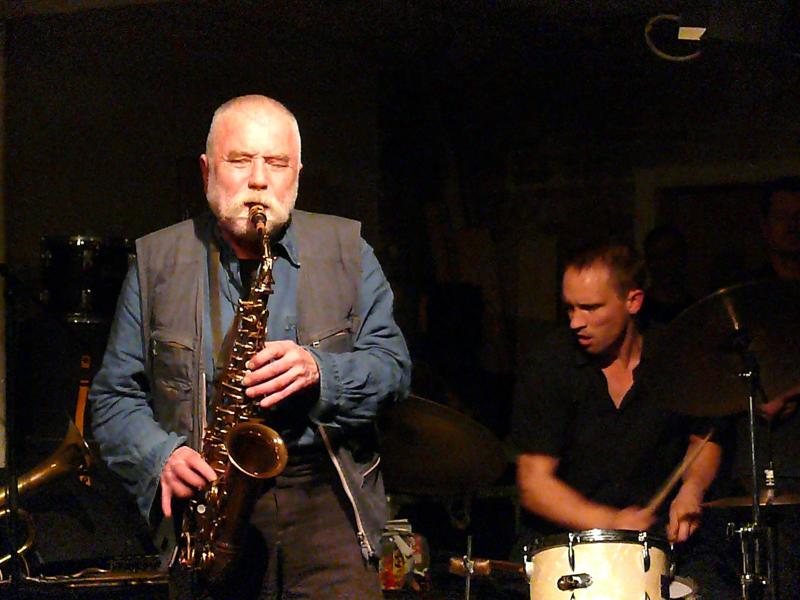

Café Oto
London, UK
April 18-20, 2011
Since its inception in 1997, Peter Brötzmann's Chicago Tentet has become one of the foremost large groupings in free jazz, not least because of its unrivalled roster of talent and its durability as a unit. When asked how he had kept such an exceptional group of musicians together, German reed iconoclast Brötzmann replied: "Doing it for such a long time tells me that they want to do it." As he explained to BBC Radio's Jazz on Three in a live interview on the final night, it certainly wasn't for the financial reward: "I'm embarrassed when it comes to paying the guys." Rather, "it's about the spirit." And there was spirit in abundance for the three nights of the Tentet's (currently numbering eleven players) residency at north London's Café Oto in what promised to be one of the jazz events of the year in the capital. This was the Tentet's London premiere and its first gigs in UK since the Scottish 2007 dates in Stirling, which yielded American Landscapes 1 & 2 (Okka, 2007).
Made possible by support from the Goethe Institute, as well as the enthusiastic attendance of the Café Oto audience, the multinational grouping had the luxury of an extended stay and the space to present multiple facets of its artistry. Each evening comprised a set from a subgroup drawn from within the Tentet, followed by a solo or duo, and finally the whole shebang. While some might see these sets as diversions or unwanted hors d'œuvre before the much-anticipated main meal, they were largely successful in their own right and permitted greater appreciation of the constituent talents in these intimate surroundings.
Survival Unit III
As the inaugural event of the residency multi-instrumentalist Joe McPhee's Survival Unit III grabbed the attention. They kicked into the red and stayed there, with Michael Zerang tumbling a rolling free beat around his drum kit while McPhee repeated frayed alto saxophone lines and Fred Lonberg-Holm plucked in his cello's upper registers. It was an uncompromising start which set the bar high. Now 71, McPhee becomes more in-demand the older he gets, with the cooperative Trio X being among his most prolific outlets, but collaborations with diverse improvisers figure prominently, such as his visit to Café Oto in December 2009, immortalized on the acclaimed Oto (Bo'weavil, 2010).

McPhee's first Survival Units encompassed an electronic backing tape against which he could play in the early days when no suitable accompanists were to be found, while the next version, documented on At WBAI's Free Music Store, 1971 (Hatology, 1996) was a bass-less quintet featuring the Clifford Thornton's baritone horn. Although the application of the name to this unit remained unclear, there was a link to the initial incarnation as Lonberg-Holm's effects provided prominent support this time out. With his array of pedals and switches spread in an arc at his feet, easily accessible to expand upon the already broad palette afforded by his virtuosic cello, Lonberg-Holm was a key determinant of the group mood. He exhibited a predilection for extended techniques, which meant that this threesome dealt as much with sound as song. Zerang fitted right in, combining his buoyant rhythms with his love of unconventional timbres, exemplified by his use of an arsenal of unusual sound generators: implements resembling backscratchers, ping pong balls and cymbals deployed on his drum skins. For his part McPhee reveled in overblown saxophone skronk, though his tender side was never forgotten, being always ready to unleash melodic ruminations even within the most arid environs.
In fact, the saxophonist began the second piece alone and more lyrically, swinging the bell of his saxophone from side to side as he played the room, before a delicate, almost tentative exchange with the cello. What followed was a cogent demonstration of their highly attuned approach. Zerang thickened the soundscape by dragging backscratchers across the heads of his drums, then used a table tennis ball to let loose unearthly shrieks. Lonberg-Holm joined forces in what became a litany of abrasive scratching and lacerating squeals. Inspired, McPhee propounded a querulous circular breathed wail, before becoming honeyed once more. In contrast their final piece was completely different again taking on the dimensions of a junkyard symphony of bangs, crashes and guttural honks.
Per-Ake Holmlander
Swedish tubaist Per-Ake Holmlander joined the Tentet in 2005, having already been a mainstay of bassist Barry Guy's New Orchestra and Chicago saxophonist Ken Vandermark's Territory Band. To open his solo set he established a two note pattern which he modulated by varying volume and attack—soft then brassy, fast then slow, sliding and bending the notes. As he blew, seated with his unwieldy axe, his face seemed to meld with the instrument, especially when he was circular breathing: a drone ascending through the registers, punctuated by sniffs as he inhaled through his nose. As he said disingenuously, while taking respite after his exertions, "The tuba is not so much music, it is more athletic." He could be very quiet for such a big man with such a big instrument. His second installment began with a piercing whistle and slurps of inbreathed air, evolving through gargles with higher pitched voice harmonics. He then proceeded as if giving vent to an outpouring of spleen, becoming more vibrant and brassy as his animation increased.
 Per-Ake Holmlander
 Holmlander proved himself an amazing technician, but one who was able to ally technique with musicality. Such was his physical connection that at times it seemed as if he were caressing, kissing or even trying to inflate the tuba. But, in fact, he played the only tune of the whole three days—a rendition of "Jabulani," by Abdullah Ibrahim, formerly known as Dollar Brand—which began in a most unlikely way with blurts, snuffles and splutters, before an exuberant vamp presaged theme and variations including a lengthy circular-breathed digression. Wonderful.
Brasstet
Lined up across the Oto stage to open the second evening, the four strong Brasstet stands as one of the subgroupings which have less of an independent life outside the mother ship; based on this showing, that might be an oversight. As an opening gambit, their instrumental throat-clearing, odd breaths and preparatory squeaks were so imperceptible that no-one noticed. It was only as the cumulative detail took on a noticeable rhythm that attention was captured, eventually unfurling into an effervescent Ivesian brass band with luxuriant harmonies.
The foursome constantly grouped and regrouped, breaking down into fluctuating duos and trios. McPhee, this time on pocket trumpet, and Chicago trombonist Jeb Bishop started the following number with the trumpeter's breathy screeches paced by muted trombone. Fellow trombonist Johannes Bauer, standing alongside, appeared to be living the music even when not taking part, as fleeting expressions swept across his face, accompanied by conducting hand gestures, as he concentrated. His eventual entry catalyzed a horn chorale full of playful conversation.
Later, Bishop's slow repetition of funereal bass notes quieted to an interchange of almost inaudible whirrs and slobbers. Bauer whispered sometimes with his horn at his lips other times not. Slowly gaining momentum and volume the two trombones bickered animatedly until suddenly halting—apparently mid phrase—causing laughter all round.

Joe McPhee
In a bravura introduction to the last piece McPhee supplemented his pocket trumpet growls with vocalized harmonics, muted by his hand, recalling the sonorous burr of a didgeridoo. Aptly matched by tuba, the trombones entered with assorted mutes, exploring overtones in a colloquy knitted from four interweaving threads. Listening to this consonant brass chorus, it was, however, possible to grasp how some of the Tentet confluences might arise.
Fred Lonberg-Holm/Paal Nilssen-Love duo
Chicagoan Fred Lonberg-Holm and Norwegian drummer Paal Nilssen-Love debuted as a duo on the second night. Electronic cacophony vied with pile-driving drumming in a powerhouse start. Under the American's ministrations, the cello functioned as effectively in a noise environment as in its more customary chamber habitat. Adjusting his buttons and pedals while bowing, the cellist added sheets of buzzes, white noise and interference. Lonberg-Holm's technique astonished close up, whether scrubbing on his strings, creating hyper distortion, or tapping percussively with both the horsehair and the heel of his bow. Such was his ardor, that almost straight away half the hairs were trailing from the bow.
Nilssen-Love convinced as the consummate free drummer—speed, power and articulation, he showed it all. His energy levels were prodigious, leaving him bathed in sweat almost immediately after he appeared. Alongside the jackhammer drumming, he also investigated the more timbral byways expected of a European improv percussionist. A small cymbal held against his crash cymbal as he struck it at speed sounded like the sea washing on the shore, an effect he amplified by placing gongs and cymbals on his drum heads for a ghostly resonance. There was no quarter sought or given, but the impact remained curiously uninvolving. It wasn't until towards the end of their 30-minute set that they allowed an enticing space to develop.
Sonore
One of the longest standing Tentet sub-units, having first emerged as a threesome under the Sonore moniker back in June 2002, the reed trio of Brötzmann, Ken Vandermark and Mats Gustafsson launched the final evening. This combination offered a splendid opportunity to hear all the subtleties of the three reedmen too easily obscured during the combined tumult. As if reading from a score, they opened with a united clarion blast from Vandermark on clarinet, Gustafsson on baritone and Brötzmann on alto. But, in fact, everything they conjured was spontaneous, with fluid shifts between every permutation as the course of the music dictated. There were spellbinding passages, resulting from bountiful interplay and deep listening.
 From left: Ken Vandermark, Peter Brötzmann
 In their first piece Vandermark and Gustafsson parried with each other in the upper registers, sending bat squeak split tones fizzing around the room. Their second improvisation of four in an enthralling 40-minute set was the peak among heady foothills. Brötzmann enjoyed a dynamite solo spot, where every breath and inflection of his carefully controlled vibrato was apparent, while Vandermark's later tenor explosion displayed a Brötzmann-like impassioned oratory. A beautiful threnody from the German led into a gentle group coda which rounded off matters to perfection. Each man gave it his all, with no holding back due to the impending main course.
Kent Kessler />Bassist Kent Kessler, the driving force from the Vandermark 5, presented a one man set which demonstrated his interest in texture and timbre. Hunched over his bull fiddle, the Chicagoan commenced by bowing frantically, as he slid his fingers up and down the fret board for a variable drone. He especially favored his arco work, but one pizzicato sequence brought Charlie Haden to mind with the gravity of his knotty melodism and resonant muscular tone.
Peter Brötzmann's Chicago Tentet As a series of tasters, the various small groups accomplished their intent, whetting the appetite to devour the entire banquet from the same plate. Ranging from the passionate lyricism to sheer bellowing, and touching on most points in between, they also graphically illustrated the breadth of approaches embodied within the larger aggregation.
It is hard to think of any large improvised music grouping which has sustained itself over such a prolonged period and toured so often. Perhaps the Tentet's nearest forbearer is the Globe Unity Orchestra, which also featured Brötzmann among its number—similarly multinational, but less consistently on the road. Since its initial release, The Chicago Octet/Tentet (Okka, 1998), the rump of the personnel has persisted with Brötzmann, McPhee, Vandermark, Zerang, Kessler, Bishop, Lonbeg-Holm and Gustafsson still aboard, and the benefits certainly show. Although the core remains constant, their working methods have evolved drastically. Originally a vehicle for the members' compositions, ever since a May 2005 North American tour Brötzmann has encouraged the Tentet to draw upon its collective savvy by foregoing charts. Unsurprisingly the band's excellent five-CD box set, Three Nights In Oslo (Smalltown Superjazz, 2010), furnishes the most up-to-date representation of what to expect, even down to sets by identical subgroups.
 From left: Johannes Bauer, Kent Kessler, Jeb Bishop and Mats Gustafsson
One of the most compelling aspects of the Tentet's performances over the three nights was the degree of collaborative purpose achieved by a total improvising unit. Although the individual parts were stellar, with egos checked at the door, the marvelously flourishing group ethos was the real star of the show. In numerous instances the band moved together in freewheeling arrangements. Without either a conductor or sheet music, the only inference could be that its unity stemmed from the years of shared experience and practice. Individual's compositional sensibilities acted to magnify the cohesion: Vandermark belted out a saxophone riff as an accompaniment to a rocky segment for Nilssen-Love and Bishop before a lush horn chorus, while at other times Bauer orchestrated the horns to conjure punctuating figures.
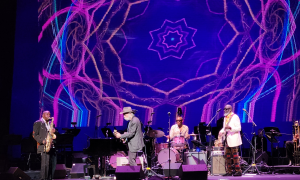
In the close-quarters setting of Café Oto, an eleven-strong band rocking out with two drummers—even when everyone but the string players dispensed with amplification—meant that, at times, the volume was ear-ringingly loud. To mangle Tolstoy's famous words from Anna Karenina, "All happy families resemble one another, but each unhappy family is unhappy in its own way," all Tentet full ensembles have resembled one another, but each sub-grouping differed in its own way, none of them unhappy. Not that the juggernaut roar of the Tentet in furious flight was in any way superfluous, but the journey leading to that point was often even more rewarding than the culminating cathartic blow. However, it was rare for the entire cast to play simultaneously. Band members joined or dropped out in continually changing constellations. The trajectory was for successive passages of alternating crescendos and small group interaction, building up to a seething maelstrom which, often stilled for contrastingly poignant resolutions.
 From left: Fred Lonberg-Holm, Kent Kessler, Jeb Bishop and Paal Nilssen-Love
 After the first night, when the twin drum sets were set up at the front of the stage with the horns patrolling the rear, the stage layout became more logical with the two kits positioned at the left and right extremes, and the rest of the band in a loose semicircle to the front. Brötzmann spent much of his time facing the rest of the band, and although he didn't direct overtly, he nonetheless shaped the flow, at times, through the arc of his saxophone lines, which effortlessly sliced through the frenzy. But, on occasion, he was more direct. At the end of the opening night, with the band ramping up for a rollicking conclusion, the leader steered proceedings in what was obviously a well-oiled move by jumping in the air to bring everyone to a simultaneous halt as he landed.
It would be a thankless task to enumerate the highpoints from the three Tentet sets, but several passages stuck in the mind. The absolute pinnacle came on the middle night, when the band's elder statesmen, McPhee and Brötzmann, engaged in an alto saxophone intertwining of aching melodism, subverted only briefly by squalling digressions. Although not prearranged, everyone else listened intently, but chose not to join so that the piece was completed as a twosome. In the BBC interview, Brötzmann noted that his mellow side has always been there for those with the ears to go beyond the preconceptions, but clarified that he now allows it to come to the fore more often. This was just one of many times during the three days that it did so with an emotional charge all the greater when contrasted against the raging torrent in spate.
Brötzmann also featured in another highlight: McPhee posited a rhythmic figure on pocket trumpet, with just Kessler's earthy bowing for company. A vocal holler from the trumpeter momentarily interrupted the motif, and served to set up Brötzmann for a lone foray on tenor saxophone. Even at the age of 70, he hasn't lost the capacity to surprise. His regular gruff vibrato-laden tone splayed into astonishing vocalized yelps and ululating hollers, ratcheting up the stakes in intensity and passion more than usual until climaxing in a series of heartrending screams.
In another piece, a chirruping counter movement from Vandermark and Gustafsson ended with the two reedmen planted center stage, spiralling a capella vapor trails to the heavens. Gustafsson's baritone plunged deep below Vandermark's keypad popping clarinet, then surfaced to mesh in a language of feverish staccato phrases, until both men stopped abruptly, seemingly in mid-sentence, for a perfect finish, bringing a smile to the face for its unexpected felicity.
Everyone had their moments. Bishop, always ready to step forward, captivated Brötzmann's alto in a sweetly synchronized Americana tinged duet, which morphed into a bucolic brass band with the addition of McPhee's pocket trumpet. Another time the pairing of Bauer's gamboling trombone and Vandermark's cool clarinet, gradually submerged under frothing layers of orchestral sound, through which the Chicagoan impassively kept his cool, serenely floating above the increasing mayhem.
In comments posted on his Facebook fan page , Vandermark thought that these three days were a true highlight in the performance history of the Tentet, picking the second evening in particular as a standout in the career of the group: where they were focused, risky, cohesive and varied. While the audience at Café Oto didn't have the benefit of his experience to draw a comparison, no-one would be likely to argue.
Photo Credit
All Photos: John Sharpe
< Previous
The Desert and the City
Next >
Parting Shot
Comments
Tags
Peter Brotzmann Chicago Tentet
Live Reviews
John Sharpe
Peter Brotzmann
Joe McPhee
Michael Zerang
Fred Lonberg-Holm
Trio X
barry guy
Ken Vandermark
abdullah ibrahim
Jeb Bishop
Johannes Bauer
Paal Nilssen-Love
Mats Gustafsson
Vandermark 5
Charlie Haden
For the Love of Jazz
 All About Jazz has been a pillar of jazz since 1995, championing it as an art form and, more importantly, supporting the musicians who create it. Our enduring commitment has made "AAJ" one of the most culturally important websites of its kind, read by hundreds of thousands of fans, musicians and industry figures every month.
You Can Help
To expand our coverage even further and develop new means to foster jazz discovery and connectivity we need your help. You can become a sustaining member for a modest $20 and in return, we'll immediately hide those pesky ads plus provide access to future articles for a full year. This winning combination will vastly improve your AAJ experience and allow us to vigorously build on the pioneering work we first started in 1995. So enjoy an ad-free AAJ experience and help us remain a positive beacon for jazz by making a donation today.

Giveaway

Eligible winners: 15
Days remaining: 12
Days remaining: 12