Home » Jazz Articles » Interview » Omar Sosa: Bringing The World To The World
Omar Sosa: Bringing The World To The World
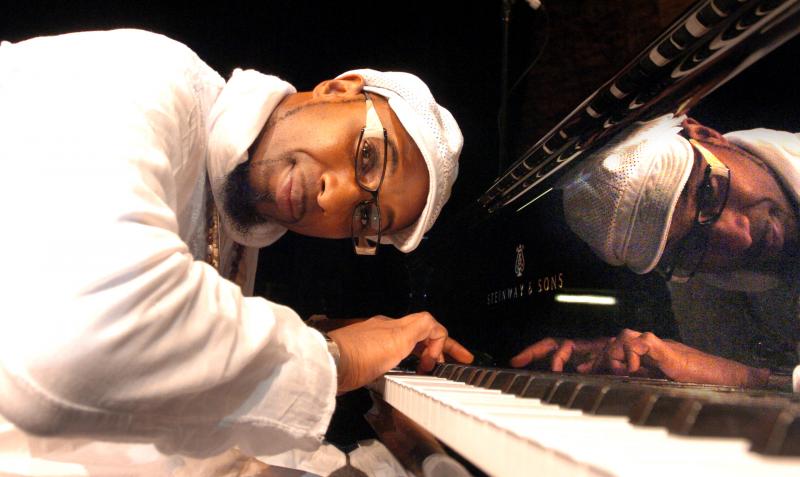

Moving to San Francisco, Sosa experienced jazz in person for the first time, becoming enthused by the freedom to play what he felt, to improvise what he willed. This addition of the jazz aspect of improvisation to the African tradition led to the music Sosa plays today. He formed a fruitful personal and business relationship with Bay Area resident/record label owner Scott Price, recording for their Otá Records label ever since. Twenty-two albums later, Sosa now lives in Barcelona, Spain with his family, spreading his brilliant impressionistic mix of African-rooted melodic and rhythmic music around the world with a band including musicians from Mozambique (bassist/vocalist Childo Tomas), Cuba, (percussionist/vocalist Julio Barreto), and America (saxophonist Peter Apfelbaum and drummer Marque Gilmore).
Sosa has created a magnificent and deep view of what is often called "world jazz." His music—whether solo piano, piano/percussion duo, quartet, quintet or larger forms—presents a silken, almost visual sheen of beauty...the beauty of the world. Imbued equally with Thelonious Monk and Chopin, as well as other pianists from Bach and Satie to Duke Ellington, Cecil Taylor and Randy Weston, Sosa has, in his quest to unite the African traditions, created a new form of music.
Albums such as Mulatos (Otá, 2004) (featuring guest Paquito D'Rivera and nominated for a Best Latin Jazz Grammy), and Ceremony: NDR Big Band Plays Omar Sosa (Otá, 2010), arranged by Brazilian composer Jaques Morelenbaum, of Antonio Carlos Jobim fame, are masterpieces of color, melody, rhythm, philosophy, and life itself. This new form of music, impressionistic rhythmic world music, has legs.
Sosa's solo recording, Calma (Otá, 2011), combines four elements: acoustic piano, Fender Rhodes, electronic effects, and samples of world music, including water music played by pygmies. The combination reflects his new feeling of peace, or "calma," that he now enjoys in Barcelona—like San Francisco, a city by the coast. Already popular in Europe and lauded by composer John Adams, Sosa—Grammy nominee and BBC Radio 3 Award-winner for World Music—is now also becoming a familiar face at New York's The Blue Note, where American audiences are discovering Sosa's soft, earthy, colorful, and humanistic music.
All About Jazz: How long have you been in Barcelona?
Omar Sosa: Around twelve years, a little more, twelve or thirteen years. And now I am formally here. I have two kids, my wife. To be honest, it's a good place to live. For music, there are a few scenes, but this is more like a tourist city in a way. I live in the old area. Actually, it's cool. Sometimes it's crazy when they have a soccer game here, everybody is screaming. This happens about three or four times in the whole month.
 AAJ: Catalonians are pretty nice people.
 OS: Yeah, the people here are great. This city is faced to the sea. When you find a city in the world that is faced to the sea, I don't know why, but most of the time the people are less tight. They are more relaxed, looser, in the way of free people. Like I said again, this is a beautiful city to live. The food is great.
AAJ: Do you ever go to Madrid for gigs?
OS: Before I came to Barcelona I lived in Madrid for seven months, a year. It is different, because Madrid doesn't face to the sea, so the people act in a different way. Actually, it's another kind of party. It's a party too, but different.
AAJ: You've lived in a few interesting places, obviously Cuba, and then Quito (Ecuador).
OS: I lived in Mexico too [laughs]. Before Ecuador was Mexico. I lived there almost eight months, nine months. I had a good time there, but... let's say I didn't have a strong connection with the tradition of Yucatan. But I learned a little bit. But when I moved to Ecuador—I moved there because I married my ex-wife, she's Ecuadorian—in Ecuador I had the opportunity to connect really strong with Ecuadorian people. I discovered this kind of music of the Pacific coast, the Esmeraldas—it's called musicas Esmeraldas. And I was deeply inside of the tradition and I combined the tradition with the Afro-Cuban tradition. This was one of the first moments I started with this obsession of mixing all the African traditions all over the world.
It was the moment I thought, "Woa, this Ecuadorian tradition is pretty much the same as our Afro-Cuban tradition." Actually, our tradition comes from Nigeria, like our religion, and they have this tradition there they call marimbas merdania. It's kind of a style of music, but inside, a philosophy too. I said "Wow, this is a good step to start creating music based in the African diaspora."
After that I moved to Spain for the first time. I went to Minorca, an island in the Mediterranean. I had a connection with a couple of friends, and I started playing a lot there. But after that I moved to San Francisco. I brought with me all this Ecuadorian tradition, and when I discovered all this Afro-American tradition, especially hip hop, the spoken word, I said, "Well, they can all combine together." And this is why I started with my first record. With this band, this group, the record was Free Roots (Otá, 1997).
 AAJ: So Free Roots was your first record, not the solo record, Omar Omar (Otá, 1997)?
 OS: No, the first one was the solo record. But to be honest, this record [Omar Omar] was a party. My manager—we have a record label together—he used to have two microphones in his living room faced to the piano, and we started to drink some wine with some friends. And I started playing for almost two and a half hours, and he recorded everything [laughs]. And I remember a couple of weeks later—we weren't working together, we were only friends—he called my ex-wife, because at that time I didn't speak any English. The only thing I could say was "jazz," "thank you" and a couple of bad words, which is the first thing you learn particularly when you live in Oakland, West Oakland—nothing too beautiful in the sense of language. But I remember he told me, "Omar, you want to make a record?." I said, "Well of course I want to make a record, but I don't see this is going to be so simple... you want to make a record?" He passed me a contract, a big contract, 150 pagess, to a guy that doesn't speak English, doesn't read English! I said, "Man, I'm gonna say 'yes,' but it's my word with your word. You betray my word, I kill you!" [Laughs]. And now we have worked for almost fourteen or fifteen years together, and we have twenty-two records together, on Otá Records. I'm proud to have this opportunity, I'm proud of myself to say "yes" at the moment he called me [laughs]. We became a family; he's my manager, his family, my family.
AAJ: Did you find the Bay Area very different to what you had known before?
OS: Of course. America's America, man. They have a lot of problems, they have a lot of scenes, things that can happen only in America! Here in Spain, I played a couple of gigs but it was hard to do this kind of conceptual work, this kind of crazy music, for a lot of people. And when I arrived in San Francisco I see this window kind of open. I played all kind of music. I played flamenco, I played Brazilian, I played whatever music you can imagine. Reggae, Mexicano, salsa, Cuban. And actually, when I started to play jazz, I said "You know, I don't play jazz. I enjoy playing music, but I don't play jazz as a style of music." This is something that I keep until today: I call myself a musician who loves to play music, but I don't play jazz in terms of straight-ahead, or bebop.
As I said before, jazz for me is a kind of philosophy. I take jazz as a philosophy of life, the freedom and the way to create, the way to learn and share and be open to reproduce what you feel inside. I love jazz in that connection. I discovered this in San Francisco. I was starting with all these musicians like John Santos, or Peter Apfelbaum or Jack Jones, all these musicians, Babatunde Lea, Richard Howell. I started to discover this wonderful world of creating music, and expressing what you feel in the moment. In a way, this is what I do until today.
AAJ: Were you listening to jazz in Cuba?
OS: We were listening to a little bit of jazz, but it was undercover. The people in the school would tell you, "They'll grab you. If you listen to some jazz you're in trouble." Because, at that time, jazz was a music from America. It was a kind of secret to listen to jazz. It's beautiful, because when you're not allowed to do something, you want to do it every day [laughs]. And pretty much this is what we did—listen to jazz almost every day, with a little radio. We took some FM radio from Miami every night around ten or eleven o'clock and we listened kind of quiet to this kind of music. It was a beautiful moment. I have beautiful memories of this.
Then, they put jazz [on Cuban radio] every night or a couple of days a week—this was the father of Horacio "El Negro" Hernandez, the drummer. His father used to have a really good radio program and he only played jazz. We always waited for this program. Whether it was every day or two times a week I don't remember, but we learned a lot. In my last two years of school the music was more free, and we started to get some radio in the school and we played some music, some Oscar Peterson, we played some different kinds of music, Faria Olestar, Weather Report, some Monk, Miles, early Miles, and this was, in a way, the introduction for a lot of people of my generation.
 AAJ: This was the Cuban radio show, or the program from Miami that you were able to listen to more openly?
 OS: It was Cuban radio. It was called Radio Progresso.
AAJ: From Horacio's father?
OS: Yes. It was a beautiful program. He used to say who was playing, the style, the concept, the biography of the musicians, and we discovered musicians on his radio show like Cecil Taylor, Randy Weston, Abdullah Ibrahim, Ahmad Jamal, Thelonious Monk, McCoy Tyner, of course John Coltrane, Chet Baker, Miles. It was beautiful, it was beautiful. I talked to Horacio a few months ago, because we have a project together with the NDR Big Band, and I talked to him about his father's radio program and we talked quite a bit about this period.
AAJ: That was when you were about eighteen, nineteen?
OS: Pretty much, well about sixteen, seventeen, because the way I grew up I graduated from school at eighteen. So, fifteen, sixteen, seventeen, more sixteen that seventeen.

AAJ: That was the music school, the Nacional School?
OS: Yes. I studied at the National Music School of Havana [Escuela Nacional de Musica Havana] a real good school, man... my time there was "Woa." I want to say thank you to all my teachers, my composition teacher, because they have a clear idea of what they try to pass on. In a lot of our cases, they passed the message. A lot of people of our generation, they love to write music, they love to play, they love to discover things—more than discover: they like to enjoy themselves in the beautiful world of music, man.
AAJ: People say that you don't follow too much the Chucho Valdéz line of playing. Was that type of music taught to a great extent?
OS: Well, Chucho is one of my heroes, he's a great friend, he's a great father. Every time I go to Cuba I go to Chucho's house, I talk to him. Everytime I have a new record I pass it to him, but if you think you'll find your own voice why imitate your father or your teacher? What is the reason, because when you just pass on the music he says, "Well, it sounded good" or "Oh yeah," but when you come out with something that is part of you, when you think you've found your language, you can discuss things with him. You know, "I did this here because I feel this." It's not like I reproduce or become a clone of him, in a way. It's something that's not possible, because everybody's individual. We're all individual human beings, so we all have the opportunity to create, to discover the gift of creating some music. If we have the opportunity, wow, it's a blessing, man. It's a wonderful blessing. This is what I've tried to do until today. I have my new record, Calma. It's a solo but it's not really solo piano.
AAJ: No, it's not, it's not at all. It's piano, plus Fender Rhodes, electronic effects and samples.
OS: Everybody thinks you mean, "He plays solo," as in only the instrument. No, I play solo on what I play [laughs].
AAJ: Yes, because with the piano, the Fender Rhodes, the effects and the samples, it was done live too, in real time with no overdubs?
OS: Yes, it was real time—the samples, the Fender Rhodes—because the foundation of the record was I wanted to have a single moment in the studio and play. And this is what I did. I had my Fender Rhodes, my samples and my effects. I played just what I felt, what came through me. I played two hours. After listening to those two hours we decided, Roy [Moisa] and me—actually he's a friend—to use the first hour, because it was more in the mood of what I tried to express in the moment I arrived at the studio. I tried to present some peace and calm around my life, some "calma" around me. In a way, Calma is one moment of my life, and actually it's the moment I live today. I think we need calma man, we need calm. We need peace. Everything is too crazy, man. And in a way we are addicted to the stress.
Eeverybody has stress in one way or another, because the whole world is moving fast. There's no way to sit down. For example, just saying "I love you." Simple things. How fast the world is moving, compared to sitting in your apartment and simply seeing some rays or something, and this is something I feel today. I need to sit down sometimes and actually this is something I had the opportunity to do in Minorca, and when I discovered this I said, "Wow, you know music needs to be like this," man [laughs]. -I tried to reproduce this in music, in the way I feel, and Calma came out like this. The first hour of recording was like this, this kind of relaxed mood. The second hour was more of an anxiety; the second hour was dark. I don't think I'm going to put it out, because it was completely yin and yang. After healing myself with all this melody and this space, I tried to create some colors too, as regards the second hour. I take a break after one hour, I come back, and it was completely different [laughs]. It's not the scene I like-it's too much. It's reflected in the music.
 This is what I like a lot in African music, because if sometimes it's a drum, it brings me to a dimension, to a deeply spiritual dimension, and this is what I look for in music.
 I'm happy with Calma because now, when I listen to the music, I hear it in front of the sea. I say "Thank you God," for giving me the opportunity to translate this wonderful, beautiful scene to music—in my view, because maybe, for other people, they say "I don't like it," but for me it's like this.
AAJ: When you were in the studio, did you have the Fender Rhodes set up at your left?
OS: I had the Fender Rhodes set up at my left hand. This is why if you listen to the record, you can see that most of time I use it as the bass of the piano. I tried to use it as the bass of the piano and, at some moments, I tried to use it as a pad—some kind of background, harmonies. I didn't put the Fender Rhodes in as a main instrument. And I tried to play with it with a bass color. I love the color of the Fender Rhodes. For me it is a wonderful round sound, and a lovely instrument. Of course, I love the sound of a good piano, and together, I'm happy with this.
 AAJ: I notice that the bass is a very important part of many of your records. In your ensembles it sometimes really stands out, and you have a great bassist now (Childo Tomas).
 OS: Oh yeah, for me this is the backbone of the music. African music without a bass, without a bass and a glue, what is it? I don't know, but it's not African music. And the foundation of every single note I play is Africa, so I always try to keep the bass, even if the rhythm's not completely "gluey" a hundred per cent. But always the bass, it's there. For example, in the piano solo the bass is there. It comes out in the moment like [in low voice] "Uuh, I'm here." When you listen to another solo record, sometimes the bass part of the pianist has some predominant really strong bass like [sings strong succession of Latin-style triplets] "donk ki dong donk ki dong donk ki dong donk di donk ki dong donk di dong dong dong"—something like this—and they put a chord in the top and get this complexity. When I play, I try to let the music come to me, and I don't force anything to go in any direction. This is why the mood of the record is like this. You can like it or not, but it's what it is.
AAJ: When you're using the electronic effects and samples you have set up, you've got these boxes on top of the piano?
OS: Yeah, yeah. A couple of Bosses, a couple of sample machines—I put in triggers to use in the moment what I feel. All I have there most of the time is ethnic music, music that comes from Africa, music that comes from Tuva, close to Mongolia, music that comes from South America, music that comes from the Afro-Cuban tradition, or from the Middle East, because I love to enjoy, man. This is what I do.
AAJ: So the samples are of various ethnic music of say twenty or thirty seconds long?
OS: Sometimes the music is, you say twenty or thirty seconds, sometimes it's fifteen seconds, sometimes it's forty seconds, it depends. One of the songs ("Aguas" from Calma) is with water, played by pygmies. It is interesting because, if the people listen to this, they think it's people playing in the water, but it's water played by real pygmies.
AAJ: They're playing the water, like hitting the water?
 OS: They hit the water with the gourd, on the open top. It's kind of crazy because sometimes they hit with the gourd, and put it in the water, but sometimes they just hit the water with their hands in a position like this [hits with hand three times]. When you want to do a pause, you create some acoustic sound with your hands, and when you hit the water you have like "pow pow pow pow." It's a way to play. I don't want to play music played by pygmies. I just enjoy this, and let the people feel whatever they want to feel [laughs]. Now you know what it is.
 Another sound in another song is a kalimba. It's a Mozambican kalimba. It was played by my bassist but I sampled it back in the day in the beginning, when we started. I put (it) two octaves low in the register. The machine by itself can do this. This is what the DJs do sometimes.
AAJ: So the kalimba has a one octave range?
OS: Yes, one octave range, but I put it low with the machine, two octaves low so it sounds like a kick or whatever. You don't know what it is. "What is this sound?" You know, it's colors. And this is what happens when we have calm, when we listen (by) ourselves, we have a lot of sounds come inside of us. Sometimes it's high sounds, sometimes it's low sounds. Maybe I'm crazy, but this is what I feel, and I tried to reproduce this in a way with the record because the day when I went to the studio to record, I didn't say "I will do this, and after this, it will be..." No, no, no, I just played. Just played, and after that I listened and said "OK." In the beginning [after the recording], I said "No, I don't want to make a record with this," but after that a few people said to me you should release it and, I said "Why not? The music is there."
But I played for me to listen to myself, and to enjoy this kind of moment. When I went to the studio, I was kind of healing myself, playing this music. Maybe it's crazy but, this is how I live, what I use to live. The day I was recording this, this is how I was living. I don't know if you understand my English [laughs]. I speak Catalan and Spanish.
AAJ: You have a live album recorded at FIP, Live a FIP (Otá, 2006) (FIP is the unparalleled French radio station that champions jazz with its evening "Jazz a FIP" shows, as well as its very carefully selected popular music day-time programming). One of the programmers, in Paris, talked about how careful they are in choosing tracks to go together. It must be a very good station for your music.
OS: I leave tomorrow for Paris, because I play Thursday. But, it's interesting because one of the radio stations that always supports my music is FIP.
AAJ: What are the actual effects you use, on top of the piano?
 OS: Calma is the last record to use this setup of electronics. I used Boss guitar pedals—a flanger, a phase shifter, a traditional chorus and a delay—but now I use one single pedal. It's kind of big—a big Boss pedal, like a lot of guitar players use—and everything is programmed. Actually I like it less than the old system, because then it was an analog thing—I needed to press the pedals, I needed to twist the buttons—and I liked this, because the particular sound in the moment was never going to be the same. Now. of course, I have a million sounds, but I can't memorize all of them. I'm happy with it, but it's different. I think it's more subtle, and because everything is digital and stereo, the sound is more refined. Before it was more [makes crunching sound]—you can hear it on Calma.
 With the old setup, you spent too much money. It was a complex scene when touring—always extra luggage and problems with cables etc.—in a lot of airports they'd open the luggage and destroy the equipment. They'd break one pedal and I'd need to go buy another, and every pedal was almost 300, 400 bucks. I love to do what I love to do, but I need to think on the economic side sometimes [laughs]. Now, I have the same pedals but in one big box; it's digital, so the sound is cleaner. But it depends what I want. On Calma, I was happy with the sound of the electronics and samples.
AAJ: You also play inside the piano, or you used to do it, and you even brushed the strings with coco shells.
OS: Yes, I used to do it, but I don't do it so much now. It was a period when I had a lot of scenes. I would fantasize, and we would have some different instruments inside of the piano together. But now, I have the samplers I can manage, and I play sometimes inside, but not all of the time. On Calma, sometimes I play inside—I use my hands, sometimes I play with a mallet—but it depends what I feel. It's the moment, man.
 Live In Rome, from left: Mola Sylla, Omar Sosa, Baba Sissoko, Childo Tomas
 AAJ: Some of the things you were doing inside the piano, like on albums like New Life (Otá, 2003), sound like Scriabin or other classical composers.
OS: John Cage is cool, no? John Cage is cool [laughs]. But it depends, because New Life was a moment and Calma is another moment. Maybe I'm more reflective or contemplative now. It's what it is. Calma (calm) is the answer where I live, and it's where I want to live, with this peace. That's it man. That's all [laughs].
AAJ: I hear a little Satie, maybe a bit of Albeniz.
OS: Yeah, I listened to Satie, Chopin, I love Chopin. I love Satie, actually. I listen to Stravinsky sometimes. Now not too much. It was back in the day. Debussy, Vivaldi, Bach, but it was back in the day. Now mostly what I listen to is African traditional music. And I listen to a lot of Tuva music; I am crazy about this. Actually, in my records, one of the songs has a sample of a throat singer from Tuva. It's this region close to Mongolia. I love this music, and the African music, all African music. Actually, Africa's too big, man [Laughs]. I'm only going to listen to one percent of the music I want to listen to from Africa.
AAJ: I was reading that there can be several different languages in one small region in Africa, like in one town...
OS: Yes. In Mozambique, in Senegal, in Mali, in Togo, in Ghana. This is one of the most beautiful things if Africa. You go to one village, and you drive five minutes to the next village and the people speak a different language, a different dialect. And the music, sometimes, is different. Their tradition, sometimes, is different. I don't say I travel too much to Africa, but I try to find music and talk to people, and listen, listen to a lot of music. I discover new things every day.
With the internet and all this stuff, you can be in any part of the world without taking a plane. Because you see the image now, everything is in the computer, but I always say it's nothing compared to when you go there and touch the earth, feel the energy, because a computer is what it is. It helps you to do things. But you can never touch the earth with a computer. You can never touch people with a computer, not yet, maybe one day [laughs]. But now, you need to pick up the plane, man, and go and touch the earth and feel the community and feel the reality and feel yourself inside of the reality, even if you like it or not, but feel yourself inside of this.
AAJ: Back to classical, I think that some Chopin sounds a little like popular music, but deeper.
OS: Music is music, man. When the music comes deeply from your heart or from your soul, some people may not like it but other people are going to like it, because it comes from the bottom of your heart. The only thing is, you need to be honest with what you say, based on what comes to you. This is an interesting process. Don't let what comes around you move you to a different direction.
 AAJ: Often, when you're playing live, you play through several moods or feels, and then finally you break into a clearly Afro-Cuban line on the piano. Is that something that you are always drawn to eventually?
 OS: No, to be honest sometimes it's a joke—sometimes, I don't say every time. And sometimes it's to show your passport [laughs]. It's like, you go to immigration and they say "OK, give me your passport. Ah, you're Cuban." I say, "Yes, I'm Cuban." "Ah, OK." No, sometimes it's because I feel it, or one of us feels it. Most of the time, the idea when we play is we always need to enjoy and try to play for each other, based on everybody's roots. This is the only condition to be in the band. Keep your roots. Don't try to come to my roots. Keep your roots—we need to share what we have. And based on this, something comes out.
Because I only tell Marcus Gilmore, the drummer, I say, "Man, don't worry. If you want to go to Cuba, please go, but I don't put any pressure on you to go to Cuba—I say it in the way of playing. "So be you. If you're the drum and bass, be the drum and bass." And when we listen to each other, we respect each other, in that kind of a way. We have a good time. I enjoy the concerts.
We don't try to impress anybody. We don't pretend to do complex, crazy or extremely difficult music. We don't make it for people to think it sounds difficult, but we try, most of the time, to enjoy and play what we like to play. I think this is the main thing. When we don't do this, this is the moment in the concert when I say "Well, the concert we did today was funny." Maybe some people liked it, but when we don't enjoy it, we smile and pass the bowl to each other; we move from one feel to another to arrive at another musical place. We move in another direction. I love these moments. We say "Wow, we played a good concert today." I'm not even concerned about whether the solos are amazing or virtuosic. No, it's if it's all together. If we don't enjoy it together, I don't care if the trumpet player played an amazing solo, or the saxophonist did a ripping solo. No, a solo is a solo. The most beautiful thing is playing together, playing in an ensemble.
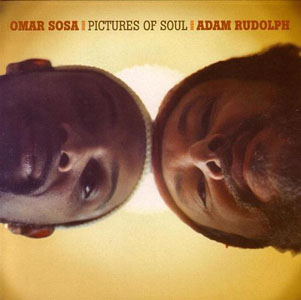
AAJ: On your duo albums, you've played with three different percussionists. (John Santos, Gustavo Ovalles and Adam Rudolph). It struck me that the duo was a great way to communicate, like one-on-one, and I wondered if it was a favorite format for you to communicate, because you can really hear the other person. It's like a conversation.
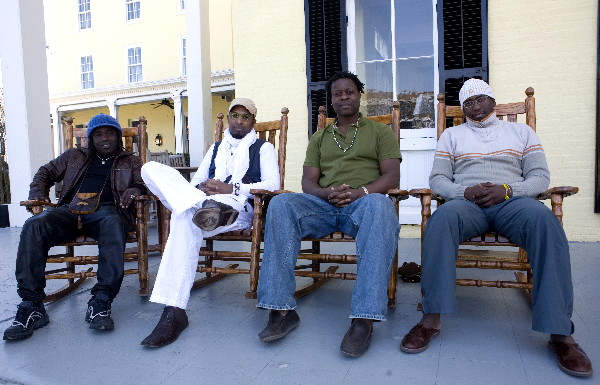
Afreecanos Quartet, from left: Mola Sylla, Omar Sosa, Childo Tomas, Julio Barreto
OS: Well yes, but you have interesting conversations between three or four or five. The only thing, in my opinion, is everybody in the conversation needs to be ready to listen, because if everybody talks at the same time it's a piece of garbage. Nothing comes through. But if everybody listens to each other, everybody is going to have his moment to say whatever they feel, and this is the idea when we try to play music. Of course, we need to play together because it's on the paper I composed, but that's one part, and most of the time the part I really love is the part that's not on the paper. [Laughs] Because it's a new part. That's the part that always surprises me in one way or another, because I never expected this, because I know what I wrote, what the sound is supposed to be. But when we create something based on some melody that's come before, sometimes we come out with some really good music, a scene, and I really enjoy this.
When you let the musician respect and play their tradition and you don't force them to play what you write on the piece of paper, everybody's going to say "What's that?." When we listen to each other and we play together, something happens. Something happens because everybody says what they feel, what they want to say. The only thing you need to do is put all this thing together, and listen to each other and love each other and play together. It sounds easy, but it's hard to do because everybody comes with their own problems, their own situation, and we need to feel this kind of energy, to arrive at this. It sometimes happens and sometimes not. But we need to fight all the time to arrive at this kind of energy.
AAJ: You said in an interview about Crossing The Divide that you were traveling across Africa to find the traditional unity, so when you are traveling across Africa or playing African music, are you trying to find some kind of unity or single thread, or feeling or spirituality?
OS: Yes, can I tell you something? You ask the question, and you give the answer too! [laughs]. The end of your question is the answer. You look for feeling, you look for a thread, you look for something to become a part of your big bag that you hold, with information and roots and tradition and scenes. Every time you go to a different place, of course, you look for this, these kinds of scenes. It's going to make you a better person; it's going to make you deeper, inside the context of what you are looking for: traditions.
AAJ: Your father was a history teacher or history professor.
OS: Yes, the profession of history. Some of the first information I had about jazz music was from him—Duke Ellington, Count Basie, Nat King Cole.
 AAJ: I hear a little bit of Ellington sometimes in your playing.
 OS: To be honest, I don't know. When I play, I just play what comes to me. And I'm open to everything. I think I have influences from a lot of musicians—in a way, this is something wonderful, because in the end you're part of this big message that comes from the elders and you try to take a little bit of the legacy of these masters. Even if you don't play their music, something in your music will come from their music.
AAJ: Randy Weston is an amazing player.
OS: Oh, Randy's a teacher, man; actually, we're good friends, too.
< Previous
Clearing Customs
Comments

Tags
Omar Sosa
Interview
AAJ Staff
United States
Childo Tomas
Peter Apfelbaum
Marque Gilmore
Monk
duke ellington
Cecil Taylor
Randy Weston
Paquito D'Rivera
Jaques Morelenbaum
Antonio Carlos Jobim
John Santos
Jack Jones
Babatunde Lea
Richard Howell
Horacio Hernandez
oscar peterson
Weather Report
abdullah ibrahim
Ahmad Jamal
McCoy Tyner
John Coltrane
Chet Baker
Marcus Gilmore
Adam Rudolph
Count Basie
Nat "King" Cole
Andrew Hill
For the Love of Jazz
 All About Jazz has been a pillar of jazz since 1995, championing it as an art form and, more importantly, supporting the musicians who create it. Our enduring commitment has made "AAJ" one of the most culturally important websites of its kind, read by hundreds of thousands of fans, musicians and industry figures every month.
You Can Help
To expand our coverage even further and develop new means to foster jazz discovery and connectivity we need your help. You can become a sustaining member for a modest $20 and in return, we'll immediately hide those pesky ads plus provide access to future articles for a full year. This winning combination will vastly improve your AAJ experience and allow us to vigorously build on the pioneering work we first started in 1995. So enjoy an ad-free AAJ experience and help us remain a positive beacon for jazz by making a donation today.

Giveaway

Eligible winners: 15
Days remaining: 11
Days remaining: 11