Home » Jazz Articles » Album Review » Jean-Luc Ponty: Open Strings
Jean-Luc Ponty: Open Strings

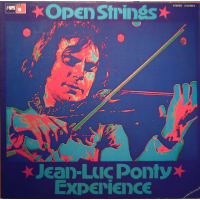
Contrasting the more mainstream Experience and King Kong—where a sometimes funky veneer easily foreshadowed what was to come—Open Strings is Ponty at his absolute freest, predating Polish violinist Zbigniew Seifert's stellar 1977 MPS date, Man of the Light (Promising Music, 2010) by more than half a decade. But there's more to link these two discs beyond Ponty's relatively unbridled energy which, at times, approaches Seifert's sheer modal fire on the opening "Flipping, part I"; the appearance of pianist Joachim Kühn—capably combining the block-chord energy of John Coltrane-era McCoy Tyner with a more unfettered spontaneity rooted in the iconic saxophonist's freer recordings of his final years on earth—is the other significant connecting thread.
Despite Open Strings's clear reference to Coltrane's groundbreaking work of the mid-'60s, Ponty's quintet also brings a distinctive European sensibility to bear, with the fervent pulse of "Flipping part II" ultimately breaking down into a piano solo that finds Kühn at his most lyrical, as bassist Peter Warren's arco blends seamlessly with Ponty's long, thick notes into a first pastoral, then soaring ascension to "Part III," with one of the violinist's earliest recorded experiments with an Echoplex, lending his pizzicato intro a semi-psychedelic veneer, even as it leads to a solo from guitarist Philip Catherine that, in its silky distortion, sounds like a nexus point of Robert Fripp and John McLaughlin.
The title track swings fiercely, but with an undercurrent of impending chaos driven by Warren and drummer Oliver Johnson, as Kühn leads to a gradually intensifying solo from Ponty that pulls the 14-minute piece to an early climax. Catherine's cleaner-toned but pitch-shifted guitar turns the heat up even further, so that when Ponty reappears, pushing into his instrument's upper register, it leads to some of Open Strings' most tumultuous moments. Even Kühn's aptly named closer, "Sad Song," breaks down into pure freedom—twice—before a sudden dissolution and hauntingly beautiful coda takes the album out on a softer note.
Ponty never recorded an album like this again, moving to the U.S. shortly thereafter for greater fame and fortune, but Open Strings remains an important record, that fills in a blank in Ponty's career, demonstrating that even the most well-known artists aren't always what they appear to be.
Track Listing
Flipping, Part I; Flipping, Part II; Flipping, Part III; Open Strings; Sad Ballad;
Personnel

Jean-Luc Ponty
violinJean-Luc Ponty: violin; Joachm Kühn: piano; Philip Catherine: guitar; Peter Warren: bass; Oliver Johnson: drums.
Album information
Title: Open Strings | Year Released: 1972 | Record Label: MPS Classical
About Jean-Luc Ponty
Tags
PREVIOUS / NEXT


Become a Sustaining Member

Since 1995, All About Jazz has championed jazz as an art form and supported the musicians who create it. Over three decades, it has grown into one of the world's leading jazz resources, serving hundreds of thousands of readers, musicians, presenters and industry professionals each month.
Help Build the Future of All About Jazz
Your support helps us continue building All About Jazz for the next generation—expanding our editorial coverage, preserving jazz history, developing new community features and creating better ways to discover the music and the people behind it.
Become a sustaining member for as little as $20 per year and you'll immediately enjoy an ad-free experience along with access to subscriber features and future articles for a full year.
Together, we're not simply sustaining All About Jazz—we're building its future. Thank you for being part of the journey.