Home » Jazz Articles » Race and Jazz » Jazz vs Racism
Jazz vs Racism


Back in the early to mid-1980s, while attending Hamilton College in central New York, I learned details about the transatlantic slave trade that sickened and angered me. I read about the history of the abolitionist movement in the 1800s, and the civil rights movements of last century, as well as the apartheid-like Jim Crow system that arose in between those movements. "Jim Crow," particularly in the U.S. South, maintained the economic, social and institutional power of whites over blacks and others with darker pigmentation, based on the legal doctrine "separate but equal" and a damnable myth: white supremacy.
As leader of the Academic Chamber of the Student Assembly at Hamilton, I even came across documents by the Curriculum Committee that explained away the lack of an African Studies concentration—mind you, they had Asian, Latin American and Middle East Studies at the time—by writing that Africans were not heir to the "great traditions."
Yet it was the great tradition of jazz that rendered me immune to leaping from anger to hatred of white people. My upbringing as a Christian also gave me a moral grounding, but it was my adoration, as a teen in Staten Island, NY, of the jazz styling of so-called "white" saxophonists such as Paul Desmond, Zoot Sims, Phil Woods, and my private sax teacher Caesar DiMauro, that really did the trick. Among other things, moral precepts and a belief system are guides for behavior and one's conscience; the music, rather, gets into your body, stirs your emotions and resonates with your memory.
I didn't segregate who I listened to based on race, so as a 15-year old beginner alto saxophonist I enjoyed a plethora of alto saxophonists across time, from Johnny Hodges and Benny Carter, Charlie Parker and James Moody, Lee Konitz and Eddie "Cleanhead" Vinson, Cannonball Adderley and Louis Jordan, Frank Strozier and Sonny Stitt to Hank Crawford, Sadao Watanabe, David Sanborn and Grover Washington, Jr.
And while attending Tottenville High School, where I played in the concert, symphonic, and stage bands, I also took sax lessons with a local legend, Caesar DiMauro. He performed European classical music on oboe and alto sax, and played jazz saxophone (alto and tenor) too. DiMauro was a gentle soul who loved to make and drink wine. He'd play with other local legends such as guitarist Chuck Wayne and trumpeters Don Joseph and Mike Morreale, who taught me at Tottenville. (In fact, DiMauro played on Wayne's 1957 album String Fever (Euphoria), and they both were featured on Tony Bennett's rare recording, Cloud 7 (Columbia) in 1955. Check out this You Tube clip of Caesar and Wayne performing "Stella By Starlight," from a documentary I produced and directed after Caesar died, called Memories of Caesar.) He loved Zoot Sims' playing, and his friends loved to tell the tale of the time DiMauro headed to hear Sims at the Blue Note and sat in. That night, reportedly, Sims liked DiMauro's riff-style too, and shouted, "Go, Caesar, go!" DiMauro's expressive approach on tenor was derived from Prez, Lester Young, but toward the end of his life his muscularity reminded me of Hawk, Coleman Hawkins.
 I'd meet him at his woodshed way on the South Shore of Staten Island, off Arthur Kill Road, and he'd take me through the fundamentals. He even taught me the art of trimming off tiny amounts of excess wood from the edges of Rico or Vandoren saxophone reeds until you could see a smooth bell curve shape when you held the reed up to the light. We'd later meet at the Jewish Community Center on Victory Boulevard and Bay Street to play etudes from jazz duet collections and passages from the Universal Method for Saxophone (Carl Fischer, 1908), by Paul DeVille.
 I'll never forget the time he told me that: "Greg, you learn all of the scales, chords, arpeggios, and patterns, but after you have them down, and you begin to improvise, let that stuff go and just play."
One of his band buddies was black American bassist Morris Edwards, a very proud "race man," born in 1925, who had played with Maynard Ferguson, Dizzy Gillespie, Illinois Jacquet as well as Prez and Hawk. Sometimes Edwards would get his head right and start speaking about black folks and the injustice we endured. If DiMauro had drunk a few, he'd say: "Aww, Morris, don't get started with that black shit again!" All the cats would laugh, and they'd resume drinking, signifyin,' selling wolf tickets, or swingin' on the bandstand like it wasn't no thang.
In college, however, my own understanding of race relations and the history of my ethnic and cultural kinfolk—black Americans—heightened and deepened beyond the grainy black and white footage of Bull Connor ordering fire hoses to be used on Negroes in Selma, Alabama, beyond Martin Luther King's "I Have a Dream Speech," beyond the annual remembrances of Frederick Douglass, Harriet Tubman, and Sojourner Truth during Black History Month in February, and even beyond Alex Haley's mini-series Roots (1977), which I watched with anger and incredulity as an adolescent while going to junior high.
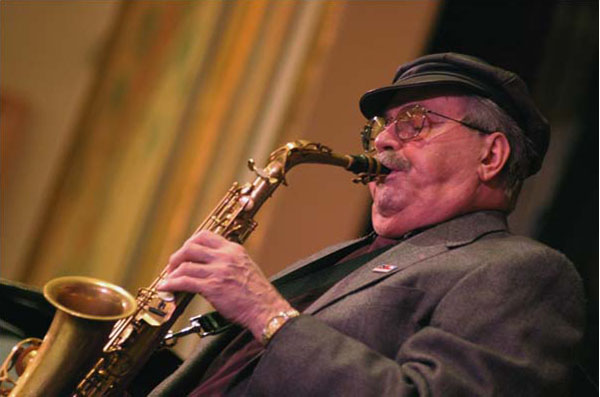 Phil Woods
If the devil is in the details, my increasing awareness of the extent of the treachery, cruelty and greed of those who perpetuated human enslavement and social repression tempted me to accept the Nation of Islam's assertion that white people were really devils! Plus, while attending Columbia University for the first semester of my senior year as an undergraduate, I saw the movement to force corporations to divest from investing in apartheid South Africa. The injustice of a white minority dominating and oppressing the black majority there incensed me also, and I became more politicized.
But, lo and behold, Caesar DiMauro (Italian-American), Zoot Sims (Midwestern and southern roots), Paul Desmond (German and Irish), and Phil Woods (Irish and French ancestry) had too strong a hold on my ears and feelings for me to accept such a racist claim as white folks, as a group of people, being devils. (Their sort of mixed lineage and heritage is what I'd later discover writer Albert Murray meant by his phrase, "Omni-American." Wouldn't you agree that the word "white" in fact "whites out" their cultural and ethnic background?)
Listening to Sims and Desmond led me back to Prez too—though Sims had some Hawk and Ben Webster in his swagger—but I liked them for their own individual qualities. Sims' plangent passion and poised yet explosive swing on If I'm Lucky: Zoot Sims Meets Jimmy Rowles (Pablo, 1977) is one of the recordings that deepened my sonic romance, and the wry dry martini quality of Desmond's gentle tone on his dates with Dave Brubeck and Gerry Mulligan seeped into my young foolish heart.
Yet, at 17, it was Phil Woods' combination of technical mastery in service of emotional expression that totally blew me away. He joined a pantheon of artists—Bird, John Coltrane, Sarah Vaughan, Cannonball, Miles Davis and Clifford Brown—in which I immersed myself, each of whom baptized me in the improvisational fires of musical greatness. Even more than his sideman work with Thelonious Monk, Clark Terry, Billy Joel, and Steely Dan, I remember Woods' early records that I would borrow, over and over, from the New York Public Library—Altology (Prestige, 1957), Sugan (Prestige, 1957) Phil & Quill With Prestige (RCA, 1957)—as well as his transcendent performance of the title track to Quincy Jones' The Quintessence (Impulse!, 1962), and his awe-inspiring sax prowess on Live From the Showboat (RCA, 1976). Like Cannonball, Woods synthesized Benny Carter, Johnny Hodges and Bird in his own unique way, creating a sound and style all his own.
 In 1979 or 1980, while still in high school, I snuck into a performance Woods gave at a high-class hotel in Manhattan to hear his mastery live and direct. I remember admiring the way he seemed to barely move his fingers over the keys of his glistening Selmer sax while producing such incredible lines, some richly melodic and lyrical, others flaming with the exciting velocity of bebop. I wore out the vinyl LP grooves of I Remember (DCC, 1978), and Woods' original compositions and arrangements in tribute to Cannonball, Desmond, Oscar Pettiford, Oliver Nelson, Bird, Willie Rodriguez, Willie Dennis and Gary McFarland became part of my high school soundtrack. His tribute to Desmond, "Paul," cast such a spell that I bought the sheet music of Woods' improvisation—to try to learn to play it, yes; but more so to read the music along with the record, as my mouth lay agape in astonishment.
 My teacher DiMauro, Sims, Desmond and Woods all became a part of my soul, so my love of them transferred to my moral center and conscience, which ultimately made me recoil from the temptation of racism during college. The beauty of their jazz performances and the wisdom of DiMauro's instruction, in an art form created and innovated by my cultural ancestors, made them, for me, aesthetic heroes whose "race," in relation to appreciating the music, was an insignificant consideration.
By the way, I don't buy the political argument that black folks can't be racists because we don't have the power to oppress others. Racism, in basic terms, is an attitude toward others based on an extremely biased and bigoted view of what's perceived as their "race." If you feel and believe that individuals or groups of people are inferior or less than human because of race or skin color, then I contend that you are indeed a racist, in outlook. The practice of racism as a behavior by individuals is situational, to be sure, but an overall attitude and outlook grounds personal practice. Institutional racism is a systemic and structural matter, and displays how destructive an idea such as race can be when it habituates within the social and legal institutions of the society. Whether personal or institutional, racism relies on the deeply flawed concept of race.
 Zoot Sims
I share the above as a personal prelude to a monthly essay column at All About Jazz on Race and Jazz. In our journey together, we'll see how race informs the jazz discourse historically and at present, and how jazz shines a bright light on ways to move beyond the fallacy of the race meme. I truly believe that jazz holds a key to surmount what one noted jazz critic called "the decoy of race." You've read above how, in my personal experience, the music saved me from becoming a racist. We'll pursue, over the course of the Race and Jazz series, why and how jazz has and can continue to serve a similar social and cultural function. We'll investigate cultural dynamics as opposed to the social construction of race, give examples of intercultural fraternity and conflict in jazz, and analyze how the race discourse has moved beyond "white vs. black" (which the late historian John Hope Franklin called "the two worlds of race") in the post-civil rights era, and especially in the Age of Obama.
I think it's crucial that we also peer into the views of other jazz journalists and musicians on our Race and Jazz theme, and even look at thorny questions involving white privilege and cultural theft, black nationalism, and why there are so few black people in jazz audiences today, as well as why the bylines of so few black American writers are featured in major jazz magazines. We'll also confront whether or not artists who consider themselves jazz musicians, yet play and compose improvisational music with little or no blues content or rhythmic swing, are avoiding or rejecting the black American roots of the music.
Race may be as much or more a third rail of discourse in American life than politics, religion, gender, class or sexual orientation. So addressing race at all, whether in relation to jazz or any other context, is, to say the least, fraught with peril. A combination of political correctness, finger-pointing and the blame game, fear or exhaustion about race, psychological shadows, and a malaise of discomfort around the issue has caused many of us to sweep race under the rug and just avoid the topic all together. Race is often tantamount to an invisible elephant in the room.
So I endeavor to make the invisible visible through representative anecdotes, map out challenges and envision resolutions, with the ultimate intent of transcending the many ill-effects of race-based thinking and seeing, to swing our collective journey into a more perfect union of lovers of jazz, and citizens of the USA and the world. How can we move beyond race, and live the better angels of our American nature, if we're not willing to confront and even admit the lessons we should learn from it? I believe that if approached carefully yet courageously, jazz can serve as a resource to contend with the complexities of race without getting caught in a briar patch of no return.
 As for my alma mater, Hamilton College, it now has an Africana Studies department, and an admirable history regarding jazz as well. I majored in Public Policy and minored in Music there; the latter greatly enriched my understanding of European Classical music and American Jazz. I also played alto sax in small ensembles and the college's jazz big band.
 Decades before my matriculation in 1981, there had been student and alumni jazz groups on campus, and professional jazz groups were—and often still are—hired to perform in the Hamilton College Chapel and other campus venues. Ten years after I graduated in 1985, tenor saxophonist Monk Rowe founded the Hamilton College Jazz Archives, which now contains interviews with 300+ jazz artists. And, in the summer of 2010, I attended my 25th class reunion and made a presentation, featuring clips from Jazz it Up!, an online jazz news and entertainment video program that I formerly hosted. My '85 classmate and friend Carol Bash, a documentarian, also presented a trailer of her work-in-progress film on jazz pianist and composer Mary Lou Williams.
Although I'm the author and initiator of this series on Race and Jazz, I truly desire for this pursuit to be an interactive dialogue between us—me and you, the readers of All About Jazz. So comment below or reach out to me from my AAJ bio page, my Twitter feed or my Facebook page. In the meantime, make sure to keep swingin!
Part 2: Race, Culture and a White Boy from Texas
Photo Credits
Page 2, Phil Woods: Michael Ochs, Courtesy of Rolling Stone
Page 3, Zoot Sims: Courtesy of Bergoiata
< Previous
Son Of Folk Songs For Jazzers
Next >
Thread Of Life
Comments
Tags
Race and Jazz
Greg Thomas
United States
Paul Desmond
Zoot Sims
Phil Woods
Johnny Hodges
Benny Carter
Charlie "Bird" Parker
James Moody
Lee Konitz
Eddie "Cleanhead" Vinson
Julian "Cannonball" Adderley
Louis Jordan
Frank Strozier
Sonny Stitt
Hank Crawford
Sadao Watanabe
David Sanborn
Grover Washington, Jr.
Chuck Wayne
Tony Bennett
Lester Young
Coleman Hawkins
Maynard Ferguson
Dizzy Gillespie
Illinois Jacquet
ben webster
Jimmy Rowles
Dave Brubeck
Gerry Mulligan
John Coltrane
Sarah Vaughan
Miles Davis
Clifford Brown
Thelonious Monk
Clark Terry
steely dan
Oscar Pettiford
Oliver Nelson
Willie Rodriguez
Willie Dennis
Gary McFarland
Mary Lou Williams
For the Love of Jazz
 All About Jazz has been a pillar of jazz since 1995, championing it as an art form and, more importantly, supporting the musicians who create it. Our enduring commitment has made "AAJ" one of the most culturally important websites of its kind, read by hundreds of thousands of fans, musicians and industry figures every month.
You Can Help
To expand our coverage even further and develop new means to foster jazz discovery and connectivity we need your help. You can become a sustaining member for a modest $20 and in return, we'll immediately hide those pesky ads plus provide access to future articles for a full year. This winning combination will vastly improve your AAJ experience and allow us to vigorously build on the pioneering work we first started in 1995. So enjoy an ad-free AAJ experience and help us remain a positive beacon for jazz by making a donation today.

Giveaway

Eligible winners: 15
Days remaining: 11
Days remaining: 11