Home » Jazz Articles » Live Review » Either/Orchestra: New York City, February 11, 2011
Either/Orchestra: New York City, February 11, 2011

Le Poisson Rouge
New York, NY
February 11, 2011
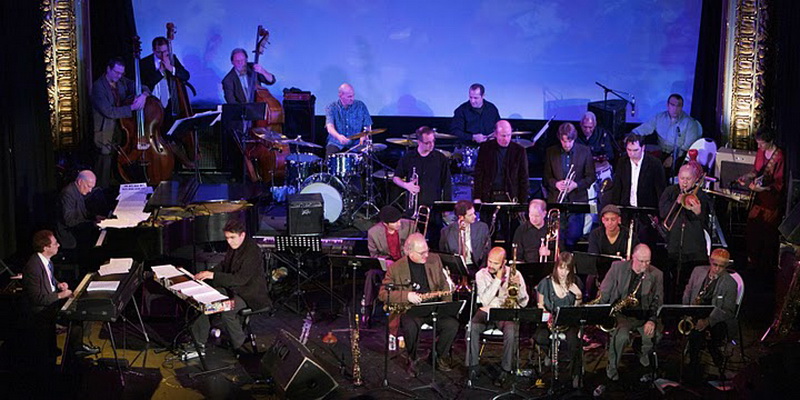
If you graduated school to work for a law firm or a contracting company, your reunion would probably not be a raucous or joyous event. However, if you and your classmates went on to be the employees of Lee Konitz, Lester Bowie, Sam Rivers, Nnenna Freelon and Morphine—and if one of you founded your own company, called Medeski Martin & Wood—there'd certainly be cause to celebrate. This was the atmosphere at New York City's Le Poisson Rouge, during Either/Orchestra's 25th anniversary show. The both reverent and irreverent big band is one of the few longstanding legends of jazz hewn outside the New York area, hailing from the Cambridge/Boston area. Much like its New England contemporary, George Garzone's The Fringe, Either/Orchestra has taken its sound and vision to concerts halls around the world, with more than 1,000 concerts under its belt. Coming into New York to join up with many of their illustrious alumni, the Either/Orchestra made an indelible mark on new listeners and seasoned fans alike.
The band was not showing its age, or any signs of restraint. Throughout the show, the stage was bombarded with a massive number of musicians, switching and compiling unorthodox changes in personnel that would have tripped up a group one-eighth its size. On one tune in particular, every rhythm guest was playing (two bassists, three keyboardists, four drummers, a guitarist and a conguero). The horns were no exception; at its apex, the band consisted of seven saxophonists, five trombonists and three trumpeters, not to mention the occasional vocalist. The ensemble also prevailed in endurance, plowing through 14 selections in a marathon stretch of three hours, with no break, save for leader Russ Gershon's occasional introductions.
With so many years of activity and so many styles traversed, the orchestra was posed with the unique task of exhibiting its versatility in a concise program, and was undoubtedly successful. What needs to be mentioned first and foremost was the group's utmost sincerity in the styles played. For all its genre explorations, the group can swing hard. A medley of "Blue Lights/Evil Eye," taken from an obscure John Gilmore/Clifford Jordan record, was driven by a playful and energetic cymbal-heavy swing from Matt Wilson. Gershon's "One of a Kind Shimmy" was pure, unadulterated hard bop, with pianist Dan Kaufman channeling Cedar Walton and Herbie Hancock, reverberating and interacting with a Jimmy Smith-inspired John Medeski, at his wah-wah organ.
Some of the orchestra's other swinging numbers were not as polite. "Notes on a Cliff," written by trombonist and alumnus Curtis Hasselbring, featured dense chord motion and plenty of crunchy dissonance. The bluesy call-and-response dialogue between trombones and trumpets was surrounded by a whirling mania of Latin rhythms, lush backgrounds and Wilson's steely Afro-Cuban rumbles. Hasselbring shared an expressive dialogue with the drums, diving headfirst into the lowest register of his trombone. "Eulogy," a two-for-one tribute to Steve Lacy and Elvin Jones, paid its tribute to these jazz greats through musical imitation. The knotty, spiky melodies, arranged in typical bop rhythmic inventions, were cut directly from the Lacy cloth. A dual drum conversation between Wilson and Pablo Bencid paid tribute to Jones' ability to create pulse and melody from his drum set; one drummer creating pulse, while the other soloed.
The ensemble clearly demonstrated a special affinity for the sound of Charles Mingus; "Town Hall Meeting" was full of the kind of manic swing, restless energy and anachronistic marriage of pre-bop rhythms and post-bop harmony that made Mingus' music so revolutionary. Gershon's Grammy Award-nominated "Bennie Moten's Weird Nightmare" paid the same kind of tribute to Benny Moten that Mingus paid to Jelly Roll Morton: similar instrumentation, same chord changes as "Moten Swing," but the meaning was all its own. The dance macabre version of this early pop tune was a bass clarinet feature for alumnus and premier engineer of his instrument, Doug Yates. Yates soloed with a refreshing and invigorating post-Eric Dolphy sound that emphasized nuance as much as it emphasized Dolphy's signature wooliness, traveling up and down from his swampy low register to his cool tempered upper register. Bassist Bob Nieske's hypnotic "There's a Bus That's Leaving Soon for Alban Berg's House" was full of pulsating, dramatic 20th-century harmony, deftly controlled by Wilson's switch between John Adams-style percussion expositions to a cool, dark swing and driven home by the ferocious, complex dual-alto soloing of Jeremy Udden and Godwin Louis.

As to be expected, the affair was not simply dressed in the ride cymbal-driven backbeat of big bands past. Either/Orchestra also brought its A-game when churning out rock and soul jams. "Something For NOLA," a musical tribute to New Orleans after Hurricane Katrina, kicked off with a glorious brass fanfare, and erupted in a The Meters-inspired funk groove. The Motown-meets-Basin-Street composition was an exceptionally appropriate vehicle for Medeski's organ blasts and guitarist John Dirac's conversational blues solo. Dirac's arrangement of King Crimson's "Red" was a brass driven appropriation of the famous prog rock group's sense of bombast. This was a moment where the group's enormous size played entirely in its favor; the film score type effect of Crimson's theatrical sound was enforced by a diversity of muted brass, auxiliary woodwinds, and blend of electric and acoustic colors.
For all its eclecticism, the band has picked up a specialty over the years through its interest in Ethiopian music. Two of the Ethiopian selections featured vocalist Teshome Mitiku, singing in a beautiful, melismatic and almost Hebraic vocal style. Mitiku's "Yezamed Yebada" featured yearning but powerful horn hits and a ferocious alto cadenza from Hailey Niswanger. Gershon's arrangement of the Ethiopian protest anthem "Altchalkoum" colored the uplifting, resilient melody with huge American big band-isms, while his tenor flowed with the unrestrained power of '60s free jazz pioneers. "Keset Eswa Bicha" exhibited a lively conversation between the brass and the reeds, over an ever-present stomp. Melodies connected and intertwined, as the rhythm section dropped in and out, all under John Carlson's articulate, clarion trumpet solo. "Ambassel,," Gershon and Mitiku's composition in the Ethiopian mode, pulsated between the trombones and the drums, setting up a lush background for alumnus Josh Roseman, whose trombone solo was as impassioned as it was intelligent. Not only was he comfortable in all registers of the horn, his sonic palette effortlessly painted a different color for each tone chosen, organized in a style versed in both Don Drummond-brand soul and Hal Crook harmony.
The band also fared reasonably well in Latin jazz. Its slightly ironic rendition of George Harrison's "Don't Bother Me/No Me Molesta," sung with original Spanish lyrics by conguero Vicente Lebron (tweaking the original intention of Harrison's lyrics in favor of a happier mood), was complete with Fania All-Stars style group vocals and joyous hand claps. On Gershon's "Breaktime for Dougo," the post-bop harmonies wrangling with the rumbles of the drum set,s and congas produced an authentic, naturalistic montuno rhythm. Yates' alto sax solo was soulful, with a heavy dose of the bizarre, while the multiple drummers rose and fell with the saxophonist.
The last number was a bellowing, mournful blues, "Born in a Suitcase." As the band laid back on the beat, behind the slightly off-kilter bop solos of Joel Yennior and Dan Rosenthal, and a rollicking organ solo from Medeski, a photo montage of the seasoned and illustrious career of the band played behind. The chart transformed into a soul jam, with Niswanger setting up enormous vertical structures of sound, ripping from top to bottom. It was an appropriate closer for a band that's been around the world, yet still pushes for more.
Photo Credit
Page 1: Phil Stiles
Page 2: Eric Antoniou
< Previous
Bitches Brew Live
Next >
Lost heroes
Comments

About Either/Orchestra
Instrument: Band / ensemble / orchestra
Related Articles | Concerts | Albums | Photos | Similar ToTags
Either/Orchestra
Live Reviews
Daniel Lehner
Big Hassle
United States
New York
New York City
Lee Konitz
Lester Bowie
Sam Rivers
Nnenna Freelon
Medeski, Martin & Wood
George Garzone
Russ Gershon
John Gilmore
Clifford Jordan
Matt Wilson
Dan Kaufman
Cedar Walton
Herbie Hancock
Jimmy Smith
John Medeski
Curtis Hasselbring
Steve Lacy
Elvin Jones
Charles Mingus
Bennie Moten
Jelly Roll Morton
Doug Yates
Eric Dolphy
Bob Nieske
Jeremy Udden
Meters
Teshome Mitiku
Hailey Niswanger
Josh Roseman
George Harrison
For the Love of Jazz
 All About Jazz has been a pillar of jazz since 1995, championing it as an art form and, more importantly, supporting the musicians who create it. Our enduring commitment has made "AAJ" one of the most culturally important websites of its kind, read by hundreds of thousands of fans, musicians and industry figures every month.
You Can Help
To expand our coverage even further and develop new means to foster jazz discovery and connectivity we need your help. You can become a sustaining member for a modest $20 and in return, we'll immediately hide those pesky ads plus provide access to future articles for a full year. This winning combination will vastly improve your AAJ experience and allow us to vigorously build on the pioneering work we first started in 1995. So enjoy an ad-free AAJ experience and help us remain a positive beacon for jazz by making a donation today.Near


Giveaway

Eligible winners: 15
Days remaining: 5
Days remaining: 5