Home » Jazz Articles » Live Review » Winter Jazzfest, New York City, Day 1: January 7, 2011
Winter Jazzfest, New York City, Day 1: January 7, 2011

Winter Jazzfest
New York, NY
January 7-8, 2011
What with the snow, the lines, the standing-room-only crowds, New York City's Winter Jazzfest can be a hectic, hectoring hell of force-feeding, a speed-read tasting menu of mad musical difference, as hard to digest in the instant as to coalesce in one's mind after the fact. It takes maneuvering at the right moments, in and out of clubs, and elbowing one's way into comfortable zones in reasonable proximity to the artists for an ultimate reward, and to savor the conceptual complexity of today's best jazz on display.
The 2011 Fest transpired over two days, Friday, January 7 and Saturday, January 8, with 30-plus acts each night distributed over five venues, at sellout capacity. Ostensibly a showcase for up-and-coming talent, the event was anchored by established musicians, often decidedly great ones. The whole prospect of the experience provokes frenzied cogitation and planning, with a schedule and artist lineup sheet, to maximize the intake of coveted slots and seeming highlights. As expected, things don't always go according to plan: attendees see different performances than anticipated, and technical difficulties beset the performances themselves. But this is the beauty of the ballgame, so to speak. The best experiences happen at times and places unexpected, and these are surprising and effervescent.
The Respect Sextet
The first surprise of the event was The Respect Sextet festival kick-off at Le Poisson Rouge. The group's relative obscurity meant a sparse attendance for the show, making for an opportunity to get up close to the stage and see exactly what the group was doing with its instruments, which turned out to be crucial as so much was going on. Band spokesman James Hirschfeld announced that he had lost his trombone earlier that day, playing alto cornet instead—a fortuitous opportunity right off the bat, for audience to experience something it doesn't hear every day.
A free opening, morphing into funk, led to a Stan Kenton-esque, big-band-style burst. A big free buildup followed, with heavy drums. In a holding pattern, some symphonic inroads were laid down, and finally Josh Rutner started a saxophone solo; edgy and modal. This all quickly became a wall of sound that, again, encroached upon the continuing saxophone solo, serving to punctuate it.
A bass buildup from Malcolm Kirby Jr., with African percussion from drummer Ted Poor, preceded more sax, this time evoking Archie Shepp, sassy and dry. Hirschfeld played random percussion toys on the floor, as Rutner and trumpeter Eli Asher played a kind of hide-and-seek. Hirschfeld's rhythmic reveille came to the forefront, with Asher and Rutner accenting.
A Latin pace was laid down with more sax, and pastel piano clusters from Red Wierenga. Then, a bop break into a brassy fanfare. A Clifford Brown style trumpet solo built and climbed and tumbled as the ensemble got brassy and brassier, with lots of big drums and a Max Roach-like drum solo with tonal emphasis, leading to a ritardo and abrupt end. Hirschfeld explained that this was a crossbreed of Sun Ra's "Saturn" and Karl-Heinz Stockhausen's "Capricorn."
Next was a Misha Mengelberg composition, with a lightly swinging saxophone intro that the two horns underlined, as the piano came in with a lush lurch and bass and drums laid out. It was almost a variation on Charles Mingus' "Fables of Faubus"—or, alternatively, a cross between Duke Ellington and Aaron Copland, with loping modal lyricism. Cymbals inched in, and Art Ensemble Of Chicago-style squeaks and jumbles, with Kirby bowing his bass and then dropping the bow for some funky plucking accompanied by breathy, choppy sax. Bass and drums came to the foreground, with chirps from the brass and Wierenga coming back with a linear chromatic melody, together with a bass buildup. All reached a frenetic pace but right on the beat. Wierenga kept going, adding quick clusters like breaking glass, presaging a humming fadeout.
On the final number, a band original, Wierenga started by plucking the inner strings of the piano to a saxophone playing scalar fragments, and a muted trumpet. Hirschfeld sat down and played mbira (African thumb piano), and a gamelan sound lead to Anthony Braxton-style nervous energy. Then, a march rhythm evolved behind, like in a parade or at a circus, with an intense buildup segueing into another saxophone solo back by bass and drums, John Coltrane-like sheets of sound, ferocious circles and hot and heavy drums. All wielded their axes against the grain, and a very percussive swing came back. Asher was able to get electronic-sounding bleeps out of his trumpet mouthpiece detached from the body. Finally a cymbal ride and a glorious march to end it all.
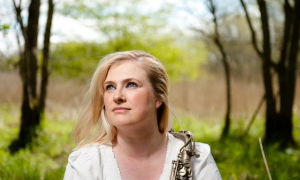
Anat Cohen Quaret with Jason Lindner
Israeli reed player Anat Cohen was more about tone and nuance than the high drama of The Respect Sextet. Her set began with a three-against-four rhythm and a Love Supreme-style intro, leading to bright hard bop. Drummer Daniel Freedman was hot. Cohen's soprano saxophone was buttery but dark, against shimmering piano, with melodic breaks scattered in. Cohen offered a nice, salt-and-peppery solo with a Latin backbeat, turning to klezmer and tarantella. Then Freedman embarked on a tom solo with touches of cymbal as it progressed. Cohen sported "My Favorite Things" stylings, but was smoother and more upbeat and cheerful than Coltrane.

Flamenco introduced the second number with a clarinet deep and liquid, with slight cracks in the upper register. A syrupy ballad tone shifted to one of a Jewish wedding dance, with more Latin on piano to follow. Cohen and her band's mode of recursively exchanging styles, with one coming and then another, all circling back around, was intriguing and rewarding. As this song wound down, more rhythmic juxtapositions cropped up along with some side-slipping on piano from Jason Lindner, with a little salsa, and a Benny Goodman finale, followed by a surprise romantic cadenza coda. There were pop influences, too, most notably Billy Joel; through it all, Cohen demonstrated a knack for accenting the Jewish strains at work in all manner of Western music.
Abdullah Ibrahim's "The Wedding Song" was next, with Cohen switching to tenor saxophone. Throughout, the rhythm section—also including bassist Vicente Archer—was crackerjack and spot-on, interpolating and interpellating, and holding back when appropriate. When the saxophone verged on sappy they brought Cohen back in time, redeeming and transforming her like alchemy.
Brother Avishai Cohen joined on trumpet for the final number, neo-bop shading into a slower pulse and back. Anat is clearly finest on her home turf of clarinet, blending world modes and pop into classic post-swing. Avishai showed shades of Lee Morgan and Freddie Hubbard, one influence rubbing up against and fighting with the other. Nice high notes broke chordal runs as Lindner, on piano, evoked Herbie Hancock, hitting keys hard in minor extensions. Again, Freedman killed.
JD Allen Visionfugitive!, Conducted by Lawrence D. "Butch" Morris
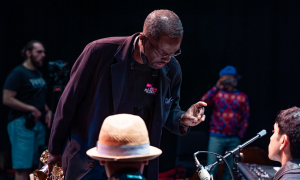
Witnessing Butch Morris conduct is like watching a great abstract expressionist painter at work. Nebulous clouds of sound swirl, with breaks of dissonant lightning, and holy diapasons breaking through like the sky on a night with a full moon. "Avant-Ellington" may be one way of describing the phenomenon, but it is so much more. Sun Ra comes to mind, and the John Coltrane of Ascension (Impulse!, 1965). The whole tradition of the shepherding of large ensembles, going back in time as far as the ear can reach, is at work here. And yet, what Morris does is in itself more advanced and magical and, at the same time, sublimely simple and effortless.
Morris broke the performance early on to offer a primer on his art. Someone in the audience shouted out for him to speak into a microphone. "Listen!" Morris magisterially hissed, to great applause and laughter. The art of conducting involves signals to the musicians—with hand, body and baton—to generate, sustain, repeat and alter motifs, both in tandem and at variance. When broken down like this in a step-by-step way, connections to such genres of modern music as distanced from free jazz as Steve Reich's trance minimalism can be seen, where patterns accrue like those on sand at a beach being shifted by the waves of the tide. As the performance progressed, Morris occasionally continued breaking in with more explanation, but the performance succeeded in remaining all of a piece, in spite of this. It profoundly demonstrated the rapport that freedom and orchestration can have, along with spontaneity and planning, democracy and organization. Tenor saxophonist Allen, with his hard-edged tone bordering the zone between energy and modal music, was the ideal focus material for Morris, who is an artist for the ages.
Jen Shyu & Jade Tongue
Jen Shyu is a kind of post-modern, world-fusion torch singer, elegant and dark in tone. Her set at Kenny's Castaways, backed by alto saxophonist David Binney, bassist John Hebert and drummer Dan Weiss, began with the vocalist singing a haunting Chinese melody a cappella, to which she added moon lute. She blended styles and tone like teas—here a Latin inflection, there hard modern jazz and, in another turn, high art warbling, bordering on opera. One passage involved reading a slave narrative off a beautiful red silk scarf. There was mention of whipping and ripped skin, in hushed, deep tones. It could be argued that this was too disturbing for a gala weekend festival, and Shyu—a sublimely promising artist—may have reaped more audience response with a lighter, warmer approach. That said, whatever approach she took was her prerogative as an artist, and she did, indeed, drive home her dark message like the point of a knife.
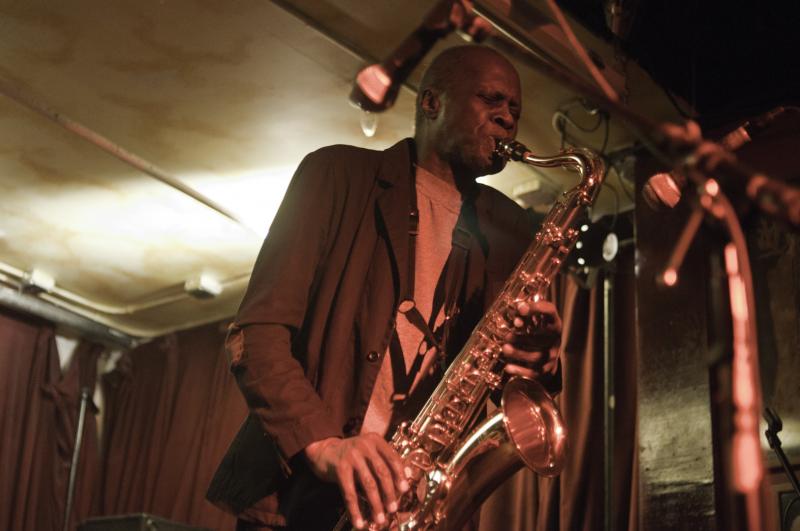
Charles Gayle
Energy, free, avant-garde—call him what you will, tenor saxophonist Charles Gayle is sui generis, in a class of his own. A major player in '60s-style radical music, his playing is nonetheless completely contemporary and completely his own. He sounds like no one else, unless he intends to. Bassist Larry Roland backed him up with rich, unobtrusive harmonies as he slugged it out with drummer Michael T.A. Thompson. There was a fine logic at work in Gayle's playing, for all its rough texture, but that logic was elusive and inscrutable; as soon as it appeared as though there was a handle on the theme he was developing, he hid his hand again, and came up with a whole new set of kings, queens and aces. The last two numbers were clear homage to Albert Ayler and John Coltrane, respectively, but again, in the context of his entirely individual approach to that point, even this was a surprise.
Matana Roberts
Matana Roberts, the striking, beautiful and charismatic saxophonist of Chicago origin, appeared onstage at the Zinc Bar at 11:30. This was the most coveted ticket of the festival, and she delivered an exquisite, entirely solo performance. Like Charles Gayle, the logic of her style defies analysis. Even more than Gayle, it actively rebuffed intellectualization, however heady and carefully considered. Watching her breathe through the bell of her instrument evoked the image of a tulip blooming, a diaphanous organism at one with a cosmically complex universe, but happening in a time of its own, beyond comprehension, perhaps, by virtue solely of its radical simplicity. It was the kind of performance, like the singer in Wallace Stevens' poem "The Idea of Order at Key West," that brought attention not to itself, but rather to its environment and that of the audience's and its own tiny place in it, leaving the crowd only to marvel and breathe deeply in transcendent relaxation.
Roberts concluded with a story about a pair of transcendent musical moments that she had witnessed in the last 24 hours: one was Giuseppi Logan playing alone in Tompkins Square Park; and the other was a milk truck driver playing saxophone during his lunch break in the back of his truck, as that was his only opportunity to practice. It was only natural that Roberts—whose music is so reflective of nature and environment—was so reflective and aware of her own environment, continually drawing attention beyond herself, and away from the ego and into the mystic.
Photo Credit Dave Kaufman
Day 1 | Day 2
Tags
PREVIOUS / NEXT

Become a Sustaining Member

Since 1995, All About Jazz has championed jazz as an art form and supported the musicians who create it. Over three decades, it has grown into one of the world's leading jazz resources, serving hundreds of thousands of readers, musicians, presenters and industry professionals each month.
Help Build the Future of All About Jazz
Your support helps us continue building All About Jazz for the next generation—expanding our editorial coverage, preserving jazz history, developing new community features and creating better ways to discover the music and the people behind it.
Become a sustaining member for as little as $20 per year and you'll immediately enjoy an ad-free experience along with access to subscriber features and future articles for a full year.
Together, we're not simply sustaining All About Jazz—we're building its future. Thank you for being part of the journey.
Near

New York City Concerts