Home » Jazz Articles » JazzLife UK » Autumn Falls
Autumn Falls


Of course, heart-gladdening doesn't happen all the time. There are serious issues to consider, and JazzLife UK has focused on some of the more mysterious and eternal enigmas of jazz during the past few weeks. For instance:
Awards—are there ever enough?
Who would win a Best-Dressed British Jazzer award?
How many jazz reviewers can be insulted in 140 characters or less?
I'll give all of these crucial questions a bit of thought later on, but first—nostalgia.
Nostalgia—it is what it used to be
Nostalgia came to the fore as I found myself wistfully remembering the good old days of analogue recordings: a moment of nostalgia whose genesis lies deep in the unfeasibly long playing times that seem to have become the current fashion for the world's young jazz whiz-kids. Marcel Proust's remembrances might have been triggered by little cakes, but mine are roused by auditory stimuli: the cracks, pops and hisses of a much-loved record. Especially the 78—the recorded music repository of my father's youth.
Aah—the 78rpm disc, how JazzLife UK mourns its passing. Brittle, yes: scratchy too, after a few plays: fragile as well, breaking with ease. But it had one great advantage for the discerning listener—it would only fit three minutes of music on each side. It demanded economy, an ability to get your musical ideas across in no more than 180 seconds. The 45rpm vinyl single maintained this fine tradition. But time, and technology, moved on and brought us the 12-inch, 331/3rd rpm, album. Time moved on in another way, too, as 20 or even 25 valuable minutes could be squeezed on to each side. The progressive rockers leapt at the chance, even as the savvier artistes held back a bit—including John Coltrane, for example, with Giant Steps (Atlantic, 1960) clocking in at 37 minutes and A Love Supreme(Impulse!, 1965) troubling the turntable for a mere 33 minutes.
Then someone invented the CD. At first it was OK: bands still thought in album time. But gradually the chance to put more than 75 minutes of masterpieces on one small plastic disc proved too much. Why think about judiciously editing your output for the listener's pleasure when you can just throw everything onto the CD and trust to the likelihood that 99.9% of listeners never get past the first five tracks? Frankly, too much of a good thing is a bad thing.
At the beginning of 2010 it seemed that every jazz CD I heard was crammed full—editing appeared to be a dying art. But in recent months some form of temporal sanity seems to be re-emerging, with a growing number of British jazz recordings coming in at less than 60 minutes. Suddenly, I am once again listening to entire albums in a single session: I can enjoy every tune, my mind wanders far less, I don't grumble nearly so much about over-long improvised percussion and piccolo duets. And, joy of joys, the deadly Hidden Track concept seems to have disappeared. All that remains is for someone to sort out the woeful state of far too much of UK jazz' CD packaging, then JazzLife UK would be a happy-ish man.
Live On Stage

In the wonderful world of live jazz it's been a time of musical contrasts for JazzLife UK: and a time of celebrations, too. The Jonathan Wyatt Big Band (pictured above) and Polar Bear provided the contrast: 40s big band swing versus twenty-first century small band honk and squawk. The Jonathan Wyatt Big Band is a Norfolk-based ensemble with a real feel for the swing and dance band era. Its performance at a Battle of Britain commemorative day in Norwich Assembly Rooms was given added authenticity by guest vocalist John Miller, nephew of the iconic Glenn Miller. The hall was full and the band, led by trombonist Wyatt, went down a storm—its tight, swinging and enthusiastic performance was a joy and would give many professional bands a run for their money.
 Polar Bear, whose music is so hard to categorize that it's been put in more categories than you can shake a stick at, proved once again to be one of Britain's finest live bands (I've deliberately left the term "jazz" out of that description). Leafcutter John still plays a mean balloon, drummer Seb Rochford still looks like he's doing nothing while he's creating some of the finest percussion patterns on the planet. They attract the crowds, too: all ages, both sexes, and looking far more cheerful than the average crowd of jazz fans despite having to stand up for the entire evening. Not much dancing in evidence, though.
 Celebrations arrived in the form of a birthday and a Birthday Honour. The Orient House Ensemble celebrated its tenth year of existence, opening its Anniversary Tour at Norwich Arts Centre. Reed player and occasional accordionist Gilad Atzmon (pictured right) leads the Ensemble: he's a charismatic front man and the band is a musical powerhouse capable of some of the loveliest, and some of the hardest-hitting, sounds around.
Pianist and composer Michael Garrick received the Birthday Honour, becoming a Member of the Order of the British Empire (MBE) in the Queen's Birthday Honours List for 2010. Garrick and vocalist Nette Robinson played a beautiful set in Lowestoft's Milestones Jazz Club: a fine example of jazz crossing the generations. He received his MBE formally at Buckingham Palace on 20 October.
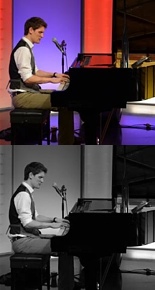
Garrick (pictured below) also published his autobiography, Dusk Fire (Springdale Publishing), this year. The book is an enjoyable insight into the life of a man who has spent over 50 years on the UK jazz scene, gaining critical plaudits and the respect of musicians, composers and writers but finding, like so many other jazz greats, that the financial rewards never quite matched his status. For many years Garrick's favorite mode of transport was the quintessentially English Reliant Robin, a three-wheeled motor vehicle: bassist Jaco Pastorius and singer Adelaide Hall both enjoyed their trips around the English countryside in this iconic car, according to Garrick. My own memories of careering around the Oxfordshire countryside in such a vehicle make me doubt this claim, though.
Awards: can there ever be enough?
I was reminded, in October, that the excellent alto saxophonist Benjamin Herman was awarded the title of Best Dressed Dutchman 2008 by Esquire magazine. That prestigious award, and Garrick's richly-deserved MBE, caused me to reflect on the British jazz scene's apparent lack of awards in contrast to many other countries. To be honest, Herman's award made me reflect at first on the distinct lack of sartorial elegance within the British jazz community. With a few, a very few, notable exceptions JazzLife UK rarely sees jazz musicians with more than a passing involvement with the tailor's art, though it pains me to say so.
 However, as I am acutely aware that my own appearance seldom triggers the description "sartorially elegant" it's probably best to return to the thorny subject of awards. We Brits, self-effacing sorts that we are, tend to eschew the concept of the award once we reach adulthood: with the exception of real awards such as Knighthoods, of course. The British jazz scene appears to be eschewing awards to such an extent that it is actually reducing their number. In the recent past there were three major awards open exclusively to the jazz community: the BBC Jazz Awards, the Parliamentary Jazz Awards and the optimistically-titled British Jazz Awards.
 The BBC ended its awards in 2009, for reasons which remain unclear, while the British Jazz Awards (which are organized by a small Midlands record label and tend to favor mainstream artists) show no sign of activity so far this year. Which leaves the Parliamentary Jazz Awards to fly the flag for the British jazz community. Yes, there are other awards that have a jazz category—the MOBOs are the highest profile of those, with Empirical winning the jazz MOBO for 2010—and the Mercury Music Prize always seems to include a jazz album in its 12-CD shortlist, but no other major awards are exclusively devoted to jazz. Is this a Bad Thing?
I'm not sure. Some countries seem to have so many awards for jazz musicians that every player has at least one. Give away too many awards and the result is a neutralization of their impact. There's also the argument that awards seldom go to the true innovators, the genuinely original, just to those who conform to the award giver's often limited concept of originality or innovation—and just how does one define "Best"? None of my nominations for the 2010 Parliamentary Jazz Awards even made it to the shortlists: how could the judges have got it so wrong? The greatest song ever written, of course, is Captain Beefheart's "My Head Is My Only House Unless It Rains" (Clear Spot, Reprise, 1972): award-less, as far as I'm aware.
Damn Those Pesky Social Networking Kids
So, how many jazz reviewers can be insulted in 140 characters or less? Who knows what the possibilities are, but three is certainly an achievable number as I discovered during an idle exploration through Twitter. That's the number of AAJ reviewers given a stern rebuke in a single Tweet by one well-known musician; who I will refer to as Number Six in keeping with the nostalgic air of the first part of this article. Apparently all three reviewers made the same fundamental error in describing a tune on Number Six's most recent CD. However, rather than pointing this error out to me—for I am one of the Unhearing Three—in an email or, more usefully, via the "Discuss" button on AAJ, the musician decided instead to moan in a Tweet.
I stand by my comment—which was an observation, not a criticism. I can't speak for my fellow reviewers because, contrary to the Tweet's implication of a conspiracy, I have never met them. My old communication skills lecturer always used to say that if your message confused one recipient, then shame on them: if it confused three, then shame on you. Or was that George W Bush?
More later, perhaps.
Christmas Is Coming
The New Year will soon follow and, of course, the annual ritual of the Best Albums Of The Year is as inevitable as Santa's sleigh. Obviously, JazzLife UK will be producing the definitive declaration of 2010's best British jazz albums (despite my earlier comments about awards) and to that end I am devoting many hours to drafting my Top Ten. I think it's been a great year for British jazz—my current slightly longer than ten album shortlist includes works by an Irish singer, a saxophonist from Israel, a Slovakian-born guitarist, a Canadian trumpeter, an Australian vocalist. They're all part of the Great British jazz scene.
So, as JazzLife UK prepares to go into "Bah, Humbug" mode for the holiday season I wish everyone a Merry Christmas and a Happy New Year. And, most certainly, more great jazz in 2011.
Photo Credits
All photos: Bruce Lindsay
< Previous
No Ordinary Day
Comments
Tags
JazzLife UK
Bruce Lindsay
United Kingdom
John Coltrane
Polar Bear
Glenn Miller
Gilad Atzmon
Michael Garrick
Nette Robinson
Jaco Pastorius
Adelaide Hall
Empirical
For the Love of Jazz
 All About Jazz has been a pillar of jazz since 1995, championing it as an art form and, more importantly, supporting the musicians who create it. Our enduring commitment has made "AAJ" one of the most culturally important websites of its kind, read by hundreds of thousands of fans, musicians and industry figures every month.
You Can Help
To expand our coverage even further and develop new means to foster jazz discovery and connectivity we need your help. You can become a sustaining member for a modest $20 and in return, we'll immediately hide those pesky ads plus provide access to future articles for a full year. This winning combination will vastly improve your AAJ experience and allow us to vigorously build on the pioneering work we first started in 1995. So enjoy an ad-free AAJ experience and help us remain a positive beacon for jazz by making a donation today.

Giveaway

Eligible winners: 15
Days remaining: 14
Days remaining: 14