Home » Jazz Articles » Interview » Josh Roseman: Reimagining the Constellations
Josh Roseman: Reimagining the Constellations
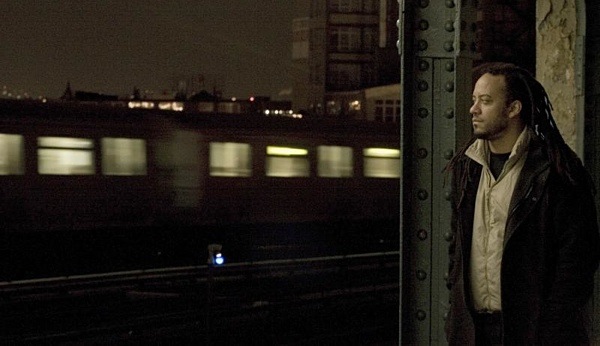

There's nothing in my life that's more grounding or more challenging than trying to play trombone. It demands a lot from me personally. It's a constant gut check. It forces you to be in touch with your priorities. And to check out your conduct.
Trombonist/composer/arranger/cosmic thinker Roseman also has a production studio and venue space in Brooklyn. He heads five bands that play different kinds of music, two of which will have new recordings out over the next several months. Then there are sideman gigs with various colleagues.
"A pathological condition. Or the reflection of a pathological condition," quips Roseman, a blithe spirit, about all the irons he has in the fire. "I'm not sure which."
Roseman, raised in the Boston area but a New York city resident since 1990, is a forward thinker, for sure. Conversation reveals with all his talent and drive, he doesn't take himself too seriously. That does not mean—at all—that he is unconcerned. And with all his stretching of boundaries and willingness to rely on intuition and let things fly freely in his music, he does not ignore traditions on which jazz music is based. He has the utmost respect for the paths that have been beaten by the feet of those who came before him.
But Roseman is, surely, a musician for his era, where he is making a strong mark. A snippet of some of the observations penned about him by critics include: "powerful and eccentric ... intelligent groove music ... musical provocateur ... blur between childlike innocence and libertine dementia." They are all accurate. His music contains many influences, like ska and dub, as much as it carries the spirit of the beboppers. He also likes electronics and the musical alchemist finds ways to make them all at once interesting, upsetting, unpredictable, contrary and yet viable in his musical mixture. Listen to albums like New Constellations: Live in Vienna (Scrootable Labs/Accurate, 2007) and Treats for the Nightwalker (Enja, 2003) and all these funky influences can be heard. Yet he also wails straight ahead with the Dave Holland Big Band and, at one time, the SFJAZZ Collective.
"I like the free approach. I like things to be strong, even if they're quiet. Even if it's just a question of leaving a lot of space, I would like the space to be effective and to present a set of options for the listener somehow," says Roseman. "None of this is based on chaos for its own sake. I just tend to find that I like situations that have a lot of contour and detail and that have a lot of intent to them. I either have to write them or set up conditions where they might come around. The purpose of doing that is not just to have something that sounds different from what you hear on the radio, or that sounds unruly. I'm after something that has a meta kind of content to it, where people feel free to show how different dynamics, different colors, different approaches, different forms of expression, are interrelated. I like this because it's my instinct to look for ways to integrate experiences and my influences, and my attention span really starts to wane if we're just focusing on one element at a time."
 Like great artists, Roseman doesn't just draw on musical things for his music. "We live in New York City. People have to deal with each other. Situations are happening all the time. You're in a beautiful neighborhood, but maybe it's not safe. You're in a crazy neighborhood, but people are incredibly real with you. Or you're on a train going from one neighborhood to another really quickly. Or you're listening to new music, but it's music samples from a long time ago. Or you're listening to popular music, but there's a level of dissonance going on in the back, but it's somehow still compelling. Try to deconstruct that, figuring out how these things can be happening simultaneously. How it challenges our expectations. That's how I get very interested somehow. That's what I'm looking for in a musical situation."
The New Constellations album, recorded at Joe Zawinul's Birdland, and then touched up with some remixing in the studio, is a good example of Roseman's musical nature. With equally experimental cohorts like Peter Apfelbaum and Barney McAll, the music is at times, dense, free, melodic and scattered. But it hangs together. "Salta Massaganna" springs from reggae and is an irresistible vehicle over which Roseman's great trombone sound dances. His notes pour like syrup over delicious pancakes. It evokes a feeling. "Olsen Twins Subpoena" has a lot of subtext, from funk to cosmic. The horns of Roseman, Apfelbaum and Ambrose Akinmusire blare out jazz improv, but across a different canvass.
That band has not been playing out live much over the last year or so, but Roseman hopes to bring it back again. "The New Constellations record was an examination of roots, early ska music. Trying to find ways to combine that with more modern performance-type ...dealing with electronic music. Different ways of thinking about time and space," he says. "It's kind of ironic as I think about it because those improvising musicians back in Jamaica at that time had a very open approach to time and space. You can hear the lineage. You can hear how that music evolved into dub music. The premise of it was to combine a really intuitive lightweight, lean, mean hard-hitting rhythm concept, with painting with a broad palette, using electronics, and to combine it with a really cool front line. Three horns. Use some sort of post-post-post The Jazz Messengers [chuckles] taking everything we know about three- horn writing and combine it with underpinnings of ska and electronic music and more progress, forward-leaning things. Shake it up and see what comes out."
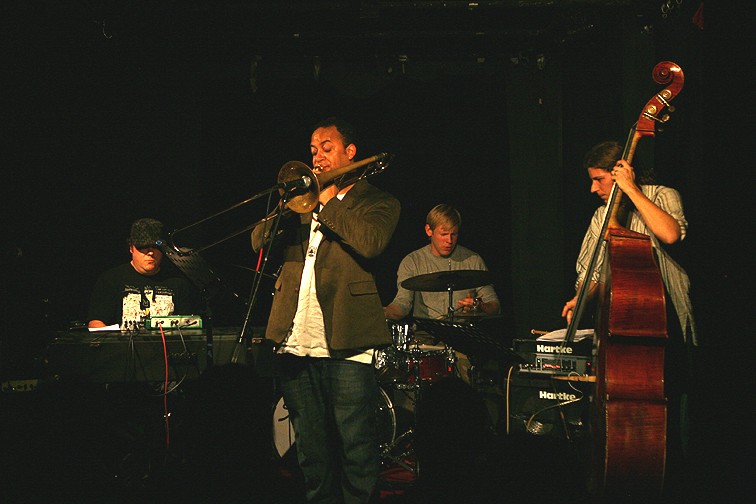 The James Carney Group, at The Knitting Factory, 2008 From left: James Carney, Josh Roseman, Ted Poor, Noah Jarrett
He's already eyeing what will happen when the group gets to reconvene. "A big suite which combines new music, added extensive harmonic writing for horns, with dance hall reggae rhythms that are super minimalist and funky. Nasty. Very mean sounding music. So you have this really grounded ... super forward, tough-sounding stuff going on in the basement. And then something very expansive going on, on the top. With normal dance hall music, you have great incidences of poly-tonality going on. The groove will be going on in one key and somebody will be chatting on top, and that will be going on in different harmonic zones. Very minimalist. It's compelling and it convinces people to think and walk and shift their head space in a different direction. If you were to push that in a different direction, to the next level, where you're starting from a purposely poly-tonal point of view, then imagine what the possibilities are."
Imaging the possibilities is a big part of Roseman's approach. "I'm disciplining myself with the next step," he notes. "Kind of keep some kind of a lean street sensibility to it. Taking my lessons from people like Madlib, and all this really intense and engaging underground hip-hop stuff that's going on now. And also to put it together and present it in a way that we have a lot of options, with the technology. I've been bringing electronic drums to gigs and a lot of analog sense and flexible, fluid ways of triggering and doing live sequencing and things like that. That stuff can be a handful. It's very rewarding though."
Roseman's current recording project is with a larger unit he calls the King Froopy Allstars. It has two other trombones—Jacob Garchik and Curtis Hasselbring—and three trumpets among the 11 pieces. It gives Roseman more and different things to pour into his creative funnel to see what comes running out. He admits it's a bit crazy to pursue the larger project in these economic times. But he presses on nonetheless to find new soundscapes.
 "It's a question of trying to team up with people, elements, situations, sounds, strategies that are really popping off, and to combine them and create shapes that geometrically are greater than the sum of their parts," says Roseman. "So it's a risky big band by design. The writing is risky. There are things harmonically, rhythmically, dynamically and strategically that are not meant to be easily resolved. It's more like presenting raw materials to the ensemble and giving the ensemble an opportunity to chip away at it and work it out. As opposed to coming up with a prefab, play-by- numbers situation that is going to leave a good impression.
"Then other tunes are very intricate and challenging to execute," he notes. "There are people (in the band) who are all-out secure musicians and other people who are amazing live wires. I have the opportunity to set them loose. Like free-range bulls in a china shop and figure out what they can wreck. Do the calculations and play with the math afterward. That's kind of the way it's designed." He likes the music to be pushed, get a visceral reaction from the listener and give people "different ways of thinking about things."
 He adds, "The arrangements that I write have been for an 11-piece band. At times we also do presentations and I'll take on somebody like Peter Apfelbaum. I'll employ him as an x-factor. He has the advantage of having cultivated some familiarity with the book from a number of different positions. He knows keyboard stuff, he's played with the big band on drums and also on saxophone. So he has a good understanding of the lay of the land. I hapen to appreciate the way the guy reacts. I know how he's developed his sense of license, so sometimes, to award him for having done quadruple duty and learning all this music, I'll just drop him in the middle of the group, take away his music stand and, figuratively speaking, put a blindfold on him and set him loose. In that case, it's a 12-piece."
The album is still being worked on. It could be out before the year's end, or in early 2011. It's yet untitled.
"We're still chipping away at it," he says in September. "We might actually do another session, because a couple of the pieces that I wrote are unreasonably, wonderfully, unmanageably dense. There's so much voodoo in them, we should take another crack at them. In another couple of cases, we weren't able to get to them, because we were getting the bread and butter done. It's a strategic question. I'm taking a closer look at that." While not finalized, there's enough for the composer to avow "it's pretty exciting stuff. It definitely puts a smile on my face. I just shake my head when I'm listening to it."
The King Froopy Allstars haven't played out much, but that's going to change. There may be concerts at the Brooklyn studio, as well as 2011 bookings in Australia and on the U.S. west coast. "We're looking for opportunities to play in New York as well, outside of our little laboratory environment."
His "little laboratory environment" is 58 North 6, where Roseman and staff are busy producing, putting on live shows and helping artists bring their projects to life.
"It's a studio, audio/visual lab, we call it. It's built upon a community model. Right now we're functioning as a semi-commercial recording studio," he explains. "We track video as well. We're preparing to move toward an open production model. I think there's a massive untapped wealth out there, as far as people's desire to support what's going on. We need to spend more energy developing tools that allow people to interact with projects they feel strongly about. As we get that rolling, the space will be functioning as a venue, a production space, and kind of a zone where projects will be able to be produced from soup to nuts and also funded. We've been chipping away at that for some time. It's been a pretty amazing learning project, for sure.
"In my day-to-day, I'm balancing doing intensive composition work, doing traditional trombone practice and coordinating outside sessions that are coming in, and finishing sessions that we've done here. It's a part man, part octopus gig. Right in the heart of Williamsburg [a Brooklyn neighborhood]. It's nice to be able to provide a resource to people who are doing work we care about it. That's the whole point behind it. We're looking forward to the point where we're able to do it more flexibly."
Roseman has been busy since his days playing with various kinds of bands in the Boston area. He attended the Berklee School of Music while still in high school and later attended the New England Conservatory of Music on scholarship. In the late 1980s, he began a long association with Oliver Lake, and through that had associations with the likes of Greg Osby, Frank Lacy, Marty Ehrlich, Michele Rosewoman and others.
He moved to New York in 1990, where his reputation got around and he started working with clarinetist Don Byron, as well as Joey Baron, Uri Caine and Dave Douglas. His attractive trombone sound, as well as his chops, got him involved in bands of fellow trombonists Roswell Rudd and Steve Turre. Robin Eubanks got him the gig with Dave Holland's big band. But Roseman still found time to get his own music going with other creative musicians, incorporating many styles of music. The Groove Collective in the 1990s, for example, used DJs and rappers.
In the latter '90s, he did projects with John Medeski, Ben Monder and Lester Bowie, among others. The Josh Roseman Unit (JRU) was one of those groups, and it is still alive today. One of those irons in the fire.
"That started as another compositionally expansive project, which I love doing. The problem is, it starts to become barely manageable," he says, chuckling. "I don't want it to become one of these projects where everybody shows up with reams and reams of music and it's a struggle to figure out how to get things controlled enough on stage so that it works." Roseman describes that work "defining lines and pushing the ensemble over them, dynamically, in terms of what's going on with harmony and tonality. In terms of what's going on with genre dynamics, juxtaposing different elements. And I'm looking for the most lightweight, easy, friendly, abbreviated way to deal with it. To have the advantage of playing with expert, intuitive musicians. Colleagues. Likeminded people.
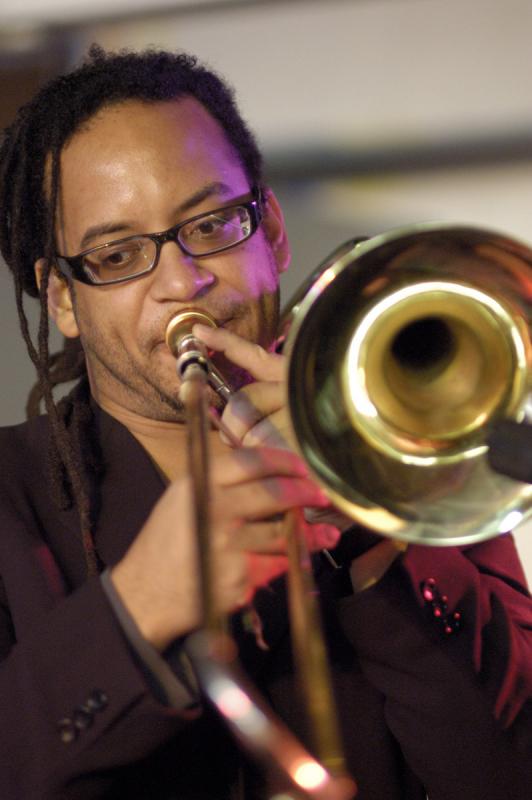 "I've had an ongoing exercise where I'm challenging myself to come up core pieces very quickly. The challenge is to do it quickly. Write it once. No revisions. And have it be totally useful. And just spit the stuff out and don't think about it afterward. That's not my normal work flow. Usually I build pieces and layers until there are tons of detail and texture and contour to it. This has been wonderful though, it's kind of an antidote."
JRU is staring to get more gigs around New York City. Meanwhile, another venture—Water Surgeons—with three trombones and keyboards (though the trombonists play other things like bass, accordion and guitar), is also active, playing around Brooklyn. That group, with Roseman, Hasselbring, Garchik and McAll, will have a recording out next year.
"We're in the middle of a second round of creative work to the session, combining, distilling ... juxtaposing elements," Roseman explains. "We're pickling it. We recorded it and now we're stuffed it into a mason jar and buried it in the backyard a little while. We're letting it interact with the different types of mold that are on it. That was an incredibly rich project to work on, because it combines three-trombone, trombone choir writing on it. There's something very special that happens when you get a bunch of trombones in the same space. When you play harmonies together with these instruments, the overtones do very unpredictable things because of the register and the harmonic richness of the instrument. You get wolf tones. You get notes you didn't actually play just sort of appearing. They're like UFOs. Unidentified sonic objects. Wonderful nonlinearities. It's quite unique. It's great stuff to write for and to perform."
He adds, "We're combining the trombone choir concept with the makings of a rock band, because we all double. I'm playing bass. Hasselbring, guitar and trombone. Garchik plays keyboards and accordion and trombone. Barney McAll is the lone non- trombonist in the group. He's playing piano, electronics and samples. I also have an extensive electronic setup as well. Triggering sequences, analog sense and analog drums and things of that nature. All this stuff is baked into the compositions. It's specified that we're switching from one type of a lineup to another. To be able to do that live is amazing. To be able to do that live in a studio with an audience, which is the way we recorded it, was really cool."
He says the inspiration the band came from a Roswell Rudd group he played with some years back at New York City's Knitting Factory. "The range of context that (Rudd) hooked up for himself was incredibly inspiring. He went from Ellingtonia to a Herbie Nichols-kind of situation to more Caribbean music to church music. This in one concert, mind you, and he was switching background groups. To cap the experience off he had Sonic Youth come up and he fronted Sonic Youth for the duration of a 15-minute extended freak-out piece. It was absolutely mind-blowing. He's a guy who is constantly inspiring me."
 Yet another project is a group called Stool Softeners, which features drummer David Treut, vocalist Areni Agbabian and guitarist Jonathan Goldberger, as well as a bassist, which varies but, at times, is Roseman. "That's a real no-holds-barred, super open context," he says. "The idea is that we're trying to deal with things that aren't really hearable but to do it in an extremely powerful way. Everybody in that group is very intuitive. But it's exemplified by this one approach I'm working on, on bass, where I have everything that's discernable totally removed from the bass. So it's a gut experience. You're not going to perceive anything that's going on above your ribcage, but you can't deny that it's happening either.
"Areni has an approach to vocals and melody that's really wonderful because she's a very intuitive musician. She tends to hear melodies and is able to react to situations even if it's just based upon the intent of the context. She doesn't actually need to hear anything to react to it. We're all kind of dancing with each other. The core to the music isn't obvious to the listener, but the actions—what's left—has been really engaging and really fun. Everybody in that group is very independently minded. I have to give very minimal direction. The fun thing about it is setting up conditions and contexts, no matter how unreasonable, and observing how the reactions unfold."
All these genre-stretching approaches are part of the creative makeup of Roseman, but he still enjoys playing straight-ahead jazz when called upon to do so. "I love playing the blues. I love to study harmony and apply myself to it. Practice Bach. Studying piano and all this stuff. But, there's a way where applying oneself to different 'schools,' let's say, is a really helpful way to flesh out your voice. It's like traveling. Wherever you go, there you are. You're in a totally different zone and people are generous with you and you don't know why. It's up to you to fashion a response. Then when you come back home, you've gone through an evolution somehow. So studying Fred Wesley is good for my free playing. Working with Slide Hampton is good for music that I play in funk bands. Working with someone like Roswell, or listening to George Lewis or listening to Julian Priester with Dave Holland, or having the opportunity to work with Ray Anderson and Craig Harris. Being stretched that way. Checking out people who've made it a priority to establish an independent identity that way leaves you with a sense of fearlessness and responsibility."
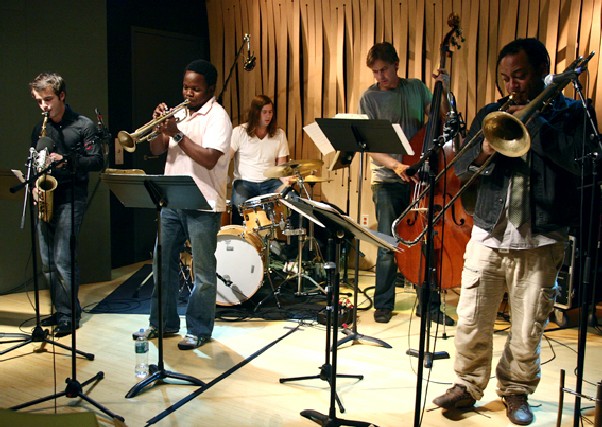 Josh Roseman (far right), with The Execution Quintet
Form isn't as important as the spirit behind it.
"I think there's been an evolution," Roseman says thoughtfully. "But I listen to Sonny Rollins every day. My favorite musicians, when you reach a certain level of mastery, you're dealing with uncapsizable players anyway. It's kind of like calling Charlie Parker a bebopper. He's not a bebopper—he's Charlie Parker. You listen to his music and you're turning on a fire hose. Anything that's dealing with genre and genre titles is secondary, or a reaction to what he did. Sonny Rollins is a national treasure. Somehow he's also radically underrated, because he transcends everything."
He brings the matter to a head when he opines, "The real significance of this music doesn't have anything to do with classifications. It's all about intent. It's all about spirit. It's all about heart. It's all about the spirit of fearless generosity."
And it starts back in the beginning, with Louis Armstrong. "That's the spiritual father of this music. That guy, in addition to being virtuosic and tireless and having unbelievable stamina, there's a spiritual presence in the music that is jaw- dropping, mind blowing," he says. "It'll change your viewpoint about stuff. You can find traces of this emotional DNA, this light, in every stage and era of the music. You can certainly hear it in Sonny Rollins' playing. You can hear it in Sun Ra. In John Coltrane. You hear it in Miles Davis. For me, you hear it in Roswell very brightly."
When it comes to definitions of jazz or swing, this young musician has his a personal perspective that guides him. "When you talk about swing as being one of the main components in the music you start to get into very interesting terrain where there's a little of the definition that has to do with metric rhythmic content. Then you get into a more esoteric way of looking at it: What is the effect of swing? Swing makes everybody feel great. Swing puts everybody at ease. Swing is something that makes not just the music work, but it makes situations work. It makes situations come together. If you were listening to Duke Ellington at the Cotton Club and those guys on that bandstand had been traveling together for years, and they know each other and they're playing all these inside jokes. They're supporting each other. They're doing all this stuff. It's swinging on an incredibly high level. But it just feels good to be in the room. That's the point. It feels good being in the room and there's something intense going on.
 "The process of following the music, tracking it across different contexts, conditions, lineups ... It becomes a way of strengthening the connection. Because all that's left is your intent to make it work and work well and feel like something and to communicate something. I don't think about (his own music) as being 'free' at all. It's another way of stripping things down until just the intent remains. It's a way of honoring that. I guess that's a better way of putting it.
As a working, creative musician, as well as one who, as producer and studio proprietor, is aiding and abetting the creative efforts of others, Roseman has to be driven. And he is. Rising out of the music, and the process of creating it and getting it out to the public, is something more, he says.
"I feel accountable to my community, my environment,." he says, pausing to select his phrases. "I've received so much, not just from the masters, but people who are younger than me. Students. The exchange that's going on in this town, nationally across the states ... Things you pick up and the way you see people investing in trying to create something, that's what drives me. There are so many examples of it. Before I moved to New York, there were artists, forms of music, that gave me a sense that things made sense. Ornette Coleman (Coleman) or Coltrane. Sun Ra. Sonny Rollins, for sure. The sense that these people are able to present solutions. Illustrated in the music with such clarity. And they're also able to articulate the human condition in such vivid, precise terms. I always got the sense that you're not alone, dealing with whatever stuff you're dealing with, trying to balance, or trying to contend with."

When he moved to New York, he also encountered a community of enthusiastic musicians who wanted to support one another. "It transcended generational boundaries or anything like that. It was a cross generational deal. To move to a place like this and work with people who have been doing it for many years and had an established body of work in other cities. People like Lester Bowie and Oliver Lake. People on the straight-ahead side as well. You could come here and learn from people who had seen everything and got all this information from the horse's mouth. That's a big charge to walk around with. I feel like I have this bond to do whatever I can do in my meager capacity to pass it on."
That communal spirit is a common thread for this engaging musician. In talking about influences or relationships that may have helped shape his thing, Roseman is selfless. His view is different. He mentions pleasure derived from watching colleagues blossom rather than pinpointing how so-and-so helped him personally grow. Even when those positive influences, in fact, would occur.
"The beautiful thing," he says in earnest, "has been to watch people find themselves. Put it together ... put out some conclusion in terms of what to do with what they've built. Living in this town for a while, it's inspiring seeing that happen. It's happened time and time again. Touring early on, opposite Joshua Redman, for example, when he first came out. Watching somebody like him find himself in the midst of his career, musically. Figuring out how he wants to articulate his persona. Or Don Byron. I had the opportunity to work with him early on in his career. Watching him do the same. It was very impressive watching Kurt Rosenwinkel go through his thing . I've had the opportunity to be close to that much harmonic information. Dynamic information. That level of intent in music, regularly, is a lot."
 Roseman has also been influenced by the people he is still cavorting with, musically, like Apfelbaum. "I've been studying and working with Peter Apfelbaum on many different levels for years. Applying myself to his music and putting together situations where we're both reacting in a very intuitive fashion. He's been good enough to work on my music as well and that's been really expansive. My close friend [Australian pianist] Barney McAll is an astounding strategist and musician. It's nice being onstage with somebody and you have no idea what they'll come up with at any given moment, but you know it's going to be really expansive. This is a guy who fashions his own instruments and plays amazing jazz piano. Can sequence things really well. He ends up sounding like a DJ with bebop chops; a DJ with a highly developed chromatic awareness and a lot of technique."
Holland's award-winning big band is also an experience Roseman treasures.
"His band is unbelievable. I've been playing in Dave's big band for around 10 years or so. It's run like a family. There's such a tremendous vibe in the group. That's been an inspiration all around. It's also been a great learning experience because he's been something between an antennae and a lightening rod throughout his whole career. He writes and plays at such an astonishingly high level. But as a bassist and a bandleader and participant on the scene he's been a catalyst for many different movements and kinds of expression for people. For me, as a musician, that's your post-finishing school. And it's the best thing in the world because you're forced to evolve. You're forced to expand because it's real. There's nothing academic about it. You're shaping this music dynamically with colleagues you respect and it's happening in real time. It might be a night by night experience, but every night you have one shot at it. Longstanding working bands, those are very special situations.
Through all these experiences, throughout all these projects, at the core is still playing that elongated fabrication of brass through which comes forced air, resulting in a rich texture of sound, put forth with daredevil dexterity as well as soul.

"Out of all the things I'm doing," says Roseman, "there's nothing in my life that's more grounding or more challenging than trying to play trombone. It's demanding on this very squirrelly, hard-to-get-to combination of levels. It demands a lot from me personally. It's a constant gut check. It forces you to be in touch with your priorities. And to check out your conduct. The value of that is you find yourself in a position with antiquated machinery in your hands and surrounded by people. You have this sense that comes from somewhere beyond your waking thoughts that you have something to express, something to offer, something to contribute, to help shape the moment. It might be something you do. Or it might be something you allow to happen. Or it might have to do with the way you're interacting with colleagues. The sense that you're becoming a catalyst for something large and useful to occur and dealing with others who are well aware of what's going on. That's very rare. That's worth doing while we're down here."
His fondness for the instrument is obvious. "The trombone is interesting because it's such a basic device. Like a violin. That you have to build your sound from scratch. When you hear somebody playing, who's really dealing with the trombone, you're hearing something that's very personal. And I love that about it. That's why with trombone players you hear a lot of individuality.
"Typically in jazz, guys will come from a number of different strains. There will be people who have really gone through the discipline of arriving at a full-focused post-J.J. (Johnson) precision. These guys have great sound and they studied the art of articulation and rhythmic placement. Figuring out how to blend and place their sound so that they're enhancing the environment. Then there are guys who come from more of a wide open, swaggering, swing-era school. They might not just be swing players, but they've inherited more from pre-bop schools. More New Orleans style of playing. That's awesome stuff too. That's baked into the identity of the instrument and super important. There's stuff in there only trombone can do.
 "The guys who I tend to like are guys who synthesize those two primary avenues. There are others. Barry Rogers, for example, and what he was able to establish. The Latin music or the more Caribbean style. Somebody like Don Drummond. Guys like that tend to be exceptions. They may have synthesized a lot from these main influences, but they've come up with conclusions that are very individual. The truth is there are a lot of people like that who you can't really classify. They include Frank Lacy, who swings really hard but plays wide open and is totally extroverted and has massive psychological resonance to what he's doing. A brilliant player. Julian Priester, who is coming up out of J.J., but has always been his own man. There's a rich meta consciousness to his playing. He's a Zen master. He's like the sphinx of trombone. George Lewis. He's so virtuosic. It's almost like he's playing a polyphonic instrument. He's come up with his own answers. Or he's figured out a different set of questions that he wants to address. Gary Valente, who's taken Buster Copper's sound, Phil Harris' thing, even Grachan Moncur's thing, and pushed it to an extreme and done it in an absolutely complete, perfectly conceived way. Nobody told him to do that. He figured it out.
"Roswell. He's inherited so much of the spiritual consciousness of the music and what it means to play trombone. He's unbelievably underrated. Curtis Fuller is a rock star. Also totally underrated. People listen predominantly to his music from the late 50s. But if you were to hear him on the bandstand in modern times, this guy is a very powerful musician and plays very exquisitely. Robin Eubanks is like a mentor to me. He's somebody who also came up with his own way of approaching the instrument. He's somebody I continue to look up to. He's always expanding."
Among younger players, he mentions Hasselbring and Garchik, as well as Rick Parker and Ryan Snow among players he enjoys. "I can't even to begin to list all the young players there are so many. There are dudes in Europe who are doing super fun stuff. Guys like Nils Landgren. He's really cool. Not just in terms of his playing. He writes well. He puts together interesting ensembles and he finds interesting ways to make them work. He positions his instrument in a compelling way. That's kind of what I look for."
"There's so many of them. It's an amazing era for the instrument. It's very encouraging. It's not just good for the instrument, it's good for the music. It's good for people to see an instrument that is getting an overhaul in terms of the way it's presented, in real time, in front of people's eyes. I think that's always exciting. With that in mind, I created a trombonists' support network called the New York Slideworkers Union, or NYSWU. We're doing performances. Recording ensembles by trombonists. (nysu.org). I'm about to incorporate it as a non-profit and we're going to start releasing some of the stuff commercially."
Another iron to place in the fire.
Selected Discography
Josh Roseman, New Constellations: Live in Vienna (Scrootable Labs/Accurate, 2007) Meshell Ndegeocello, The Spirit Music Jamia: Dance of the Infidel (Shanachie, 2008) Dave Holland Big Band, Overtime, (Sunnyside, 2005) SF Jazz Collective, SF Jazz Collective (Nonesuch, 2005) Peter Apfelbaum, It Is Written (ACT, 2005) Josh Roseman Unit, Treats for the Nightwalker (Enja, 2003) Oliver Lake Big Band, Cloth (Passin' Thru, 2003) Josh Roseman Unit, Cherry (Knitting Factory, 2002) Sheryl Crow, Sheryl Crow (A&M, 1996) Dave Douglas, In Our Lifetime (New World Records, 1994)
Photo credits
Page 2: Greg Aiello, for Searchandrestore.com
Page 3: David Bias
Page 4: Klaus Muempfer
Page 7: Stanowi Własność
All Other Photos: Courtesy of Josh Roseman
< Previous
Organic
Next >
Omega is the Alpha
Comments

Tags
Josh Roseman
Interview
R.J. DeLuke
United States
Dave Holland
SF Jazz Collective
Joe Zawinul
Peter Apfelbaum
Barney McAll
ambrose akinmusire
Jazz Messengers
Jacob Garchik
Curtis Hasselbring
Oliver Lake
Greg Osby
Frank Lacy
Marty Ehrlich
Michele Rosewoman
Don Byron
Joey Baron
Uri Caine
Dave Douglas
Roswell Rudd
Steve Turre
Robin Eubanks
John Medeski
Ben Monder
Lester Bowie
Herbie Nichols
Jonathan Goldberger
Fred Wesley
Slide Hampton
George Lewis
Julian Priester
Ray Anderson
Craig Harris
Sonny Rollins
Charlie Parker
Louis Armstrong
Sun Ra
John Coltrane
Miles
duke ellington
Ornette
Josh Redman
Kurt Rosenwinkel
Barry Rogers
Curtis Fuller
Rick Parker
Ryan Snow
Nils Landgren
For the Love of Jazz
 All About Jazz has been a pillar of jazz since 1995, championing it as an art form and, more importantly, supporting the musicians who create it. Our enduring commitment has made "AAJ" one of the most culturally important websites of its kind, read by hundreds of thousands of fans, musicians and industry figures every month.
You Can Help
To expand our coverage even further and develop new means to foster jazz discovery and connectivity we need your help. You can become a sustaining member for a modest $20 and in return, we'll immediately hide those pesky ads plus provide access to future articles for a full year. This winning combination will vastly improve your AAJ experience and allow us to vigorously build on the pioneering work we first started in 1995. So enjoy an ad-free AAJ experience and help us remain a positive beacon for jazz by making a donation today.

Giveaway

Eligible winners: 15
Days remaining: 5
Days remaining: 5