Home » Jazz Articles » Live Review » Chick Corea / Christian McBride / Brian Blade: Ottawa, C...
Chick Corea / Christian McBride / Brian Blade: Ottawa, Canada, October 3, 2010


Corea, ever the mischievous, puckish protagonist, created a context where the music centered on high-spirited playfulness: pushed and pulled; twisted and turned; and obliquely refracted--as much about the journey as it was the destination.
Dominion Chalmers Church
Ottawa, Canada
October 3, 2010
The last time Chick Corea came to Ottawa with a trio, it was for an informal and relatively unrehearsed show that, featuring old friends Eddie Gomez (bass) and Airto Moreira (drums), relied more on longstanding chemistry and a seemingly pulled-out-of-the-hat repertoire that felt a lot like being a fly on the wall of the pianist's living room. A 2008 appearance, at the TD Ottawa International Jazz Festival, found the veteran pianist back with the reunited Return to Forever, complete with banks of amps and an arsenal of keyboards, to revisit his legendary fusion group's glory days of the 1970s. And so, other than knowing that this was to be a group not to be missed—a new trio featuring two relatively new but ubiquitous friends in bassist Christian McBride and drummer Brian Blade—the near-sold out crowd at Ottawa, Canada's Dominion Chalmers Church had absolutely no idea what they'd be hearing when they bought their tickets to this, the Ottawa Jazz Festival's opening show of its 2010/11 Fall/Winter Series, other than it was going to be good. Very, very good.
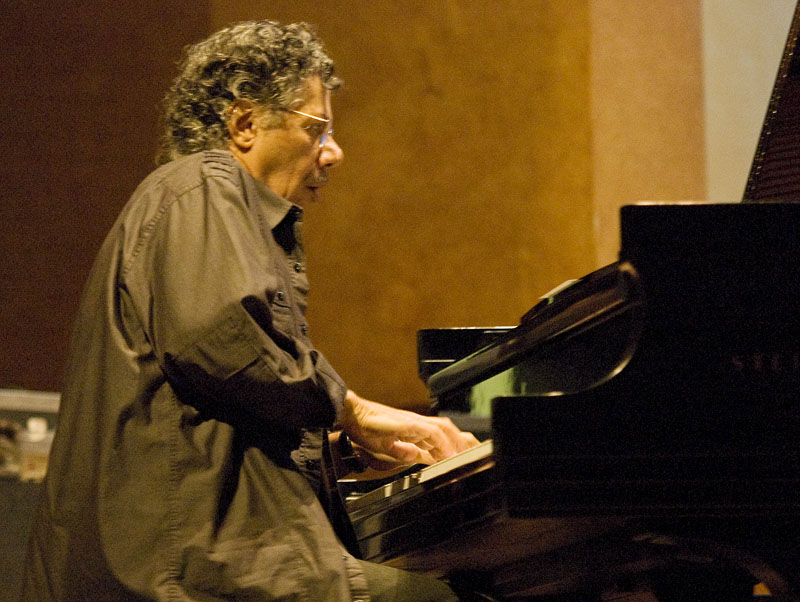
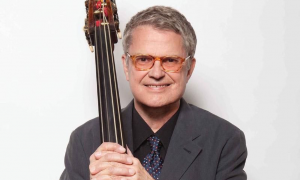
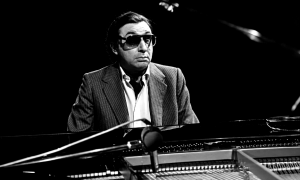
And they were right. With a repertoire that weighed heavily on new writing, or new arrangements of older material, Corea, McBride and Blade put on a show that drew an enthusiastic response from the crowd throughout its roughly 90-minute set. While every show of the tour is being recorded for a possible live album, Corea confirmed, after the show, that firm plans have yet to be put into place. Based on the trio's Ottawa show—a combination of exhilarating and near-exhausting virtuosity, balanced with the nuanced understatement of three players with nothing to prove—it'll be a crime if a live album doesn't see the light of day. Beyond the stunning playing and a wealth of fine material, what elevated this performance above Corea's other recent visits to town was its palpable sense of fun, with plenty of smiles all around and no shortage of laughter either, as Corea, ever the mischievous, puckish protagonist, created a context where the music—despite some fairly knotty arrangements—centered on high-spirited playfulness: pushed and pulled; twisted and turned; and obliquely refracted—as much about the journey as it was the destination.
Opening on a relatively subdued note with a delicate version of the late Joe Henderson's "Serenity" and a compelling rework of classical composer Alexander Scriabin's etude, "Opus 11, No. 2" (here expanded from its original miniature into a more extended opportunity for Corea to demonstrate his particularly vivid rhythmic sense), the trio gradually picked up steam throughout the set, as it revamped a lesser-known but quirky-as- expected tune from the Thelonious Monk repertoire, "Work," first recorded on Thelonious Monk & Sonny Rollins (OJC, 1955).

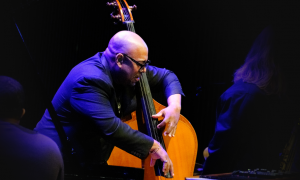
The group then moved into a series of mostly new compositions, written specifically for the trio. Two tracks, composed nearly 45 years apart, richly referred to Corea's longstanding interest in the cross-pollination of jazz and Spanish music: "Homage," which featured a solo piano intro marrying the pianist's percussive attack with his equally lithe and delicate touch; and a new, more complex arrangement of the title track to Corea's early trio classic with bassist Miroslav Vitous and drummer Roy Haynes, Now He Sings, Now He Sobs (Solid State, 1966), which began with Blade gradually building on a military march. McBride's "Song for Rosa," a dedication to civil rights activist Rosa Parks, provided some of the set's most incendiary moments, in particular, the bassist's solo—a limber dovetail to Corea, where the bassist approached near-impossible feats of speed, dexterity and, equally important, accuracy and allegiance to the song's fundamentals—but also demonstrating the trio's remarkable ability to work with dynamics. Dominion Chalmers, with its high cathedral ceiling, can be a tough room—especially when there's a drummer—but Corea, McBride and Blade played the room like the pros they are, especially Blade, who kept his touch light for the most part, but made the most of an ability to turn a single rim shot into a cannon going off; but always at the right moment, to provide sharp contrast or dramatic punctuation.
The drummer's own compositional contribution, "Alpha and Omega," was a numinous tone poem, and a strong endorsement of Blade as more than "just" a drummer: his Fellowship Band, heard most recently on Season of Changes (Verve, 2008) and featuring Blade's distinctive writing, has become one of modern jazz's most influential groups; while Mama Rosa (Verve, 2009) has proven Blade—not surprisingly, based on his often richly thematic and song-form-like writing for Fellowship—to be a deeply spiritual, warm and honest singer/songwriter. Still, "Alpha and Omega" was a relatively abstract contrast to his Americana-centric writing—like Season of Changes' melodically memorable "Stoner Hill"—demonstrating, perhaps, a new compositional direction that still manages to reflect the many interests that Blade has had the opportunity to explore and develop with Fellowship.
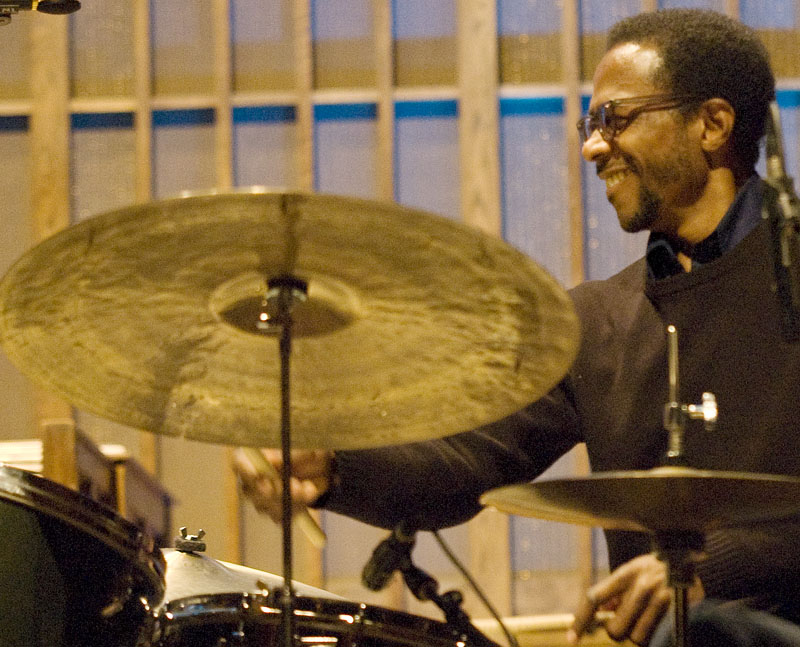
The trio closed the set with "Fingerprints," Corea's answer to saxophonist Wayne Shorter"s iconic "Footprints." First appearing on Past, Present and Futures (Stretch, 2001), with his then "New Trio" of bassist Avishai Cohen and drummer Jeff Ballard, and later revisited on the Chillin' in Chelan disc of his Japan-only Five Trios (Stretch, 2007) box set—again with Ballard but, this time, with McBride onboard—the Ottawa performance raised the bar even higher, with Blade, in particular, delivering a set-defining solo as his body, at one point, raised off his drum stool as he pushed forward with reckless abandon and near-brute force. McBride and Corea delivered equally visceral solos, driving the audience immediately to its feet at its powerful conclusion, demanding an encore which brought the concert full circle— ending, as it began, with a Joe Henderson tune, this time the better-known "Isotope."
Despite turning 70 next year, Corea's career—like a number peers including guitarist John McLaughlin, with whom the pianist collaborated for the Five Peace Band (Stretch, 2009) album, and a tour that brought the quintet (also featuring McBride, Blade and saxophonist Kenny Garrett) to Montreal in the spring of the same year—is actually picking up speed, with 34 dates booked between now and the end of 2010. Blade, in addition to working on material for a new Fellowship album and a follow-up to Mama Rosa, is equally booked out, with more dates in this trio, half a dozen Fellowship dates and a special concert for the Portland Rescue Mission, organized by singer/songwriter Emmylou Harris. In addition to dates with Corea and his own Inside Straight band, McBride has three albums in the can, all in need of mixing for release beginning in 2011, including his first ever big band record.
As busy as everyone is, it only made the stunning display of collective virtuosity and empathic chemistry all the more remarkable, especially considering that this date was only the fifth show of the tour. It was a tremendous way to kick-off the Ottawa Jazz Festival Fall/Winter season; if the rest of its program is anywhere near this good, then Ottawa jazz fans are in for a very good year.
Photo Credit
All Photos: John Kelman
Tags
PREVIOUS / NEXT

Become a Sustaining Member

Since 1995, All About Jazz has championed jazz as an art form and supported the musicians who create it. Over three decades, it has grown into one of the world's leading jazz resources, serving hundreds of thousands of readers, musicians, presenters and industry professionals each month.
Help Build the Future of All About Jazz
Your support helps us continue building All About Jazz for the next generation—expanding our editorial coverage, preserving jazz history, developing new community features and creating better ways to discover the music and the people behind it.
Become a sustaining member for as little as $20 per year and you'll immediately enjoy an ad-free experience along with access to subscriber features and future articles for a full year.
Together, we're not simply sustaining All About Jazz—we're building its future. Thank you for being part of the journey.