Home » Jazz Articles » Interview » Nobu Stowe: Beyond Free
Nobu Stowe: Beyond Free


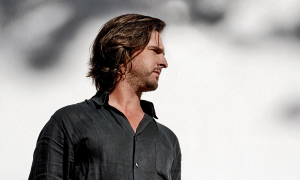
Stowe's improvisation is essentially "spontaneous composition,"—which clearly sets his music apart from so-called "free improvisation." His writing talent is evident in his various composition-based projects—from progressive rock and fusion to post-bop units—dedicated to perform his individualistic originals of progressive attitudes, blended with popular music sensitivity. As evidenced by his growing international reputation, Stowe's music is friendly enough to attain the support from the masses and, at the same time, adventurous to satisfy even the most seasoned connoisseurs.
Like his music, Stowe is a unique individual person. Born as Nobuyoshi Suto in Japan, Stowe has been living in the US (Berkeley, Chicago and, currently, Baltimore) for most of his adult life. He is a psychologist educated at University of California at Berkeley (B.A.) and University of Chicago (Ph.D.), and currently conducts research at University of Maryland exploring the biological basis of motivation. He is also a journalist who has contributed intriguing articles, reviews, and interviews (including ones with Keith Jarrett, Michel Legrand, Gary Peacock, Paul Bley, Martial Solal, Bill Frisell, Marilyn Crispell and Chico Hamilton to the Japanese magazine Jazz Tokyo and the Spanish magazine Toma Jazz. Stowe is the contributing author of the first ever complete catalogue of ECM Records to be published in Japan (July, 2010).
All About Jazz: As leader/co-leader, you have published five albums on Konnex and Soul Note. Except a few composition-based tracks, the music on these albums is fully improvised. Unusual for fully improvised music, your improvisation covers a great range of stylistic variations, and sounds almost pre-composed because of the tuneful melodies, tonal harmonies and structural cohesiveness. The term "total improvisation" is used to describe your fully improvised music. How do you define the term?
Nobu Stowe: "Total improvisation" is the term coined by Keith Jarrett. Total improvisation is, like "free improvisation," which is a genre of fully improvised music. But unlike free improvisation which is often restricted to atonal and arrhythmic sound exploration, total improvisation embraces song-like melody, tonal harmony and rhythmic propulsion. It is essentially "spontaneous composition." There is a related term "instant composition" notably practiced by Misha Mengelberg and his Instant Composer's Pool (ICP) Orchestra. Compared to straight free improvisation, both total improvisation and instant composition tend to have more defined structures and rhythmic figures. I do not think there is a clear musical distinction between total improvisation and instant composition, but I think total improvisation is more melody and tonal harmony oriented.
AAJ: Your approach to fully improvised music is multifaceted and contains kaleidoscopic musical elements. How do you summarize your musical characteristics?
 NS: I will list three keywords. The first is "storytelling." I love to narrate a story through my music. This is the reason why my music incorporates many different elements, moods, etc. The second is "spontaneity." I believe spontaneity is the key for the musical freedom, composed or fully improvised, to avoid the cliché and to attain the musical freshness. The third is "romanticism" which directly leads to the tuneful melodies and tonality-oriented harmonic progression characteristic of my music. In a recent email, the famed avant producer Leo Feigin wrote "NS, you are an incurable romantic!" A few years ago, Leo praised highly of my co-leader album New York Moments (Konnex, 2007). But in this email, he was essentially saying that my music is not for his label, Leo Records, because it is too "romantic." But I felt honored.
AAJ: Your style is unique within fully improvised music, especially compared to avant or free-jazz type persuasions. I feel you are trying to achieve something beyond so called "free music." How do you set yourself apart from the free musicians? How do you go beyond free?
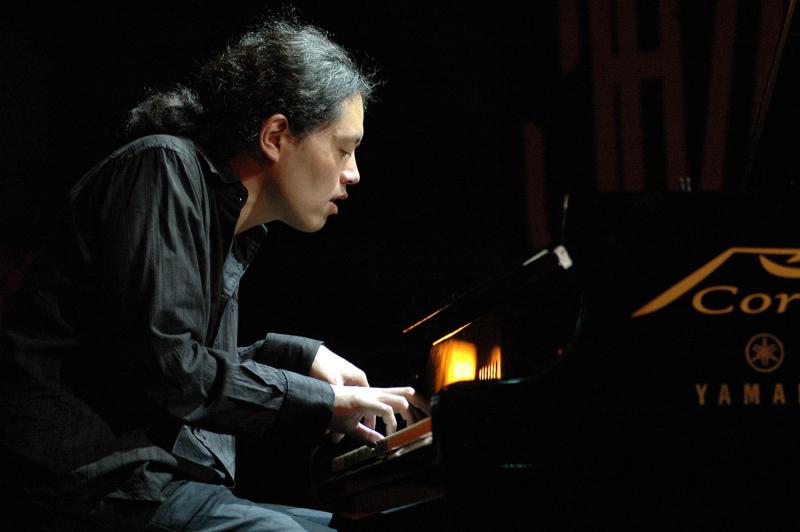
 From left: Nobu Stowe, Achille Succi
 NS: One of my problems with avant-garde/free jazz, in particular with free improvisation, is the monotonic nature of many performances. I mean why free improvisation is predictably atonal, arrhythmic and demanding to the ears, if it is really free from any form and cliché?
Of course, there are the Holy Grail works by the masters, such as Derek Bailey, AMM, Evan Parker and others, that transcends these issues I just raised. And I do appreciate a good number of free improvisation outings. But I believe free from traditional elements is not the sufficient and necessary condition for free music. This is because as soon as the music becomes free of the traditional elements, it is trapped, hence not free from untraditional or let's say "traditionally free" elements. So I believe that true free music is only possible through understanding but not by denying traditional elements.
I believe that spontaneity is the key to achieve the true musical freedom, and so, melody is the answer. What I mean here by "melody" is the tuneful, song-like and hummable melodic phrases which can transcend cultural barriers. I feel such melody only comes spontaneously. So the process of melody creation belongs to the realm of intuition—the creative process that is largely independent of a learning process. This assures the fact that melody creation is spontaneous and free from cliché.
AAJ: While your music is firmly based in improvisation, arguably the most critical element in "jazz," it subliminally draws upon vast influences. Is it intentional or a natural vibe?
NS: It is both intentional and natural. I am a composer, improviser, pianist, and keyboard player, but I do not consider myself a jazz player, per se. First, I need to admit that it took me over 20 years to appreciate jazz. There are many talented jazz musicians, who naturally understood jazz to begin with and are well educated in the jazz tradition. I dare not compete with these jazz naturals for straight jazz idioms. On the other hand, I am a natural improviser, improvising as far as I remember. And by the time I finally discovered jazz in college, I had been already fluent in other music idioms, including progressive rock, pop, classical music, various ethnic music—at least superficially. So I wanted to find my own jazz idiom reflecting my personal music history and influences. For this, I intentionally avoided formal jazz education.
AAJ: So who were your primary influences before discovering jazz?
NS: I was born and raised in Japan until I moved to the States at age 18, and have been influenced by many genres of music from different cultures. My music preferences changed somewhat dramatically over the time.
My parents did not listen to jazz, but had a good collection of records, classical music, movie soundtracks and also ethnic music, such as French chanson, Italian canzone, Andes folklore, Indian raga, Chinese traditional music, and so on. My favorite classical composers were J.S. Bach, Beethoven and Chopin. I also loved the film composers, such as Nino Rota, Michel Legrand , Henry Mancini and Ennio Morricone. As a soundtrack, but not as a jazz album per se, I listened to Ascenseur pour l'échafaud (Universal,1958), by Miles Davis, and Orfeu Negro (Emarcy, 1959) by Luiz Bonfa and Antonio Carlos Jobim. When I was around 12, I fell in love with The Beatles. This fever lasted for three years or so, and I listened everyday to The Beatles (including member solos), and their contemporaries, such Bob Dylan and The Rolling Stones. Then, I became heavily into progressive rock, not only the pioneering British bands, like Yes and King Crimson, but also the bands from Europe and South America. I listened to jazz-rock, but my favorite was symphonic rock. I was especially fascinated by the Italians, PFM, Banco, New Trolls, Area, Le Orme etc. The singing, tuneful melodies, generally characterizing the Italian music, caught my attention. During this period, I also listened to some of the classic jazz albums, such as [Miles Davis'] Kind of Blue (Columbia, 1959) and [John Coltrane's] A Love Supreme (Impulse!, 1964). But I felt these albums were all boring! However, I remember enjoying Ballads (Impulse!, 1962), by Coltrane, probably because of his deeply emotional melodic playing.
 I attended UC Berkeley, double-majoring in Psychology and Music (composition). In college, I heard the ECM masterpiece Return To Forever (1972) [Chick Corea]. The naturalistic melody and sounds infused with the Brazilian music made a big impression. So I started listening to fusion bands, Weather Report and Mahavishnu Orchestra, etc. Then, I moved from Berkeley to Chicago to attend graduate school. During that time, one of my friends strongly recommended me to check out Keith Jarrett. I first bought his most famous album, Koln Concert (ECM, 1975). I liked it, but not necessarily loved it. But something clicked, and so I bought another album—My Song (ECM, 1978). I still remember vividly the first time I ever listened to this album. It was on a chilly late autumn day in Chicago. From the first note of the album, the music captured my heart. I love the entire album, but the track "Country" is my favorite. After this, I started collecting any album with Keith, then anything on ECM, and eventually pretty much any subgenre of jazz. Other than Keith, Michel Petrucciani, Django Reinhardt, Charlie Parker, Chet Baker, Duke Jordan, Joachim Kuhn, Steve Kuhn, Aldo Romano, and Masahiko Togashi are the jazzmen who gave me the strongest impressions. But I do have many more favorite jazz musicians.
AAJ: At what age did you start playing the piano?
NS: I started classical piano lessons when I was three years old. Frankly speaking, I did not like playing or more precisely, practicing the piano then, but managed to continue the lesson with a private teacher into my high school years.

AAJ: Chart the progress of your musicality from, let's say, your teen years up to your debut recording in 2006?
NS: Following Beatles-inspired bands, I formed a progressive rock unit called "Pale Ghosts" at age 15. This was a trio consisted of Takashi Kanai (guitars, bass), Honyo Ohte (drums) and myself (keyboards, vocals, guitar). We played my original compositions that were close to the style of Italian symphonic rock with strong classical music influence (especially Baroque era), emphasis on the group ensemble rather than individual soloing. We did some live activity, but this was mostly a studio project. I kept playing with this trio all through my college years even after moving to the States. We made several demo recordings which brought several contract offers. But I was foolish enough not to take these offers because I was dreaming or more likely imagining to be signed by Sony. By the way, Ohte is a talented illustrator and is responsible for all covers of my albums on Soul Note and Konnex.
I started shifting my musical direction from rock to jazz. I was never formally educated in jazz, but learned the vocabulary through listening to many albums—I am an avid LP/CD collector—and by practicing on my own. I first tried fusion, played and composed in this style for a few years. Then, I met Vytis Nivinskas—a super-fine double-bassist who had come to Chicago from Lithuania to study jazz at DePaul University. Vytis is now back in his native land, and teaches at Vilnius Conservatory. With Vytis, I formed my first jazz unit, Outside In. We played original compositions by Vytis and myself, plus some standards. We did not publish any official album, but I have kept in touch with Vytis, and am planning to perform and record with him again in the near future.
In Chicago, I also started publicly performing total improvisation. I undertook a few concerts of fully improvised music, usually with a drummer. The musical success of these concerts gave me the confidence for the direction I wanted to pursue as for total improvisation. By the way, piano-drums duo is my favorite format of total improvisation. I am hoping to make many duo albums of total improvisations with different drummers throughout my music career.
After receiving the doctorate degree in Psychology from the University of Chicago, I moved to Baltimore where I still live. In Baltimore, I formed Trio Ricochet with Tyler Goodwin on double-bass and Alan Munshower on drums. Trio Ricochet played mostly my original compositions, but also some standards as well. The trio played at the Blue Note NY, Knitting Factory, and Smithsonian Institute. The trio was offered several contracts, but there has not been an official release, and that's largely my fault. While I consider the composition-based piano trios like Trio Ricochet or Outside In as my main project, I have not been playing in this format for awhile. But I am planning to revive a composition-based piano trio very soon, and hopefully, can finally release an official album in 2011.
AAJ: Did your family encourage you to pursue music?
NS: My parents were, and still are, very supportive of my music. But probably they would have been troubled if I told them "I want to be a rock star"—though I dreamed of this idea for awhile.
AAJ: What's the story behind your first leader/co-leader albums, Brooklyn Moments (2006) and New York Moments (2007) released on Konnex?
 NS: After the move to Baltimore, I started collaborating with various improvisers. I am really a mainstream player with the focus and the talent in melodic and tonal playing, but have been trying to expand my musical horizons towards avant-garde and free playing. One of my early attempts to fuse the mainstream and free elements is documented on these two albums. I first met Blaise Siwula in 2005 when I played a duo set with Vytis Nivinskas at C.O.M.A. series that Blaise was (and still is) hosting on a weekly basis. Blaise suggested performing together with Ray Sage on drums. So a month later we played a fully improvised trio set that was satisfactory to all of us and decided to record in a studio.
We recorded the first session as trio, and the second session as a quartet featuring the fierce virtuoso Dom Minasi on guitar. These sessions were released as Brooklyn Moments (trio) and New York Moments (quartet). There are some rough spots, but I am still quite happy with the overall results. The trio and quartet covered a good range of musical genres, from atonal wailing, energetic free flights, spiritual modal playing, to tender ballads, always with open-end looseness backed by structured tension. The success of these sessions indicated a big potential for fusing the avant energy with my natural tendency for melodic and tonal playing.
I noted earlier that Leo Feigin praised New York Moments highly. He compared the album with the works by the legendary USSR unit, The Ganelin Trio. Leo even sent me one of their albums, Catalogue: Live in East Germany (Leo, 1979). Of course, I felt honored, but have to admit I was the only member who had been familiar with The Ganelin Trio. I was familiar with the music of the Soviet trio, partially because Vytis was the protégé of the reedman, Vladimir Chekasin.
AAJ: After the two albums on Konnex, you were signed by Soul Note. Your first effort on this famed Italian label is chamber-esque Hommage an Klaus Kinski (2007). This work is credited to the "NS Stowe—Lee Pembleton Project." What's the story behind this project and the album?
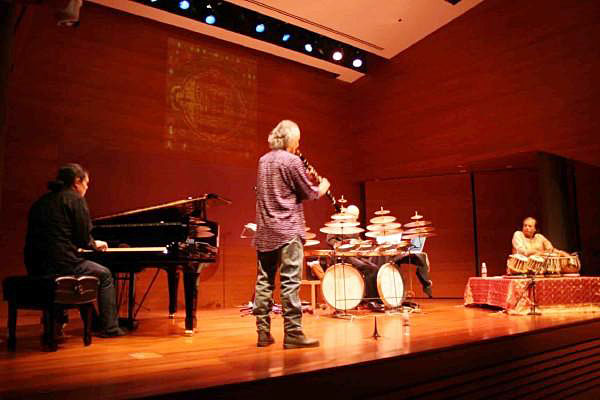 From left: Nobu Stowe, Perry Robinson, Andrea Centazzo, Badal Roy
 NS: While in Chicago, I met Lee Pembleton. Lee is a sound sculptor, artist coming from the tradition of noise music as well as musique concrète. Lee participated in my fusion projects before relocating to California. But we kept in touch, and always wanted to do something together. After the completion of Brooklyn Moments and New York Moments, I was eager to explore more of an introverted approach to fully improvised music. My inspirations for this came from the chamber-free works by Jimmy Giuffre, Lee Konitz, Paul Bley. I pictured it would be nice to carry total improvisation in the chamber-free mode on the sonic canvas provided by Lee.
So with this idea, Lee and I decided to have a recording session. I really wanted Perry Robinson for this project, because he is directly coming out of the chamber-free tradition set motion by Giuffre et al. Fortunately for me, Perry kindly accepted my proposal. Other members participating in this recording were Blaise Siwula, John McLellan and Ross Bonadonna. Blaise is primarily known for his passionate blowouts, but is adept at subtle playing as well. John, who had collaborated frequently with Blaise, Mat Maneri, and others, is a masterful drummer of space and silence. I personally regard Ross as the best kept secret of the fertile avant scene of New York. I met Ross when I recorded at his Wombat Studio in Brooklyn. Ross is not only a good engineer, but is also equally skilled on guitar and various reed instruments, most notably on bass clarinet and alto saxophone. He really understands the foundations of the music, accustomed to a wide range of musical genres, and can think out of the box and be free and spontaneous at the same time.
AAJ: Why a dedication to German actor Klaus Kinski?
NS: The title was taken from the track, "Hommage an Klaus Kinski," that was fully improvised by Lee, Ross and myself. But this was only named so after the recording session, because this particular improvisation just happened to be strongly reminiscent of a scene from Fitzcarraldo, the 1982 film masterpiece featuring Kinski, directed by Werner Herzog, and the soundtrack by Florian Fricke and his group Popol Vuh. So we originally had no intention to come up with a song or an album dedicated to Kinski. But I have been a great fan of the films by Herzog and Kinski as well as the freshly meditative music by Popol Vuh since my high school days.
AAJ: You and Perry Robinson participated in Andrea Centazzo's album The Soul in The Mist, released on ICTUS in 2007. How did this musical meeting happen?
NS: I was first exposed to the music of Andrea Centazzo through his duo album with the Swiss master Pierre Favre, probably the most melodic percussion player ever. Then, I listened to Andrea's duo album Clangs (RDC, 2000) with Steve Lacy. When I came across the homepage of the revived Ictus Records—a label established and operated by Andrea himself, I decided to email Andrea. This was after the recording of Hommage an Klaus Kinski. Andrea liked what I did with Perry and suggested forming a trio with him. We had a short East Coast tour, which was recorded, produced and released by Andrea. My piano playing is rather reserved on this album, but I believe this is an ideal album to appreciate the criminally underappreciated talent of Perry, and also the compositional skill of Andrea who is primarily known for his fully improvised music with Derek Bailey, John Zorn, and Evan Parker et al.
AAJ: You released An die Musik Soul Note, 2008), a set of duo and trio improvisations with Alan Munshower on drums and Badal Roy on tabla. The stylistic methodology differs significantly from other releases of yours. The fully improvised music contains tuneful melodies with a strong sense of tonality. It is perhaps your most direct answer to Keith Jarrett's solo piano improvisations, but also suggests world music influences, somewhat reminiscent of the music of the group Oregon Jazz Band and Pat Metheny. What events led to the fruition of this album?
 NS: Of my published works, I believe this album represents my song-oriented approach to fully improvised music at the purest. Back in 2006, I was extremely happy to receive an email from the legendary producer Giovanni Bonandrini. Earlier, I had sent him several recordings of mine, including a total improvisation duo with Alan recorded in January 2005 in Washington DC. Giovanni kindly wrote that he was very impressed by this performance and would like to release it on Soul Note. Unfortunately, the sound quality was not adequate for an official release. So Giovanni asked me to re-record the material. Of course, being fully improvised music, it was not possible to re-record the DC performance, but I scheduled two nights of live recording sessions at An die Musik in Baltimore. For one session, Alan and I were joined by tabla master Badal Roy. I had been familiar with Badal's playing through his seminal works with Miles Davis, John McLaughlin, and also Perry Robinson. I thought Badal's deep tabla groove would be a nice complement to Alan's sensitive touch on drums. I was thrilled when Badal accepted the proposal. The recording session was the first ever time, Alan and I played with Badal. But we quickly managed to achieve sympathetic interplay.
AAJ: Your new album Confusion Bleue (Soul Note, 2010) has just been released. You explored yet another direction with this album. The improvisation on this album contains your musical signatures, such as tuneful melody, structural cohesion, and kaleidoscopic variations, but also incorporates more free elements than usual with great energetic focus. What was the basic idea?
NS: After the introverted chamber-free music of Hommage an Klaus Kinski and the highly melodic An die Musik, I wanted to record energy-charged music leaning towards more overtly "avant-garde." So that was the basic idea which was reflected in the choice of members who participated in this recording. While Lee Pembleton's influence from musique concrète was primarily reflected in Hommage, I wanted to put the spotlight on his background as noise musician as well. I again counted on Ross Bonadonna's versatility, especially his fantastic guitar parts, which hugely contributed to this album. I believe Ray Sage's rhythmic propulsion is rarely matched in free drumming and for his fire, he can be compared, in my opinion, even to the greatest masters, such as Elvin Jones, Rashied Ali and Andrew Cyrille. While I prefer bass-less setting for fully improvised music—this is to keep my harmonic choices open, I asked Tyler Goodwin to join on double-bass because of his acute ear and quick harmonic reactions.
While the focus of this recording was on energy, I wanted to infuse as many musical elements and moods as possible especially that of melodic, tonal inventions, structural cohesiveness within the overall framework of free music. I wanted to infuse a lot of colors into the music. This was also the reason why I improvised not only on the acoustic piano, but also on Wurlitzer electric piano and glockenspiel. I am well satisfied with the results, and very happy to know many critics seem to think highly of this album.
AAJ: While incorporating a fair amount of free music languages, your fully improvised music sounds almost based on a pre-composed material, because of strong melodic motifs, often tonal based harmonic progressions and well-defined rhythmic changes. Do you make any preparations for this?
NS: First, I would like to assure that none of my fully improvised music is based on any pre-composed material, including melodic motifs. I think if I have any special talent in music, it is the creation of tuneful melodies. The melodic motifs I improvise or spontaneously compose often sounds very tuneful—some people even suggested that I should re-use these melodies as composed materials. Indeed, a lot of my compositions were spontaneously composed. But if I indicate the performance was fully improvised, I can assure that no pre-composed material, even "sketches," were used. I expect the same from other members.
Not for solo, but for group improvisation, I do make some preparations to generally define the direction of improvisation outcome in order to avoid unorganized chaos—is the opposite of the organized chaos—which is the musical chaos and to ensure the focus, energy and tension. Selection of appropriate improvisers for an intended musical setting—or the blueprint—is one of such preparations. In a group work, especially involving collective improvisation, the matching among each musician is extremely critical. If the matching level is low, the direction of improvisation tends to be diffusive, and the resulting music will lack the focus, energy, and tension. So it is important to have a blue print of the intended musical outcome and to select the improvisers according to this blueprint.
For small group improvisation, as long as each musician has the ability to listen to each other and be versatile—an important capacity for the all inclusive total improvisation, the musical path will likely open automatically and spontaneously. But, for larger group improvisation, I often provide basic instructions before each collective improvisation. For example, I would say something like "let's do the next improvisation in the mode of chamber-free" or "let's start from guitar and drum duo," etc. This is because collective improvisations by a large group, especially a group of four or more improvisers, are often prone to unorganized chaos. But I never give more specific instructions such as "let's start in the key of E-flat on a funk vamp," for example.
AAJ: As previously mentioned, your improvisations cover a wide range of musical styles rarely heard in fully improvised music. At the same time, you manage to infuse your own definitive musical identity in each of your performance with different improvisers under different settings. How do you accomplish that?
 NS: To increase the chance of establishing the musical focus and cohesive organization—that includes organized chaos in group improvisations, I often assume the role of the leader and conductor. In this regard, my approach to collective improvisation is fundamentally not democratic or liberal. I can do so partially because the piano is a very dominant instrument—it is essentially a solo instrument that can sufficiently cover the three (traditional) fundamentals of music, melody, harmony and rhythm by itself.
But again, the key is the spontaneity which always guarantees the musical freedom under any framework. So within the given direction and framework, each improviser is free to explore. Also, I thrive to be fluid in my leadership; to be open for the ongoing ideas by other members. So yes, my group improvisations are not a democratic collective improvisation, but they are the products of collective effort, nevertheless.
AAJ: Where do you draw the line between structure and improvisation? Your music often conveys a seamless middle ground between vast expansionism and tangible theme-building motifs. These days, that is uncommon.
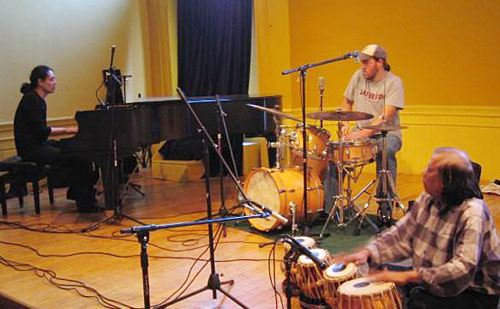 From left: Nobu Stowe, Alan Munshower, Badal Roy
 NS: The all-inclusive approach is mostly a conscious choice, but the line drawing process between the traditional (structure/melody/tonal harmony) and untraditional (sound exploration/free rhythms/atonality) is rather unconscious. This line drawing process is a product of interplay, and is influenced by the musical characters of the other musicians in the particular setting. While I intentionally seek the tension that emerges when mixing structured thematic motifs and free sound explorations, I let the spontaneity decide the balance between these two elements.
AAJ: Your improvisation is characterized with tuneful melodies and tonal harmonies, which intimates a comparison to Keith Jarrett for some listeners. What is your take on this comparison?
NS: I frankly admit that Keith Jarrett has been the greatest inspiration to me, especially for my jazz and improvisation oriented works. The key words that I listed to describe my own music also adequately characterizes Keith's music. But I have to say that I was already practicing total improvisation before discovering Keith in college. I have old cassette tape recordings that captured my total improvisations from my elementary school years. Of course, back then, I was not aware of this concept, and was not consciously improvising per se, but rather I was spontaneously composing. In fact, a good portion of my original compositions arise from spontaneity as I already stated. What I am saying is that the overall elements of a composition, such as the melody as well as the basic harmonic structures and rhythmic motives, often come to me spontaneously—just as they were already composed.
A tuneful melody is definitively the most recognizable element in Keith's and my music. But I believe my sense of melody and also harmony is sufficiently different from those of Keith. I am not a virtuoso pianist like Keith, but I think I manage to avoid being a copy cat of Jarrett, and have something original to say. Having said that, I am not aware of musicians who are practicing this type of highly melodic approach to fully improvised music other than Keith and me. I could think of two other pianists, Stefano Battaglia and Richie Beirach. Specifically, I am speaking of the duo albums by Battaglia and Beirach, respectively, Omen (Splasc(H), 2007) with Pierre Favre, and Tidal Wave (3D, 2004), with Masahiko Togashi. By the way, I consider Togashi as the greatest improviser from Japan.
AAJ: In each of your otherwise fully improvised albums, there is one track based on pre-composed material. For example, there is a compelling and unorthodox rendition of "Blue in Green" on Confusion Bleue. What thought-processes led to this?
NS: I believe the creative process of improvisation is the same as that of composition. In my opinion, spontaneity is the single most critical element in any performance, fully improvised or not. What I mean is that one's playing is inevitably constrained by various factors, such as one's own limitation as a musician, personal history, type of instruments, members involved, the time and the location of performance, etc. These factors are present in both composition-based and fully improvised music. So improvisation, based on a composition or not, is not the automatic ticket for the musical freedom, but this fact appears to be repressed or ignored by many improvisers. The truth is that if one can be spontaneous, the musician can attain the musical freedom in any musical genre and framework. In a way, playing a composition such as a jazz standard is excellent practice for being spontaneous and free.
For these reasons, I am indeed proud of the rendition of "Blue in Green" in Confusion Bleue. This was the first time that I managed to materialize on a record my vision of standard interpretation—spontaneous interplay, but with respect for the melody and overall structure—in a recorded session. I am happy to report that this track was recently selected as one of the Top 10 renditions of jazz standards by the Spanish magazine, Toma Jazz.
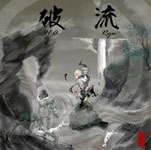 My original composition "Pochi" is included in An die Musik. This song is dedicated to my cat of the same name. I found Pochi in front of my old apartment in Berkeley, and he moved with me to Chicago, and then to Baltimore. This is my favorite of my own compositions, and I was happy to release this song officially before the passing of Pochi—he died of cancer at age 17, on September 2, 2008, about three months after the release of An die Musik. This song was originally written for my piano trio—that was another project, which the legendary producer Giovanni Bonandrini regarded highly. The version on An die Musik is actually a shortened version. I am hoping to release the full version in the near future.
On the one-year anniversary of his passing, actually on September 1st 2009, I played "Pochi" as a duo with the fantastic multi-reed player Achille Succi at Sant'Anna Arresi Jazz Festival in Sardinia (Italy). Achille is a lyrical and melodic player at heart but with a progressive free mind, which is a rare but enviable combination. I got in touch with Achille originally, per the advice of AllAboutJazz critic Budd Kopman a few years back. Achille is still little known in the US, but I honestly believe his multi-dimensional talents deserve wider recognition.
 AAJ: Do music and a research psychology background represent a yin-yang type of lifestyle for you?
NS: Not really. This is because the essence of both music and science is creativity. The foundation of science is logical deduction, but without creative insights or intuition, the logic will lead to "intellectual emptiness..." just like theoretical exercises in music—which is a logical procedure, leading to the same empty outcome without the melody; the intuitive elements of music.
AAJ: You are also a contributor of the Japanese jazz magazine, Jazz Tokyo. Tell us about this magazine, and your writing as a jazz journalist.
NS: Jazz Tokyo is the most prominent online publication in Japan. The magazine was founded by Kenny Inaoka to cover "Jazz and Beyond," especially to support independent labels around the world, that are publishing creative music, but not necessary with the financial resources to promote effectively.
Inaoka-san is the editor-in-chief, and is also a famous producer in Japan—mostly known for his work as the house producer for Trio Records, which was a jazz label established by the audio maker Kenwood in the early '70s. But he also worked with other labels, including Why Not, ECM, and Sony. He produced many notable jazz musicians, including Al Haig, Elvin Jones, Don Cherry, Anita O'Day, Jack DeJohnette, Masahiko Togashi, Masabumi POO Kikuchi, and others. He even produced the soundtrack by Keith Jarrett for the video Nihon Sora Kara No Oudan (Japan from the Sky). This was a fully improvised duo performance by Keith and his son Gabriel on percussion.
In 2007, I started contributing for Jazz Tokyo per request by Inaoka-san, and have written CD reviews, and also conducted interviews with my idols, including Keith Jarrett, Michel Legrand, Gary Peacock, Paul Bley, Bill Frisell, Marilyn Crispell, and Chico Hamilton, among others.
AAJ: Please tell us about The ECM catalogue, just published in Japan.
NS: This is the first complete catalogue of ECM Records in the world. The editor is Kenny Inaoka who handled ECM distribution to Japan through Kenwood. I am honored to be one of the contributing authors. The catalogue includes all of the officially albums, plus promos, EP, LP, CD and DVDs released on ECM and its subsidiary JAPO label between 1969 and 2010. The album covers are all in color, with an individual album guide in Japanese. But all other information, such as titles, musicians, tracks, and album index, is in English. So the book should be valuable even to non-Japanese readers.
The catalogue was originally scheduled for the publication in 2009 to celebrate the 40th anniversary of the German label, but the book was finally published on July 13th 2010 from Kirara Sha through Kawade Shobou, and costs 4,000 yen, which is approximately $45. I just heard negotiations are on the way so that local ECM distributors, such as ECM Munich or ECM USA, will handle the distribution of this catalogue as well.
AAJ: Future plans?
NS: I have several recordings ready to be released. One is a fully improvised recording from January 2009 with Lee Pembleton, Achille Succi, Alan Munshower, and Daniel Barbiero. Daniel is a bassist highly active in the vibrant improv scene of Washington DC. He is a sensitive player with sweet tone, and a good knowledge of contemporary classical music. I believe this recording is the most mature and well-balanced work of my inside/outside approach to fully improvised music, and hope it will be released soon. The album title will be L'Albero delle Meduse, which means, in Italian, Jelly Fish Tree, and there is a funny story behind it.
Another is a recording with Lee Pembleton, Ross Bonadonna and Jason Bivins. Jason is the associate professor of Philosophy and Religious Studies at North Carolina State University. He writes about jazz for several publications, including Cadence, Paris Transatlantic, and Dusted Magazine, and is also an inventive guitarist in the tradition of Keith Rowe and Derek Bailey. The original idea for this recording was to create some sort of Jarrett-meets-AMM. Normally, I am opposed to post-production works, other than simple mixing, for fully improvised music. However, we have decided to carry more elaborate post-production works on this particular recording. The idea is to make the virtual soundtrack of "The Dream Quest of Unknown Kadath," the 1927 novella by H.P. Lovecraft. The music will be accompanied by a series of illustrations by Honyo Ohte, of course, inspired by the Lovecraft story.
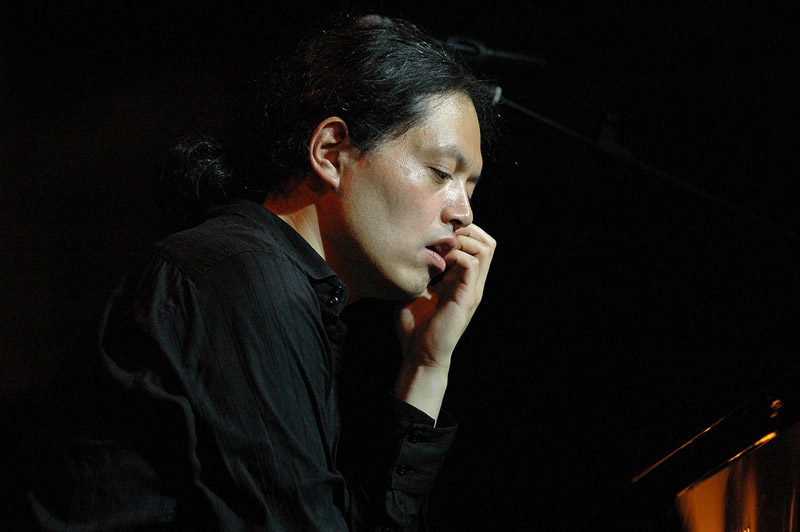
In February of this year (2010), Achille Succi, Daniel Barbiero and myself participated in a recording session lead by Andrea Centazzo that also featured the wonderful trumpet player Dave Ballou. We played and improvised, based on scores by Andrea. Andrea is currently carrying the post-production, and so hopefully, this recording will be released shortly.
My current focus is a total improvisation trio with Achille Succi and drum legend Barry Altschul. Following the duo appearance at 2010 Sant'Anna Arresi Jazz Festival in Sardinia, Achille and I decided to form a working unit and we are totally thrilled to have Barry on board. The key word for this trio is versatility, and I am hoping to cover wide-ranging musical contexts unrestricted by the framework of fully improvised music. Achille and Barry are both capable of subtle lyricism and avant-aggression, concrete melodic playing and abstract sound exploration, with the strong sense of rhythm in groove and in free playing, and possess acute ears for tonality and atonality. They are most of all spontaneous, and that is very critical in any music, improvised or not. So Achille and Barry are the ideal partners for the all-inclusive methods of fully improvised music and total improvisation.
Selected Discography
Nobu Stowe, Confusion Bleue (Soul Note, 2010)
Nobu Stowe, An Die Musik (Soul Note, 2008)
Nobu Stowe, Hommage An Klaus Kinski (Soul Note, 2007)
Nobu Stowe, The Soul In The Mist (Ictus, 2007)
Nobu Stowe, New York Moments (Konnex, 2007)
Nobu Stowe, Brooklyn Moments (Konnex, 2006)
Photo Credits
Pages 1-3, 5, 7: Agostino Mela
Page 4: Katsuhiko Suto
Page 6: Courtesy of Nobu Stowe
< Previous
Second Chance
Next >
Confusion Bleue
Comments

Tags
Nobu Stowe
Interview
Glenn Astarita
United States
Keith Jarrett
Michel Legrand
Gary Peacock
Paul Bley
Martial Solal
Bill Frisell
Marilyn Crispell
Chico Hamilton
Misha Mengelberg
Derek Bailey
evan parker
Miles Davis
Luiz Bonfa
Antonio Carlos Jobim
The Beatles
Bob Dylan
The Rolling Stones
Yes
John Coltrane
Chick Corea
Weather Report
Mahavishnu Orchestra
Michel Petrucciani
Django Reinhardt
Chet Baker
Duke Jordan
Joachim Kühn
Steve Kuhn
Aldo Romano
Blaise Siwula
Dom Minasi
Jimmy Giuffre
Lee Konitz
Perry Robinson
Mat Maneri
Andrea Centazzo
Pierre Favre
Steve Lacy
john zorn
Oregon and
pat metheny
BADAL ROY
john mclaughlin
Elvin Jones
Rashied Ali
Andrew Cyrille
Stefano Battaglia
Richie Beirach
Achille Succi
Budd Kopman
Al Haig
Don Cherry
Anita O'Day
Jack DeJohnette
Dave Ballou
Barry Altschul
For the Love of Jazz
 All About Jazz has been a pillar of jazz since 1995, championing it as an art form and, more importantly, supporting the musicians who create it. Our enduring commitment has made "AAJ" one of the most culturally important websites of its kind, read by hundreds of thousands of fans, musicians and industry figures every month.
You Can Help
To expand our coverage even further and develop new means to foster jazz discovery and connectivity we need your help. You can become a sustaining member for a modest $20 and in return, we'll immediately hide those pesky ads plus provide access to future articles for a full year. This winning combination will vastly improve your AAJ experience and allow us to vigorously build on the pioneering work we first started in 1995. So enjoy an ad-free AAJ experience and help us remain a positive beacon for jazz by making a donation today.

Giveaway

Eligible winners: 15
Days remaining: 5
Days remaining: 5