Home » Jazz Articles » Interview » John Tilbury: A Strong Emotional Response To Music
John Tilbury: A Strong Emotional Response To Music


Tilbury's biography of his friend, associate and erstwhile member of AMM, Cornelius Cardew, which took him over two decades to write, has been recognized as the definitive statement on Cardew's life and work. In conversation, Tilbury frequently makes reference to Cardew's views and opinions, and, unsurprisingly, he himself still espouses views and beliefs that flow from the political views that he and Cardew shared.
At the beginning of this interview, Tilbury initially suggested we listen to a recent AMM recording of himself and Prevost in Poland. As we sat listening, Tilbury would comment critically on his own playing. This is where the interview begins.
All About Jazz: It is interesting sitting with you listening to this, because it is as if you hear it as though it is not you. When you've done a piece like this, do you know what you've played? Or is it a surprise to you when you hear the recording back?
John Tilbury: It is always different, playing it back. Of course, they say distance lends enchantment, but sometimes distance lends disenchantment. If you hear it immediately after you perform it, relatively speaking, a day or two after, that is one thing. And then, months later you'd hear it from a completely different perspective, because you can't remember the actuality of the performance with the same detail. In a way, it is better because you can judge it more objectively then. I'm listening to the music now, which is quite recent, and I feel I am still doing it, still performing. I'm kind of still there. It is quite close to me psychologically. I remember making those sounds at that particular point. Like at the beginning where I made that error. I wanted to hit one note—the prepared note—and I got it wrong and had to recoup somehow. There is that famous story of Thelonious Monk, when he came off after a set, very annoyed and frustrated, and said, "I made all the wrong mistakes." [Laughs] I know what he meant.
Sometimes, when I play a larger aggregate of notes, I can anticipate the qualities of sound and the nature of the harmony that I'm playing, but not exactly—I don't exactly hear the actual chord in my head. Maybe a cluster-type chord or a whole-tone type of chord. But once I've played it, then I'm there on top of it, and I'm immediately reacting and adjusting, using various transpositions, for example; I like to do that with chords, playing around in that way. I like the economy of that way of working. But I enjoy that experimental part of it, working on the material. It is like you are dealing with a piece of pottery, clay, kneading with your hands, moving it around, making shapes. It is very physical. I enjoy the physicality of playing the piano. Other times, you are dealing with smaller groups of sounds and you know what is going to come out.
Obviously, when you are dealing with intervals and individual tones you can hear things; there's more control. I'm playing a descending scale, for example, and I omit a few notes because I think at that particular moment I wanted a certain intervallic quality. And I know how to do that. Of late, I have got into playing scales and arpeggios. Listen. [Listens to recording]. I like playing scales. Scales can be very beautiful. Perhaps it's about going back to my childhood. I try to remember exactly what I have played, what intervals. Sometimes I alter the intervals slightly. There they are again—it's very appealing.
I guess I started to discover something that I hadn't really used much before. Then you want to concern yourself with it and develop it in some way. It becomes the area you are interested in, and perhaps, over a few weeks or months, that becomes an important feature of your repertoire.
AAJ: The way you're describing it, every time you are doing that afresh.
JT: Yes, yes.
AAJ: How do you avoid going down pathways you've been down before?
 JT: Well, sometimes I'm quite happy to do that. Then it is a question of why am I doing that. Is it because I know I shall have instant success? In Feldman's words, I can knock the audience flat. Or is it for other reasons—because I don't think I've exhausted that particular area. So, there are different reasons for doing something or for avoiding something. But when I play Feldman's Palais de Mari for example, I know there is a certain point in the piece when the opening bars come back again, and the listeners—who are, as it were, professional listeners—will recognize that, and I can intensify that moment of recognition by an extreme pianissimo dynamic. It is a very beautiful moment when that little motif comes back so quietly. And of course, that is kind of contrived. And then after a time, I resist the temptation of providing my audience with cheap thrills. It feels glib, cheap, vulgar. It is the same thing, in a way, with the piano preparations. They make such beautiful sounds; you just play a note in the middle register which has a coin interlaced in between the strings, and it makes this incredibly archaic sound which sounds like an old grandfather clock—there is something redolent of the past. It is very beautiful. You do that and people are amazed that such a sound can come out of the piano. So there are all kinds of tricks you can play like that—when the going gets tough, I suppose.
 AAJ: You are talking about this for AMM and for the Feldman as well. So is it equally true whether the music is scored or improvised?

JT: I think there is so much Feldman that is, in a sense, improvised because he gives you only one dynamic marking for an hour-and-a-half piece. He might prescribe ppp for example for the whole piece, as in "Triadic Memories"; that means you simply have to play within a very soft dynamic, say from ppppp to mp. That's quite a range, and you find an incredible variety of shades and qualities within that very soft dynamic. In Baroque music, too, you find long stretches of music which maintain the same overall dynamic throughout.
AAJ: You re-recorded "Triadic Memories," and the re-recording is radically different from the first one, a longer version. What was the impetus to re-record it? Is it that you heard it in a new way and felt it needed re-recording?
JT: I was never satisfied with it, right from the beginning. I wasn't exactly dissatisfied with it, otherwise I wouldn't have let it go. But, basically, it was a very simple thing. I just couldn't fix on a tempo. And tempo is crucial, for sure. There is a story—I can't remember who it is—one of the conductors, before going on stage, used to concentrate very hard and think about tempo, getting it right. It's true, with repertoire, after months of practice, you gradually settle into a tempo, and it is very, very subtle. And if you get the tempo ever so slightly wrong, it's a strange, discomforting feeling.
In fact, in the case of "Triadic Memories," it was different. It wasn't that I'd found the right tempo and then, when I recorded it, it wasn't right. I just never found the right tempo. In the end, I decided it was too fast, and I had to really slow it up, radically slow it up—go in the opposite direction and then maybe let it come back a little, towards somewhere in the middle. So I did a performance—in Porto, I think it was—and somewhere else, I can't remember where, before I did the recording at St. John's, where I played a lot slower. [25 minutes slower.] It was an issue of tempo, pure and simple. I think with the St. John's performance I finally got it right. Funnily enough, I met somebody at the Ulrichsberg festival in Austria—a German musician, who had the piano solo box set and had just got the new one. He said, "But why do you play it so slowly?" [Laughs.] I assume he had got so used to the first version.
I was never happy with it. It was the one piece of the whole set that I was happy to be able to re-record. I was asked by the Italian label Atopos if I would do some Feldman. I said I'd done all the Feldman solo piano, but I wouldn't mind re-recording "Triadic Memories." And they said, "Yes, fine, do it." They wanted a live performance, and it was set up at St. John's. Thanks to Fulvio di Rosa, I was given the opportunity to make what I think is a better version... I remember I was in a terrible mood when I recorded the original because I was so frustrated. It wasn't right.
AAJ: It is interesting that the original came from you. The original fits on one CD, and the re-recording goes onto a second CD. Was there pressure for you to record a version that fitted onto one CD?
JT: No, the way these things work, "For Bunita Marcus"—which I'm still happy with—just squeezed onto one CD. I did have some evil thoughts, because apparently it can be compressed without changing the pitch. I thought maybe they'd done that, and so I asked them outright; they swore they hadn't. But I couldn't help being suspicious because each of those two pieces, "Bunita Marcus" and "Triadic Memories" just squeeze on.
AAJ: So it genuinely did fit on without trickery.
JT: Well, I'll take their word for it. [Conversation is drowned out by the AMM recording. JT listens to bowed cymbal on AMM recording] Eddie's playing too loud! It is a very wide frequency; he is playing very high notes and I'm rumbling about in the bass. I quite like that indeterminate rumbling on the low strings. It doesn't go on for too long.
AAJ: With two people improvising, that must be one of the dilemmas: if the other one goes high, do you go low or do you both go high?
 JT: One of the things I always feel uncomfortable with in relation to Western culture is this obsession with contrast, although since the '60s it has been rather dented by the arrival of minimalism. But a high note had to be followed by a low note; a fast movement had to be followed by a slow movement then another fast one—this obsession with crude contrast. So I think I'm aware of that and it is not an issue anymore. It would have been just as likely for me to join Eddie, in this instance, with a high frequency sound; it just depends what my musical instinct tells me is right at the time.
 Going back to "Triadic Memories," there was an example of what we were talking about—the variety of soft playing that a single prescription invites. Feldman prescribes ppp for the whole piece. That means you have to look for the variety of softness within that one prescription. But in this case—ppp is very, very soft—and I played pretty softly throughout. But then there comes a point—you probably heard it—about two thirds of the way through, where you turn the page and you are suddenly confronted with ppppp. That is very extreme; I don't know of any other piece that has ppppp marked. There, you are absolutely pushed to the edge. The only way of thinking of that is that you have got to play really high risk—high-risk playing. I decided at the concert that I would do just that. Obviously, I know what is coming; what happens is that there is a kind of pause and then you get these repetitions of chords—nine, eleven, five different chords, played at that incredibly low dynamic level. There was no room for compromise at all; ppppp means that you are right on the edge. The next step is no sound. There is nothing left except for silence. Well, it came off. Most of the notes sounded, and they were incredibly soft. I remember Sebastian [Lexer, the sound engineer] saying afterwards, "That was really high risk." [Laughs.] And I was very pleased about that.
So, going back, I guess we were talking about improvising vis-a-vis playing repertoire. That was certainly the case with Feldman. Although the actual notes are prescribed, nevertheless you feel at any given moment you have choices to make; you are never on automatic pilot.
AAJ: If you were to play on automatic pilot, everyone would notice. It wouldn't be the same at all.
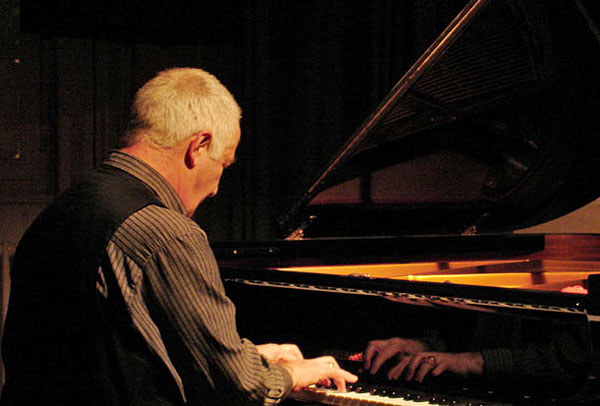
JT: That's what keeps the pianist alive, that intensity of concentration which is required. Cornelius had that. It was extraordinary. When I first heard Feldman's music, it was at a concert—I was taking part—Cornelius was playing some solo pieces and he had this wonderful variety within the prescribed softness. Feldman himself acknowledged it. Cornelius wrote beautifully about his early music. He compared it to Alice in Wonderland, going down into Wonderland and having to get used to the new light, the darkness. And you eventually get used to it. That was a beautiful analogy. It was typical of him; the commonplace and the magical were all part of his vocabulary.
Talking about improvisation and repertoire, I recently performed Feldman's "For Piano and Orchestra." We played it in Glasgow with the Scottish Symphony Orchestra and an Israeli conductor, Ilan Volkov; and it was broadcast. We were talking—in a radio interview—about playing with the orchestra, and I made the point about how different and difficult it is for a pianist to have to play with a conductor. Most of the piano repertoire is solo. Of course, there are many classical concertos. Mozart wrote many great concertos; Beethoven, five; Brahms, two; the Romantics wrote one or two; Ravel, two; Schoenberg, one. There are some highly talented classical pianists who are less comfortable with the concerto repertoire. It was very interesting, because during the rehearsal of the Feldman I kept coming in a fraction early, and Ilan, the conductor, said, "Don't worry, the pianist always comes in early." It is something to do with the attack, the beginning of the sound; the pianist tends to anticipate and come in too early. While the orchestra, Volkov told me, tend to be a little bit late; they're late, you're early. Apparently, German orchestras are very late in respect of the beat. I tried to adjust to that, but in one or two places there is a pretty obvious lack of coordination. Particularly when you have three individuals, say the conductor, a solo orchestral player (say, a cellist with a pizzicato) and the soloist—three people trying to coordinate the same attack. So the margin of error is miniscule. For me, the problem is also visual; I'm looking at the conductor, I'm anticipating the solo cello, horn, or whatever, and I'm tensing the hands to articulate a particular chord. It is very very difficult to do that.
Comparing that with improvising—when you prepare yourself, and you play when you're ready—with an orchestra you prepare yourself, with the tension in the fingers ready to play, but then you look, and you make the sound as and when you are told to. There are all these determinants which make it very difficult.
AAJ: This is the first time for a while that you and Eddie have played as a duo as AMM, isn't it?
JT: We released Norwich (Matchless, 2005), which is going back a few years. But we have played together a few times since then. We played with Sachiko M. We played with John Butcher, on Trinity (Matchless, 2008), which I think was very successful. We enjoyed playing together. We have played enough, I would say, but not necessarily with each other.
AAJ: Then there was Freedom of the City last year with John Butcher, Ute Kanngieser and Christian Wolff [released as Sounding Music.]
JT: About the time that Keith left, we did release a duo, but we didn't call it AMM. It was called Discreet Moments (Matchless, 2004). At the time the entitlement, AMM, was an issue. It hadn't been resolved.
AAJ: So it was AMM in all but name.
JT: Well, Keith and I released Duos for Doris (Erstwhile, 2003) and we didn't call that AMM. So when Eddie and I recorded Discreet Moments we decided that it wouldn't be appropriate to bring AMM into it. When it was confirmed that Keith had left the group, Eddie insisted that AMM had functioned as a duo before, so now we're functioning again as a duo.
AAJ: Was that controversial? Did you consider recruiting another member to replace Keith, or from the outset was it going to be the two of you?
JT: We haven't really considered a replacement. In any case, it might be a bit late in the day now, I think. We like to feel that we can just ask different people to play with us; we enjoy that. And I think we'll leave it like that. It would really be Eddie's call, not mine. In a way, we are freer. The two of us, we can mix and match as we feel appropriate. It would be wrong—it would be too late, I think—to start rebuilding a new AMM image. I can't really speak for Eddie, but I don't think he has that in mind at all. But certainly we both want to nurture the idea of playing with invited people.
AAJ: And it works well. Do you miss Keith's presence? It is coming up to six years that he has been gone from AMM.
JT: No. I don't mean that in a hostile way, but you deal with the situation that you are in. I think in a way I am a more reactive musician to Keith and Eddie. Whether there is Keith or Eddie or both, there is always creative music-making I can react to. I need that. It might be worth elaborating on that a bit, because I think Keith and Eddie are, if you like, born musicians; it was inevitable that they should become musicians. The very fact that they were self taught—they didn't have any pressure on them, which I did because I had a very conventional musical training. I could have done something else, but I had music thrust upon me by my piano teacher: "You will be a pianist. That is what you will do." And I said, "Oh well. OK. If you insist, I might as well." [Laughs.] I went along with it. My mum and dad were simple folk, and for them the teacher knows best. They knew I was talented, obviously. So that is what I did.
 Going back to this idea of a reaction, I always had a very strong emotional response to music. I remember—it must have been when my dad came home from the war in '45, when I was nine—I remember him playing some hymns on the piano. (He played the organ a bit as well.) For some reason, I found them incredibly sad, and I was weeping, just from him playing these hymns. I was a real music lover; I was very emotionally attached to music. Music can still create strong emotional responses in me. Anyway, I became a musician. When my dad played hymns, I just wept; when Keith and Eddie invited me to play with them, I didn't respond with tears; I reacted in another way, with musical piano sounds. That has always been very important for me—call and response.
 A propos, I was listening to "The Marriage of Figaro" yesterday on BBC4, and I was completely swept along by this; the energy and the beauty of it were absolutely extraordinary. I was quite overwhelmed. One of my favorite musical quotes is by a musician I admire very much because of the intensity of his playing and his touch—Clifford Curzon, an English pianist who died in 1982. He once said, when he was talking about music lovers and critics, "You know, they don't know what a phrase costs." And I knew instinctively what he meant by that. He was referring to the huge emotional and intellectual cost, what it actually demands of you to play the way he does. I have one particular phrase in mind from the slow movement of a Mozart piano concerto [K488; Piano Concerto No. 23 in A major] that has an almost unbearable intensity. I suppose, for me, in essence, that is what music is all about.
AAJ: Are you quoting that because it is equally true of you, you feel that same cost?
JT: Yes. I do. Or rather, I strive towards it, towards failing better. It is uneven, of course. You are not playing on the edge all the time but you must have that commitment, that seriousness, when you play. If not, why bother? I was going to say conviction, too. Maybe conviction is misleading because certainly in improvising uncertainty, hesitancy, can find elegant and moving expression. You are feeling your way; you're not sure whether you are making the right decisions, especially in the early stages.
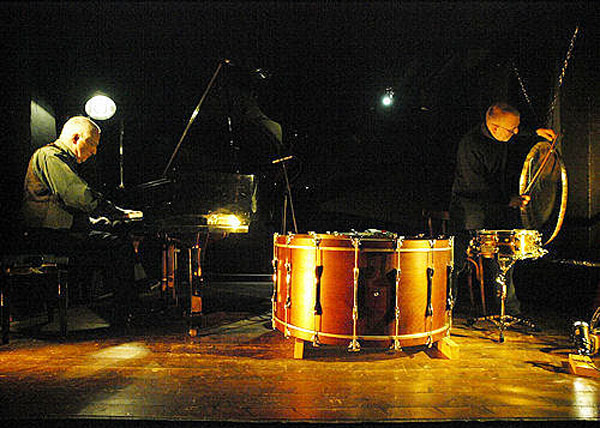
From left: John Tilbury, Eddie Prévost
I was listening to a program about the Tate Modern the other day. Nicholas Serota, the director of Tate Modern, was talking about the great number of people that visit it—millions of people each year. I thought about this; what exactly is the experience they are having there? J. G. Ballard described Tate Modern as a middle class disco. I'm not sure about that; I wouldn't have used that phrase, but I can see that the fact of going to Tate Modern in itself is of very little significance. What kind of commitment do the people who go there have? There are lots of people there. There are conversations behind you that you really don't want to hear; in front of you your vision is impeded. It is too much like ordinary everyday life, too much like walking down Oxford Street—part of a day out, conveniently fitted in. Exactly what kind of experience is it? Are they just "doing art?" Compare that with our concert at King's Place. The Tate Modern is handed to us on a plate, with considerable inducement; it provides status, especially to business. Some works at Tate Modern purport to represent the human condition, yet they serve only to anesthetize. At best, they create a feeling of empathy. But we don't need art to feel empathy. The anger and fury of the young British Islamists was not fuelled by art, but by switching on their TV sets and watching the news. Political art is problematic because, more often than not, the song is invalidated in and through the culture that sings it.
The Feldman concert—that is something else. There you have a group of people who commit themselves to sitting and listening and concentrating for one-and-a-half hours. That is completely different. How many people have the time to sit and listen and reflect for even 10 minutes, never mind an hour-and-a-half. This degree of commitment is unusual. What I think we were doing, apart from anything else, was satisfying a contemporary need in people for calmness, attention, concentration, respect for others.
AAJ: People do give that depth of concentration in a concert, which they may not while listening to CDs at home.
JT: Where you are very vulnerable to distraction.
AAJ: With an art exhibition that you really like, you go back to it four or five times, for exactly that reason.
JT: Yes. You go in there for, say, 10 or 15 minutes and just look at one painting. That is it, and then you just leave. Although there is always the risk of disturbance. It is such a private experience, you don't want people to be there. You just want to be by yourself, looking at a painting. There is a Vermeer in Vienna that we have been to see a few times; Janice likes to go there just to experience this Vermeer painting. I think she is so jealous of her experience—it is so precious, fragile, vulnerable, that she wants somehow to protect it.
I remember going to a concert with a pianist I much admired, the Austrian pianist Friedrich Gulda. He also played jazz. He won the Beethoven prize, which he returned. When I was a student in Poland, in Warsaw, with a bunch of students, we went to hear him play. He played Mozart and Beethoven first, then after the intermission he played Debussy. The Mozart was so pristine, so magical that I decided I didn't want to hear anything else; I'd had enough. So I didn't go to the second half. But afterwards we met him and I told him I hadn't been to the second half and told him why. He said, "I can understand that, but it is a pity you didn't hear the Debussy. It was even better." [Laughs.]
AAJ: Is your own emotional response to the music that you described your ideal of what you want the audience to experience when you play? Is that what you hope for?
 JT: I do. Ideally, I want it to be life-changing. I'm certainly not doing it for my own self-gratification. I strive towards something worthwhile, which brings the musicians and listeners together
 I have spoken about music and tears. It is not often that people weep during performances of music, even these days. Of course, you don't have to weep if you have an emotional response. But I remember once playing "Triadic Memories," and at the end of the performance two women in the audience were weeping, one older, one younger woman. I knew one quite well, the other one not so well—I knew her husband, who was a German music critic. It was entirely inappropriate for me to say, "Why are you weeping?" but I tried to figure it out. Perhaps it was because of this wonderful fragility and vulnerability of the music, which was emblematic, in a way, of the human condition. I like to think that is what it was. I can't think of anything else. Apparently—you may have heard this yourself—people go to the Rothko Chapel in Houston (AMM went, we didn't play there but we visited) and quietly weep. But that is quite a heavy scene. All those black paintings, in some ways, it's quite oppressive. There is a kind of charged atmosphere.
 AAJ: If people go there, it seems more to do with what they themselves are taking there, rather than what they find there.
 JT: Yes, I think that is so.
AAJ: Were you learning [the piano] from a very young age?
JT: Yes. Well, not that young. I did have a few lessons during the war, but that was when I was away, evacuated down to Torquay. Really, I started—in fact nowadays it would be considered to be very late—when I was nine. The war ended, and I was already nine. That was when I began lessons with Dorothy Symes, a local piano teacher, and I was with her right the way through until I was 17 or 18 when I went to the Royal College of Music. It was a very conventional trajectory my musical career, really. Yes, Mrs. Symes was a very emotional woman, nervous and highly strung. She was often moved by performances of music; you could tell music meant everything to her. Emotion was an important component of our lessons, though it was never really discussed as such.
Cornelius used to talk about music's uncatchability. That is a very important part of it, I think. Music disappears into the ether. It can't be mummified. Recordings are simply a reminder, a document that something took place. I remember when AMM played Oregon, I think it was Portland, or maybe Seattle. Anyway, some young guys knew all of our records but they said they're nothing like the real thing. [Laughs.] That is the truth of the matter.
AAJ: You mention Cornelius. The book you wrote about him was a labor of love for you, taking over 20 years to write. By the end, did you feel that it had captured the essence of Cornelius as you knew him?
JT: I do. Yes. I don't make any excuses. I think it did. It is a serious book, and obviously he was such a rich and complex character that people have different takes on him. I tried to be ultra-democratic. I was always asking people's opinions, and there are lots of interesting views.
AAJ: There is a vast cast of characters in the book.
JT: They all have their say. So the richness of the character comes through, not just from my musings but as a result of what other people conveyed to me. So, I think, I hope I did him justice
I'm pleased because I did my best, and I think I achieved something. There has been a very positive response from all kinds of people, some who knew him very well, some not so well. I am constantly meeting people, out of the blue, who have read the book and respond in quite different ways.
For example, the Scratch Orchestra—some people have a slightly different take on him. Some people thought I had painted him rather too negatively, but other people thought I gave him too much credit.
AAJ: It seemed to capture what it was like at the time.
JT: The Scratch stuff draws on a lot of contrasting memories from various people. That is how it was. There is a very good film by Hanne Boenisch, [Journey to the North Pole] who sadly died last summer. Hanne Boenisch was a German filmmaker who came with us when we went to Newcastle. She made a film of the Scratch Orchestra, a very good film—a documentary. Luke Fowler's film [Pilgrimage from Scattered Points] is interesting but it is an art film—also very good, but naturally from a quite different perspective. Hanne's film is a documentary, and you see Cornelius talking and reflecting. It's interesting stuff. I tried to capture the atmosphere—how it was in those days. They were good times; I feel privileged to have been around at that time, not only with Cornelius but just around in the '60s, being able to appreciate all those wonderful dreams and illusions we had.
A lot of people I know found the second half of the book quite difficult because it is relentless, but that is how it was. In a way, I wanted to get that feeling of relentlessness into the reader. I didn't intend it to be easy. I could have compressed it, but I keep repeating it—a bit like a performance, in a way. And people think: "There's another ten pages of this!" That is how it was. The reader experiences that intractable feeling of it going on and on and on, not stopping, not giving up—page after page after page—all the time. That is how it was. And it constitutes half the book.
 AAJ: Musically, he is such a complex character to get a handle on. There are so many facets to him. The section on "Treatise" makes it seem like an unfathomable work—which is part of its charm.
 JT: It is what it is. Your approach, if you decided to interpret a few pages of it—as long as you were doing it in good faith, i.e. seriously—your performance would be just as authentic as mine. There is no way in which my knowing more about the composer than you suggests a less authentic interpretation—it wasn't meant like that. It was for future generations to make of it what they can. There is no sense of my being able to claim any authenticity. I just describe how it was at the time, and how Keith and I and others dealt with it. There are no prescriptions of how it should be interpreted; people go about it in many different ways.
AAJ: There are several recordings of it, and it was also performed at The Drawing Room, by Rhodri Davies and company.
JT: Rhodri is a very talented and sensitive musician; I've played with him a few times. I have performed the whole thing solo myself. I did it in Glasgow once; I recall not being very happy with that particular performance.

AAJ: It is really about what effect playing with the graphic score has on one's playing. Is it different than if one were improvising in the same time?
JT: It is, very much. In fact, one of the early AMM recordings contains an improvisation from the same concert—I think we were in Chicago—the first half is "Treatise," the second a free improvisation with three of us; it is very different music. Although all of us, especially Keith and Eddie, have a very free way of interpreting it, I was probably more influenced by my more traditional conservatory training, because there are many associations with traditional notation, as you know. But it does sound very different; it is quite interesting to compare the two, actually. What Cornelius said, which sums it up really, is: "People make their own music in response to my 'music,' which is the score itself." Cardew makes no proprietary claims.
In an interview with me a few years ago, a music journalist posed the following question: "You're sitting at the piano bench readying yourself to play. The audience is hushed; there's an air of anticipation. Your fingers are poised over the keyboard. At that critical moment, do the mental processes you go through differ according to whether you're about to play a composition or an improvisation? If so, in what ways are they different?" I answered as follows: There are no hard and fast contrasts. Both modes are subject to constraints, imposed from without, which determine what and how one plays. Playing the score, of course, the notation prescribes the broad limits—whereabouts on the keyboard, a relative duration, a relative dynamic (sometimes). Crucially, it does not tell you how to make the sound, nor even, actually, what sound, what A-flat, for example—its tuning, its timbre; such contingencies depend upon the instrument, and the tuner, the room temperature, etc. So if the hands are poised and the muscles tensed, this state of bodily affairs is only partially determined by information gleaned by the player from the score. Incidentally, playing solo (from the score), one should not underestimate the leeway enjoyed by the performer: deciding the actual moment of execution from the moment of sitting down at the instrument. Compare this with playing under the control of a conductor's baton, for example.
The leeway in free improvisation is greater; one can wait until the music is already underway, has established itself, thanks to the initiative of the other players. But here, too, the first sounds of a set may come as a response to an external provocation—perhaps, though not necessarily, less specific than a musical notation. Once, Keith Rowe even described his own body as a "very strict composition—you get legs dangling down there and arms floating around, so many fingers and one head."
< Previous
Zollar System
Next >
Seek It Not With Your Eyes
Comments

Tags
For the Love of Jazz
 All About Jazz has been a pillar of jazz since 1995, championing it as an art form and, more importantly, supporting the musicians who create it. Our enduring commitment has made "AAJ" one of the most culturally important websites of its kind, read by hundreds of thousands of fans, musicians and industry figures every month.
You Can Help
To expand our coverage even further and develop new means to foster jazz discovery and connectivity we need your help. You can become a sustaining member for a modest $20 and in return, we'll immediately hide those pesky ads plus provide access to future articles for a full year. This winning combination will vastly improve your AAJ experience and allow us to vigorously build on the pioneering work we first started in 1995. So enjoy an ad-free AAJ experience and help us remain a positive beacon for jazz by making a donation today.

Giveaway

Eligible winners: 15
Days remaining: 3
Days remaining: 3






