Home » Jazz Articles » Interview » William Ellis: Music On A Chink Of Light
William Ellis: Music On A Chink Of Light

 Black and white photographs of jazz legends taken by the likes of Herman Leonard, William P. Gottlieb and William Claxton have gained iconic status over the years. Decades on, their photographs of Charlie Parker, Dexter Gordon, Billie Holiday, John Coltrane, Chet Baker and Miles Davis adorn countless walls of jazz aficionados around the world. These photographs may owe their status, at least in part, to the fame of their subjects. Back in '89, as a photographer struggling to build a name for himself, William Ellis knew only too well that for the doors of opportunity to swing wide open for him, he too had to land a big fish.
 One photograph of Miles Davis, one captured moment, opened these doors and launched the career of one of the most interesting and dedicated of the modern generation of jazz photographers. However, like the musicians he photographs William Ellis has paid his dues; long years of photographing festivals and local events up and down England honed his talents and gave him a taste for performance photography. When the defining moment came, Ellis was ready to pounce. He hasn't looked back since.
Anyone who has seen Ellis operating, prowling around the edges of the stage, often removed from the scrum of photographers at the bigger festivals, can appreciate that here is an artist at work. There is an intensity about him that utterly belies his gentle, quiet demeanor and quick humor in conversation. His absorption in the task at hand, in his craft, is total. As with a dog jealously guarding a particularly juicy bone, it would not be wise to tap him on the shoulder in this state.
Ellis studies his subject, gets a feel for the music and the personality that is creating that music and decides in his mind what picture he wants. More often than not, that moment presents itself and, in the click of a shutter, is captured. "I want to make a picture that will last," explains Ellis. "That's always what I'm trying to do, otherwise what's the point? I don't just want to turn up and take pictures of something happening, I want something that really affects me and, I hope, affects other people too."
A love of the music and a profound respect for its practitioners drives his work, but the outcome of his labor comes down to the light, which dictates everything. Music may be his muse and light his mistress: music on a chink of light.
"Light is the key," says Ellis. "I don't analyze my pictures, or any pictures too much. I guess it's more instinctive now, more intuitive how a picture's been made in certain respects, but light is definitely the key. In a stage situation, you have got no control over the light. I envisage how I can use the existing light there to create an image that's going to tell you something—that enriches the viewer with an image that rings true."
A lot of Ellis' inspiration has come not from fellow photographers—though he cites a long list of those whose work he admires—but from painters.
"I look a lot at paintings, and how artists use light to shape, accentuate or hide elements to create drama and narrative. The way that light has always been used by painters never changes. I've always been interested in art, the Dutch painters, all the usual suspects who painted portraits and still life. Those influences, European artists and then later American artists like [Edward] Hopper—they're all in your mind at the same time, and it's not a conscious thing; it's subconscious, like film noire." This subconscious association with a classic cinema genre may go some way to explain why many of Ellis' pictures appear to have been shot in the '50s. Still, paintings and not the moving picture, as he reiterates, are his main source of inspiration.
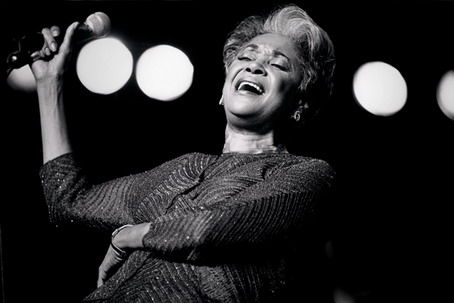
"Over the years, I've made a point of going to galleries and soaking the whole thing up. I was in Guangzhou last October, covering a concert for the Hong Kong Jazz Festival, and I went to the gallery where there was an exhibition to mark the 60th Anniversary of the revolution there. They had all these traditional Chinese artworks right through to Yue Minjun. I feel that any young people who are interested in photography can do nothing better than go and look at paintings. The more reference points the better—local artists, any artists. Any painting you can see, you should go and see it. It's like music—the more you hear, the more you will enjoy."
It all began for Ellis in the late '70s, as he recalls:"I'd done town events and small festivals in the northwest of England; I always shot with permission and charged for the pictures. I was used to working in that kind of environment where you are there to do a job and if you don't get the job done, boy, you're in a pickle.
"As in every endeavor, determination and commitment are vital to achieve what you need to do, but being polite and using a little charm are as important.
"I'd been lucky enough to photograph some major figures there like Cleo Laine and John Dankworth, Julian Lloyd Webber, the cellist, and Burl Ives, believe it or not! All these amazing characters; a lot of them have left us now. It gave me a taste for performance photography. I was in my early 20s, and it kind of got under my skin a bit."

Ellis would soon all but abandon photography, only to take it up some years later, inspired by another passion: "I left photography for a while until my late twenties, when I started getting into jazz seriously. My feel for the music came from Frank Sinatra, Count Basie's orchestra and all those tremendous orchestrations my mother played on the radio. Then I got into Miles."
The turning point, however, was in '89, when Ellis read that Miles Davis [left] was coming to play in England. "I just had to go and see him, though I never thought I'd be able to photograph him. I was scrabbling all over Manchester with my contacts to get accreditation to shoot, and I couldn't. Everybody wanted to shoot Miles Davis."
Ellis eventually tracked down the promoter, who was obviously impressed with the fact that Ellis had actually paid for his tickets for both nights. A compliment slip was left for Ellis to collect at the booking office, and he had the necessary permission to photograph Miles. Getting in was one thing, getting a picture which would set him apart from all the other photographers was another.
As Ellis is the first to admit, an element of luck can play a part in the capturing of a photograph, without a doubt. "In this situation with Miles, there's a strong side light coming in from Miles' right, which creates drama and strength. The stance of the subject is very direct, confrontational almost. That was lucky that light was there, he stood there like that, and I saw it. "
Ellis' photograph of Miles was used for the program of the trumpeter's concert in Glasgow the following year. "That's what opened all the doors," explains Ellis. "If you get the chance you take it. That gave me some credibility and the accreditation to shoot at jazz events and festivals and get other things rolling. I started to get work and commissions. From there I was able to build up the archive—the body of work of all the other great musicians—so thank you, Miles."
Since that evening at the Manchester Apollo over 20 years ago, Ellis has come a very long way. In the last year alone, he has photographed all the major jazz festivals in the UK, and has also clicked his shutter at festivals in Bremen, Mexico, New York, Hong Kong, Cuba, Ireland and Malaysia. Then there is all the stuff that happens in between, like organizing exhibitions and giving seminars.
Needless to say, in the last two decades, Ellis has photographed a lot of the greats in jazz, both historical and contemporary, and he talks of his profession as a privilege which he never takes for granted. "How could you ever meet these people?" enthuses Ellis, shaking his head slowly in wonder. "Louie Bellson, Clark Terry, Jimmy Heath—it just amazes me."
These days, Ellis is in demand around the world, but in the early years before invitations to festivals like Cape Town or artist-in-residence status at North Sea Jazz became the norm, Ellis would drive 500 miles from Manchester to Glasgow in an evening to photograph Bobby King or Dizzy Gillespie and then drive 500 back.
"You've got to be determined and you only get out of it what you put in. It's very much a case of paying your dues, and I still am. You should take nothing for granted, but have a presence, a respect for yourself and the pictures you've shot over the years, and for who you've photographed."

The respect that Ellis has for his subjects can be measured not only by how he always shoots with permission, but by the way he talks about the musicians: "I remember some years ago photographing Albert King in Glasgow, and he was in a wheelchair; he gets up, picks up his Flying V and just plays the life out of it, then gets back in his chair and then they wheel him back out. Clark Terry, the same; I photographed him at Birdland a couple of years ago, and again they wheeled him in, he got up, picked up his horn and he was a different man. That's what music can do. I'm still blown away just by being within ten feet of these people."
Similarly, when asked about the photograph that got away, Ellis' anecdote reveals an uncommon respect for artist and audience alike: "The one that really sticks in my mind was the Miles Davis tribute tour in '92, with Wallace Roney, Herbie Hancock, Dave Holland, Wayne Shorter and Tony Williams. I saw it in Glasgow. I can't recall what they were playing, but it was a really quiet part, and on the backdrop there was a massive shadow of Wallace Roney playing just like Miles, and it makes me tingle now to think of it, but it was simply too quiet to go 'click.' I just thought, 'I can't do it.' The music was too important."

In conversation with Ellis, one of the things that come across is that there is some kind of an exchange going on when he photographs a musician—two artists giving of themselves. Full in the knowledge that he is both taking and receiving something from his subject, Ellis is quick to reciprocate: "I always like, if I see the musician again, to give them a nice print" Ellis says.
"This is Michael Brecker's tenor, and that's Randy, his brother, in the background. It's a picture which is obviously very poignant now, though at the time, you don't think about what can happen. I gave him this print when I saw McCoy Tyner and Michael Brecker at the Iridium, NY, and he just looked at it and said, 'That's a nice one' and disappeared—beautiful, like a big butterfly breezing in and out."
There is a unifying thread to Ellis' work, whether it be a performance shot in a club, a concert hall or festival, or a portrait of the musicians he so admires; that common denominator is intimacy. Action shots, per se, are not what he's about. Many of the subjects of Ellis' photography are captured, revealing a softer, more vulnerable side to their often larger-than-life personas on stage.
This is something about his work that Ellis readily recognizes: "It's a very considered thing; when I look through the work that I've done, there's a definite feel to it. Maybe I'm too close to it, but they are quite peaceful pictures, really. I think there's a bit of the blues in my pictures, and that's possibly part of what people connect with as well—that kind of slight poignancy, the emotion that music gives us and the shared humanity."
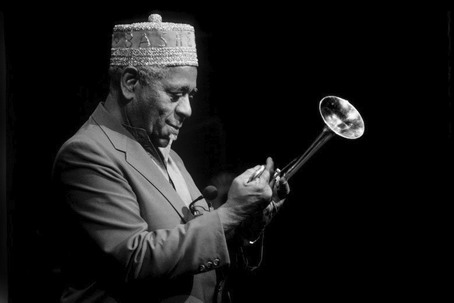
This ability to capture the essence of a musician, stripped of the mantle of entertainer is seen to great effect in Ellis' photograph of jazz's greatest clown, Dizzy Gillespie: "This picture of Dizzy Gillespie [below] is a very gentle picture, a very contemplative picture. The light is beautiful and soft—he's turning to the side of the stage. That's giving us shape to the face, it's giving us definition, and it's giving us a little bit of contrast, but not too much. It's still a gentle picture which matches the expression. Sometimes all these elements come together, and that's what makes a picture. Having that appear and recognizing it and recording it—to me, that's what I'm about."
Light is never far from any discussion of photography with Ellis. When describing a photograph of pianist Mulgrew Miller he refers to the "Rembrandt quality" of the light falling on his cheek: "The light and the movement and the shapes that it makes are what make the picture.
"Maybe because I'm so conscious of the light, I'm trying to make a picture that will last, one that isn't tiring to the eye. It shows the person clearly, not just in terms of focus but in terms of who they are and where they're at, and what kind of feeling you receive from the musicians as a viewer.
"In a way, I'm trying to define what the music means to me and what that musician means to me. I don't know them personally, but I can know them a little through their music; we all feel we know the musician to some extent."
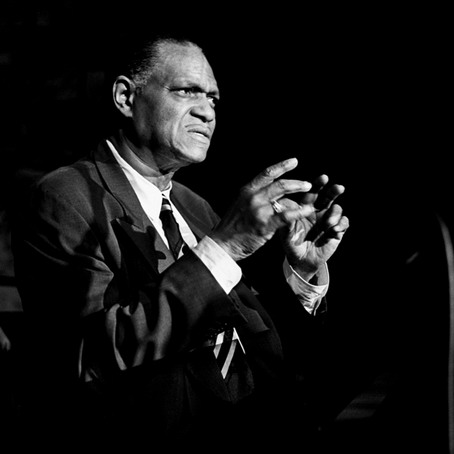
Ellis is not the type of photographer who shoots off hundreds of photos and selects the one that most appeals. He has an idea of the picture he wants, and he waits for it: The picture of pianist McCoy Tyner [next page] was one of only six shots Ellis took at this session, and the result is undeniably powerful.
Tyner—the great pianist of John Coltrane's '60s quartet and a living jazz legend—appears in Ellis' photograph with the intensity of an Evangelical preacher, the commanding strength of a heavyweight boxer. "You can see the shadows under his nose and the shadows under his fingers—this is a very three-dimensional figure, very strong, very powerful, but kind of soft at the same time.
"As a picture, it's a kind of homage to Karsh," continues Ellis. "One of my big influences was [Yousef] Karsh, the way he used light and lit things. It's fairly studied, though it is a stolen moment. You have the light and the tungsten look. He looks elder statesman-like, respectfully observed—a respectfully observed master."
That mixture of respect and reverence towards Ellis' subjects is tangible in his photos: "From when I first started taking pictures, I felt that musicians—wherever they're performing, at whatever level—are messengers. They bring a point of view, sadness, a joy. I know they're all human like everybody else, but in a performance context they acquire another dimension, so in quite a few of my picture I can see the artist depicted heroically."
Ellis is passionate about the music and its practitioners: "Music drives the whole thing," he explains. "It inspires the image. I am oblivious to anything else. I'm very focused on getting the image that I feel should be there—it has to be discovered."
"I get a feel for what's happening, get a feel for the music. Then I choose my spot to work from. If it's not working, I'll move somewhere else.
"Yeah, you need some luck," acknowledges Ellis, "but I think you have to have something envisaged in your mind to be able to accept what's in front of you—to have a considered view of what you're trying to create, the mood you're trying to reflect. I'm trying to show a moment that's not there—a moment that's not always seen. The luck sometimes is maybe that there's not a mic stand in the way."
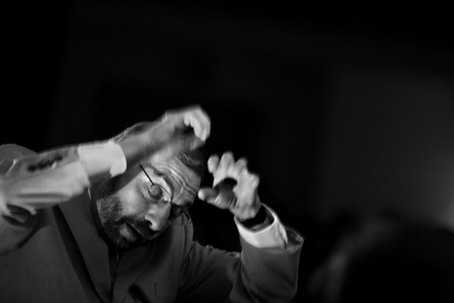
The more composed pictures in Ellis' oeuvre tend naturally to be taken offstage, like this photograph of singer Kurt Elling [below] which was shot in '09, shortly after Elling came off stage in Toronto where he had been performing with a big band. "He was doing the whole Sinatra bit," recalls Ellis. "He came off stage, and he was just kind of prowling around in this big room back stage, just coming down a little bit. He was about to go to the door to leave. I went over, introduced myself and said I'd like to make a special portrait of him. He looked at me and said, 'Okay.'
"I'd seen some down lighters to the side of the room, which was effectively the only source of light. That downward light is going to suggest drama, so that's what I went for. This was taken with a standard 50mm lens. I've got it in my mind what I want to do—I want to go for that Brando look, and there we go."
Whether shooting in a club or a festival or taking portrait pictures, however spur-of-the-moment they may be, it is very rare that Ellis is refused permission to shoot. No doubt this has a lot to do with his manner—respectful yet gently persuasive. This respect also extends to the audience whom he is standing in front of and working around, and whom sometimes he asks to move to accommodate the shot he needs.
"The way you speak to people, your manner, is so important," affirms Ellis. "You have to be confident but not a pain in the neck. When you're shooting, you have to be conscious that the audience is actually paying for this. It's a balance of always acting professionally, always being respectful to the musicians primarily—without them we've got nothing—and also respect for the audience.
"If I see that the only place I can get the shot I need is from the front row, I smile at the person, and say, Would you mind for one minute?' It's never happened that I haven't got the smile back. People know what you're doing and are on your side if you're courteous and thoughtful."
This approach to his work has seen Ellis establish an already impressive portfolio, and his talents have been recognized beyond the international jazz festival circuit.
 The Bridgewater Hall, Manchester commissioned Ellis to create a document of the different genres of musical performance they have there for an exhibition staged in May, 2010. Ellis photographed Tommy Emmanuel, Liza Minnelli, Buena Vista Social Club and the Halle Orchestra. It has been, as Ellis testifies, a rewarding experience. "It's been very exciting to photograph other genres of music and to see the common link that unites us all in every type of music, in terms of communication and brotherhood."
 In recent times, Ellis has spent more time doing photographic portraits than in the past. It's a whole different ball game from shooting concert pictures, but again, capturing intimacy for Ellis is the key. "It's more personal; on stage it's more of an arena, and I do enjoy that side of my work, but a portrait has a different significance.
"In the portraits, I'm very relaxed and quiet, and that is reflected back. One of the things that I enjoy and place most value on is that personal contact, that eye-to eye, even if it's only for two minutes. It's very intense, but at the same time relaxed and intimate.
"When it's over, it's a shake of hands and away. An exchange has taken place, a quite profound exchange. There's an affinity, for that person to be so giving of themselves. I love that intimacy. It fascinates me what people give out, and how they give it out to you and how you respond to it. It's what photography's about for me—it's an exploration of people. You're actually photographing yourself in a way, because it's the way you see things. It's like a mirror almost."
When it comes to photographic influences in addition to Karsh, Roy De Carava is one of the first names that springs to Ellis' lips. "I think he was the first Afro-American to have photographs purchased by Steichen in the Museum of Modern Art New York photography section there. He made massive steps for photography in the art world and also for Afro-Americans to be lionized in these establishment areas.
"His work was Harlem life. It's a document of a lifestyle because he was living it on the inside. When you see his work—The Sound I Saw (Phaidon, 2001) or The Sweet Flypaper of Life (Simon & Schuster, 1955) your jaw will drop—it's got so much spirit, humanity and warmth. It's very significant, profound photography.
"Then you've got people like William Gottlieb and Herman Leonard and those guys, and Lee Friedlander, who did a killer book on different genres of American music. He's better known as an art photographer now. In terms of jazz photography, probably Herman Leonard, because he's the other side of the coin to Roy DeCarava; Roy's work was real life and Herman's is more studied, more composed."
Although Ellis would shy away from any comparison with the likes of Leonard or DeCarava, his own talents have received notable recognition. Ellis was invited by the American Jazz Museum in Kansas to produce its inaugural International Exhibition in 2005, an honor which still humbles Ellis today.
"It knocks me out to feel part of creating the visual heritage of music and to be recognized in the States. It's indicative of the outlook of jazz—no nations, no borders— that a guy from England should be invited to produce the inaugural International Exhibition at the American Jazz Museum, in Charlie Parker's home town. I feel enormously privileged."
The American Jazz Museum recognizes Ellis' talent and the role he plays in portraying and recording this greatest of musical art forms, and has supported him in giving presentations of his work in Hong Kong and Penang, where this interview took place.
In addition, Ellis was invited to serve on the committee of the Milt Hinton Award for Excellence in Jazz Photography, where he sits alongside the legendary Herman Leonard. Ellis invited Leonard to attend the opening of another exhibition of his work at the American Jazz Museum in 2008: Jazz in Black and White: Bebop and Beyond. "He wrote back saying he couldn't attend," Ellis recalls, "but sent me a lovely note which read: 'Beautiful images; glad to see someone younger has the eye. Herman.'"
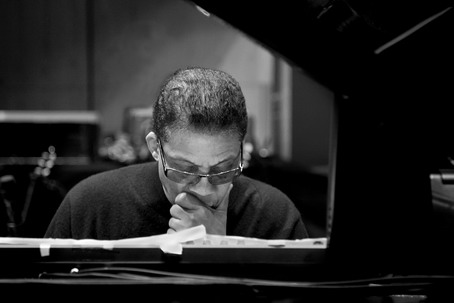
Ellis has plenty of good stories about his years photographing jazz artists all over the world, and plenty of photos, too, showing the lighter side of the subjects of his photos: "I went to see Herbie Hancock in Manchester. He was introducing his band—a really hot band, of course —saying he's the leader of this band, and he's just won an Emmy for this, that and the other, and when he comes to the harmonica player, Gregoire Maret, he says: 'All he has to do is turn up with his harmonica, and that's it.' Everybody laughs and then he says: 'Mind you, I don't have to bring the piano.' He's got a ten-ton truck carrying around his concert Grand. And you could see the thought had just occurred to him. It just cracked me up."
Ellis recognizes an affinity between playing jazz and doing jazz photography—two art forms which are carefully constructed yet which contain freedom, movement, spontaneity and inspiration. "Jazz to me feels in some way like a concept," explains Ellis. "It's a manifestation of feelings and attitude, but there's nothing there until it happens, and for me that's the same with a photograph. You have to have butterflies in the stomach to really go and do it. Every time I pick up a camera I have the same feeling, I imagine. I'm not a jazz musician, though I played in bands as a kid, so I have a little insight into how it feels.
"So you have your knowledge, your experience, your influences, your ability and your confidence, but nothing happens until you make it happen, whether it's hitting a note, hitting a cymbal or hitting a shutter. That's part of the great thrill—the abyss that you look down into, and there's nothing there until you make it appear. That excitement is a big part of the drive and inspiration that keeps things happening, and I think that's probably true of most forms of expression, whether it's visual arts or performing arts—that wonderful intake of breath just before you go over the edge.
"I reach a state of mind, a point at which I know that I can make an image and convey what is happening. When I'm in that state of mind, it's a very serious state of mind. It's a very intense thing. You have to have that edge in whatever field you're in. You've got to deliver, and you're delivering to yourself, in many respects. I won't be deflected. It's an intensely personal thing. I'm creating a body of work—that's what I'm about."
Without a doubt, the drive, focus and determination to succeed that emanate from Ellis have been the major factors behind his already impressive body of work. It is a body of work that suggests that Ellis can already be considered as one of the most significant of contemporary jazz photographers.
"Some people might think that jazz photography has been done. What I do is for now and as time passes all things are viewed in a different context, but if you think about Louis Armstrong—did they break all the trumpets after Louis? No. Then there was Roy [Eldridge], and then Dizzy [Gillespie] came and then Miles, and Terence [Blanchard], and another Roy—somebody else picks it up in their time, and the band plays on."
View more William Ellis photos.
< Previous
Lock My Heart
Next >
Luz
Comments
Tags
William Ellis
Interview
Ian Patterson
Charlie Parker
Dexter Gordon
Billie Holiday
John Coltrane
Chet Baker
Miles Davis
Cleo Laine
John Dankworth
frank sinatra
Count Basie
Louie Bellson
Clark Terry
Jimmy Heath
BB King
Dizzy Gillespie
albert king
Wallace Roney
Herbie Hancock
Dave Holland
Wayne Shorter
Tony Williams
Michael Brecker
McCoy Tyner
Mulgrew Miller
Kurt Elling
Tommy Emmanuel
Milt Hinton
Gregoire Maret
For the Love of Jazz
 All About Jazz has been a pillar of jazz since 1995, championing it as an art form and, more importantly, supporting the musicians who create it. Our enduring commitment has made "AAJ" one of the most culturally important websites of its kind, read by hundreds of thousands of fans, musicians and industry figures every month.
You Can Help
To expand our coverage even further and develop new means to foster jazz discovery and connectivity we need your help. You can become a sustaining member for a modest $20 and in return, we'll immediately hide those pesky ads plus provide access to future articles for a full year. This winning combination will vastly improve your AAJ experience and allow us to vigorously build on the pioneering work we first started in 1995. So enjoy an ad-free AAJ experience and help us remain a positive beacon for jazz by making a donation today.

Giveaway

Eligible winners: 15
Days remaining: 11
Days remaining: 11