Home » Jazz Articles » Bailey's Bundles » Laurie Antonioli: A Constellation In The West
Laurie Antonioli: A Constellation In The West
Formal study, careful examination of Nancy King, and an invitation by Mark Murphy brought Antonioli and her developing scat chops to public attention. During this period, she concentrated largely on bebop, drawing her into orbit with excellent but largely unheralded saxophonist/vocalist Pony Poindexter. Poindexter took Antonioli on the road for a European tour that ended as an eight-month pilgrimage.
In 1985, Antonioli debuted on vinyl with Soul Eyes (Catero Records), recorded with pianist George Cables. In the years following, the singer became a staple of the Bay area, working with singers Bobby McFerrin and Jon Hendricks, pianist Cedar Walton, and most closely with the late saxophonist Joe Henderson, a relationship lasting until his death in 2001.
Antonioli has spent the lion's share of the years since 1985 working as a music educator in the US and abroad. In 2002, Mark Murphy suggested Antonioli for a professorship in the jazz vocals department at KUG University in Graz Austria, where she worked until the summer of 2006, when she returned to Northern California to teach at the Jazz School in Berkeley.
Surrounding her repatriation, Antonioli returned to the recording studio, recording two new collections, the second being American Dreams (Intrinsic Music, 2010). Once lost to the academy, Laurie Antonioli has returned in a big way, emerging as a powerful constellation in the west. Here is what she has been up to in the studio under her own name.
 Laurie Antonioli and George Cables
 Soul Eyes
Intrinsic Music
2010 (1985)
What the duet Soul Eyes reveals in Antonioli is a talent evolving with impressive velocity. As a debut recording goes, the singer emerges fully formed with chops to burn. Antonioli and pianist George Cables ride a minimalist "In A Mellowtone" out of the chute, Cables playing with Count Basie-like attention to notes, sprinkling only those necessary to support Antonioli's fresh-scrubbed youthful voice. Her scat shops are perfectly intact, melding naturally with Cables' piquant comping. "Prelude to a Kiss" is humid Duke Ellington, Antonioli, relaxed, dancing with Cables in a full-bodied performance, the pianist more orchestral.
The ballad "Lazy Afternoon" displays the paradox of Antonioli's youthful maturity. By the time of these recordings, the singer had already sung with Mark Murphy and toured with Pony Poindexter. That wealth of bandstand experience provided Antonioli abilities beyond her years. This manifested as a fresh approach to established standards that could not be achieved by older artist. Juxtaposed against the exacting scat of Charlie Parker's 1948 composition "Barbados," a view of Antonioli's range is readily secured.
Antonioli covers two tunes composed by uber-composer Larry Gelb: the angular "Bird Lives" and the inventive "I'd Like to Melt Your Ego for Dinner." On these difficult tunes, she excels in navigating the songs' melodic corners and recesses with Gelb's too clever lyrics. Antonioli revealed that a full album of Gelb songs was once recorded and never released. From these samples, release of this material would certainly be welcome. Soul Eyes was a bright and assertive debut by an artist intent on further growth and evolution.
 Laurie Antonioli featuring Nenad Vasilic
 Foreign Affair
Nabel Music
2004
Twenty years later, Laurie Antonioli's musical vision was fully expanded. Where Soul Eyes showcased a keen jazz sensibility, Foreign Affair shows Antonioli picking up where Cassandra Wilson left off with recordings like Blue Light 'Til Dawn (Blue Note, 1992) and New Moon Daughter (Blue Note, 1995). Wilson opened the jazz doors to a more organically conceived presentation, recasting the expected ("You Don't Know What Love Is") and unexpected ("Death Letter"). Where Wilson plied her wares with increasingly larger groups with increasingly esoteric instruments, Antonioli keeps things small, acoustic and very fundamental.
The majority of Foreign Affair is original material by Antonioli and bassist Nenad Vasilic, a titanic talent himself. The neighborhood of the music is distinctly Eastern Europe, brandished by the presence of Vasilic and the rich Old World heritage of Antonioli herself. Heritage informs every song on this disc. The opener is a Vasilic original, "Ballad for Djole," a languid tango that readily illustrates the value of drummer John Hollenbeck to jazz and music in general, and also exactly how breathy a tenor saxophone played by Johannes Enders can be. Sensual, sexual, slowly ebbing, this piece perfectly frames what can be expected from the rest of the disc.
"Holy Water," written by bassist John Shifflett and Antonioli, is a crisply beautiful tome on spirituality, sporting Vasilic's exacting bass and Ender's soprano saxophone. "Where Flamingos Fly" returns to the languid voluptuousness of the opening number, propelled by Vasilic's demanding bass figure and guitarist Armen Xhaferi's modern accompaniment. Likewise is Vasilic's "Tschusch Chochek." Hollenbeck's precise and understated drumming balances Antonioli's Eastern thinking vocalese, achieving an unusually fine musical eutection. Antonioli's "I Know You" might be the jazziest of the pieces, but then again, it is more broadly based. Joe Henderson's "Crni Narcis" and Keith Jarrett's "The Cure" reveal the singer's acute interpretive power. The latter presents more Antonioli vocalese/scat talent, presented to very great effect.
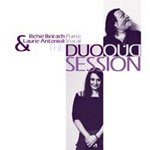 Laurie Antonioli and Richie Beirach
 The Duo Session
Nabel Music
2005
While chronologically next in the Antonioli discography, The Duo Session was recorded between the two former releases in 1992. Another piano-voice duet, this time with pianist/composer Richie Beirach, The Duo Session takes on the quasi-theme of vocalese based on trumpeter Miles Davis' Kind of Blue (Columbia, 1959). Chief among the Blue offerings are highly impressionistic performances of "Flamenco Sketches" and "Blue in Green." Beirach is a much different pianist and accompanist than George Cables, drawing out a greater maturity in the singer.
"You and the Night and the Music" and "On Green Dolphin Street" are the straightest jazz on the disc, but are not without their surprises. In the former, Beirach provides percussive instrumental drama to sweep Antonioli's sensual tsunami to its only logical conclusion. The latter standard is revealed as a straight- man lament to the movie-by-the-same-name's spoof plot. "You Don't Know What Love Is" is given a driving edge with lightly dissonant piano by Beirach. Antonioli sings from her lower register, muscular, assertive and commanding.
Larry Gelb's "New Souls" adds a quiet grace to the recording. A ballad in name and personality, the song could easily be a Broadway aria. The closing two Beirach compositions find Antonioli entering the Theo Bleckmann realm of vocal performance art, where she modulates her voice in what can be considered extra-jazz ways. That may be the most appropriate way to hear her music, as expanding the creative edges of not just jazz, but all music.
 Laurie Antonioli
 American Dreams
Intrinsic Music
2010
American Dreams brings us to the contemporary Laurie Antonioli. The disc is a collection of originals, standards and ringers that together act as the most logical evolution out of Foreign Affair. The singer's vision extends into the realm of Americana in a fresh and informative way, further extrapolating the language of Cassandra Wilson from the 1990s. Again, Antonioli relies on a superb bassist in John Shifflett and drummer Jason Lewis, who provide the perspicacious rhythm drive that makes this recording such a brainy one. Antonioli achieves a natural balance between the emotive and intellect in both her choice of repertoire and its performance.
The singer teams up with KUG colleague and pianist Fritz Pauer for close to half of the offered selections, the best being "How Long" with its distinctly Midwestern flavor courtesy of Dave McNab's sinewy slide guitar. The melody and structure, as well as Sheldon Brown's tenor saxophone, recall a young Billy Joel, circa The Stranger (Columbia, 1977), brilliantly updated. The singer digs deeper into the American landscape with "The Dreary Black Hills/Get Up and Go," again buoyed by guitarist McNab, whose solo on "Get Up and Go" echoes Toy Caldwell with a serious jazz jones. "America the Beautiful" is sumptuous with Antonioli's rich voice and Sheldon Brown's spot-perfect bass clarinet brushing with broad strokes. This is a beautiful American landscape captured in music.
Antonioli's treatment of the standards "Moonlight in Vermont" and "Oh, What a Beautiful Morning" are startlingly framed by the singer's exceptional band. Pianist Matt Clark provides a unique ivory presence that holds together these aurally vaporous apparitions, while Brown's tenor follows the singer's voice like two sparrows chasing one another. As a lyricist, Antonioli joins a rarefied group that includes Hendricks, Eddie Jefferson and Oscar Brown Jr. as evidenced by her Fritz Pauer collaborations and her sole song composed with Richie Beirach, "Long Way From Home." It is not hyperbole to say that Laurie Antonioli is emerging as the most important vocalist, let alone jazz vocalist, this decade. Let us hope for much more music from this brilliant constellation in the west.
Tracks and Personnel
Soul Eyes
Tracks: In A Mellow Tone; Lazy Afternoon; Bird Lives; Barbados; Soul Eyes; Weaving Patterns On You; I Thought About You; Little Girl; Prelude to a Kiss; I'd Like To Melt Your Ego For Dinner.
Personnel: Laurie Antonioli: vocals; George Cables: piano.
Foreign Affair
Tracks: Ballad for Djole; Holy Water; Where Flamingos Fly; Tschusch Chochek; I Know You; Mayana; Crni Narcis; The Cure; Music Box.
Personnel: Laurie Antonioli: vocals; Nenad Vasilic: bass; Johannes Enders: tenor saxophone, soprano saxophone; Armend Xhaferi: guitar; John Hollenbeck: drums.
The Duo Session
Tracks: Flamenco Sketches; You and the Night and the Music; Blue in Green; Green Dolphin Street; New Souls; The Island; Moonlake; You Don't Know What Love Is; Sounds From Your Heart; Memories, Dreams & Reflections.
Personnel: Laurie Antonioli: vocals; Richie Beirach: piano.
American Dreams
Tracks: Samba Nada Brahma; Vienna Blues; Moonlight in Vermont; How Long; Sweet Sound of Spring; Under Consideration; Stimulus Plan America the Beautiful; Dreary Black Hills/Get Up and Go; Just a Dream; Oh, What a Beautiful Morning; Long Way From Home.
Personnel: Laurie Antonioli: vocals; Matt Clark: piano; John Shifflett: bass; Jason Lewis: drums; Sheldon Brown: tenor saxophone, soprano saxophone, bass clarinet, harmonica; Dave McNab: acoustic guitar, electric guitar.
About Laurie Antonioli

Tags
PREVIOUS / NEXT

Become a Sustaining Member

Since 1995, All About Jazz has championed jazz as an art form and supported the musicians who create it. Over three decades, it has grown into one of the world's leading jazz resources, serving hundreds of thousands of readers, musicians, presenters and industry professionals each month.
Help Build the Future of All About Jazz
Your support helps us continue building All About Jazz for the next generation—expanding our editorial coverage, preserving jazz history, developing new community features and creating better ways to discover the music and the people behind it.
Become a sustaining member for as little as $20 per year and you'll immediately enjoy an ad-free experience along with access to subscriber features and future articles for a full year.
Together, we're not simply sustaining All About Jazz—we're building its future. Thank you for being part of the journey.