Home » Jazz Articles » Live Review » Ottawa Jazz Festival 2010: Days 1-3, June 24-26, 2010
Ottawa Jazz Festival 2010: Days 1-3, June 24-26, 2010

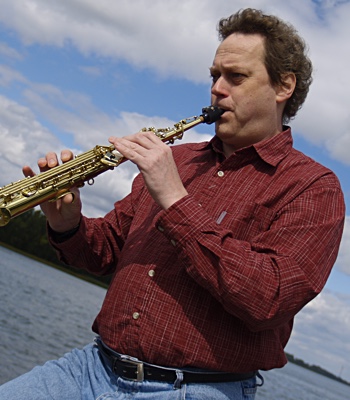
 Mikko Innanen & Innkvisitio
Etienne Charles and Folklore / Bill Frisell's Beautiful Dreamers
Bill Frisell 858 Quartet
TD Ottawa International Jazz Festival
Ottawa, Ontario, Canada
June 24-26, 2010
Back in April 2010, when the TD Ottawa International Jazz Festival unveiled its 30 Anniversary program, the general consensus was that it had somehow managed to top its 2009 edition, which boasted one of the strongest lineups ever. 2010 has brought a considerable number of changes to the festival, and while some represent the end of an era, others represent a new direction that bodes well for the festival's future.
With the retirement of program director Jacques Emond after an incredible stretch of 30 years, OIJF will be in search of a new program director to build on Mr. Emond's tradition of excellence. Over the years, however, Executive Producer Catherine O'Grady has assumed an increasingly active role in programming, bringing a more left-of-center disposition and becoming a much-needed local advocate for the rich and, at least in North America, unfairly overlooked European scene. Her stellar Improv Invitational series at the National Arts Centre's Fourth Stage, beginning five years ago, has provided an ongoing, dedicated vehicle for artists ranging from Evan Parker and Roscoe Mitchell to Nils Petter Molvaer and Wibutee. The Improv series continues in 2010 with its predictably outstanding programming, with a bevy of international artists including Globe Unity Orchestra, Norwegian pianist {Tord Gustavsen}}, Polish trumpeter Tomasz Stańko and Korean singer Youn Sun Nah.
Two other longstanding series have been replaced/renamed. The Connoisseur series, an afternoon institution of concerts in the theater of Library and Archives Canada, has been re-titled the Anniversary series, but a rose is a rose by any other name, and 2010 boasts a fine group of more centrist shows that will include Canadian pianist Michele Gregoire and Ottawa's own Hugh O'Connor, as well as two final shows that hold considerable promise: the first, pianist Fred Hersch, the second, trumpeter Tom Harrell.
More severe a loss is the longstanding Studio Series, which took place in the 350-seat Studio of the National Arts Centre. In its place, the OLG Late Night Series inaugurates a new tent on the west side of Confederation Park, directly opposite the larger main stage. With another fine lineup including drummer Manu Katche, Canadian altoist Christine Jensen and her big band project, and the freewheeling Mostly Other People Do the Killing, the only question is how the sound will be in the tent. It's a new venture, with a few teething pains no doubt to be had, but the design of the tent is top-notch, with a generous stage, a grand piano, and seemingly well-configured sound system. Sometimes change is good, and in some ways, this new series in a new location may well do better than the Studio series, as people leaving the park after the main stage shows will now have another option right along their path.
The main stage, as usual, is reserved for larger, more eminently approachable crowd pleasers, but Ottawa's reputation as one of the purer jazz festivals—at a time when others face much more mixed programming to help stay afloat—remains intact. Yes, there are some shows, like the first official evening's Smokey Robinson, that are a stretch, but in relative terms not so far as to be an issue to most, and the rest of the programming promises to be as exciting as this festival has ever seen, ranging from piano icon Herbie Hancock, who brings his The Imagine Project to Ottawa, and guitar legend John Scofield, who returns with his gospel-inflected Piety Street (EmArcy, 2009) Band, to jazz jam band progenitors Medeski Martin & Wood, making an overdue return appearance in Ottawa, and that show's eagerly anticipated (but still, a little curious) opening by Oregon co-founder/guitarist Ralph Towner and trumpeter Paolo Fresu, touring their recent Chiaroscuro (ECM, 2009). Equally anticipated are individual shows from saxophonists Kenny Garrett and David Sanborn. Garrett nearly blew the roof off the Library and Archives theater a few years back, so who knows how high into the stratosphere he'll go, unconstrained by any kind of ceiling?
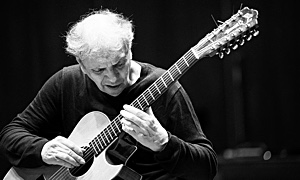
OIJF also introduces another new series, the Friends series which, akin to Montreal's By Invitation, brings artists into a venue for two nights with two different groups of their own choice. Amongst the highlights are two artists who are no strangers to Ottawa—drummer Matt Wilson, who seems to show up at the festival almost every year, and guitarist Bill Frisell, who will perform one night with his 858 Quartet, and the other with his new trio featuring violist Eyvind Kang and drummer Rudy Royston, and whose first release, Beautiful Dreamers will be out on Savoy Jazz later this summer.
There's more still, and while local bassist John Geggie will, once again, hold sway at the late night jam sessions with pianist Nancy Walker and drummer Nick Fraser, he'll also give festival-goers a taste of his regular Geggie Concert Series, with a "without a safety net" performance at the Improv series featuring drummer Jim Doxas and trumpeters Cuong Vu and Jimmy Lewis.
All in all, an exciting year, with plenty to choose from.
Chapter Index
- June 24: Mikko Innanen & Innkvisitio
- June 25: Etienne Charles and Folklore
- June 25: Bill Frisell's Beautiful Dreamers
- June 26: Bill Frisell 858 Quartet
June 24: Mikko Innanen & Innkvisitio
For the first night of the Improv Invitational Series, OIJF brought Finnish saxophonist Mikko Innenen, seen here in 2009 as part Delirium. This time, it was with his own group, Innkvisitio, whose Paa-Da-Pap (TUM, 2007) was a fine debut of music combining Ornette Coleman-inspired freedom with wild electronic textures, powerful improvisational energy and empathy, and a kind of dry humor that, at times, broke out into rich laughter amongst the band members. Serious improvisation needn't be all that serious after all, and if one sign of a good performance is how much the group is enjoying itself, then Innkvisitio's performance was a particularly strong one.
 From left: Seppo Kantonen, Mikko Innanen
 The group played tracks from Paa-Da-Pap as well as some material from soon-to-be released sophomore disc, but while three-fourths of the album's group was on-hand for its Ottawa show—in addition to Innanen, synthesizer player Seppo Kantonen and drummer Joonas Riippa—original member Timo Lassy was replaced by Swedish saxophonist/clarinetist Fredrik Ljungkvist, perhaps the most well-known of the group internationally speaking, as an ongoing member of Atomic, as well as Norwegian percussionist Thomas Strønen's group, Parish, that released its self-titled second album on ECM in 2006.
Whether on alto or baritone, Innanen possessed a seemingly endless stream of ideas, with extended techniques that gave him plenty of flexibility to drive his set of original compositions. Particularly strong on baritone, with the ability to deliver deep, visceral growls and more delicate upper-register phrases, he was especially in tune with Ljungkvist, the two providing cued support during an especially impressive solo from Kantonen late in the set, where the keyboardist's otherworldly tones were matched by angular phrases with odd intervals and displaced time. Riippa was also an impressive engine for the group, rarely soloing but bolstering the performance with everything from a solid backbeat to tumultuous turbulence, all with an clear eye for when the free play had to end and it was time to return to Innanen's knotty themes.
And the compositions were quirky. An early piece began with Kantonen alternating between sharp, loud, chords, matched by Riippa's loud crashes, but quickly dissolving into dark balladic territory—beautiful in a brooding, foreboding fashion. The group didn't deny swing as a component, but it was often a transitional thing, as the music freely moved from one rhythmic feel to another, with the elastic rubato that's a signature from that part of the world, a regular partner to more defined pulse. And as much as Kantonen continued to provide alien soundscapes, he also provided, at times, a clear bass line with his left hand that differentiated this bass-less group from most of its kind, where time and swing are so often implied rather than overtly delivered.

All four were impressive players, but Innanen and Ljungqvist stood out, with the majority of the direct solo space. Alternating between an alto/clarinet frontline and another where Innanen countered on baritone to Ljungkvist's tenor, comparisons could be drawn to some of American reed man Ken Vandermark's projects, but there as an underlying humor n both the writing and the approach to soloing; not only did Mikko Innanen & Innkvisitio bring it, but they did so with an infectious sense of play that made it an early favorite for the 2010 OIJF.
June 25: Etienne Charles and Folklore
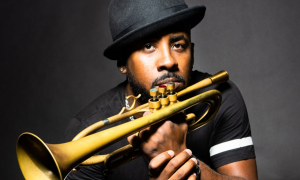
Entirely different, but displaying the same collective enthusiasm, Etienne Charles brought his Folklore quintet to the Library and Archives theater, for an afternoon performance that satisfied existing fans and undoubtedly brought the Trinidad-born trumpeter some new ones as well. With his own impressive educational résumé—Berklee, Florida State, Juilliard—Charles brought along some of his partners in crime from the much-lauded Folklore (Self Produced, 2009), including the multi-cultural Jacques Schwarz-Bart on tenor saxophone, and Obed Calvaire, a particularly exceptional drummer who is already delivering on a wealth of promises with everyone from Dave Liebman and Clayton Brothers to Barney McAll and David Kikoski. Not on Charles' album, but so familiar with the music that they may as well have been, bassist Ben Williams (Stefon Harris and Blackout) and the relatively unknown but impressive pianist Sullivan Fortner rounded out the group, which had the audience on its feet for a standing ovation by the end of its exhilarating, 90-minute show

Redolent of the Caribbean (closing, as he did, with a calypso) and New Orleans, Charles' music is, nevertheless, thoroughly modern, comfortably marrying a deep-rooted understanding of the traditions that are at the core of his music with more sophisticated harmonies, especially in the case of Fortner, who brought a rich sense of thoughtful invention, even when the group delivered a blues mid-set. His eyes often on the rest of the group, he demonstrated a keen sense of when to inject a driving harmony to push some of this very accessible music ever so slightly on its edge.
Eye contact, smiles and, at times, enthusiastic laughter amongst the players created an infectiously strong connection with the audience, made all the warmer by Charles' relaxed and affable song introduction—and his band intros as well, which clearly demonstrated his respect and appreciation for those around him. When not playing trumpet with a plangent tone and fluid delivery, Charles switched to percussion, thickening the compelling grooves and becoming an engaging foil for Calvaire, especially towards the end of the set, where they engaged in thrilling combination of trade-off and in-tandem soloing.
 Williams only took one solo, but he was an unshakable anchor throughout the set—lithe yet muscular, and seemingly as happy to work a simple pattern as he was pushing the music forward with more complex ideas. But, amongst a group of standout musicians, Schwarz-Bart was, perhaps the most charismatic, a powerful presence who was capable of executing Charles' high velocity heads, but was equally disposed to solos that built to fever pitch with the saxophonist working a single note over and over again, often in the upper range, not unlike alto saxophonist Kenny Garrett.
 But singling out any performer in a group this good isn't meant to diminish the rest of the musicians. Whether swinging with fiery intensity, or grooving with Afro-Cuban polyrhythms, Charles and Folklore delivered an afternoon show that pulled a bit of the outdoor sunshine and warmth into Library and Archives Canada.
June 25: Bill Frisell's Beautiful Dreamers
 A new series with a new group on a new label. After being associated with Nonesuch for over 20 years, Bill Frisell has moved to Savoy Jazz. In a brief chat after his first of two shows at the National Arts Centre's Studio to inaugurate OIJF's new Friends series, the modern guitar icon explained that he was simply no longer able to release albums as often as he'd wanted—surprising, given that Nonesuch was regularly releasing an album a year, but not so surprising, considering that Frisell grew up at a time when artists like Miles Davis and John Coltrane were putting out two or three albums a year. With Frisell involved in so many projects, one album a year simply isn't enough to document them, and it's great news that Savoy is committed to a more aggressive release schedule. Beautiful Dreamers, his first for the label and featuring the trio he brought for his first Friends series performance, will be out in August, and he'll be heading into the studio this fall to record the 858 Quartet that will be performing the following evening, for an early 2011 release.
 Frisell's Beautiful Dreamers is an aptly named trio featuring violist Eyvind Kang—a longtime collaborator dating back to the guitarist's wonderfully oblique Quartet (Nonesuch, 1996)—and drummer Rudy Royston, a relative newcomer who made one of his first appearances with Frisell in a trio with bassist Tony Scherr at the 2007 OIJF. Together, they consolidated almost all of Frisell's seemingly infinite musical interests and voracious appetite for exploring new ways to bring them together. Beautiful Dreamers can be a delicate, ethereal chamber group, but it can also kick ass, as the trio did towards the end of the set with a bluesy original that built from near-acoustic levels to a not-quite-ear-shattering but still powerfully loud climax.
As odd a configuration as Frisell has ever led, the guitarist's bag of sonic tricks was augmented by Kang's. Like Frisell, the violist employed real-time sampling and looping to flesh out the trio's sound—though, also like Frisell, more often than not in subtle ways—but it was when he began kicking in an overdrive box and an octave divider to send his already lower-end string instrument plunging into the range of a bass, that it became clear: this is no conventional violist. The viola is a sadly underused solo instrument as it is—unfortunate because it possesses a richer and sometimes more appealing tone—but Kang's musical reach is as expansive as Frisell's, reaching into American country, hints of Celtic, tinges of Middle Easter tonalities and no shortage of just plain and unexpected grit. He's developed a number of recognizable and very distinct techniques over the years, in particular a way of doing trills and hammer-ons that are more often heard on guitar.
Royston—a Jersey boy who has also been playing with another Frisell alum trumpeter Ron Miles, as well as Colorado-based saxophonist Fred Hess and, more recently, Beyoncé saxophonist Tia Fuller—has been contributing plenty of pulse to Frisell's live work, including a particularly fine show at the 2009 Festival International de Jazz de Montréal, proved himself to be an equally fine colorist, as the trio began rather amorphously, with the kind of skewed, off-center harmonic ambiguity for which Frisell is known; only gradually coalescing into shape and form. Still, he's a groove-meister at heart, with a lazy, Jim Keltner-eseque backbeat that drove some of the more powerful music that created a marvelous arc to the 90-minute set that saw the trio called back for not just one, but two encores from the loudly appreciated audience.
 Rudy Royston
 For the first time in awhile, the set didn't consist of a lot of familiar Frisell that he's been mining, twisting and turning from albums like Good Dog, Happy Man (Nonesuch, 1999) and The Intercontinentals (Nonesuch, 2003), though there were altered appearances from Disfarmer (Nonesuch, 2009) and the Grammy Award-winning Unspeakable (Nonesuch, 2004). Instead, there were a number of new songs, hopefully to appear on the forthcoming release, and covers that were also new to the repertoire. The trio performed an atmospheric and brief version of its very sweet namesake, covered Benny Goodman, pulled out a country standard ("Keep on the Sunny Side"), did a lighthearted version of "Tea for Two" and delivered a warm take of Little Anthony and The Imperials' 1964 hit, "Goin' Out of My Head," where Kang's pizzicato was out front, reverent but still ever-so-slightly wry. The trio also closed the evening out with a change-heavy bop tune that proved, if there were ever any doubt, that Frisell's overt jazz chops remain intact, and that Kang is equally capable of navigating rapid-fire changes while Royston swung with intent, as the trio only came together for the head at the song's end.
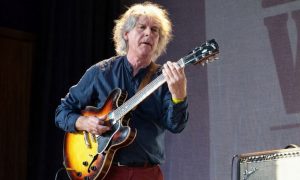
As ever Frisell's combination of electronic wizardry and acoustic techniques—like pushing on the body of his guitar while holding a note or chord, to create a gentle pitch shift—were absolutely unmistakable, and while he completely eschews any kind of guitar posturing, he remains a charismatic performer. Despite becoming one of the most imitated modern guitarists since Pat Metheny, he's never been copied. With a slow, thoughtful delivery that built on positioning which allowed him to hold notes as others moved a melody forward, at times creating his own internal counterpoint—and a remarkable ability to skew even the most conventional set of chords/voicings by altering but a single note—there was often an almost mischievous glimmer in Frisell's eyes, as he occasionally broke into a bigger grin at something either he or his trio mates did.
 Eyvind Kang
 Frisell's writing for the trio was some of the best in recent memory, harkening at times back to albums like This Land (Elektra/Nonesuch, 1994), still one of the guitarist's most fully realized albums, compositionally speaking. If Beautiful Dreamers' OIJF performance was any indication, the trio's late summer recording debut is going to be a great one.
June 26: Bill Frisell 858 Quartet
 For Bill Frisell's second night at the OIFJ Friends series, he reconvened a group that came into existence earlier in the century to record music inspired by—and originally included exclusively in an expensive art book, until Songlines released it as a standalone CD a couple years later—German painter Gerhard Richter. Richter 858 (2005) was some of Frisell's most challenging music in recent times, demonstrating that, amidst more accessible recordings like Unspeakable and East West (Nonesuch, 2005), the intrepid guitarist had lost none of the edge he displayed on early solo albums like Before We Were Born (Elektra/Nonesuch, 1989) and Is That You? (Elektra/Nonesuch, 1990). As the years go on and Frisell introduces more and more projects, it becomes clear that this multifaceted artist never really leaves anything behind; he just blends it with everything else that catches his fancy, and elements invariably find their way up in the mix again, just more equitably balanced.
 But the 858 Quartet that performed at the OIJF was a considerably softer, unequivocally more beautiful beast than that on the album, making its pending recording this fall, and planned new release early in 2011, something that will, no doubt, be high on the "must have" list for the capacity crowd that filled the Studio of the National Arts Centre. 858 is also a group that exemplifies Frisell's loyalty to musicians he has met and connected with along the way. Cellist Hank Roberts was a member of Frisell's first major group, dating back to the guitarist's ECM days and Lookout for Hope (1988), while Frisell first worked with violist Eyvind Kang on Quartet—the start of a relationship that has continued right up to the guitarist's Beautiful Dreamers, which played the Studio the previous night. Violinist Jenny Scheinman is the newest recruit, relatively speaking, first working with Frisell on Richter 858 and The Intercontinentals, and the guitarist returning the favor on her own albums including the vignette-driven 12 Songs (Cryptogramophone, 2005) and more ambitiously sweeping Crossing the Field (Koch, 2008).
With the sound of chirping birds creating a gentle, relaxed ambience in the room—so quiet that a whisper was like a roar—Frisell and the quartet came onstage, with Kang and Scheinman mirroring the sound of the birds with delicate, swooping harmonics, and Frisell slowly building into the first tune. Using the same guitar as the night before—some kind of custom-built/Telecaster hybrid—he still had his usual mad scientist's rig of devices, but the volume remained so quiet that, had his guitar been a hollow body, it would have been possible to hear its natural sound over the amplification. Few well-known guitarists, outside of perhaps Jim Hall—with whom Frisell serendipitously collaborated on Hemispheres (ArtistShare, 2009)—work at such quiet levels that it's almost necessary to lean forward to hear their music.
Frisell's tone, despite running through the same two Fender Deluxe amps as the night before, sounded almost acoustic at the start, though he did morph through a variety of textures throughout, even kicking in some overdrive later in the set, proving that volume isn't required to achieve a gritty sound. As much as Frisell's sometimes predilection for repeating long phrases—and working them with the subtlest of evolutions, such that it's only after a few minutes that it becomes clear just how much the music has changed—define some of the compositions and arrangements he's written for 858, this remains some of his most heavily scored music, though there's no shortage for interpretation and solo space for everyone in the group. Roberts' feature, on a version of The Intercontinentals' world-informed "Baba Drame," was both a set highlight and clear indication of how even, in this case, a very simple premise can be milked for all it's worth, year-after-year, and still reveal plenty new in the process.
 "Baba Drame" wasn't just an indication of how significantly context can alter the same music; when Frisell brought 858 to Mannheim, Germany for Enjoy Jazz 2010, it was the same lineup, save for Scheinman, who was replaced by another longtime Frisell cohort, trumpeter Ron Miles, and the brighter tonality of brass completely changed the quartet 's complexion. That performance was also a soft, near-acoustic concert, but 858's Ottawa performance more closely approached the sublime, with Frisell's shifting tones an egalitarian foil for Scheinman and Kang's sometimes unison, sometimes orbiting lines and Roberts' occasional plummets into near-bass walking lines.
 Frisell revisited "Tea for Two" from the previous evening, but with a more circuitous arrangement that only revealed itself fully near the song's end. It was unmistakably engaging—and enlightening—to hear Frisell rework Stephen Foster's traditional chestnut, "My Old Kentucky Home" for what is essentially a classical string quartet context, albeit one with a violin replaced by electric guitar. Chamber music this was, but despite being filled with rich string arrangements and ethereal segues, it still managed to groove, swing, and even get down and bluesy. It may be one of Frisell's more unusual settings, but as deep as the music was—played by a sympathetic quartet of players whose relationships define both a comfort level and an inherent adventurous nature—it was as well received as Beautiful Dreamers was the night before. For a kick-off to OIJF's Friends series, these two shows were an unequivocal success, and bode well for the rest of the series, which will feature two nights by drummer Matt Wilson (one evening with Scheinman participating), one by pianist Robert Glasper, one by Europe's Globe Unity Orchestra, and a closing series performance featuring saxophonist Javon Jackson and his guest, legendary soul jazz pianist Les McCann.
Coming up in AAJ's coverage of the TD Ottawa International Jazz Festival's days 4-6: saxophonist Kenny Garrett; guitarist John Scofield and the Piety Street Band; Mostly Others Do The Killing; guitarist Ralph Towner and trumpeter Paolo Fresu; Medeski Martin & Wood; bassist John Geggie with drummer Jim Doxas, and trumpeters Cuong Vu and Jimmy Lewis; Korean singer Youn Sun Nah; and drummer Manu Katche.
Visit Mike Innanen, Etienne Charles, Bill Frisell and TD Ottawa International Jazz Festival on the web.
Photo Credits
All Photos: John Kelman
Days 1-3 | Days 4-6 | Days 7-9 | Days 10-11
Tags
TD Ottawa International Jazz Festival
Live Reviews
John Kelman
Canada
evan parker
Roscoe Mitchell
Nils Petter Molvær
Globe Unity Orchestra
tomasz stanko
Youn Sun Nah
Fred Hersch
Tom Harrell
Manu Katche
Christine Jensen
Mostly Other People Do the Killing
Herbie Hancock
John Scofield
Medeski, Martin and Wood
Oregon
Ralph Towner
Paolo Fresu
Kenny Garrett
David Sanborn
Matt Wilson
Bill Frisell
John Geggie
Nancy Walker
Nick Fraser
Cuong Vu
Jim Lewis
Ornette Coleman
Fredrik Ljungkvist
Thomas Strønen
Ken Vandermark
Etienne Charles
Jacques Schwarz-Bart
Obed Calvaire
Dave Liebman
The Clayton Brothers
Barney McAll
David Kikoski
Ben Williams
Stefon Harris
Miles Davis
John Coltrane
Ron Miles
Fred Hess
Tia Fuller
Benny Goodman
pat metheny
Hank Roberts
Jenny Scheinman
Jim Hall
Robert Glasper
Globe Unity Orchestra
Javon Jackson
Les McCann
PREVIOUS / NEXT
Support All About Jazz
 All About Jazz has been a pillar of jazz since 1995, championing it as an art form and, more importantly, supporting the musicians who make it. Our enduring commitment has made "AAJ" one of the most culturally important websites of its kind, read by hundreds of thousands of fans, musicians and industry figures every month.