Home » Jazz Articles » Live Review » Live!Singapore: June 8-11, 2010
Live!Singapore: June 8-11, 2010

 Rarely do the worlds of jazz, classical music, world music and musical theatre come together in one place to hobnob and strut their stuff, but that was exactly what happened at Live!Singapore, an ambitious event organized by Koelnmesse and IMG Artists. Festival directors, producers, agents, managers, executives and artists of these four disciplines came from more than fifty countries, and gathered in Singapore to discuss the respective challenges they face in a rapidly changing world, both technologically and demographically speaking.
 The choice of Singapore as the venue was a sign of the growing importance of Asia in the performing arts marketplace. The exchange of ideas and the forging of new partnerships were the principal aims of Live!Singapore, a three-day event which united an extremely impressive array of figures from the performing arts in a series of forums and discussions. An international trade fair and a series of outstanding showcase performances from some of the world's most renowned musicians provided the opportunity for attendees to show off their wares.
Each day had a particular focus, with classical music on day one, musical theatre on day two, and jazz and world music on the final day. The focus was largely, though not exclusively, on the performing arts in Asia, and what emerged strongly from each day were the common themes of the desire to reach a greater audience, the importance of education in generating an appreciation of the arts among the young, the need for partnership and collaboration, and the challenges of promoting Asian artists both at home and abroad.
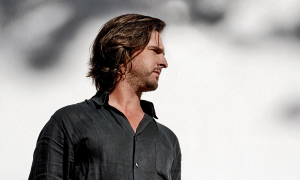
The three-day extravaganza got under way with a jaw dropping performance from American violinist Joshua Bell. Looking relaxed in a black t-shirt, Bell demonstrated in just fifteen minutes why he is considered to be one of the very finest concert violinists in the world. Even those who are not devotees of classical music were beguiled. Although the differences between the classical, musical theater and jazz and world fields are pronounced in some ways, Zarin Mehta, President and Executive Director of the New York Philharmonic struck a resonating chord when he said in the subsequent panel discussion: "Great music will always find a foothold." In jazz, this has always been the case and is why the music survives, continues to grow and to redefine itself.
The similarities between the status of classical music and jazz, just as much as the differences, were salient in the keynote speeches of Sir Clive Gillinson, Executive and Artistic Director of Carnegie Hall, and Tsung Yeh, Director of the Singapore Chinese Orchestra, and in the fascinating panel discussion which followed. Gillinson's mission at Carnegie is to present "the best of all music" and nobody could accuse Carnegie of having ignored jazz over the years. From Duke Ellington's annual Carnegie concerts in the '40s to Sonny Rollins' concert in '08 to celebrate the fiftieth anniversary of his first appearance there, jazz has played an important part in the legend that is Carnegie. Incidentally, as Warren Allen pointed out in his review of eighty five year-old reedman James Moody's 4B (IPO Recordings, 2010), Carnegie Hall has played host to Moody at least once every single year since '50.
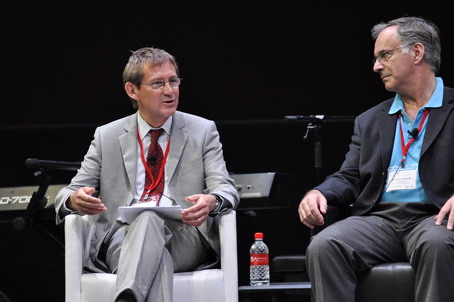 From left: John Holden, Sir Clive Gillinson
 In a captivating and eloquent speech Gillinson spoke of the need to bring classical music back to the people through outreach and education programs. Over $200 million has been spent to update the performance areas in Carnegie Hall, and Gillinson has done an admirable job in bringing in punters who are experiencing Carnegie Hall and possibly classical music for the first time. Jazz, like classical music, has always had a small but cogent market; the two musical forms share the mark of minority music and perhaps elitists ones at that, though jazz has never enjoyed the level of state funding or the profile that classical music has. One notable exception is the Lincoln Center where Wynton Marsalis is doing something analogous to Sir Clive Gillinson at Carnegie The annual Essentially Ellington Competition, for example, sends out six original Duke Ellington charts transcribed by David Berger, with a recording of the pieces performed by the Lincoln Center Jazz Orchestra. The program has been running since ' 94 and has reached nearly a quarter of a million students.
Both Gillinson and Marsalis understand that the future health of classical music and jazz alike lies at grassroots level and through collaboration. "The key" is partnership;" Gillinson said at Live!Singapore, "alone we could never do half of what we do." He went on to stress the importance of "persuading our political masters that education in the arts is important" and sounded a battle cry to make the arts in general central to our lives. Although the Lincoln Center has in recent times given performance space to adventurers like John Zorn and Cecil Taylor, the program has a decidedly traditional, historical outlook and Marsalis, for all the great work he does propagating and preserving America's only indigenous art form, could perhaps learn from Gillinson who pronounced with regard to programming: "It is possible to be challenging and innovative and still appeal to the public."
Gillinson proclaimed in addition that: "so much of the future of classical music is being shaped in Asia." This is not only true from the point of view of the number of wonderful Asian classical musicians emerging on the international scene, but also in terms of Asia as a consumer market. Joyce Chiou, Executive Director of the Philharmonia Taiwan revealed that 65 percent of the classical music audience there is under 35 years of age. Jazz audiences may be a little longer in the tooth, but as day two's "Jazz: Glorious Past, Uncertain Future?" session highlighted, there is also reason for optimism for jazz in Asia.
In the last half dozen years new jazz festivals have sprung up in Thailand (2), Malaysia (3), Indonesia (4), Mongolia, Nepal, Azerbaijan, China, and Korea, where the three-day Jarasum Jazz Festival draws an impressive 150,000 people. There is also a new jazz festival due to start in India in '11. In addition, Australia, which is so closely linked to Asia, has a plethora of vibrant jazz festivals both young and long-established. It may be of interest to Wynton Marsalis that Australia is arguably the greatest preserver of traditional jazz in the world, with the Australian Jazz Convention now in its 65th consecutive year, and with traditional jazz societies dotted around the vast country. However, unlike the classical audience in Taiwan, the traditional jazz audience in Australia and the musicians themselves are all the wrong side of 65, and they too realize, better than most, the necessity to reach out to a younger audience.
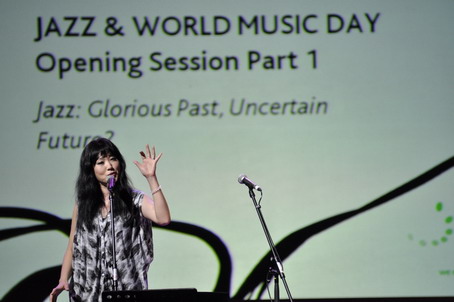 Youn Sun Nah
 The ability of jazz to transcend time, appeal to all ages and to all cultures was perfectly demonstrated during the showcase performance by Korean singer Youn Sun Nah, which preceded the panel discussion on jazz. Youn Sun Nah's Voyages (ACT, 2009) is one of the finest crossover albums in recent years, and she has collaborated with some of Europe's top jazz musicians including trumpeter Mathias Eick, bassist Lars Danielsson and guitarist Ulf Wakenius. Her fifteen minute slot held the audience totally rapt. Beginning with a bewitching solo version of "My Favorite Things" which sounded like a slightly ethereal lullaby, Nah then revealed the strength, passion and range in her vocals during an electric interpretation of Egberto Gismonti's "Frevo." For this number she was ably accompanied by Singaporean guitarist Munir Alsagoff.
The all-too-short set concluded with a hypnotic version of Nat King Cole's "Calypso Blues" with Nah, again solo, looping layer upon layer of vocals to create a totally original and highly impressionistic soundscape. Nah's memorable performance provided the clearest metaphor for the position of jazz in the world today—in front of a highly appreciative but less than packed audience, a Korean singer who didn't know what jazz was fifteen years ago, brought new life to a fifty-year-old song with the aid of the latest technology.
The panel sitting for the discussion on jazz was moderated by Paul Augustin, director of the Penang Island Jazz Festival. With all the panelists acknowledging in passing that jazz's past is indeed a glorious one, the emphasis during the discussion was very much on the present. In his excellent keynote speech, John Cumming, Director of the London Jazz Festival, reminded those present of the value of jazz as a tool for personal and collective growth, with its emphasis on resourcefulness, individual response, dialogue, communication and a collective effort. As Sir Clive Gillinson had mentioned on the first day, Cumming also emphasized the central role of education in fostering the growth of the music, and the music itself as an important educational tool.
 John Cumming
 Cumming and Sophie Brous, the programmer for the Melbourne Jazz Festival described the challenges of staging a large festival in a major urban environment with Cumming underlining that a successful festival should be above all a celebratory event. Both were in agreement that the festival should mold itself to the shape of the city: "A sprawling festival for a sprawling city" as Cumming put it. Smaller festivals like Augustin's Penang Island Jazz Festival have more basic issues to contend with, like survival for one, but Augustin and Sandra Lim Viray of The Philippine International Jazz and Arts Festival both spoke of the desire to create festivals with a local identity.
Getting the balance right between music which has both artistic value and crowd appeal is more of an issue in Asia where audiences in general are much less familiar with jazz and more used to a diet of smooth jazz which finds Bob James at its cutting edge and Norah Jones as it most familiar face. It is not always possible however, in spite of the best intentions, to include a local artist on the festival program as the otherwise excellent Miri International Jazz Festival found in'10, though it is a source of pride for Augustin that his Penang Island Jazz Festival has included a local band every one of its six years, surely an essential requirement in the promotion of local talent.
Whilst international jazz artists are increasingly enjoying the benefits of playing in Asia, from Japan to Korea and from Thailand to Malaysia, for jazz artists from Asia it is something of a mountain to climb to be heard abroad, as panelist Jeremy Monteiro observed. Monteiro has had a successful career as a jazz pianist for 35 years, and is known as The King of Swing in his home town of Singapore. He scored a notable success at Montreux '88, and has performed all over the world with the likes of Charlie Haden, Randy Brecker and Michael Brecker, James Moody, and Ernie Watts. There was however, a degree of frustration in his voice when referring to the stringent, not to say expensive visa requirements to play in America: "From there [America] to here [Asia] there's a three-way highway but from here to there there's a footpath. But you can't take it personally."
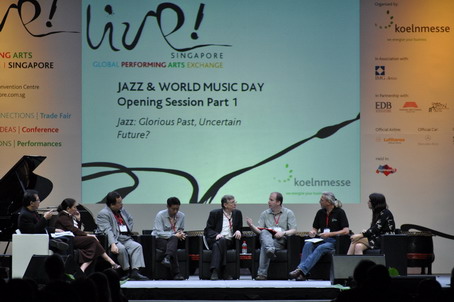 From left:Paul Augustin, Sandra Lim Viray, Jeremy Monteiro, JJ In John Cumming, Tony Whyton, Ian Patterson, Sophie Brous
 The author's presence on the panel representing jazz website All About Jazz was a reminder of what Zoran Mehta meant on day one when he talked of "the most extraordinary means of propagating our art" now within our reach. Just in the last twelve months All About Jazz has covered more jazz festivals than perhaps any other jazz publication in the world, and over 24,000 musicians globally have a professional profile at the site. With the slow death of the record companies, jazz musicians now have the technology to record their own music and to sell it via the web. Advocacy websites like All About Jazz, motivated by a love of the music, are playing their part in promoting musicians and their music in the globally changing market. Social networking and web-generated business is undoubtedly one of the greatest forces of the future and the way forward for many musicians to find a way into previously distant or inaccessible markets.
Musical theatre, which held court on day two, was the odd one out to a degree, as it is an industry driven almost exclusively by commercial considerations and goals, and it is an art form lacking the state support enjoyed by classical music. However, listening to the highly entertaining and informative keynote speech delivered by David Atkins, CEO of David Atkins Company, and watching the amazing singing talents of 14 year-old Julia Abueva from Singapore, who has already appeared on the American television show Oprah, what is not in doubt is that the passion for musical theatre of its practitioners, producers and promoters matches that of those dedicated to classical music, jazz or world music.
Atkins speech echoed the themes stated overtly and intimated at in the classical and jazz discussions, that is to say that musical theatre has to remain relevant while retaining traditions and standards. Musical theatre [like jazz], Atkins explained, suffers from the doomsayers who predict its demise at least once a decade. However, in '09, despite the unfavorable economic conditions, Broadway musicals grossed over one billion dollars. In another parallel with jazz, Atkins described how musical theatre has survived competing entertainment forms such as TV, DVD and the Internet, and has learned to use these formats as a platform. If musical theatre is to have a healthy creative future, Atkins affirmed, then its performers and writers must be "rooted in their own culture and rooted in their own identity" —sage advice for Asian jazz musicians too, perhaps.
The question of jazz's identity has never been voiced more loudly than today. The almost tiresome question "What is jazz?" divides opinion but never renders a winner in the debate. The panel discussion on World Music, "Reflecting on the Past and Shaping the Future" revealed similar headaches in defining the catchall phrase "world music," and thankfully the panelists declined to do so. This was perhaps largely due to an insightful and educational power-point presentation and speech by former international world music consultant and KCRW, NPR broadcaster Tom Schnabel, who gave the audience a potted history of world music and covered pretty much all the bases, right up to the once unlikely scenario of a present day Broadway play celebrating the life and music of Fela Ransome Kuti. What next? Louis Armstrong On Ice? Charlie Parker in the West End?
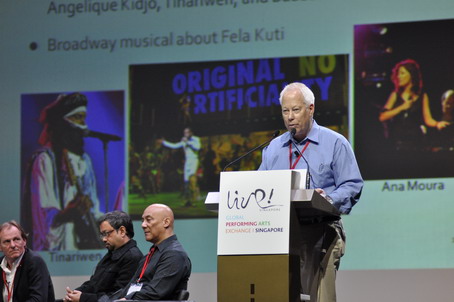 Tom Schnabel
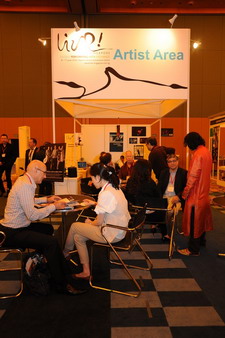
 A series of Big Picture Sessions got to grips with important issues affecting the performing arts, and the broad range of themes covered music rights and royalties, online marketing, culture, politics and economic life in the arts funding landscape, as well as artist management and the agency world. Similarly, pitch sessions allowed promoters to reach an interested audience in intimate surroundings. With so much going on, not to mention a significant amount of networking, (business cards were changing hands faster than dollar bills at a racecourse) it was impossible to catch all the showcase performances. With the exception of Youn Sun Nah, all the music showcased on the final day was world music. There were several notable performances, though some coincided with Big Picture Sessions and a fair amount of business that was being conducted in the trade fair hall.
Two excellent performances were on show in the main hall just prior to the Jazz and World Music Festivals and Promoters Programming Round Table. First up was Korean percussion group Gong Myoung, which gave an energetic performance laced with imagination and humor. Japanese and Korean percussion groups seem to be almost as common as the ubiquitous Irish dance troupes that have done such great business in the last fifteen years or more, but Gong Myoung is quite unlike any other percussion ensemble. Although the time constraints of the showcase limited what they were able to perform, in other settings the quartet employs instruments from around the world, from the didgeridoo to the cajon, as well as incorporating vocals, acoustic guitar, and on occasion, strings into their setup.
The set comprised several strongly contrasting pieces. Exhilarating, the dialog between four hour-glass-shaped janggu drums. These drums are made from paulownia wood and the skin is made from white horse leather. The drum is played with both hands, the right maintaining a rhythm with a drumstick stick while the left hand moves a flexible stick in a blur from left to right striking both heads. With four different rhythms going at once and oscillating all the time it made for fascinating viewing as well as listening. A wonderfully comedic piece featuring instruments made on stage using found objects produced a flute from a piece of plastic tubing which required holes to be drilled into it, and a plastic water container which sent water spraying as it was banged with vigor. A woman was brought up on stage and she danced gamely to the rhythms before the quartet dismounted the stage and proceeded to walk and play among the audience, reviving memories of the Sun Ra Arkestra in the process.
Another outstanding piece entitled "GongMyoungYooHee" saw each of the four musicians hitting a wooden resonating box with different size cuts of bamboo, again raising and lowering the tempo, creating lush harmonies and reaching a spectacular crescendo. This is music which forges a link between traditional Korean music and modern innovation—truly progressive music. On the evidence of just fifteen minutes it is not difficult to see why Gong Myoung has been in-demand for tours and at festivals around the world since its formation in '97, including the legendary SXSW festival in Austin, Texas.
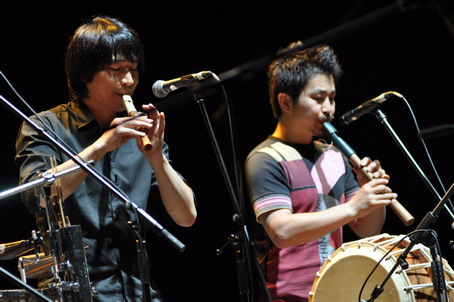 Gong Myoung
 Following straight on the heels of Gong Myoung was Irish fiddle virtuoso Frankie Gavin and De Dannan. In a nation which produces fine fiddlers as readily as Scotland produces fine malt whiskies, Gavin is considered to be one of the very best. Formed as far back as '75, De Dannan has undergone numerous lineup changes over the years, with Gavin the sole original member. What is usually a quartet was reduced to a trio as two members were unable to attend. Nevertheless, the combination of fiddle, Barry Cunningham on bodhran and Mike Gavin on acoustic guitar combined to stir up a few lively jigs and reels which lacked only a bit of Irish dancing to spark musicians and audience alike in common purpose.
If Irish dancers are called for then perhaps Germany is the best bet to find them, according to Tom Schnabel, as there are reputedly no fewer than nine commercial Irish dance groups touring that nation. This odd little nugget of information popped out during the Jazz and World Music Festivals & Presenters Programming Round Table, which touched on and expanded upon some of the themes generated during the day's earlier jazz round table. Dr. Tony Wyton, senior lecturer in music at Salford University and author of Jazz Icons:Heroes, Myths and the Jazz Tradition (Cambridge University Press, 2010), gave a thought-provoking keynote speech by way of introduction, which was equally impassioned.
 "At their best festivals can act as catalysts for change," Whyton advocated, "they can transform everyday spaces into magical worlds or encourage people to see their environment in a new way." Whyton added how jazz and world music festivals have the ability to galvanize communities and contribute to a sense of civic pride. Outlining one of the most significant benefits of such festivals, Whyton spoke of their ability to offer audiences a view of diverse cultures in a positive light, something which cannot be underestimated in the global context in times of rising waves of nationalism and outright xenophobia. "Jazz and world music programs," Whyton declared , "often have the potential to go beyond performance and provide the audience with a new and inspiring cultural experience."
 Themes discussed by the panel included the advantages of collaboration between festival programmers versus the dangers of homogenizing festivals, the different considerations behind festival programming, and the challenges of introducing so-called risky new music to a paying public. Although world music is almost as difficult to satisfactorily define as jazz it would appear to be easier to program a world music festival, where anything goes, compared to jazz festivals, which lay themselves open to criticism for stretching the boundaries of what constitutes jazz. Whyton gave the example of Wynton Marsalis, who discovered on a fact-finding mission to European jazz festivals in the late '80s that only two out of ten bands were actually jazz bands, with festival programmers declining to call their events "music festivals," according to Marsalis, while seeking the aesthetic elevation that jazz brings. Most of the panel agreed that mixing things up is good from the audience's point of view, though Jeremy Monteiro had some sympathy for Marsalis' observations: "I think a festival which has less actual jazz than other genres should call itself a music festival. There should be at least sixty percent jazz."
Times change however, and Tom Schnabel described how he tried to convince the board of the Hollywood Bowl to introduce a world music series for the first time: "I told them," Schnabell recalls, "that Los Angeles is very different from the '50s or the '60s. There are 150 different languages spoken in Los Angeles and there are so many different communities; we have to serve the communities." The theme of music connecting with the communities at grassroots level, of being accessible and tangible, and festivals being celebratory community events was one which reoccurred throughout the course of the three days.
One question which was raised and remained unresolved, at least in an Asian context, was the question of networking; it was noted that while European festivals are able to network in English, a lack of common linguistic ground in Asia poses considerable challenges. At the end of a lively discussion where the incredibly eclectic nature of jazz and world music was acknowledged, what emerged above all else was the importance for festival programmers of knowing why their festival exists and knowing who their audience is if a festival is to be successful.
Jazz and world music festivals may exist to promote tourism or to create jobs. They may be the brainchild of politicians who seek to foster civic pride or put the town on the international map and attract investment. They may be primarily cultural events, commercial events or have an educational intent. They may even be seen as having therapeutic benefits to the community at large. However, it is worth recalling the words of Sir Clive Gillinson, who was not referring specifically to classical music when he said, on the first day of Live!Singapore, "Music is not a panacea; it is transformational, but it is not a panacea."
The therapeutic and transformational nature of music was seen to great effect in one of the most fascinating sessions entitled "Music and the Brain," conducted by Dr. Kamil R. Chemali, a neurologist from Cleveland Clinic who is also an active researcher in the field of music and neuroscience. Accompanied by the impressive classical piano playing of Prisca Benoit, Chemali described the brain's response to music with the additional aid of some rather detailed cross sections of the ear and the brain. Music's ability to sooth the savage beast, or to make a beast of us for that matter is hardly news, but there was no denying the impact of this presentation. Most poignant, was the video clip of a woman crippled by multiple sclerosis who displayed a marked improvement in her ability to walk when accompanied by strongly rhythmic music. Equally impressive was the film of a woman who had lost the ability to speak after suffering a stroke, but who was coaxed by her therapist into making sentences through song, which was the first step on the road to recovery of her speech.
The final word at Live!Singapore was left appropriately enough to the musicians, and there were a couple of outstanding showcase performances in the late afternoon. Sadly, apart from the conference ushers, there were only a handful of people to witness the Natig Shirinov Rhythm Group in a small room on the second floor of the labyrinth-like conference center. A quartet from Azerbaijan comprised of three drummers and a kind of Asian cornet, they gave a blistering performance which had the zeal and trance-like fervor of religious music. Shirinov was something to behold, playing the double-headed nagara drum with his hands as if his life depended on it. His incredible speed and virtuosity drew gasps from those in the audience, and brought to mind the great Zakir Hussain, no less.
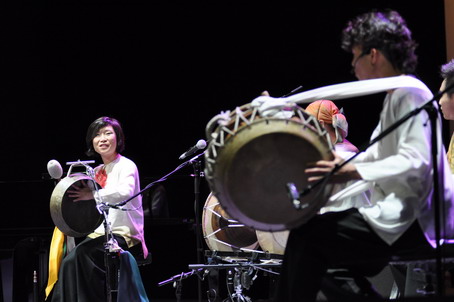 Noreum Machi
 It was necessary to draw breath after that performance, but there was still Korean percussion ensemble Noreum Machi to catch in the main hall. Like the day's other Korean percussion ensemble, Gong Myoung, Noreum Machi draws from Korean tradition but asserts a modern twist to its performance; this, and their ability to connect with the audience, is where comparison between the two groups ends. This quartet captivated the audience with an adrenaline-fuelled performance of samulnori percussion music, which brought together the double-headed janggu drum and the kkwaenggwari,—a small gong—in heady marriage. The music has its ancient roots in shamanism and animism, and haunting chants and dance filled the stage, while the ribbons tied to the gong drum sticks carved vibrant arcs of color like tracer against the black backdrop. Noreum Machi is a Korean minstrel term used to refer to only the very best musicians—musicians so skilled that no one would be bold enough to follow—so it was fitting that Noreum Machi brought down the curtain on Live!Singapore.
Although the gathering of speakers, performers and exhibitors was most impressive, the organizers may have been disappointed with the otherwise low turnout which translated at times into half-filled or near-empty showcase performances. However, the upside was that the relatively uncrowded surroundings allowed for greater communication among attendees. As with most events, momentum builds over a number of years, and the positives from Live!Singapore far outweighed any negatives. The watchwords of Live!Singapore were partnership, collaboration and networking, and to this end the event can be considered a success. With plans already in motion to stage Live!Singapore next year, all the signs indicate that this will become a major event in the international arts calendar.
Photo Credits
Koelnmesse/IMG Artists
< Previous
Trigonometry
Comments
Tags
Live!Singapore
Live Reviews
Ian Patterson
duke ellington
Sonny Rollins
James Moody
wynton marsalis
john zorn
Cecil Taylor
Youn Sun Nah
Mathias Eick
Lars Danielsson
Ulf Wakenius
Nat King Cole
Bob James
Norah Jones
jeremy monteiro
Charlie Haden
randy brecker
Michael Brecker
ernie watts
Louis Armstrong
Charlie Parker
Sun Ra
Zakir Hussain
For the Love of Jazz
 All About Jazz has been a pillar of jazz since 1995, championing it as an art form and, more importantly, supporting the musicians who create it. Our enduring commitment has made "AAJ" one of the most culturally important websites of its kind, read by hundreds of thousands of fans, musicians and industry figures every month.
You Can Help
To expand our coverage even further and develop new means to foster jazz discovery and connectivity we need your help. You can become a sustaining member for a modest $20 and in return, we'll immediately hide those pesky ads plus provide access to future articles for a full year. This winning combination will vastly improve your AAJ experience and allow us to vigorously build on the pioneering work we first started in 1995. So enjoy an ad-free AAJ experience and help us remain a positive beacon for jazz by making a donation today.

Giveaway

Eligible winners: 15
Days remaining: 13
Days remaining: 13