Home » Jazz Articles » Interview » Sarah Manning: Shattering The Glass Ceiling
Sarah Manning: Shattering The Glass Ceiling


All About Jazz: Jackie McLean, Rufus Reid and Dr.Yusef Lateef were three of your teachers during your high school and college years. Tell us something about their influence in your development.
Sarah Manning: I grew up in Torrington, CT. Jackie McLean had a school called the Artists Collective. He and Dolly McLean, I believe, were the founders of the school. I think that in growing up in Connecticut, his sound was sort of in the air. I certainly knew who he was and listened to his playing. Jackie was always a little sharp in his tone. I'm one of those people who loved that sound. He definitely encouraged me. I only met him a couple of times in the Artists Collective. One of them was when I debuted an arrangement of a Sonny Clark tune that I transcribed off of one of Jackie's records. I arranged the tenor and the trumpet a half step apart on either side of the alto melody. So I added four bars to that particular arrangement, which was extremely dissonant. He happened to be sitting in the front row and covered his ears. But he actually sort of liked it. That was kind of neat. It definitely encouraged me to have a legend right in front of me when I debuted the arrangement.
I studied with Rufus Reid at William Paterson. He coached the big bands. I would occasionally go in and talk with him. He's such a great person—just a really warm person, very supportive and encouraging. It was after I left the school that I had a dream in which he gave me a bicycle and told me to travel to places where there were musicians who, frankly, could kick my butt. At that time I was living in Northampton, MA. That dream had a big effect on me. I moved to the Bay Area shortly after that.
He was the person who got me in contact with Akira Tana, who played on my first two records. They had a group called TanaReid for about ten years. When I went out to California, I emailed Rufus and I told him what I was doing. He told me a couple of people to look up, and one of them was Akira. I played with Akira for several years. Whenever he was available, I always worked with him. He's a funny guy, too. I think the California lifestyle suits him. He likes to play golf and carries around a golf tee in his pocket. He's got his golf shirt and his golf cap. When the gig's over and it's a nice day, I think he's heading for the green.
Yusef Lateef had a monumental influence on me, philosophically. William Paterson is a very straight-ahead school. When I went there, I played one of my original tunes on a jury. One of the people who came from a very strong tradition was kind of questioning why I played an original. You don't want to be playing an original, you want to play the tradition of the music.
a href=http://www.allaboutjazz.com/php/article.php?id=36743 target=_blank>
 I transferred to Smith College from William Paterson. I spent two years at William Paterson, then I got my degree in Women's Studies from Smith. Yusef Lateef had a Monday morning master class at Hampshire College. I went to his office hours and played him a recording of a couple of things of mine, including a version of "Body and Soul." He kind of said, "Look, this isn't really relevant. This is music of 40 or 50 years ago." He really put the emphasis on finding your own voice, even if it means having a small audience. It took a while for his words to sink in. I had been very concerned with sounding like a bebop player before I could get to my own sound and my own voice. I think he kind of pushed it aside and said that you always need to be searching for that. He had an enormous influence. I studied composition with him privately as well, when I was at University of Massachusetts, where I did a couple of years of graduate school.
<AAJ: Were there others in or outside of the field of music who spurred your creativity?
SM: I always like to think that I allow myself to be influenced by many different things. I deliberately did not just study music. At Smith, there were a whole lot of other things I could study. I was interested in Asian Literature. A certain style of Japanese poems has influenced some of my compositions. So I try to take a holistic approach to music, in general. I think that if you can be a well- rounded, beautiful person, then your music will follow.
 AAJ: That's a unique approach. A lot of young musicians are pretty much all music, all of the time. Perhaps that's a tad too narrow.
SM: When I was at William Paterson, I spent much of my time in the music building. It had no windows. It was basically concrete walls.
AAJ: Shea, the music building, has a bit of a maximum security feel, doesn't it?
SM: It does. Whether it's true or not, there's a legend floating around that the designer/architect of the building committed suicide. It's kind of a labyrinth.
When I was a kid I ordered the T-Shirt from Down Beat that had a picture of Charlie Parker and said, "If you don't live it, it won't come out of your horn." I think I took the view that it's true. So if you spend all of your time in a windowless, concrete practice room, your music can become too self- referential.
AAJ: As you mentioned earlier, you left the Jazz Studies Program at William Paterson to pursue a degree in Women's Studies at Smith College, while continuing to grow as a musician. Can you talk about the challenges inherent in being immersed in two distinct disciplines?
SM: I had to be very self-directed, and I still am now. One of the things I do in addition to being a musician is I'm also a Real Estate Agent for Cooper & Cooper Real Estate. That's my choice of day job. Many musicians have day jobs in music. I find that this is something I love to do and it helps me have that freshness of perspective on my music. You have to remind yourself how much you love both aspects of your life: the creative side and the non-creative side. Self- direction has never been a real problem for me. In fact, it's usually been people who tell me, "You've got to stop working," or, in high school, "Maybe you're practicing too much."
You might say that a discipline like Women's Studies is totally unrelated to jazz, but I have always tried to tie in everything that I'm doing to my music. I would say in that sense, jazz tends to be a little bit of an old-fashioned, male dominated profession. Having the perspective of being in Women's Studies and studying women's works, gender politics, and the ways in which women gained agency in society, really helps me as a musician work my way through a business that's set up where you don't see as many women.
AAJ: The world of jazz performance is as male-dominated as any other field of endeavor. Have you ever experienced and can you describe any forms of sexism and discrimination you've encountered playing music and trying to find work in the music business?
SM: Sure. I have been told by a promoter that my photo wasn't interesting enough. They wouldn't listen to my music. I was also told that "We like to support diversity but our audience isn't ready."
AAJ: That's ludicrous.
SM: What it comes down to, and I think it's changing with this generation of players, is that jazz is a business based on social networking. It's not a business like any corporation where there are policies in place. Most work comes from word of mouth. People tend to hire and work with people who fit best into their social circles. And so I think that's where jazz kind of lags behind the times, because it's the way we find work. I think what's changing is that younger players are more used to working with women, and don't think anything of it. I think that's one thing. The other aspect of it is that, as far as promoters are concerned, they don't necessarily know what to do with women. They're coming from a sort of old-fashioned perspective. So you often see the solution right now is to have Women In Jazz Festivals, Women In Jazz Days. It's an effort on their part to be inclusive of women, but I think we're not really there yet until we don't need that.
AAJ: So, at least in terms of the younger generation, the artists are really ahead of the business infrastructure.
 SM: I think so, because there is a really big disconnect generally in jazz between the promoters and the artists themselves. That's changing with technology because the more artists have technology on their side, they can promote their own music through things like Facebook, CDBaby, to get in touch with their fan base directly. I really don't have a problem with the people that I'm able to reach, who listen to my music. They're not coming at me and saying they don't want to listen to me because I'm a woman. It's more in terms of overall marketability. It's the structures that have been in place for years that are coming from the institutionalization of jazz, not so much the listeners or the younger generation of players. And that's not to say that some of the masters of jazz of an older generation haven't been supportive—I would absolutely not be where I am (wherever that is!) without having receptive and encouraging mentors.
AAJ: At what point in your career did you decide to start Shatter the Glass?
SM: I started in 2007, when I was still living on the West Coast. I was slowly getting things going towards moving to New York. I chose the band in New York, and then I moved here. I think it was addressing the issue of the elephant in the room, which is that people know there aren't too many women in jazz. How do you feel about that? What do you have to say about it? And also to address the issue by keeping the focus on performance. It's been interesting that a lot of times people assume that my group is all female—and it's very distinctly not. I think that can promote the marginalization of women. The guys in my band, we're working together because we like how we sound together. It has nothing to do with gender.
 AAJ: Did you have a fully formed idea of what you wanted to do with the group, or have the concepts and goals evolved along the way?
SM: I think that I've been determined to have the same band, the same members, and to write for them and their strengths, as opposed to just picking up bands. That's one thing I see a lot of in jazz that is unfortunate. Again, it's just the structure of it—the way that leaders work as opposed to sidemen. It's less conducive to having the same group. I think that the music suffers. I just got through playing on the West Coast, where there were certain things I couldn't write if I didn't have the rehearsal time. It couldn't be sight-read on stage. I can't bring in the charts. And the times I would do that, something might fall apart. It was limiting me as a composer.
Now I feel that my band really challenges me, and they're opening my ears to different directions. For example, [pianist] Art Hirahara has an incredible left hand. He has the most contrapuntal left hand of any jazz pianist I've heard on the scene today. This counterpoint that he's doing is almost like a classical sound. That's definitely influenced how I've written for the band, because I know he has that capability.
AAJ: What motivated you to become a role model for young women who want to play jazz and lead groups?
SM: I didn't have a lot of those role models, coming up. It was significant to me when I met the first other female jazz player who became my friend—she's a flautist by the name of Sukari Reid-Glenn—somebody who had the same interests that I did. Since they were few and far between when I was growing up, it was really important for me to be able to talk over my experiences with them. I want to provide that for other women coming up and also to lead by example. By promoting my own group and getting out there and getting heard and being a visible presence, that's going to encourage young women, and it will encourage people as a whole to listen to women players and pay more attention to us.
AAJ: Does the politics of women's empowerment ever get in the way of the music, or vice versa?
SM: That's a good question. I would say that I do my best to not let that happen. I'm basically trying to lead by example more than anything else. As part of our mentoring, we've invited women to open rehearsals. For instance, I played a show at the Jazz Gallery where I had people submit an inquiry to come to the show as a special guest and come backstage—another female instrumentalist—and get to know the band, be a part of the hang. But it's not something I talk about while on stage. When I'm on stage, it's just about the music.
AAJ: In putting together Shatter the Glass, was it difficult to find musicians who share both your musical and political visions?
SM: No, I don't think so. I actually got very lucky with who I ended up choosing, right away. I'm sure there are people who wouldn't be supportive of the name of the band. Generally speaking, the meaning is a double-entendre. It could also mean music that's edgy and can shatter glass. So it's got a double meaning. We're not a political organization. We're just out there to challenge people's perceptions by what we play.
AAJ: Tell me something about the kinds of responses you get from Shatter the Glass' live performances.
SM: They're really no different than if the band was performing under my own name. We try to perform in different ways. For instance, we did a residency in Northampton, MA at an art gallery on the main street. It had floor-to-ceiling glass windows. We performed in the window and left the door open. People were walking by on the street. We were in a fishbowl scenario. We try to interact a little more with the audience when we can in that way. During the concerts, there was a point in which there were about 20 or so people on the sidewalk looking in, while the rest of the audience was looking out at them and at us. So we're trying to break the barrier between the audience and the music in ways that are a little less conventional.
AAJ: Congratulations on the release of Dandelion Clock. It's impressive how well everything works on the record. Your compositions are interesting and melodically rich. You've developed into a soloist with a genuine voice. There's a feeling of mutual support in the band. And everyone on the record gets a chance to shine. Please elaborate on the origin and evolution of the project.
SM: Actually, this project is extremely cathartic for me. I hadn't recorded in about three years. And in that time, I moved to New York City on April 1st of last year. It was a major life change for me in many ways. I arrived in the city with little more than some books and my horn. So it was a major transition. I really felt like I had arrived at a place where what I was going for with the music was almost implicit in lives of my peers. I feel like I stepped into a community in a way I never felt before. The life change was very positive but also painful. The compositions are coming from a place where I was able to translate what I was going through in my life into music.
 One of the compositions is called "Crossing, Waiting." That one is modeled after the sound of a train's signal gate. I had Kyle [Struve] use one of his cymbals that has a concert A overtone. And then I wrote the tune based on knowing that. It's got some tritone elements as well.
The train crossing is very symbolic for me in my life experience, and it has a literature reference as well to a book by Madeline L'Engle. She's written some books for children and a number of books for adults. In one pivotal scene from the book, And Both Were Young, the protagonist is a young artist and boarding school student. She has broken the rules to visit someone outside of campus boundaries, and just when she is about to cross the train tracks and back onto campus and safety, she's spotted by school officials. Because it is dusk she can't be sure they recognized her since many of the girls look alike in their uniforms. At that moment a train passed by, giving her the choice to run off and hope they didn't identify her, or wait for the train to pass, cross the tracks, and face the consequences, which could include being expelled. She chose to wait for the train to pass and then cross the tracks. So that's kind of the metaphor I was using for this particular tune.
 AAJ: Art Hirahara, Linda May Han Oh, and Kyle Struve are your cohorts in Shatter the Glass and they play on the new record as well. Tell me something about their individual contributions to the music on Dandelion Clock.
SM: I tried to write features for each person. The tune "The Owls (Are On The March)" ended up being a real feature for Art. Again, it's because of his almost classical-sounding contrapuntal playing. There are some passages that are almost fugue-like, where he and I and the bass are playing, where the time kind of breaks down. He's also using the piano strings on that piece.
Linda is featured on "Crossing, Waiting," both in keeping up the pulse of the tune, and also the bridge is a little bit of a nod to Mingus' "Fables of Faubus." Basically, it's a division of three. She's playing triplets over the four-four time.
One of the things Kyle's done as part of his musical resume, is playing with a rock band called Heavy Rescue. He has the indie rock sound as part of his drumming. So the arrangement of "The Windmills Of Your Mind" is sort of a homage to Radiohead's "Exit Music (For a Film)," when the drums come in at the very end with a really rock-and-roll back beat.
AAJ: Were the compositions written specifically for the record date?
SM: "The Owls (Are On The March)" was written when I was in transition from the West Coast to New York City. I spent about a year-and-a-half in Massachusetts, in between. So that was written ahead of time. As the band grew tighter, the tune evolved a little more. "Marble" was written specifically for the date. The arrangements of "The Peacocks" and "The Windmills Of Your Mind" were done especially for the date. "Phoenix Song" and "Habersham Street" I had recorded previously, but not with this ensemble. "I Tell Time By The Dandelion Clock" and "Crossing, Waiting" were written with the album in mind.
AAJ: It's striking how well "The Peacocks" and "The Windmills Of Your Mind" mesh with your original compositions. What made you decide to choose these two tunes for the record?
SM: Marc Free was the producer of the record. He asked me to include two tunes that were not originals. I chose those particular tunes mainly because of their melodies. For years I have been haunted by "The Peacocks." The Wayne Shorter version, actually. When Marc asked me to choose a couple of tunes, that one immediately came to mind. As far as "The Windmills Of Your Mind" is concerned, I'm sort of obsessed with that tune. It's cyclical in nature. One of the things that I really get into as a composer is sort of hypnotic manifestations of time. And that particular tune is a 14-bar phrase. It seems like it could go on forever. That's what really attracted me to it.
AAJ: Is there anything else you would like to say?
SM: Actually, there's one thing I would like to add. There's one tune on the album that is completely improvised.
AAJ: "Through The Keyhole"?
SM: Yes. That's also something I'll credit to Marc. I didn't know, going into the studio, that we were going to do that. It turned out to be something I'm very proud of. It's like somebody turned the lights off and turned the tape off, and we got a chance to play without knowing we were being recorded. Everything I'd internalized over the past six months finally came to the surface. I was struck by how much I love playing with who I'm playing with, and how they really listen. I think it really comes out in that particular piece.
Selected Discography
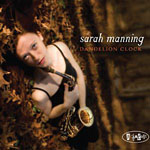
Sarah Manning, Dandelion Clock (Posi-Tone, 2010)
Sarah Manning, Two Rooms, Same Door (ArtistShare, 2006)
Sarah Manning, House on Eddy Street (Elflion, 2004)
Photo Credits
Pages 1, 3: Renee Allen
Pages 2, 4: Courtesy of Sarah Manning
< Previous
Manu Katche: Play As You Are
Next >
Tapestry Unravelled
Comments

About Sarah Manning
Instrument: Saxophone
Related Articles | Concerts | Albums | Photos | Similar ToTags
Sarah Manning
Interview
David A. Orthmann
United States
Jackie McLean
Rufus Reid
Yusef Lateef
Sonny Clark
Akira Tana
Charlie Parker
Art Hirahara
Linda Oh
For the Love of Jazz
 All About Jazz has been a pillar of jazz since 1995, championing it as an art form and, more importantly, supporting the musicians who create it. Our enduring commitment has made "AAJ" one of the most culturally important websites of its kind, read by hundreds of thousands of fans, musicians and industry figures every month.
You Can Help
To expand our coverage even further and develop new means to foster jazz discovery and connectivity we need your help. You can become a sustaining member for a modest $20 and in return, we'll immediately hide those pesky ads plus provide access to future articles for a full year. This winning combination will vastly improve your AAJ experience and allow us to vigorously build on the pioneering work we first started in 1995. So enjoy an ad-free AAJ experience and help us remain a positive beacon for jazz by making a donation today.

Giveaway

Eligible winners: 15
Days remaining: 10
Days remaining: 10