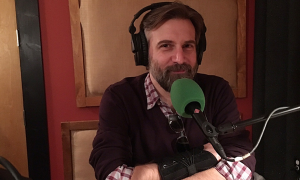
Home » Jazz Articles » Interview » Manu Katche: Play As You Are
Manu Katche: Play As You Are

For over 20 years, Katché has toured and recorded with such iconic figures as Sting and Peter Gabriel, bringing his highly distinctive time keeping to their music and touring all over the world. As a sideman, he has recorded with an impressive array of musicians and songwriters and has played on Norwegian saxophonist Jan Garbarek's recordings for nearly two decades.
It was his drumming on ex-The Band guitarist Robbie Robertson's "Somewhere Down the Lazy River"—from his eponymous 1987 Geffen album—that first caught the attention of ECM producer Manfred Eicher, beginning a long association with the legendary German record label. Still, Katché didn't record as a leader for the label until 2005—an 11-year hiatus following the release of Stick Around (Zildjian, 1994). Neighbourhood (ECM, 2005) was met with considerable critical and popular acclaim, followed two years later by Playground (ECM, 2007).
Katché is currently touring to promote his third release on ECM, the appropriately titled Third Round (2010). The music on all three ECM discs is highly melodious and gently lyrical, combining the brevity of pop tunes in the writing, with a stripped-down jazz approach to the playing. It is music that is fresh, accessible and groove-based.
With a new lineup of musicians, Third Round offers subtle textural contrasts to Katché's previous ECM recordings without straying too far from a style that Katché is refining and honing into a highly personal and distinctive sound.
The host of a highly successful TV music show in France, as well as a weekly radio show, Katché has limited time to appear as a sideman these days, though after 20 years of playing for other people, Katché is stepping forward with sure feet (and hands) as a leader in his own right.
All About Jazz: Can you tell us how much work went into this recording, because it's something that many people rarely think about.
Manu Katché: Of course it's a lot of work when you write music, but I write music all year 'round. I write on the piano and then I put a demo on the computer. I print out the charts and I send everything to everyone. The principal work was getting what I wanted sound-wise. I really had in mind Pino [Palladino] and Jason Rebello and Tore Brunborg and Kami [Lyle] to form the sound. Finally, when we recorded, it took three days. It was very intense because we started at ten in the morning and finished around ten at night. We weren't trying to change the structure; we were trying to get the right attitude, the right approach and the right sound.
Manfred Eicher is very good as a producer in the old-school way; he lets you play around and then he says, "Okay I think you're reaching something. Keep on doing this; forget about that," and after a while he'll get us to do a take. It was a lot of work to find the right approach between ourselves. It was challenging to get as good as we could. I think when you listen to the album, it's more or less a continuation of what I've done before, but I really wanted to sound a little bit different so I used electric bass and a little bit of Fender Rhodes. I wrote most of the themes for soprano saxophone and I asked Tore to try and find different elements and approach to what I'd done before.
AAJ: There is quite a similarity in sound between Third Round and your previous two CDs as leader on ECM, but also some notable differences, and I wonder if the title signifies a trilogy in compositional terms and maybe the end of a cycle at the same time?
MK: I think when I did this album, I had in mind to be a little bit more myself on the drums, which doesn't mean that before I wasn't—just that instead of doing the punctuation, the syntax, I wanted to try and put more into it. I would say that it's definitely a little bit of a different approach. Before, we were a quintet and I'm very happy how we sound as a quartet. It gives space, and when you use electric instruments, you can use sustain more than with acoustic instruments. That's maybe what makes you think it's a bit different and the end of a way of composing for ECM, but I don't think so; I think it's very me sound wise.
You know, I've been doing a lot of rock music for a long time, and when I started the ECM project I just concentrated on going for the emotion and sensitivity without any effects. I'm not saying it's not the case on this one, but now I think I'm gradually bringing my knowledge from the rock music industry and my way of approaching the music into the music I make with ECM.
AAJ: You've had a long association with ECM, particularly with Jan Garbarek, which stretches back many years; how did you first get to work with ECM?
MK: When I met Jan I met Manfred. Manfred heard me on record; I remember it was "Somewhere Down the Crazy River" by Robbie Robertson. Actually, it comes from a jam from myself. I thought to myself that if they like this rhythm, this groove, then they like my style in a way. It was clear that they wanted to change direction rhythmically. It was very easy working with Jan. Of course he's a legend, but he was so nice and so warm, and everything we did at the time worked instantly.
AAJ: Did you choose Tore Brunborg because his sound is somewhat evocative of Jan Garbarek?
MK: Of course he sounds very close to Jan, though the phrasing is different. Jan, of course, has marked the sound of Northern Europe, particularly Norway. On my second album, Playground (ECM, 205), I had Trygve Seim because he was recommended by Manfred Eicher. When we went on tour, his partner was pregnant and he was unable to complete the tour. I told him having a baby is the best thing in the world, so you have to be with her and not with me. He said he could recommend me a guy who is an amazing artist, and he gave me a record by Tore. I heard his playing, his phrasing and his sound and I thought, "Wow, that's the guy I want."
The first time we met was in France and he came straight to the gig. Of course he had all the records in advance and the set list, but he just played wonderfully, just beautifully. I told him that was exactly what I had in mind. We feel very comfortable together, very at ease. I told him I would love to have him on my next record.
When we did the record, I was very comfortable with Pino and Jason, who I've played with for many years, and I felt like I knew Tore after touring. I asked him to use some effects on the soprano saxophone even though he knew little about using effects, but I wanted him to bring something in that would make him play just a little different, and with cause and effect maybe lead to something else.
AAJ: He certainly leaves a big mark on Third Round.
MK: Yeah, he does.
AAJ: Most of the songs on Third Round are under or around four minutes, and they're very melodious which is more typical of pop songs...
MK: You're absolutely right. I don't even think about this when I write. I've been playing with pop artists for more than 20 years, so I'm used to their structure. The way I listen to the music and the way I approach it is very much pop—I'm just talking about the structures of my compositions. Even if it's instrumental music like jazz, I'm not a big fan on record of—which is different than on stage— having 150 bars of improvisation. I think that when you listen to a record you just go for a trip, and if the trip is too long you get bored, unless you are Tony Williams, Elvin Jones, Herbie Hancock, Keith Jarrett, John Coltrane or Miles Davis, which I'm not.
I love melodies and I try to be as melodic as I can, even when I play drums, and I think when you listen to Third Round, you go for a little trip. When we play live, of course, we go a little bit more for the improvisation but not too far away, not going crazy. The audiences are pleased because maybe they are not used to that way of structuring in instrumental music, but they react very positively to it. It's in, and not so long after, it's out, and they appreciate that.
AAJ: There are a couple of very short numbers on the album, "Out Take Number 9" and "Urban Shadow," and both of these compositions end at surprising times, leaving the listener wishing that they had gone on—particularly the former, which sounds like a feature for you as the drummer. Why did you make it so short?
MK: When we played it in the studio, it was nice. I was pleased, but not pleased enough. It's funny you should say that, because it really features myself and I thought, "When we do it live, we're going to have plenty of time to feature my drumming," but on the record it didn't reach what I was expecting, maybe because we had just three days to record and that track was recorded pretty much at the end of the session. I didn't want to get crazy with it, and I liked the vibe of it as a short piece. We'll get to it on stage, don't worry.
The other one, "Urban Shadow" has no drums on it. I'd tried that track live with the band before, and I used brushes or mallets sometimes, but I thought it sounded better without me. The others said, "Manu, it's a drummer's record. We can't do that." I said, "We can do whatever we want." It has a beautiful atmosphere and the drums do not bring something else to it, which means it doesn't need drums. If I was the producer I might think, "Maybe we need that drummer on it," but as it was, it sounded compact and beautiful and intense with these guys playing on it, so I wanted them to play on their own.
AAJ: What drum setup do you use on Third Round?
From left: Kami Lyle, Jacob Young,Manu Katché Jason Rebello, Pino Palladino, Tore Brunborg
MK: I always use the same cymbal set, which is a 21-inch Armand ride. It's a lighter ride than the rest of the ride cymbals I normally use. Then I have another 21-inch ride with rivets. I'm using two six-inch Avedis and A Custom splashes, an 18-inch Dark crash cymbal and a 16-inch Armand Avedis New Beat. My hi-hat is 13-inch. I'm not using China on this recording, but I'm using a small, 11-inch Oriental splash cymbal which I've played before, but it's not in my set up all the time. My drum kit is my regular kit, which is 22 bass drum, 12, 13 and 16 toms. No matter whether I'm in the studio or whether I'm playing live, or whether it's pop, rock or jazz, I'm always using the same setup. I only change the cymbals if I'm playing rock; I use a rock ride Zildjian 21-inch, but always the same drum kit.
AAJ: Your drumming sound is not easy to define; how did you develop your drumming style over the years?
MK: I remember listening to Tony Williams, and then I went to see him in Paris. That's what woke me up. I was amazed; he was a genius. The way he hits the drums, it sounded like he was hitting wood—so loud, so precise and so warm. No metal at all. But this was not the drum kit, it was the way he hit the drum kit. He made the sound. And then he had this thing on the hi-hat going crazy. I love his sound. It's unique; as soon as you hear it, you know it's him. From that age, I think I was 18 or 19, I thought I should work on my sound. My background is different, coming from classical music. I did a little bebop but I wasn't good at all, though I listened to Thelonious Monk, Bill Evans and everything, and I still listen to that. Then I discovered the Motown sound, and I was really impressed with the way you could hear the vocal performances. Then my generation is fusion: Chick Corea, {[Weather Report}}, Mahavishnu Orchestra, Billy Cobham, Jaco Pastorius, Stanley Clarke. I wasn't paying attention so much to the drummers, but the music—just the sound of it. Then, living in France, there was a lot of mainstream variety music, but at the same time a lot of Celtic music, a lot of North African music and West African music.
My background is classical, my genes on my father's side are African, and all of this made me think that I should bring something which I like and which defines me. It was not an analysis; it just came to my mind. If I was ever lucky enough to play with someone like Marvin Gaye, I should have something special to bring to his music. When I was a percussionist at the Conservatoire, I was mainly playing timpani—I loved the timpani—and actually my grip on the drum sticks are timpani grips, which is on the top of the stick. I thought I should mix my classical background and culture with everything I've learned in my country. When I say "learned," I mean everything that came to my ears. I was doing a lot of sessions, working with French singers and doing jazz. I also had a few bands, fusion and things like that. It's like a melting pot of everything. So my sound and my style developed from that time.
After awhile, I reduced my drum kit and my cymbals. Then instead of doing the back beat on the snare I did the back beat on the floor tom. This wasn't from listening to other drummers; it was making a point of everything I had learned to bring something else to the music when playing as a sideman. I was doing sessions seven days a week, and sometimes the session leader would say, "I don't like that. I don't want you to play like that." I would say, "Let me please present to you what I came with." Sometimes it worked, sometimes it didn't.
It took me up to my meeting with Peter Gabriel in 1986, when I played "In Your Eyes." He was just in front of me, and I'll remember what he said for the rest of my life: "You know Manu, just play as you are." I thought, "What does that mean, play as you are?" Then I thought, "Yeah, it's a cultural thing," and I tried to bring all my different elements into my approach to the music. It was a big point for me to realize what I was trying to achieve. I was able to play with Jan Garbarek, then go back to Peter Gabriel, do some Joni Mitchell or some French mainstream music, et cetera, et cetera.
AAJ: Peter Gabriel puts on one of the most powerful shows around; what is it like playing behind him?
MK: Very intense. The audience makes you think you are like God, [laughs] and everyone on stage around Peter is another God. Then you have the pressure of being amazingly good. And I was in charge of the whole band, which was okay because that's what I'd been doing for many years. The audience is so with you, so generous and so excited, so positive, that they send you vibrations that tell you you're God. I have to say those years with Peter were ... amazing doesn't do it justice. When I think about it today, it was like a different world.
On stage there was a lot of power, also from Tony Levin, who is a great artist, not just a great bassist. These people have something. Of course they have talent, but they are blessed, touched with something that we don't know what it is. They kind of pass you that while you are with them. It's an interactive exchange but you don't know when you live it, it is just there. It's not easy to describe, but it's something magical. Most of the artists I've mentioned and have recorded with have and transmit this. I've been very lucky.
AAJ: When you played concerts with Peter Gabriel, did you ever feel nervous when he would fall backwards into the crowd during "Lay Your Hands on Me"?
MK: The first time I was, because I didn't know it was going to happen. Nobody told me. All of a sudden I saw him reach the front of the stage and fall backwards. Wow! I was amazed. I was drumming but I was more concerned what was happening in the audience. It was incredible; people were passing him all around the venue. Of course, it took a while to come back to the stage. Some nights it was very, very long [laughs]. Sometimes he'd go to the end of a big venue and then come back, slowly. It's like you're in a film, it's not for real.
AAJ: Coming back to Third Round, there's a lyricism in the music and in the melodies which seems reminiscent of Sting, but not directly so, What have you learned from playing with him?
MK: It's funny that you say that because I don't see that in my music, but maybe I'm too close to it. Sting is a workaholic; he never stops. He never stops until he's pleased. I think I've learned that—to be very professional. If we decided to start at ten let's start at ten, and we're going to finish when we're going to finish, but when we are pleased. This is the kind of guy Sting is, but in a nice way. I did the Brand New Day tour with him in '99 and we did 286 gigs, and I tell you that in every gig we had a sound check. He never missed one. In each sound check we were checking things in the structures, in the harmonies and in the rhythm every time.
I have to say it was very exciting because it wasn't like going to the office and everything went automatically, no. You were always there, concentrated, on your toes and trying to become as good as you can. And that's what I learned from him; he never lets anything become habit, he's always thinking we can get better. Sometimes we were not better, but at least we tried. Then the next day at the sound check he would say, "OK, let's go back to what we did before." He's a perfectionist, but in a very relaxed way, and that's what I learned from him, both in studio and live—to go as far as you can. He's a gentleman and a very easygoing man as long as you are there and you give him what he's expecting from you. We're very close. We have a deep and great friendship.
AAJ: You're touring a lot throughout the rest of the year; who's in your working band?
MK: The pianist is an Italian guy who's living in France now. His name is Alfio Origlio, and he also plays Fender Rhodes. My bassist, who plays very much in Pino's [Palladino] style is a French guy called Laurent Vernerey. We've done a lot of sessions together and he's a good friend. He plays electric bass. The saxophonist is another Norwegian guy who plays when Tore is not available. His name is Petter Wettre and he's a very good player on tenor and soprano. That's the quartet.
AAJ: You're probably doing a lot fewer sessions as a sideman now that you have an established identity as a leader in your own right.
MK: Of course—I'm writing for a new album, then I'm recording it and then promoting it which takes quite a long time. The tour is 170 gigs, which is quite a long tour. I also have a TV show every week called One Shot Not for which I do programming as well as editing with the director. I have a radio show every Sunday night—I've got one guest and we talk about the new CD and do a jam. I did some sessions last summer with Herbie Hancock for his new album, but I can't do sessions like I did before. I haven't got the time. I have to say, I like it better going for my own music and my own band more than being a sideman; it's more interesting.
AAJ: What's the concept behind One Shot Not?
MK: If you've seen Jools Holland's show [in the UK], it's pretty similar. I have between three and four artists. We see them from the morning to the night when they perform, so the afternoon is rehearsal. I propose if they want to jam or if they want to do a track of their own stuff. That's the same for the four artists. Then at 8:30 at night, we have an audience and each artist does two or three songs each. I spend three or four days editing in the studio to make the TV audience understand what an artist does before a performance.
The concept came from when I was doing things like Live Aid, Mandela Day and Amnesty International. I saw all the artists watching the performances of the other artists. I felt that was something special that had never been shown on TV. At the end of the gigs, they all went on stage and performed the same song. So that's exactly what I'm doing on the show; all the artists watch each other and at the end of the show we do a big jam.
AAJ: What sort of music do you feature?
MK: It's very eclectic; I'm going from indie to pop to jazz. It's everything I like, because I choose the music. There are no restrictions. I have someone who works with me. She proposes a lot of different artists, and if I like the music I'll go to see them in London or Paris to see how it works live.
AAJ: That sounds like a fun job. What are the viewing figures like?
MK: It's great. I've discovered a few amazing groups that I've never heard of before. My role as a sideman, which you asked me about before, is evolving. It's now inside my own show. For example, I discovered this guy called Senk—an English guy who used to be a DJ and who's now a songwriter. I discovered him on the internet. I love what he does, so I contacted him and he came and played a couple of tracks with me and Pino Palladino. Probably I'll play on one of his records. The TV show creates a new way for me of being a sideman. We get about 1.5 million viewers. There' a great buzz about it and an amazing press. We've pumped it up on the web too, and it's mainly young people who watch it.
AAJ: What advice would you give to someone who wants to take up the drums?
MK: You have to work a lot to get enough technique to deliver what's in your mind. That's the first thing. The second thing is, work with a metronome because you have to keep time. Instead of going 120 BPM go 60 BPM and work everything very slowly, and it will be printed on your brain forever. And the third and last thing would be trust yourself. Even if people around you tell you they don't think it's right, think it's right; then you're going to deliver your own personality, and that's going to make you known and wanted. The way you play is the way you are, and that's unique. That's what we need in the music—multiple unique personalities.
Selected Discography
Manu Katché,Third Round (ECM, 2010)Manu Katché, Playground (ECM, 2007)
Manu Katché, Neighbourhood (ECM, 2005)
Jan Garbarek, In Praise of Dreams (ECM, 2004)
Youssou N'Dour, Nothing's In Vain (Nonesuch Records, 2002)
Sting, Brand New Day (A&M Records, 1999)
Jeff Beck, Who Else (Sony Records, 1999)
Tori Amos, Boys for Pele (Atlantic Records, 1996)
Gypsy Kings, Tierra Gitana (Nonesuch, 1996)
Tony Levin, World Diary (Papa Bear Records, 1995)
Pino Daniele, Non Calpestrare I Fiore Nel Deserto (Warner Bros, Records, 1995)
Manu Katché, Stick Around (Zildjian, 1994)
Peter Gabriel, Us (Real World, 1992)
Jan Garbarek, Ragas and Sagas (ECM, 1992)
Manu Katché, It's About Time (EMG, 1991)
Jan Garbarek, I Took Up The Runes (ECM, 1990)
Youssou N'Dour, The Lion (Virgin Records, 1989)
Joni Mitchell, Chalk Marks In A Rain Storm (Geffen Records, 1988)
Sting, Nothing Like the Sun (A&M Records, 1987)
Robbie Robertson, Robbie Robertson (Geffen Records, 1987)
Peter Gabriel, So (Geffen Records, 1986)
About Manu Katche

Tags
PREVIOUS / NEXT

Become a Sustaining Member

Since 1995, All About Jazz has championed jazz as an art form and supported the musicians who create it. Over three decades, it has grown into one of the world's leading jazz resources, serving hundreds of thousands of readers, musicians, presenters and industry professionals each month.
Help Build the Future of All About Jazz
Your support helps us continue building All About Jazz for the next generation—expanding our editorial coverage, preserving jazz history, developing new community features and creating better ways to discover the music and the people behind it.
Become a sustaining member for as little as $20 per year and you'll immediately enjoy an ad-free experience along with access to subscriber features and future articles for a full year.
Together, we're not simply sustaining All About Jazz—we're building its future. Thank you for being part of the journey.