Home » Jazz Articles » Album Review » Joe Chambers: Horace to Max
Joe Chambers: Horace to Max

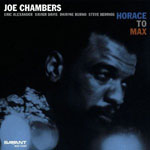
Amongst so many legendary composers, Miller's "Portia"—from one of Miles Davis' latter-day electric albums, Tutu (Warner Bros., 1986)—may seem odd. Still, with a strong quintet featuring drummer/percussionist Steve Berrios—allowing Chambers the freedom to concentrate on in-the-moment group interaction rather than having to overdub his mallet instruments over his kit—it's becomes an atmospheric highlight that, in addition to Chambers' oblique marimba solo, affords plenty of space for lithe pianist Xavier Davis, and an indigo-rich head played by saxophonist Eric Alexander, who has something of his own to prove here.
Often pegged squarely as a mainstream performer, Chambers couldn't have made a better choice in recruiting Alexander for a session that marries Afro-Cuban rhythms with straight-ahead swing and more. But over the harmonic ambiguity of Shorter's "Water Babies"—Chambers, this time, layering vibes and marimba over his kit—Alexander truly shines, extending himself into outré territory with a closing solo of controlled power and restraint that would make its composer proud.
Two tracks featuring vocalist Nicole Guiland—Roach's swinging chestnut "Lonesome Lover," co-written with Abbey Lincoln, and his melancholic but politically charged ballad, "Mendacity"—lend Horace to Max its largely centrist position. Still, Dorham's oriental-tinged "Asiatic Raes" gets reworked with a clavé drums/percussion intro, before moving into its stop-start head and a fiery pulse, anchored by bassist Dwayne Burno, that gives Alexander and Davis the first salvos on an album filled with focused, often brief, but always memorable soloing. The only Chambers original, "Afreeka" is a revisit from Urban Grooves (441 Records, 2003) where, coincidentally, he also gave a first kick at "Portia." Here, however, the group trims down to a percussion-driven, piano-less quartet, for a joyful, Afro-centic track that puts Chambers' vibes and marimba out front, as he interacts in a fashion all the more remarkable for his having separately overdubbed the two instruments.
Elsewhere, Chambers gives relatively short shrift to Monk's enduring "Evidence," though taken an almost impossibly fast clip, and a more extended look at Silver's soulfully swinging "Ecaroh," with lengthy features for Alexander and Chambers (on vibes) that travel a knotty set of time changes yet remain assured in their seamless shifts.
On 2006's The Outlaw, his first for Savant, Chambers' stated ambition was to reestablish himself as a mallet player. He achieves even greater success on Horace to Max, while not entirely eschewing his inestimable skill behind the instrument that cemented his reputation in the first place.
Track Listing
Asiatic Raes; Ecaroh; Man from South Africa; Mendacity; Portia; Water Babies; Lonesome Lover; Evidence; Afreeka.
Personnel

Joe Chambers
drumsJoe Chambers: drums (1, 3, 4, 6-8), vibraphone (2-7, 9); marimba (5, 6, 9); Eric Alexander: tenor saxophone (1-6, 8, 9); Xavier Davis: piano (1-6, 8); Dwayne Burno: bass (1-6, 8, 9); Steve Berrios: conga drums (1, 9), drums (2, 5), percussion (3, 6, 8); Nicole Guiland: vocal (4, 7); Helen Sung: piano (7); Richie Goode: bass (7).
Album information
Title: Horace to Max | Year Released: 2010 | Record Label: Savant Records
Comments
Tags
Joe Chambers
CD/LP/Track Review
John Kelman
Savant Records
United States
Bobby Hutcherson
Andrew Hill
Wayne Shorter
Marcus Miller
Thelonious Monk
Kenny Dorham
Horace Silver
Max Roach
Miles Davis
Steve Berrios
Xavier Davis
Eric Alexander
Abbey Lincoln
Dwayne Burno
Horace to Max
For the Love of Jazz
 All About Jazz has been a pillar of jazz since 1995, championing it as an art form and, more importantly, supporting the musicians who create it. Our enduring commitment has made "AAJ" one of the most culturally important websites of its kind, read by hundreds of thousands of fans, musicians and industry figures every month.
You Can Help
To expand our coverage even further and develop new means to foster jazz discovery and connectivity we need your help. You can become a sustaining member for a modest $20 and in return, we'll immediately hide those pesky ads plus provide access to future articles for a full year. This winning combination will vastly improve your AAJ experience and allow us to vigorously build on the pioneering work we first started in 1995. So enjoy an ad-free AAJ experience and help us remain a positive beacon for jazz by making a donation today.

Giveaway

Eligible winners: 15
Days remaining: 14
Days remaining: 14



