Home » Jazz Articles » Bailey's Bundles » The Multi-Tasking State of David Binney 2010
The Multi-Tasking State of David Binney 2010
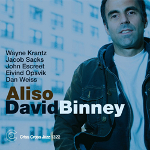 David Binney
Aliso
Criss Cross
2010
Aliso is Binney's much anticipated follow-up to 2009's excellent Third Occasion (Mythology Records). It is a bit of a brilliant throwback to the "blowing session" days of 1960s Blue Note Records, where the musicians come together with little or no practice and produce a masterpiece—think of saxophonist Art Pepper's Meets The Rhythm Section (Contemporary, 1957). For Aliso, Binney and company had previously been on different tours, all returning to New York City the night before the recording date.
Like many of the famous dates of the past, Aliso combines original compositions with ostensible standards. The crucial word here is ostensible. Binney pulls from the songbooks of saxophonists/composers Wayne Shorter, Sam Rivers and John Coltrane, and pianist/composer Thelonious Monk. There is nary a Tin Pan Alley tune to be heard among the nine pieces present. Binney draws from a more recent pool of compositions, specifically jazz compositions. No lyrics cloud the issue of this music. It is all notes and staves. The sum of these parts is very progressive acoustic jazz that is as uncompromising as it is nostalgic in its conception.
Binney is joined by musicians with whom he has worked in the past and with whom he shares a certain empathy. Pianist Jacob Sacks, who played on Binney's 2005 Bastion of Sanity (Criss Cross), and is part of his New York City rhythm section, spars effectively with the leader on Shorter's "Toy Tune" while turning in a perfectly angular and integrated solo on the same. Guitarist Wayne Krantz is such a potent presence he can be regarded as the grain of sand this organic quintet takes and turns into a pearl. His solos on the title track and Coltrane's "Africa" are steeped in pathos and creativity.
Binney is in top form (is there ever a time when he is not?). His composing and soloing are intense reminders that giants still walk among us, doing giant things. On the alto saxophone, Binney has no current peer. His muscular tone, informed by a keen creativity, makes his art one to watch closely. Binney remains a nuclear presence in jazz, pushing boundaries while never painting himself into a creative corner.
Visit David Binney on the web.
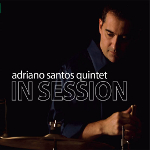 Adriano Santos Quintet
In Session
KingJazzAD Music
2010
Brazilian drummer percussionist Adriano Santos has most recently been tending his trade with Hendrick Meurkens and the New York Samba Jazz Quintet, appearing on Sambatropolis (Zoho, 2009) and New York Samba Jazz Quintet (Zoho, 2006). After finishing his conservatory training at Berklee College of Music, Santos moved to New York City in 1995, enrolling in City College of New York. Since that time, Santos has been a fixture in the area, providing expert guidance in all things pertaining to Latin rhythm.
Music lore supports the genesis of Latin jazz as first performed by Machito and His Afro-Cubans, lead by musical director Mario Bauza. Bauza composed the first Latin jazz piece "Tanga" in spring 1943, using jazz instruments and solo improvisation. "Tanga" was based on the clave rhythm, defined as a five-stroke rhythmic pattern (3-2/2-3) ubiquitous to Latin jazz. What the clave rhythm gave rise to was the integral importance of drums and percussion to the jazz genre, a musical relationship that is genetically linked. Percussion is the heartbeat of Latin jazz and it is one beautiful arrhythmia.
Santos received a degree in movie scoring from Berkley, a talent he puts to full use on In Session. "From The Lonely Afternoons" displays Santos' considerable abilities to coax any number of sounds and moods from both his kit and band. The piece begins with organic pastoral sounds from the cymbals, layered with wooden rub shots, bass runs and babbling brook piano. Then enters the clave rhythm on the snare rim. Binney provides some of his most focused ensemble playing, proving his soothing command of the Brazilian vibe. Binney is every bit as effective as Bobby Watson, also a master this Latin sound.
Binney, who produces In Session with the leader, solos and comps clear-eyed and tempo perfect. Santos gracefully shares the space with him, but not at the expense of the percussion focus. The two—with rhythm section Helio Alves (piano), David Ambrosio (bass),and Dende (percussion)—extract a certain magic from the indigenous South American terrain that is conveyed with crystal clarity.
Visit Adriano Santos on the web.
 Alper Yilmaz
Over The Clouds
Kayique Records
2010
Binney joins company with Turkish bassist Alper Yilmaz for the edgiest offering of these three discs. Yilmaz (with Binney) is already well known to the jazz community from his 2007 recording Clashes (Kayique Records). Virtuosic in the vein of Jaco Pastorius, yet refined and low-key like John Patitucci, Yilmaz flexes his creative muscles in such a way as not to show off. He presents a fully considered and conceptualized music that immediately speaks for itself.
Guitarist Nir Felder provides the harmony instrument normally reserved for keyboards in a jazz ensemble, redefining said position as one of fractal generation. The relationship among instruments and instrumentalists on Over The Clouds is one of post-modern, de-constructionist counterpoint, J. S. Bach and Peyote buttons. Binney and Yilmaz spar on "Yet" like Coltrane and Rashied Ali did on their lengthy recitations on Interstellar Space (Impulse!, 1974).
The disc can be summed up in the brilliant 11 minutes of "Misir with Grandma," where the entire band solos separately beginning with Binney, whose soliloquy is both thoughtful and probing. This is saxophone at the outer reaches. Guitarist Felder provides various electrical effects in the background at just a low enough signal to noise ratio to create anxiety. Binney and Felder then duet with Yilmaz adding the nervous element. Then Yilmaz bares his Turkish soul with a wandering melodic and harmonic section that integrates what seems to otherwise be the disjointed collection of free jazz musical parts.
David Binney is proving to be jazz's Everyman: always available and always creative. Like pianist Edward Simon, Binney shares a special empathy with Yilmaz, one that will continue of pay dividends with each recording session.
Visit Alper Yilmaz on the web.
Tracks and Personnel
Aliso
Tracks: Aliso; Day in Music; Toy Tune; Strata; Teru; Fuchsia Swing Song; Bar Life; Think of One; Africa.
Personnel: David Binney: alto saxophone; Wayne Krantz: guitar; Jacob Sacks; John Escreet; Eivind Opsvik; Dan Weiss.
In Session
Tracks: Sabor Carioca; From the Lonely Afternoons; De Ton Pra Tom; Xibaba; Contemplação; Pro Zeca; Amphibious; Ninho Da Vespa.
Personnel: David Binney: alto and soprano saxophones; Helio Alves: piano; David Ambrosio: acoustic bass; Dende: percussion; Adrianos Santos: drums and percussion.
Over the Clouds
Tracks: Yet; Flughafen; Mir With Grandma; Her Waves; Straight Up; Cagdas' Tuner; Perplexity; Over The Clouds.
Personnel: Alper Yilmaz: electric basses, sound design, loops; David Binney: alto saxophone; Nir Felder: guitars, effects; Bodek Janke: drums, percussion (1, 3, 4); Volkan Oktem: drums, percussion (2, 5, 7, 8); Aslihan Dermitas: voice (8); Tolga Tuzun: sound design (8).
About David Binney

Tags
PREVIOUS / NEXT
David Binney Concerts
Become a Sustaining Member

Since 1995, All About Jazz has championed jazz as an art form and supported the musicians who create it. Over three decades, it has grown into one of the world's leading jazz resources, serving hundreds of thousands of readers, musicians, presenters and industry professionals each month.
Help Build the Future of All About Jazz
Your support helps us continue building All About Jazz for the next generation—expanding our editorial coverage, preserving jazz history, developing new community features and creating better ways to discover the music and the people behind it.
Become a sustaining member for as little as $20 per year and you'll immediately enjoy an ad-free experience along with access to subscriber features and future articles for a full year.
Together, we're not simply sustaining All About Jazz—we're building its future. Thank you for being part of the journey.