Home » Jazz Articles » Album Review » Cosa Brava: Ragged Atlas
Cosa Brava: Ragged Atlas

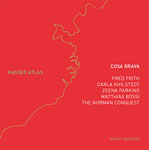
Collecting a group of people with whom he's collaborated increasingly over the past several years—notably violinist/vocalist Carla Kihlstedt (Tin Hat) and keyboardist Zeena Parkins (Björk, Tin Hat)—Frith has fashioned a group as capable of subtle interpretation as it is more aggressive stances. Use of electric instruments, including Frith's occasionally overdriven guitar, and some ratcheted-up energy—not to mention drummer Matthias Bossi's occasional pulsing rhythms—may make this a rock band by tenuous definition, but even potentially applicable terms like "progressive rock" only apply in the sense that this music is, indeed, forward-reaching. Broad dynamics, a blend of acoustic and electric instrumentation, fine compositional detail, and surprisingly memorable melodies make Ragged Atlas' largely continuous, 13-song suite best absorbed as a whole.
There are unmistakable high points to be found. Only Frith could write a song like "Falling Up (For Amanda)" where, amidst interlocking, minimalism-informed parts, a vocal chorus gradually reduces its time signature one beat at a time through regular and irregular meters, lingering long after the song is over. It may be mathematically precise, but it never feels considered, as The Norman Conquest's sonic manipulations gradually augment and expand the group's real-time sound. Elsewhere, the opening "Snake Eating Its Tail" acts as Ragged Atlas' fanfare; its knotty, serpentine unison melody punctuated with sharp percussive stops and starts, and a gradually expanding soundscape, courtesy both of Frith's arrangement and (once more) The Norman Conquest's aural enhancements.
But Ragged Atlas' greatest success is its ability to transcend time. Folkloric melodies abound, bolstered by the sound of Kihlstedt's violin and Parkins' accordion, and yet Frith's contrapuntal approach and shifting bar lines speak to his experience writing in a New Music environment. Instrumentals like "Round Dance" suggest how Renaissance Music might sound, had it evolved, without diversion, into the present millennium.
Despite Frith's clear leadership, and the defining presence of his angular yet eminently approachable playing—in addition to Kihlstedt, who has emerged as one of the past two decades' most intriguingly boundary-busting violinists—Cosa Brava is a group. Its overall conception may be Frith's, but its sound would be unmistakably altered were any of its members replaced. As a debut of music that transcends time and genre, Ragged Atlas stands as one of 2010's most auspicious debuts.
Track Listing
Snake Eating Its Tail; Round Dance; Pour Albert; R. D. Burman; Falling Up (for Amanda); Out on the Town with Rusty, 1967; Lucky Thirteen; Blimey, Einstein; The New World; Tall Story; For Tom Zé; A Song About Love; Market Day.
Personnel

Fred Frith
guitar and vocalsFred Frith: guitar, bass, voice; Carla Kihlstedt: violin, nyckelharpa, bass harmonica, voice; Zeena Parkins accordion, keyboards, foley objects, voice; Matthias Bossi: drums, percussion, sruti box, voice; The Norman Conquest: sound manipulation; Anantha Krishnan: mridangam and tabla (4).
Album information
Title: Ragged Atlas | Year Released: 2010 | Record Label: Intakt Records
About Fred Frith
Tags
PREVIOUS / NEXT

Become a Sustaining Member

Since 1995, All About Jazz has championed jazz as an art form and supported the musicians who create it. Over three decades, it has grown into one of the world's leading jazz resources, serving hundreds of thousands of readers, musicians, presenters and industry professionals each month.
Help Build the Future of All About Jazz
Your support helps us continue building All About Jazz for the next generation—expanding our editorial coverage, preserving jazz history, developing new community features and creating better ways to discover the music and the people behind it.
Become a sustaining member for as little as $20 per year and you'll immediately enjoy an ad-free experience along with access to subscriber features and future articles for a full year.
Together, we're not simply sustaining All About Jazz—we're building its future. Thank you for being part of the journey.