Home » Jazz Articles » Interview » Anthony Jackson and Yiorgos Fakanas: Interspirits
Anthony Jackson and Yiorgos Fakanas: Interspirits

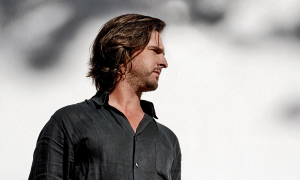
 From left: Anthony Jackson, Yiorgos Fakanas
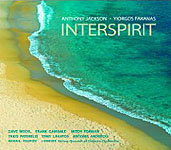
A trip to Greece in late 2007 to play a concert—surprisingly, his first visit to this country in four decades as a professional musician—would result in Interspirit (Abstract Logix, 2010), the first recording to which he has put his name as a leader/co-leader. Oddly, perhaps, it is collaboration with a fellow bassist, Yiorgos Fakanas, who's also a busy composer. The resultant music of this meeting is, broadly speaking, fusion music; the best of Greek jazz musicians combining with heavyweights of the genre like Frank Gambale, Dave Weckl and Mitchel Forman.
More specifically, it is a fusion of like minds, as Fakanas and Jackson share a musical vision which draws from wide sources and appreciates music for its own sake, regardless of category; European, American, classical, New World, Old World, jazz and funk are all there in the mix, and the result is a vibrant and unquestionably modern fusion. It is a fascinating coming together of two great musical minds—and, as they themselves reveal, a very natural process at every step of the way.
"I was touring in October '07," says Jackson taking up the story, "and the last stop on the tour was Athens. I'd never been to Greece before." In Jackson's touring band were drummer Dennis Chambers, guitarist Mike Stern and saxophonist Bob Franceschini. Stern and Franceschini were killing two birds with one stone; in addition to the gig with Jackson they had lined up some concerts with Fakanas, with whom they had previously recorded on the Greek bassist/composer's Domino (ANAM Records, 2005). The club they were playing in was owned by Fakanas, and during a break in the gig Jackson got to hear Fakanas' CD, which immediately struck a deep rooted chord. "It wasn't the typical bassist album," recalls Jackson, "it was an orchestral album with horns and augmented with strings. It was obviously a composer's album. This was a serious composer, not just a bassist who writes songs."
A serious composer, indeed; Fakanas, in fact, is one of Greece's most versatile composers and a renowned musical educator who has taught over six hundred bass students at his own music school. The author of a staggering seventeen books on bass playing and musical theory, it is fair to say that he has exercised a significant influence in Greek conservatories and on a very large number of musicians. No slouch himself as a recording artist, Fakanas has participated in over seven hundred recordings, has written music for film and theatre and founded ISKRA, Greece's first jazz-fusion group. Like Jackson, Fakanas has a deep appreciation of classical music and has performed with and conducted some of Greece's most important orchestral groups.
Fakanas' club, Athina Live, is often host to touring musicians from America and Europe and when Jackson passed through with his band Fakanas took the opportunity to let him hear his music:"During the intermission, he heard Domino, with Dave Weckl on drums and Mike Stern on guitar," Fakanas relates. It had an impact on Jackson as Fakanas continues: "He liked it very much and asked me if I had written the whole thing because he was very surprised that a bassist could compose and arrange music in that way."
Jackson also listened to Fakanas's previous CD, Echoes (Libere Records, 2004), which featured trumpeter Wallace Roney. This CD, based on Greek themes, was written and arranged for a jazz orchestra plus string ensemble, and made such an impression on Jackson that when Fakanas proposed that they record an album together Jackson didn't need much persuading.
 "We shared a lot of musical impulses, a lot of musical history and a lot of musical goals," says Jackson. "Certainly it was an unusual conception, the two of us playing. I remember thinking; I've been offered to make my own record for decades and always turned it down mainly because I'm not a composer. I can sit down with score paper and write music but my writing is just not inspired; I'm not talented in that department, capable but not talented. So I decided why not? This guy is a fine writer and a fine player. I said 'yes' on a whim."
Fakanas had achieved what nobody else had in the three decades since Quincy Jones unsuccessfully proposed that Jackson record his own album. With Jackson's agreement to collaborate, Fakanas was in an enviable and somewhat daunting position at the same time: "I've known his playing since I was a kid. Anthony Jackson, along with Jaco Pastorius and Stanley Clarke were the three people who really influenced my playing, and my thinking about the role a bass guitar can have in a tune and music in general. It was a big honor for me and a big responsibility, because Anthony was always one of my bass heroes, one of the people who influenced not only my playing but my musicality as well."
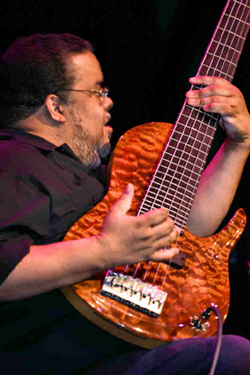
All the music on Interspirit was composed and/or arranged by Fakanas, with Jackson in mind: "I've been listening to the way Anthony plays the bass and the way he participates in other people's music for a long time, so I knew a lot about his style. I wanted to have strong tunes with the opportunity for Anthony to show his comping ability. Anthony is one of the greatest accompanists I have ever heard in my life, so allowing him free reign in that area was crucial. But another thing that was very important for me was to provide melodies, because Anthony is a very unique melodist. He draws a rich, beautiful sound when using fingers, thumb and flat-pick, and he often records a line and then rerecords it, sometimes doubling or tripling the part, adding octaves up, down, or both, and sometimes he detunes the new parts which creates a natural chorus effect which is fantastic."
For Jackson, the biggest challenge was not improvising behind the ensemble playing as he explains: "The biggest challenge for any interpretive player, even for a concert pianist playing a concerto, is to bring out your own personality playing the music written by someone else. It takes a great level of interpretative skill. I didn't change everything, I was faithful to the melodies, the ensemble parts, but I was able to demonstrate what I'm all about."
What Jackson is all about is making the music sound better. He doesn't take a single solo on Interspirit, leaving all five to Fakanas. That was the way Jackson wanted it: "I've done thousands of recordings but only a handful of solos; that is not where my strength lies. My strength lies in interpreting. Of course comping is a challenge, but an equal challenge, and in many ways a greater challenge is to take music already written and turn it into something personal—to try to observe what someone has done and yet make it an original statement. That was the challenge of this project."
To those who think that Jackson can do this sort of thing in his sleep it may be surprising to learn otherwise: "Some of Yirogo's charts are extremely challenging, very brilliantly written," says Jackson. "It was sometimes murderously difficult."
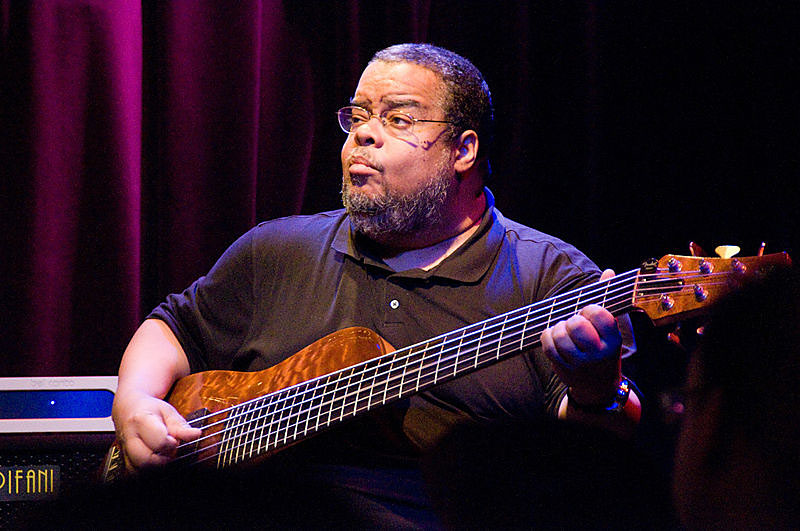
For his part, Fakanas is in no doubt as to Jackson's virtuosity or the significance of his contribution on Interspirit. "He's a real musician," enthuses Fakanas, "and what he likes is to improve the music, to improve the composition. But the way he plays behind the solos, the way he is comping, is like doing a solo—that's the impression I have. He treats the instrument like a guitar when he goes up, but when he goes down it's the deepest bass sound I've ever heard in my life. He treats the lower register bass strings in a unique way. "
The music on Interspirit is technically impressive, both from the point of view of the arrangements and in the playing of all the musicians involved, but as Fakanas explains, there was, from a personal point of view, an overriding objective to this project: "Another goal which I tried to achieve which was much more important than any technique was to try and compose tunes combining two different worlds, the European and the American way of playing grooves and of playing fusion music. That was my main goal. That is why you will find melodies that you might not expect from a jazz musician or a fusion musician; it's maybe more melodic, more pan-cultural. That's why I used the string ensemble on "Cuore Vibes Part 1." There are a lot of funk grooves and jazz-influenced melodies but the main goal was to combine multiple sources and methods in my compositions. "
 The miniature string ensemble piece "Cuore Vibes Part 1" may seem like something of an anomaly in a fast-paced fusion album but the reason for its inclusion is quite simple, as Fakanas explains: " As I mentioned before, I had composed a CD a few years before with a string ensemble, which Anthony liked very much. It is the only ballad on this CD. I had the idea to start the ballad with a string ensemble playing the main melody. Anthony liked the way I write for strings, and this CD is for Anthony, so it's like a dedication to him.
"On the other hand," continues Fakanas, "combining string orchestras and classical orchestras with jazz or any other modern arrangement is something that interests me very much. In Greece, I'm arranging and composing for very large classical orchestras. Here I use the combination of the classical and jazz styles, which has sometimes been called Third Stream. What I really like doing and what I am trying to do is to compose music in this style, with the combination of two orchestras.
"I'm just trying to use jazz harmonies to add new colors to the symphonic, orchestral colors. That's why I like composers like the Russians and the French of the early nineteenth century, like Stravinsky and Prokoviev. They created completely new colors in the symphonic orchestra. These are the composers who most influence me."
Classical music has made a huge impact on Jackson as well, and his breadth of knowledge of classical music and the history of the music is quite staggering. Listening to him talk so passionately about his formative childhood influences such as Chopin, Schuman, Prokoviev, Shostakovich, Bartok and Rachmaninov is illuminating: "My way of approaching the bass guitar is influenced by the way Rachmaninov approached the piano" Jackson asserts. "The way he played the piano was unlike anything else. Staggering technical accomplishment and power, married to the ability to play like a butterfly when required. Whatever he felt the music required and that's the way I've tried to play as well."
Besides a shared love of classical music the two bassists share a common outlook on the universality of music. Fakanas says, "I believe that jazz music and fusion music are international. Of course, the music was born and developed in America, but for me it is always a combination of African rhythms and European harmonies, and this combination developed in America. So, Interspirit represents the international spirit that comes from all over the world. It underlines an international meeting between different cultures, but with a common goal in coming together." Says Jackson, "I've always been attracted to music—whether it be jazz, rock, pop or country—as pure music. Be well versed in all the forms. I came to Yiorgos completely open, not thinking that this would be America meets old world, jazz and classical; oh, no. Don't ask what I'd like to do; don't write something because you'd think it'd be comfortable for Anthony, just write whatever you want." Some "murderously difficult" playing later, Jackson realized that he got exactly what he wished for.
Fakanas's writing is ambitious, with some of the pieces written and arranged for up to fourteen musicians. On "Cuore Vibes Part 2," there is even a third bassist, Tasos Kazaglis on contrabass. If this seems like an excess which even Ornette Coleman would shy from, there is a very simple explanation, as Fakanas reveals: "Tasos is a very good classical double-bassist, and is part of the string ensemble. I'm using this double-bass in order to give a more complete character to the string ensemble. It's a string quartet plus a double-bass. He's playing in the upper octaves in order not to be between me and Anthony."
 Much of the music on Interspirit has the feel of a little big band, something which Fakanas is quick to recognize: "That's exactly the point," affirms Fakanas. "When I was growing up in Greece in the late seventies and early eighties, we didn't have any schools offering jazz education. But I had a very good opportunity to learn; when I was nineteen years old I was chosen by the Greek government to represent Greece in the European Youth Jazz Orchestra. It was a big band made up of musicians under twenty-three years of age, from all the European countries. It was impossible to have something like that in Greece at that time, so it was a major influence on me. The leaders, pianist Michael Garrick, and Bill Ashton were composing and arranging. John Etheridge was one of the band instructors.
"When I returned to Greece I started composing tunes," continues Fakanas, "and kept in mind the big-band concept. That's what I'm trying to do with my quintet, because I always like a lot of rhythm in my compositions. At the same time I leave space for improvisation, and this characterizes my music. The sound of a big band is always somewhere in my compositions."
 The musicians who make up the Kinisis String Quartet of Colours Orchestra and the seven-piece brass section hail from Greece, and are joined by Weckl, Gambale and Foreman. Fakanas brought the Americans into the project and is delighted by their contribution: "All of them play like it is their own album," he enthuses. For Jackson, who has collaborated with all three over the years, their inclusion in the project was significant: "It was one of the things that made me less apprehensive about committing to my first project of this kind," he explains, "the fact that Yiorgos was not only talking about getting the best players but putting it into action. It gave me confidence to commit. I knew that here was somebody with whom I could have a productive and rewarding musical association. How could I say no?"
A productive association it has certainly been, for Interspirit is one of the more original fusion recordings of recent years, with playing of the highest standard. It has been a demanding but ultimately rewarding experience on a personal level for both Fakanas and Jackson. For Fakanas, simply playing alongside Jackson was somewhat intimidating: "It was a great honor for me but also a great challenge because Anthony Jackson plays the same instrument and he's one of the greatest bass players ever! I wanted to make something that he would be proud of." Jackson, despite the personal challenges he faced, is justifiably pleased with the results: "It was a very intense and very rewarding project," he says. "Interspirit was the first project of its kind where there was a chance to experiment with something I had long thought about. I had never come into a project where the music was written around me as the featured player. Interspirit gave me the chance to reach out and find myself. I'm pleased with the way it turned out."
The hope is to bring the music to a live audience, as Fakanas explains: "Right now we're trying to organize tours with Anthony and me on bass, with Mitch Forman and Horacio "El Negro" Hernandez on drums, along with saxophonist Takis Paterelis and trombonist Antonis Andreou. In Greece, we played just seven concerts but we are hoping to tour America, Europe and Asia later this year. And I'm looking forward to future collaborations with Anthony," Fakanas confirms.
For Jackson, too, the ambition is tour with this music, the economy and logistics permitting. However, there is a determination in his voice when he says: "It's not going to be easy but I have confidence that it will happen and it's something that I want to happen. It's going to happen." As for the suggestion by Fakanas that there may be future collaborations, there is little doubt in Jackson's mind: "I am certainly going to collaborate with Yiorgos again on other projects where he is going to write orchestral music with me as a featured performer. I have always wanted to play with an orchestra. Yiorgos is the first person I have had the chance to record with in such a context. "
With one eye on the future and summing up the essence of Interspirit Jackson states: "I think it will become more apparent with future collaborations with Yiorgos that an important aspect of the record is an inner, subtle glorification of the collaboration between composer and performer. There's more to come. I have a lot more left in me."
Selected Discography
Anthony Jackson/Yiorgos Fakanas, Interspirit (Abstract Logix, 2010)
Fahir Atakoglu (with Anthony Jackson), Istanbul in Blue (Far&Here LLC, 2008)
Steve Khan (with Anthony Jackson), The Suitcase (Tone Center, 2008)
Yiorgos Fakanas, Domino (ANAM Records, 2005)
Yiorgos Fakanas, Echoes (Libera Records, 2004)
Hiromi (with Anthony Jackson), Another Mind (Telarc Jazz, 2003)
Simon Phillips (with Anthony Jackson), Another Mind (Magna Carta, 1997)
Michel Camilo (with Anthony Jackson), Rendevouz (Columbia Records, 1993)
Yiorgos Fakanas, Amorosa (Sony Music, 1991)
Michel Petrucciani (with Anthony Jackson), Playground (EMI Records, 1991)
Dizzy Gillespie (with Anthony Jackson), Rhythmstick (Cti Records, 1991)
Iskra (with Yirogos Fakanas), Parastasis (Utopia, 1990)
Wayne Krantz (with Anthony Jackson), Signals (Enja, 1990)
Yiorgos Fakanas, Horizon (RCA Records, 1989)
Iskra (with Yiorgos Fakanas), A New Day (Polygram, 1986)
Steely Dan (with Anthony Jackson), Gaucho (MCA Records, 1980)
Paul Simon (with Anthony Jackson), One Trick Pony (Warner Brothers, 1980)
Chick Corea (with Anthony Jackson), The Leprechaun (Polydor Records, 1976)
The O'Jays (with Anthony Jackson), Ship Ahoy (Philadelphia International Records, 1973)
Photo credits
Anthony Jackson, Page 2: Art Bromage
Anthony Jackson, Page 3: Courtesy of The Institute of Contemporary Music Performance
All Other Photos: Courtesy of Yiorgos Fakanas
Visit Anthony Jackson and Yiorgos Fankanas on the web.
< Previous
Peter Bernstein Quartet, Live at Smalls
Next >
Royal Toast
Comments

About Anthony Jackson
Instrument: Bass, electric
Related Articles | Concerts | Albums | Photos | Similar ToTags
For the Love of Jazz
 All About Jazz has been a pillar of jazz since 1995, championing it as an art form and, more importantly, supporting the musicians who create it. Our enduring commitment has made "AAJ" one of the most culturally important websites of its kind, read by hundreds of thousands of fans, musicians and industry figures every month.
You Can Help
To expand our coverage even further and develop new means to foster jazz discovery and connectivity we need your help. You can become a sustaining member for a modest $20 and in return, we'll immediately hide those pesky ads plus provide access to future articles for a full year. This winning combination will vastly improve your AAJ experience and allow us to vigorously build on the pioneering work we first started in 1995. So enjoy an ad-free AAJ experience and help us remain a positive beacon for jazz by making a donation today.

Giveaway

Days remaining: 11