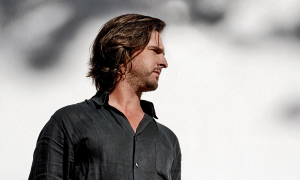
Home » Jazz Articles » Interview » John Santos Finds His Groove
John Santos Finds His Groove
...for a lot of artists, our backs are up against the wall. We don't have any choices. Our music will not get out if we don't put it out ourselves.
—John Santos
 John Santos is riding high these days. His most recent album, S.F. Bay , was nominated for a Grammy Award as Latin Jazz Album of the Year. He has received increasing notice from critics, and is a recognized leader not only in the Bay Area's Latin scene, but in jazz as a whole. This spring, Santos is leading a series of talks and concerts at La Pe'a Cultural Center in Berkeley, focusing on the issues and experiences of local musicians. I caught up with Santos shortly before the Grammy Awards ceremony in February.
 All About Jazz: Let's start with the obvious: you've been nominated for a Grammy. How does that feel?
John Santos: Oh, it's fine (laughs). I haven't had much time to really trip on it. I've been really, really busy with a lot of things, so I haven't had a lot of time to let it sink in. Which is good, because I don't want to get nervous about it. In reality it doesn't change things too much. We've been getting a lot of good congratulatory messages, and calls from friends, but once they announce the winners, nobody's going to remember who the nominees were. [The Caribbean Jazz Project eventually took the prize, for their 2002 album, The Gathering.] It looks good on the resume, though, so that's nice. But seriously, it really is an honor to be recognized. And for us that means a lot. I feel happy for the players in the group. We've been together for a real long time. Our group has been together 17 years, and this is the first time we've had that type of recognition.
AAJ: Your friend Omar Sosa was also nominated. How does it feel to go up against a friend and collaborator like that?
JS: You know, the whole field is kind of like that. Of the five people and groups that were nominated, four of the groups are all friends! I was playing with Jane Bunnett just a few weeks ago in Havana, sitting in with her band. We're good friends. Omar and I have a long history of collaboration. Omar is a guest on my album, and I'm a guest on his album. And the Caribbean Jazz Project is full of players we've known for many years, so it is a very family, in-house kind of feel. The only artist in there we're not real familiar with is this cat from Brazil, Duduka da Fonseca.
It's kind of funny to find ourselves in this position, where we're all competing against each other, but whoever wins, it's going to be cool, because it's going to be somebody from within the family, and somebody who's not one of those persons who always gets nominated and always wins. Not that those guys don't deserve it, but it's good that whoever does it this time is one of the small guys, so to speak.

AAJ: Your new album is released on your own label, Machete Records, but you're out there running with the huge corporate labels. What sort of challenges and opportunities do you find in doing it yourself?
JS: That's a whole ball of wax that most musicians dread, I think, having to get involved in. It's a great deal of work for a whole staff of people to be a record company. It's really filling up a lot of my time now, and I'm not all that happy about that, you know? I'd really rather be practicing and writing and doing the creative stuff. On the other hand, I've always done administrative work in leading my own band. I've never worked with a manager or agent; I've always done that stuff myself. So it's not too different from what I've been doing, but it's a big workload, having to jump in and basically start at the bottom.
I've done this before'I released a couple of albums in the '80s on my own, and promised myself I'd never do it again, yet here I am. It's mainly because of the state of the industry. I feel like for a lot of artists, our backs are up against the wall. We don't have any choices. Our music will not get out if we don't put it out ourselves. Machete is good evidence of that, because we have a group that writes enough music'much more than enough'to put out a new CD every year, but we've only got six CDs in seventeen years! That's going to change; as of now, we will put out a CD every year. And I feel great about that. But it's a lot of work and the challenges are great; there's stuff I'm sure I can't even foresee, because I'm learning as I go along.
All the big companies are struggling, too. The distributors are struggling. A lot of those companies are going under, and they're taking the artists' product with them, which is a shame. When they file for Chapter 11, they have the right to sell your stuff to whoever they want, and you're not entitled to recoup or get your stuff back in many cases.
It's a bumpy road, but on the other hand it feels great to have the nomination. Just to be there shows that you can get recognition without a major label, and that's encouraging for all the artists who are in our position, which is most of them! You really do have a chance if you do it yourself, and I think with the Internet, that levels the playing field a little bit. It doesn't level it completely, but it puts the balance back a little bit from where it was.
AAJ: I was about to ask you about the Internet, since you have a well-maintained Web site; and there's so much talk in the industry about piracy and file sharing. Do see the Internet as mostly positive?
JS: I do, but I'm saying that as a person who is not really computer savvy. I've had a Web site for several years now, and from my perspective it's positive because it's been a great promotional tool. It's been the main source of bringing people to an awareness of who we are, and it gives them access to buy our CDs from anywhere in the world.
Since we don't deal in real commercial pop music, that whole question of file sharing and MP3s being traded or pirated over the Internet almost doesn't apply to us, at least not in the same way. We're don't stand to make or lose millions of dollars from people trying to get our stuff on the Internet for free. So that hasn't affected me much.
For me it's a positive thing. It gives any artist a chance to compete on a one-to-one level. We can let the world know what we're doing and where we're playing and make our statements, and give people access to our music. So I think it's a wonderful tool. And that's the reason I decided to go ahead and put these records out on my own; I figured I could sell them only through the Internet, exclusively. And I tackled it. But then once it was up and running for a couple of months, I started getting inquiries from distributors, and now we're with a few of them. The ball slowly picked up momentum, and now it's rolling.
AAJ: Let's change gears for a moment. What does the phrase "Latin jazz" mean to you?
JS: To me, that's a whole world of music. It's very similar to just saying "jazz," you know? It's not really a style of music, in my opinion. Jazz is not a style of music, jazz is like an attitude, and so is Latin jazz. It's a vibe. It's a certain freedom, a spiritual content that exists in the music. When you get into styles, you have swing and bebop and Dixieland, where there are certain things that can be identified stylistically, but you can't say that about jazz as a whole, and I don't think you can say that about Latin jazz either.
Yes, Latin jazz is a sub-category of jazz, but it's got a lot of the same problems and history and implications in terms of trying to categorize it. There are certain styles within the genre of Latin jazz: there's different rhythms, different eras, different types of instrumentation, but it's really a wide open field. It's not limited at all. There's a whole dance element to Latin jazz, but also jazz itself started out as mostly dance music in its earlier eras. Latin music has that same legacy, and carries forward into today as still a very strong dance form. But there's that whole other side of it that is not meant to be danceable. Just like jazz does, it gets into the fusion of world music, odd meters, odd instrumentation... there's no limitations.
AAJ: You used the phrase "world music." Latin jazz often gets lumped into that, which is really a catch-all category. Do you think Latin jazz is marginalized?
JS: It certainly gets marginalized, mainly because jazz itself is marginalized. And Latin jazz is a small subcategory of this marginalized form called jazz. So of course it's marginalized.
I'm learning more and more how true that is in trying to promote our music, because there's a lot of jazz radio stations that won't play the Latin jazz stuff if it has certain things. Like if it has lyrics in Spanish or African languages. They don't play it, because their audiences are used to instrumental music being jazz. And maybe if it's Latin but doesn't have the lyrics, then they are more likely to play it. But a lot of Latin jazz has lyrics. And a lot of it crosses over; for example, there's a huge gray area between salsa and Latin jazz.
So I think it does get marginalized a great deal. There's a lack of presence of Latin jazz in most of the educational venues, like the colleges that have jazz programs, the jazz festivals around the world. The Latin element there is still quite miniscule.
AAJ: And there are so many jazz histories out there, both in print and on film, but often it seems that Latin jazz gets one chapter somewhere near the end...
JS: If that!
AAJ: ...like it's its own little thing, and it isn't integrated throughout. As an educator, that's something you've preached quite often, that Latin music is really a force throughout the history of American popular music.
JS: Precisely. And it comes through the jazz connection, which is why it's important to talk about Latin jazz in the same conversation when we talk about the blues and other elements which form the roots of jazz. It's all part of that conversation. It's part of the history of pop culture in the United States, and yet it doesn't get treated that way at all. It's practically nonexistent in jazz education.
AAJ: At the same time this issue of All About Jazz: San Francisco will be out on the streets, you'll be doing a lecture and concert series at La Pe'a Cultural Center. Will you be discussing some of these same issues there?
JS: We certainly will, although that series focuses more specifically on Bay Area Latin jazz. We're going to be interviewing people who have played a role in the past as well as some of the younger, up-and-coming people who are really pushing the field and mixing Latin jazz with other styles: groups like Mingus Amungus and Omaya. We'll be talking about their experiences in the local scene. We will certainly touch upon these broader issues, but more than a overall history of Latin jazz, it'll be something pertaining to Bay Area Latin jazz.
Each week there will be a concert, with a panel discussion preceding each one. I'll be hosting the panels, and we'll have different combinations of musicians from the various groups that are playing. Jesse "Chuy" Varela will be moderating the first one.
AAJ: As a Bay Area native, how would you say the jazz scene here has changed in your lifetime?
JS: That's a good question. I would have to qualify it by saying that I don't feel I can speak for the whole jazz scene, because I work in kind of a specific niche as a Latin player and a percussionist.
From my perspective, the scene has grown a lot, just in terms of the musicians, and this is something that's not just specific to San Francisco. I think in general, musicians have opened up to the world. The Internet has a lot to do with that, the opening up of Cuba has a lot to do with that, people are starting to understand that there's a whole world of stuff out there that is fascinating and is very related to the world of jazz. So any musicians who are into jazz, want to know the history of jazz, want to become better players and improvisers, have better rhythmic understanding, all those things would lead them to expand into Caribbean music, into Latin American music, and into African music. In that sense the Bay Area has flourished; it's one of the leading areas in the whole world. A lot of people have come here from all over the world to live, and have brought their music, and have blended with the musicians who are already here. And so creatively and artistically, the whole thing has blossomed.
On the other hand, economically we're feeling the crunch as bad as anybody else. There's very few venues to play in comparison to the number of great musicians that are here, and that's a problem also that is not exclusive to our area.
 AAJ: Getting back to Omar Sosa for a moment, you and he have a new duo album out. How did that come together?
JS: Well, starting with the group itself, Omar lived in Oakland for a few years; it was about six years ago when he moved here. And when he got here, he really did a lot to make people take notice, he's such a special player. He did a lot of collaborating with different artists, and just by chance he and I ended up on the same gig one day'we were both subbing for somebody else. But we enjoyed each other's playing, and then we both had the idea at the same time that we should get together and play, just the two of us. I had never done that before, playing in a duo, and he hadn't either. But for some reason we both felt that it could work, so we got together and soon we had booked our first gig. We had a great time, and we wound up doing that for about three years. We did a live album at La Pe'a Cultural Center at that time, and we also did a lot of touring: in Europe, and the Virgin Islands, and up the East Coast.
Now this second album, the one that just came out, that's been a work in progress for the past four years. Instead of doing a live album, we wanted to do one in the studio. So we did it piece by piece. I didn't have a label, so we got into the studios when we could. We used a couple of guest artists, some people visiting from Cuba, and Maria M'rquez, a wonderful artist who lives in the Bay Area. But we put it together little by little. Then finally, after trying to shop it around and waiting for a deal, I couldn't wait any more. So I released it myself at the same time as the Machete record.
AAJ: So what's that vibe like, with only two people?
JS: It's great. It's like being in a big lake, where you can swim in any direction you want, any way you want: on your back, or you can go under the water. You can do anything. It's much more free than playing with a large group. When you're one of ten people, you have a role to play. And that has its own beauty, but also its own restrictions. In the duo, there's no rules, there's nothing. It's like running out there naked. It's a blast, especially if you're with someone who you trust and feel comfortable with. We're just constantly jumping off the cliff, knowing that the other person will be there to catch us.
It's really an unusual situation for me as a percussionist, especially as a Latin percussionist, because the vast majority of the time we're called upon to keep time and to accompany other soloists, or play time for the dancers. To be able to play this way, especially with Omar, since he's a drummer first of all'he studied percussion before he became a pianist'it's like playing with another drummer. He's very rhythmically sure of himself, and we share a background in the same traditions. We've both studied Afro-Cuban ritual music a great deal, so that's like our safety net. And we're both really into experimenting and using different sounds. So it's something I look forward to every time.
AAJ: One more question'what's in your CD player right now?
JS: Ella Fitzgerald, Love Songs: Best of the Verve Songbooks.
AAJ: Cool. Very cool.
Website: www.johnsantos.com
Photo Credit: Martin Cohen
< Previous
Studio Sessions: Rare and Unreleased
Comments

Tags
For the Love of Jazz
 All About Jazz has been a pillar of jazz since 1995, championing it as an art form and, more importantly, supporting the musicians who create it. Our enduring commitment has made "AAJ" one of the most culturally important websites of its kind, read by hundreds of thousands of fans, musicians and industry figures every month.
You Can Help
To expand our coverage even further and develop new means to foster jazz discovery and connectivity we need your help. You can become a sustaining member for a modest $20 and in return, we'll immediately hide those pesky ads plus provide access to future articles for a full year. This winning combination will vastly improve your AAJ experience and allow us to vigorously build on the pioneering work we first started in 1995. So enjoy an ad-free AAJ experience and help us remain a positive beacon for jazz by making a donation today.

Giveaway

Days remaining: 5