Home » Jazz Articles » Interview » Greg Kelley: Flesh to Metal
Greg Kelley: Flesh to Metal


Or something—efforts to characterize his art are bound to fail, turning back on themselves with the fatal realization that the only way to properly experience his work is to be silent and listen to it very carefully.
Kelley's work is not in essence symbolic: it could be characterized as holographic, perhaps, the way the smallest elements contain the largest, and the manner in which nothing and everything happens in his performances, flurries of activity that go on only to dissipate into the void, and then resituate themselves again in another fashion.
Kelley is one of the great originators. He has precursors in his minimal, or lower- case school of playing. Guitarists Keith Rowe and Derek Bailey come to mind. But no one before him has so unashamedly fused flesh to metal. He can be humorous and then just as quickly deadpan. The "mood ring" from the 1970s comes to mind, the way its colors changed depending on pulse or blood temperature.
Kelley has a mind, to be sure; and a remarkable one. But it is the act of trained, disciplined listening as opposed to structural analysis that opens the door to the glories of his inner kingdom.
All About Jazz: You have a national profile; you've played with everyone from Keiji Haino, to Joe McPhee to Jandek. And you've recorded on—what is it, 80 albums?
Greg Kelly: I don't think 80 but I don't know actually.
AAJ: But, say, the average girl in the street that you meet wouldn't have heard of you.
GK: That is true.
AAJ: What if you went up to her and said, "Well I'm a musician," and she asked you, "What kind of music do you play?" Could you answer that?
GK: It depends if it was completely random like that, or if I'd talked to them beforehand and had an idea of what kind of knowledge they had...If I'd just met them off the street I'd probably say, "It's not really music" [laughs]. And they'd either stop talking to me or ask more questions.
AAJ: What do you think of labels like—some people call your music "lower-case." There's a little ambient, drone, noise—what do you think of these labels?
GK: Generally they're trying to find some kind of quality between various musicians that holds them together and I don't think they're always accurate. Lower-case started because James Coleman, the theremin player, had read an interview with Steve Roden, and Steve Roden had described his music as lower-case.
AAJ: Steve Roden is from where?
GK: He's from California and he's a sound artist. He does a lot of recordings, field recordings, with some studio manipulation. He had described that as how he thinks of his own music. He didn't think of it as a genre, or something anyone else would make, he just said that's how he thought of his music. So James liked that idea and he started a mailing list or an e-mail group and early on a lot of musicians were talking on that list, Bernhard Gunter—he's a German composer...That mailing list started and that was more of a discussion group. It wasn't meant to name a label, or define a style. It was basically to discuss a certain kind of art or music that was not too showy or fireworks or technical—that was more about quiet or contemplation. But anytime something like that becomes codified it becomes problematic.
 It's hard to quantify what makes something what it is, and I felt like people thought we were part of this lower-case movement, which is mostly people just talking on the Internet. But we would never define what we are doing as lower-case. It's more a simplistic way of giving someone a vague idea of what kind of music someone's playing...But, I feel like it was more useful early on but once something gets codified and people get serious about it and start drawing lines in the sand, then it becomes uninteresting for me to use that word because it's got a lot of weight to it.
AAJ: You talked about the "drum/clarinet" story in your 2003 AAJ interview with Fred Jung—and also with Susannah Bolle (on rarefrequency.com). You probably don't feel like talking about it again.
GK: It's not that exciting. Basically, the gist of it is that how I became a trumpet player was pretty arbitrary.
AAJ: Now people credit you with forging a new style of trumpet playing, which I think is largely justified. And I don't see it in the music you've listened to—Dan Fogelberg, Fleetwood Mac, Sonic Youth on the one hand—or Stravinsky or Bach or what have you. There are no precedents I see in your style. How did you discover it?
GK: I think trial and error for the most part. But in general I've always just strived to make music that I want to listen to, and music that interests me for whatever reason. And obviously in none of those things can you hear a precedent, necessarily, form Fleetwood Mac, to what I'm doing. When I got into college I started listening to George Crumb, and I thought that that was, in terms of classical music, pretty much as experimental as—
AAJ: That is a common touchstone for every one from John Zorn, to many others —Julius Vasylenko mentioned him in an interview.
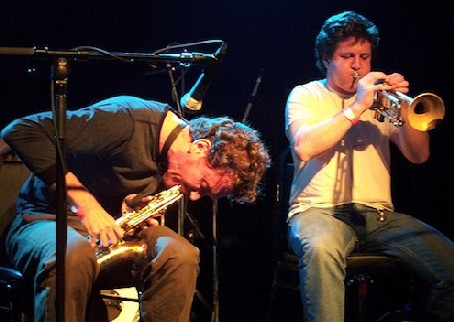 From left: Bhob Rainey, Greg Kelley
GK: The first thing I heard from him was "Black Angels," which is a string quartet, amplified, and I think I felt like there was like these two extremes in the music I listened to—Sonic Youth, The Butthole Surfers, Tite Curet Alonso, and there was the trumpet, and music that could be made on the trumpet, and that had me listening to Bach and Stravinsky and Mahler. But it wasn't until I'd heard contemporary classical music that I realized those two things could be there in equal measure. When I first heard Crumb it didn't sound like Bach, it sounded like some of the noisier sections from Sonic Youth, or No Wave. And I liked that about it. So I think I tried to start playing that kind of music, but for the trumpet there wasn't that much composed modern classical music, and what was, was more on the modernist side, as opposed to the experimental. And through Zorn I discovered people like Maurizio Kagel.
At my school they had a great listening library, and they bought pretty much everything that was considered classical. So, they had the whole Deutsche Gramophone avant-garde series, which had Il Gruppo, Kagel, Ligeti. One thing that's interesting about Kagel—my school was conservative in terms of the scope of music they were working with, pretty much from Bach to Wagner, and everything after that was "not music," and everything before was "primitive." And those were the things that I liked. I liked early music, and I liked late music.
Ed Tarr, who was a heavyweight baroque trumpeter, worked with Kagel, and he's on these early Kagel records—there's one called "Der Schall," that I actually got to play a couple of years ago. That had Ed Tarr on there playing things like a mouthpiece attached to plastic tubing attached to a funnel, and other assortments of—not very trumpet-like noisemakers, and it was really exciting for me to hear someone of his caliber, and some of my peers at school respected—and then I would play then that record, and say, "Look, this is Ed Tarr making weird noises," and usually they were horrified and hated it, and said he must have done it for money. As we well know, it's not the best moneymaker.
But I think it was just through finding that whole area of music and just listening to a lot of that that I came to play the way that I do, which is first discovering new sounds that were interesting to me, and after that— you hit a wall and start wondering how to organize it.
AAJ: This, what I've called the "body/instrument continuum"—where there's sort of a celebration of the body in your playing, almost as if to say you shouldn't be ashamed of your body, or your instrument—
GK: Maybe. I've found the body, in terms of the trumpet, can be problematic because it's painful. And I've always been attracted to, and jealous of, people playing prepared guitar because they have a physical detachment from it. You can place objects on the guitar, turn up the volume so you don't even have to touch it, and walk away, cook dinner, come back and it's still making sound. It's a lot of work with the trumpet.
AAJ: This is what your touching on now, the massive amount of work it must have been to develop your unique style, forge your new direction. How long did it take you? Was there a "big bang" when it all came together, with a light bulb going on in your head or was it a long, slow imperceptible process?
GK: More like a long, slow imperceptible process that's sort of ongoing until I quit or die, whatever comes first. But there was never any sort of huge revelation. The only things that have come in that way were, that I'd been doing a lot of research and reading and practicing a lot, and ended up doing this thing, and I could find some sort of precedent in it in AMM, or Evan Parker, and I remember the first time I heard this duo with Toshinori Kondo and Paul Lovens, and it's the first time I'd heard anyone doing something that was so similar to what I was doing. It was a little bit shocking. I think a lot of that has do to with the nature of the instrument, when you move beyond pitch orientation, there's sort of a limited palette of what you can do.
 AAJ: How about Birgit Ulher?
GK: She's someone I didn't hear until I'd been touring with Bhob Rainey for a few years.
AAJ: Was her style distinctive enough from yours that you didn't feel that you were being "copied"?
GK: No. I knew she'd been doing it for a long time anyway. That first time when I first heard Kondo, or when I first heard Axel Dorner, these are the only times I felt concerned...These are just surface details that you recognize and for a second you say, "Oh my God, this person is doing things that I've been working on for a long time," but after a while—I've toured with Axel and we have very different aesthetics and I certainly don't feel any anxiety.
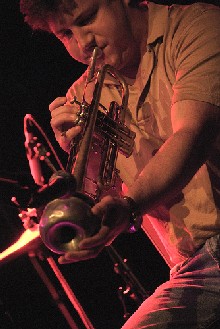 AAJ: That's what I've suggested, what I'm calling "physicality"—or almost "animality."
GK: Right. I think his playing is so controlled, he's so good at what he's doing, that it almost takes the physicality out of it. And even in his more free-jazz playing it's definitely very much coming from jazz and also has this control, whereas my free jazz playing is just trying to push the limits of what I can do.
AAJ: But you cook when you do it, like in Cold Bleak Heat [band with saxophonist Paul Flaherty].
GK: In that, because I don't have an affinity for or history with jazz, I feel it's a more alien kind of place that I'm coming from—but more just trying to push the limits of the sound to get it to a more unstable place...It's hard to articulate these things, which is why I like working with Bhob [in their duo Nmperign]. He's great at verbalizing his intent, why something works and why it doesn't.
AAK: When you play with Bhob, who leads?
GK: Who leads! It's more of a bickering, there's no leading. In that situation, we really do work both with and against each other. If anyone lead I think we would fail. It's not that kind of dynamic, it's more like boxing.
AAJ: But you're not competing, are you?
GK: No. We're just sort of...It's a combination of letting the music go where it wants to go but if you see it going to a familiar place, then changing the path.
AAJ: It seems that if you do plan ahead, it is only to demolish what you've conceived.
GK: Right. There's no planning ahead. Maybe for a solo you'll have a certain idea of what you want to do but in any of the groups I've been in where we attempt to have some kind of plan it usually doesn't work. There were a couple on the first Nmperign tour, with Tatsuya Nakatani. We had one show where we said, "Let's play really quietly. It's a small room, a great room to really explore these minute sounds." We started and it wasn't really going anywhere, it seemed kind of aimless. Then one of us decided to play something a little more aggressively and it ended up building into one of our most ferocious sets of the whole tour.
AAJ: Who broke the ice?
GK: I'm not sure. I think it was a combination of one accent that was a little more and then someone else feeding on that...And then another time we were in this loud bar and we were pretty much told to make it quick because they didn't want us to play. So for that one we said let's just do a blazing free jazz set and we played loud for about 20 seconds and then Tatsuya started bowing something and we ended up in this sort of glacial, slow-moving, mid-volume to low-volume improvisation that wasn't at all what we intended.
So I think intention doesn't always work out because then you're stuck, sometimes, with something that doesn't work.
AAJ: As long as it's an intention you can dash?
GK: Right, but those are the only two times we've ever talked about what we were going to do beforehand in any of the Nmperign performances. Usually we don't say anything except should we use microphones because we're in a huge room or not.
AAJ: At a panel talk at the Axiom Gallery in Jamaica Plain, Bhob said he basically has four "songs" in his repertoire and every improvisation he does is a variation on that.
GK: That's interesting. I haven't heard that one before [laughs]! I don't know any of those songs—or I probably know all four of them!
AAJ: Do you have music going on in your head, or sound or noise, that you think you want to direct into your music or is it just—again, the "body/instrument continuum? "
GK: I have a lot of different ideas bouncing around, some of them have to do—some of them are conceptual, some are more organizational. Some are sound-based but when I play usually I try to shut all that out because I feel like just adds to the noise of everything.
AAJ: How do you feel when you are playing? Are you relaxed or stimulated?
GK: It depends. I think most of the time, anxiety is the main thing I feel.
 AAJ: When I see you live it can be very tense because you're sitting in those uncomfortable chairs and you don't want to disturb the person next to you—or you and Bhob, first and foremost. So it's an edifying experience, not always pleasurable in the immediate sense, but there's an afterglow.
GK: I think in the moment of making it, it's an intense concentration, almost like doing a job, something as boring as shoveling snow: you just know you have to clear this entire driveway and it's hard work, and sometimes it hurts and you have to keep doing it, but the end result is hopefully something pleasurable. But not always...
And about the afterglow you speak of: it could be immediate or it could be two weeks later you realize, "Oh, actually now that I think about it or now that I have some distance from it, I'm happy with how it came out."
But it's very rarely that I'll be making music and enjoying it at the same time. I might like the way it's coming together but if it's working now, you have to keep it working. And also, if you're in a moment where you're thinking "This is sounding really good," you can get into the trap of (thinking), "Why change it?" And then you get to the point where you're stuck with it and you really need to switch out of it and how do you do that? And so it can be kind of frustrating. It depends who you're playing with, too.
AAJ: So it's almost like a hike or a mountain climb, where you're driven to do it but it is strenuous.
GK: Right.
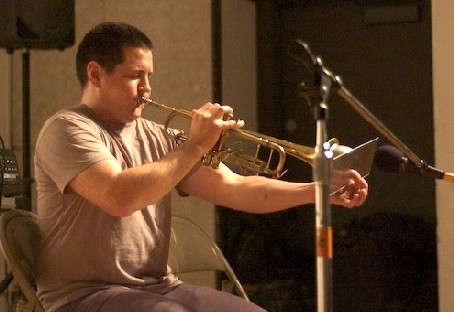
AAJ: You have a holographic sense, capturing a large quantity in one grain. It reminds me of William Blake, seeing "infinity in grain of sand."
GK: Or trying to stay out of trouble...
AAJ: What kind of trouble are you liable to get into?
GK: Sometimes if it's easy to say something—if it flows, you're liable to say things that in retrospect are completely inaccurate.
AAJ: Like if you're drunk.
GK: Right...But also I think a lot of the music I do, I'm not trying to make it so specific that there's a certain meaning behind it, that there's a certain meaning to be gleaned. I like keeping it abstract.
AAJ: Do you have more to say about that?
GK: I guess the important thing is some kind of engagement. And that's what I look for in music or in a book—you want to be engaged in something, you want it to activate your brain in some way.
AAJ: Is there anything you want to impart to your listener in an ethical or political sense?
GK: I don't think in any concrete or finite way. An openness to possibilities. And expectation and what can be expected and what should be expected. I suppose you can spin that out in a variety of ways that would address some kind of ethics or politics but I don't choose to make it that explicit...I think in general there has to be a question of some kind and I wouldn't want anything to be too easy And I suppose that would reflect my world view: I don't look at anything as black and white. Well, I'm black and white in certain regards but I don't believe in "this is good and this is evil," and that you can cut anything out 100 percent.
AAJ: You're very Blakean.
GK: I like Blake a lot, actually.
AAJ: Thinking about your albums with Gunter Muller [More Gloom, More Light (Rossbin, 2003]), with Jason Lescalleet [Love Me Two Times (Intransitive, 2006)] and Ommatidia (Intransitive, 2009), the Muller seems very static, and the Lescalleet seems almost orchestral in its development. It's a great album...The first disc has that development and then on the second there's a total disintegration. The crescendo and the denouement— was that something you were consciously doing? Or take Ommatidia; that seems almost a collection, a series, of songs—of lyric songs.
GK: Well, one of the early working titles of that album—Bhob was labeling it "Variations" for a while because he wanted a sort of dry clinical name, that represented what was on that recording. And there are a lot of recurring themes there, which in large part, for me, are definitely subconscious, especially because some of that was recorded a year apart.
AAJ: Who came up with the final title?
GK: Both of us. We got together and we were listening to one of the final versions and we came up with the idea that there are these cells that reflect the whole, and I think Bhob said it was something like a bug's eye, or a fly's eye, where they have the different cells and they take in all the information. That was sort of how the album had come out. That was an idea we both liked and so we decided to look up what the word was and it was "ommatidium," of which we used the plural.
AAJ: Again, it brings to mind the hologram where all the information of the image can be found in one particle of it...I also think of Brian Eno's "thinking music," which in one way is completely cerebral, and in another, is completely non-cerebral. Your work does inspire thought, even though the structures aren't premeditated.
GK: I think inasmuch as there's nothing necessarily premeditated, there is an intention. When Bhob and I play we don't turn our brains off and see where it takes us—
AAJ: There's a mindfulness to it.
 GK: Right. Oftentimes when you just turn your mind off, you play in a way that feels good but it becomes formulaic and you fall into certain habits...Bhob had a good quote he got from a Vic Rawlings radio interview about how you know when you have a good improvisation and how to continue with that. And Vic said, "You'll play something that makes you feel like shit and the feeling is so awful you never want to play that again." So you make sure to avoid that feeling as much as possible when you play again.
AAJ: In order to forge the style you've forged and to push away these things that didn't work for you—that would have taken a great deal of imagination.
GK: Well, imagination is a word with so much weight, so loaded with data and history.
AAJ: A good way of putting it.
GK: It's kind of like 1-4-5 chord changes. Words having this weight and history and all this predetermined information loaded into them. So when you say a word like "creativity," I feel like they have such a strong—persuasive quality about them. But a lot of times with things like chords or melody or rhythm, that would feel artificial to me. I do that in other contexts, like with [singing duo] Damon & Naomi, but with Bhob or solo, melody has so much weight and history, I feel like it shuts down the listener in how they are supposed to appreciate it or understand it because they have a familiarity with that kind of thing. They know that "minor" means "sad," for example.
AAJ: Do you feel you express emotion in Nmperign or your solo work?
GK: I think so. I think even in spite of itself that will happen— what kind of emotion is a different thing. It's closer to the way I experience emotion, in that it's complicated. We'd have to agree for one thing on which emotion.
AAJ: And that would be anathema to your whole project.
GK: Right. That doesn't mean emotion is stricken from the proceedings but that has more to do with the interaction between the musicians, and with the listener.
 From left: Greg Kelley, Doug Theriault, Kelvin Pittman
AAJ: Your new solo CD, Self-Hate Index (Semata, 2008), seems like an angry album.
GK: People took that as an angry title, too, but it's an index, a scale. I don't think that's an angry record.
AAJ: It seems like a difficult listen, unlike your other work. Which isn't a bad thing, just a unique thing.
GK: Some of the Heathen Shame [with guitarists Kate Village and Wayne Rogers] stuff is like that but it's actually some of our most exuberant material.
AAJ: Going back to the CDs we discussed earlier: the one with Muller has that static quality, like a cloud hovering over a landscape; whereas the one with Lescalleet has that orchestral development. Did this happen consciously or was it business as usual?
GK: I don't think we have a "business as usual"—or "business as usual" is trying to create problems, throwing a wrench into things and working ourselves out of it...The Muller record was very different because the bulk of it was one concert, and then a solo recording by him and a duo with us; whereas the one with Jason happened after seven or eight years of working together.
AAJ: So it has to do with evolution....Can you reveal what "Nmperign" means or is that a secret?
GK: It's not a secret. There's a Latin phrase, "ignotum per ignotius," which means, "the unknown through the more unknown," and Bhob took some letters out of that.
AAJ: There's a word for that type of compression. In the middle ages, they would take quotes from the Bible and take letters out of them so they would fit on a relic. So maybe there's a religious quality to your work?
GK: Maybe there is.
AAJ: You're very contemplative.
GK: One of our records did have stuff from the Dead Sea scrolls in it, too. That was another one where because of the deterioration of the document itself, there would be whole sections of it they couldn't translate so they just put an ellipsis, so you just get these fragments. I think it was Bhob who thought it would be good to have a name with more consonants than vowels.
AAJ: These paradigms tell a lot about your music, all these "buried secrets." Any interest in alchemy?
GK: A little bit—but I don't think we're trying to turn anything into gold.
AAJ: Alchemy can have other meanings...Nietzsche characterized certain men as alchemists.
GK: And what were the qualities of that man?
AAJ: Someone who could take a bad hand and turn it into a royal flush.
GK: Right.
AAJ: You're doing a pretty good job of that.
GK: Trying!
Selected Discography
Nmperign, Ommatidia (Intransitive, 2009)
Nmperign with Jake Meginsky, Selected Occasions of Handsome Deceit (Rel, 2010)
Hair Police, Our Minds Problem Vol. 4 (self-produced, 2009)
Weasel Walter, Apocalyptic Paranoia (Gaffer, 2009)
Life Partners, Men Are Talking (Ride The Snake, 2009)
Alex Neilson and Greg Kelley, Passport to Satori (Goldenlab, 2009)
Anthony Braxton, Nine Compositions 2003 (Rastascam, 2008)
Greg Kelley, Self-Hate Index (Semata, 2008)
Greg Kelley, Religious Electronics (No Fun, 2008)
Cold Bleak Heat, Simitu (Family Vineyard, 2007)
Nmperign/Jason Lescalleet, Love Me Two Times (Intransitive, 2006)
Greg Kelley, One hour as something that didn't turn out the way I intended it to (I'm not Anti-Music, Music's Anti-Me) (Chocolate Monk, 2006)
Heathen Shame, Speed the Parting Guest (Twisted Village, 2005)
Axel Dorner, Greg Kelley, Andrea Neumann and Bhob Rainey, Thanks, Cash (Sedimental, 2004)
Nmperign, We Devote Every Effort To Offer You The Best That You Deserve To Have For Your Enjoyment (Siwa, 2003)
Nmperign with Gunter Muller, More Gloom, More Light (Rossbin, 2003)
Greg Kelley, If I never meet you in this life, let me feel the lack (Rossbin, 2002)
Bhob Rainey and Greg Kelley, Nmperign (Selektion, 2001)
Greg Kelley and Jason Lescalleet, Forlorn Green (Erstwhile, 2001)
Greg Kelley, Trumpet (Meniscus, 2000)
Photo Credits
Pages 1, 2: Seth Tisue
Page 3: Phillip Berryhill
Page 4: Susanne Bolle
Page 5: Spiralcage.com
< Previous
Broken Shadows
Comments

Tags
For the Love of Jazz
 All About Jazz has been a pillar of jazz since 1995, championing it as an art form and, more importantly, supporting the musicians who create it. Our enduring commitment has made "AAJ" one of the most culturally important websites of its kind, read by hundreds of thousands of fans, musicians and industry figures every month.
You Can Help
To expand our coverage even further and develop new means to foster jazz discovery and connectivity we need your help. You can become a sustaining member for a modest $20 and in return, we'll immediately hide those pesky ads plus provide access to future articles for a full year. This winning combination will vastly improve your AAJ experience and allow us to vigorously build on the pioneering work we first started in 1995. So enjoy an ad-free AAJ experience and help us remain a positive beacon for jazz by making a donation today.

Giveaway

Days remaining: 13