Home » Jazz Articles » Bailey's Bundles » The State of Reissues 2010: Dave Brubeck, Art Pepper, So...
The State of Reissues 2010: Dave Brubeck, Art Pepper, Sonny Rollins, Thelonious Monk, John Coltrane and Joe Pass

Original Jazz Classics was inaugurated as an imprint of the Fantasy label in 1982 with the intention of releasing jazz recordings previously available only in LP and cassette formats from Prestige, Contemporary, Riverside, Galaxy, Pablo and other labels. These releases are being 24-bit remastered by Joe Tarantino and supplied with new liner notes from prominent observers to complement the original notes.
The Original Jazz Classics Remasters series begins with five discs: pianist Dave Brubeck's Jazz at Oberlin, alto saxophonist Art Pepper's Meets The Rhythm Section, tenor saxophonist Sonny Rollins' Way Out West, pianist Thelonious Monk's Thelonious Monk with John Coltrane and guitarist Joe Pass' Virtuoso. The earliest was recorded in 1953 and the latest 20 years later. Three of the releases sport a quartet, one a trio, and the last, a solo performance. Two of the five leaders are still living and recording.
These five releases, save for the relatively late Virtuoso, are a nice slice through 1950s jazz. There can never be too much of it, and through release programs like this one, they will always be available.
 The Dave Brubeck Quartet
Jazz at Oberlin
Original Jazz Classics Remastered
2010
Dave Brubeck was already several recordings deep into his career when his quartet recorded live at in Finney Chapel at Oberlin Collage, March 2, 1953. In 1950, Brubeck suffered a near fatal accident and took some time off befor forming his quartet in 1951. The quartet took up an extended resident at San Francisco's Black Hawk Lounge and recorded several more albums before hitting the college circuit and waxing Live at the College of the Pacific (Fantasy, 1953) and then Jazz at Oberlin that same year. This was part of the period of prolonged percolation anticipating Brubeck's full breakout after joining Columbia and the release of Time Out (Columbia, 1959).
Jazz at Oberlin clocks in at a sleek five songs over 38:00, opening with an immediate break into "These Foolish Things (Remind Me of You)." In 1953, small ensemble jazz was still under the spell of Charlie Parker. Paul Desmond, another alto player, represented a singular voice outside of Parker's shadow. Brubeck's playing is almost delicate, as is the rest of the rhythm section, before preempting Cecil Taylor's and Don Pullen's percussive, atonal ferocity. Juan Tizol's "Perdido" is almost frantic but never threatens to lose control.
"Stardust" is a lithe ballad played transparently, while "The Way You Look Tonight" foreshadows Brubeck's keenly inventive arranging ability. "How High The Moon" reflects this same unique arranging while. A fittingly swinging coda to this brief release. New liner notes are provided by Ashley Kahn provide a historic perspective to the importance of this recording and its promotion.
Visit Dave Brubeck on the web.
 Art Pepper
Meets the Rhythm Section
Original Jazz Classics Remastered
2010
It is almost too good a story not to romanticize at least a little, but this particular story needs little embellishment to be compelling. Neil Tesser's new liner notes to Art Pepper's Meets the Rhythm Section give fresh perspective to producer Lester Koenig's original 1957 sleeve lines. Before this famous session on January 19, 1957, Pepper had been particularly strung out on heroin. He had been released from a 10 month incarceration in federal prison for drug charges the previous summer, and since that time had been vegetating in a narcotic garden.
As the story goes, without the saxophonist's knowledge, Pepper's live-in girlfriend, Diane, arranged with Koenig to have Pepper record with trumpeter Miles Davis' working rhythm section made up of pianist Red Garland, bassist Paul Chambers and drummer Philly Joe Jones, who happened to be in town with time to record. At the time of this session, Davis and his band (then employing John Coltrane on tenor saxophone) had last been in the studio recording the marathon sessions ultimately leading to the quartet of recordings for Prestige Relaxin', Cookin', Steamin' and Workin', which were eventually resequenced and released on Miles Davis: The Legendary Prestige Quintet Sessions (Prestige, 2006).
Busted horn, busted life, busted attitude, and very high, an angry Pepper enters the recording studio not knowing what he is going to play and ultimately not knowing how to play several of the numbers decided upon. Tesser's notes reveal from Pepper's autobiography Straight Life (Schirmer Books, 1979) that Pepper "went blank" when asked for the first song. Cole Porter's "You'd Be So Nice To Come Home To" and and Jimmy Van Heusen's "Imagination" were suggested and while Pepper was familiar with the tunes, he had never played them. That little bit of stress produced two of the more memorable tracks on the disc. Pepper, without hesitation, launched into these songs, remaking them in the same real time way Charlie Parker used for his 1947 recasting of the Gershwins' "Embraceable You."
The Dizzy Gillespie songbook provided "Tin Tin Deo" and "Birk's Works." The former presents some very deft drumming by Jones and the latter a nice mini-duet between Pepper and Garland. Chambers is the anchor on which this session is tethered. Both his pizzicato and arco soloing is captured better with the present 24-bit remastering than on previous releases. Restored to this session is "The Man I Love" which had been released on the odds- and-ends collection The Way It Was (Contemporary, 1972).
Visit Art Pepper on the web.
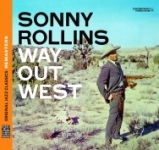 Sonny Rollins
Way Out West
Original Jazz Classics Remastered
2010
The pianoless jazz combo was nothing new when Sonny Rollins recorded Way Out West on March 7, 1957. Benny Goodman fiddled with a clarinet, vibes and drums format in the 1940s, and baritone saxophonist Gerry Mulligan had already made history with trumpeter Chet Baker and a pianoless quartet at the Haig in the early 1950s. Way Out West marked the first time Rollins recorded as a tenor trio sans piano. He would take this format into the noted Freedom Suite (Riverside, 1958).
Rollins had ended 1956 recording with drummer Max Roach in various formats, some led by Roach, others by Rollins. Accompanying Roach to Los Angeles for an EmArcy recording date with Roach's working quintet of (Kenny Dorham, trumpet Bill Wallace, piano, and George Morrow, bass, resulted in the album Jazz in 3/4 Time (EmArcy, 1957)). Rollins booked time for a trio recording using West Coast musicians Ray Brown (bass) and Shelly Manne (drums). He did this without the knowledge of Roach, who later questioned him about it.
But that was not the only ripple of controversy surrounding Way Out West. Photographer William Claxton's famous sleeve cover of Rollins in the desert wearing a cowboy had and gun belt, a photo made at Rollins' request, prompted Lester Koenig to print a disclaimer on the sleeve cover that Rollins had authorized the photograph in an effort to meet criticism of the recording as a "scam." Some 50 or so years later, the album title, cover art and repertoire only make sense as the East Coast tenor titan comes west to record with the local talent.
The release boasts two performances of Johnny Mercer's "I'm An Old Cowhand," the alternate take considerably extended from the A side. Shelly Manne sets up a loping rhythm that is picked up by Brown. Rollins' tone is a natural resource, full and virile, teeming with life. "There Is No Greater Love" displays Rollins' pristine ballad touch and the originals, "Come, Gone" and "Way Out West," the saxophonist's sense of humor and whimsy. The remastering has sharpened Brown's bass and brightened Manne's cymbals. The edges of Rollins' rasp is accentuated, increasing the organic quality of that famous tone.
Visit Sonny Rollins on the web.
 Thelonious Monk
Thelonious Monk with John Coltrane
Original Jazz Classics Remastered
2010
In December 1956, Miles Davis fired John Coltrane from his first quintet. The previous October, Coltrane had taken part in Davis' marathon recording sessions that would result in the albums collected on Miles Davis: The Legendary Prestige Quintet Sessions (Prestige, 2006). Growing less reliable due to his heroin addiction, Coltrane had become a drain on Davis and was let go. That was just the thing to flip Coltrane.
Recording sporadically during the first half of 1957, Coltrane eventually came into the orbit of Thelonious Monk when the pianist was beginning his famous extended stay at New Work City's Five Spot Cafe. It was during this period that the sides that would become Thelonious Monk with John Coltrane were recorded. A mixed bag, to be sure, Thelonious Monk with John Coltrane features the two musicians in quartet and octet settings. The quartet pieces—"Ruby, My Dear," "Trinkle, Tinkle," "Nutty," and "Functional"—had bassist Wilbur Ware and drummer Shadow Wilson as the rhythm section. The octet pieces—"Off Minor" and "Epistrophy"—retained Ware, replacing Wilson with Art Blakey and adding altoist Gigi Gryce, tenorist Coleman Hawkins and trumpeter Ray Copeland.
In the development of John Coltrane as a soloist, Monk acted as a leavening agent, that organic thing that turned Coltrane from the hard bop tenor saxophonist into the enigmatic "sheets of sound" performer he would be thereafter. It would have been a very different Coltrane rejoining the Miles Davis in January 1958, had he not interned with Monk during this important evolutionary period, not to mention the effect it would have had on the canon what would become Kind of Blue (Columbia, 1959).
Coltrane was not the only one to benefit from this collaboration. Monk also benefited. Just prior to his stint at the Five Spot, Monk had just had his cabaret card reinstated after its 1951 revocation on drug charges. The six months Monk was in residence at the club was the period when he solidified his reputation and went on to change the sound of jazz. That influence, that germinal spirit, is readily evident on Thelonious Monk with John Coltrane. Monk's compositions are unique.
Visit Thelonious Monk on the web.
 Joe Pass
Virtuoso
Original Jazz Classics Remastered
2010
Virtuoso is the outlier in this series of reissues. Released in 1973, it is 20 years away from the forward-thinking Jazz at Oberlin, choosing rather to look back. It is a supreme example of the soloist's art and can only be properly compared to the solo performances of pianist Art Tatum from his Pablo period. Born Joseph Anthony Passalacqua in East Brunswick, New Jersey, Joe Pass began playing guitar just after his ninth birthday. He began to perform widely after age 14, fell in to drug addiction and spent most of the 1950s out of the spotlight.
After a two and a half year stay at the drug rehabilitation center Synanon (where Art Pepper would rehab a decade later), Pass emerged with The Sounds of Synanon (Pacific Jazz, 1962). In 1970, Norman Granz brought Pass into the Pablo fold where he stayed until his death in 1994. Virtuoso put Pass fully on the jazz map without a true peer in sight. The album is a collection of 11 standards and one original that span the depth and breadth of jazz guitar playing. Pass' technique is characterized by the near simultaneous ability to control the bass, harmonic and melodic structure of songs.
Pass possessed both an encyclopedic knowledge of the American Song Book and the ability to perform songs in different styles. Like Art Tatum, Pass is difficult to digest in a single sitting. His performances are crammed full of intelligence, humor and a bit of showing off. But hey, if you have the chops, why not use them?
Visit Joe Pass on the web.
Tracks and Personnel
Jazz at Oberlin
Tracks: These Foolish Things (Remind Me of You); Perdido; Stardust; The Way You Look Tonight; How High The Moon.
Personnel: Dave Brubeck: piano; Paul Desmond: alto saxophone; Ron Crotty: bass; Lloyd Davis: drums.
Meets the Rhythm Section
Tracks: You'd Be So Nice To Come Home To; Red Pepper Blues; Imagination; Waltz Me Blues; Straight Life; Jazz Me Blues; Tin Tin Deo; Star Eyes; Birk's Works; The Man I Love.
Personnel: Art Pepper: alto Saxophone; Red Garland: piano; Paul Chambers: bass; Philly Joe Jones: drums.
Way Out West
Tracks: I'm an Old Cowhand; Solitude; Come, Gone; Wagon Wheels; There is No Greater Love; Way Out West; I'm an Old Cowhand (Alternate Take); Come, Gone (Alternate Take); Way Out West (Alternate Take).
Personnel: Sonny Rollins: tenor saxophone; Ray Brown: bass; Shelly Manne: drums.
Thelonious Monk with John Coltrane
Tracks: Ruby, My Dear; Trinkle, Trinkle; Off Minor; Nutty; Epistrophy; Functional; Monk's Mood.
Personnel: Thelonious Monk: piano; John Coltrane: tenor saxophone; Wilbur Ware: bass; Shadow Wilson: drums (1, 2, 4); Art Blakey: drums (3, 5); Colman Hawkins: tenor saxophone (3, 5); Gigi Gryce: alto saxophone (3, 5); Ray Copeland: trumpet (3, 5).
Virtuoso
Tracks: Night and Day; Stella by Starlight; Here's That Rainy Day; My Old Flame; How High the Moon; Cherokee; Sweet Lorraine; Have You Met Miss Jones?; 'Round Midnight; All the Things You Are; Blues for Alican; The Song Is You.
Personnel: Joe Pass: guitar.
< Previous
Ben Goldberg's Bag: Tin Hat & Go Home
Next >
Melodies
Comments
Tags
For the Love of Jazz
 All About Jazz has been a pillar of jazz since 1995, championing it as an art form and, more importantly, supporting the musicians who create it. Our enduring commitment has made "AAJ" one of the most culturally important websites of its kind, read by hundreds of thousands of fans, musicians and industry figures every month.
You Can Help
To expand our coverage even further and develop new means to foster jazz discovery and connectivity we need your help. You can become a sustaining member for a modest $20 and in return, we'll immediately hide those pesky ads plus provide access to future articles for a full year. This winning combination will vastly improve your AAJ experience and allow us to vigorously build on the pioneering work we first started in 1995. So enjoy an ad-free AAJ experience and help us remain a positive beacon for jazz by making a donation today.

Giveaway

Days remaining: 5



