Home » Jazz Articles » Interview » Yuri Goloubev: Of Chocolate Cake & Other Simple Metaphors
Yuri Goloubev: Of Chocolate Cake & Other Simple Metaphors

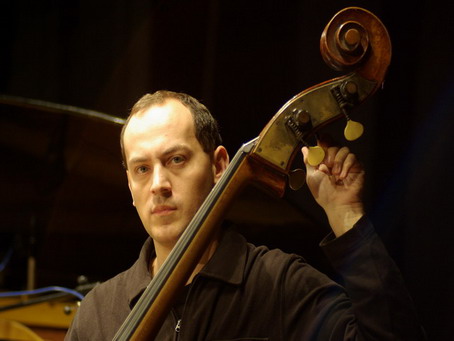
Responding to his lifelong passion, Goloubev established himself in Milan, Italy, where in the past five years he has recorded an impressive number of sessions and fully established himself on the national jazz scene.
As one-third of the short-lived but highly impressive trio SGS, Goloubev established a musical partnership with drummer Asaf Sirkis and pianist Gwilym Simcock which produced the excellent SGS Group Inc. Presents... (Music Center, 2008).
Goloubev's collaborations with Sirkis dated back several years and they have plans to record again. In the meantime, Gouloubev has teamed up once again with Simcock in the talented pianist's highly lauded trio alongside drummer James Maddren which recorded one of last year's best albums, Blues Vignette (Basho Records, 2009).
A highly distinctive double-bassist with a wonderfully resonant arco sound, Goloubev also found the time between a heavy gigging schedule to record his third album as leader, the impressive Metafore Semplici. (Universal, 2009) This highly melodic recording which is a subtle compositional synthesis of his classical and jazz experience, underlines Goloubev's song writing talents and reiterates the claim that he is one of the very best double-bass players on the circuit today.
All About Jazz: You abandoned the world of classical music for jazz; how did this transition come about?
Yuri Goloubev: This is a natural question, and I have to say it was a natural transition. I've been keenly interested in jazz since a very early age, thanks to my dad who is a jazz fan and he made me listen to various recordings. I may have been as young as seven years old when I was listening to Oscar Peterson, Count Basie, Woody Herman, Louis Armstrong and so on.
As I was growing up the music I was listening to became more sophisticated, which may not be the correct term, but I came to Dave Brubeck, Bill Evans, Chick Corea, obviously Wayne Shorter and Miles Davis; too many to name them all. Certainly I listened to all the styles as I was growing up.
I was brought up in a family where my mother was a classical pianist and for her the thought of jazz as a profession would have been very strange. So I was enrolled in a school similar to the school in Manchester, Chatham's, where they take only gifted children and they teach you to a professional level. At the same time they teach you maths and geography and all the high school disciplines but the school, which was strictly classical, basically serves to prepare you for the conservatory. This school, The Central School of Music, was affiliated to the Moscow State Tchaikovsky Conservatory and obviously that's where I later went in 1990.
Even though I was playing jazz at the time I was mostly playing it on the piano; for some reason I was afraid of even trying it on the bass. I can even remember participating in a jam session as a pianist! After listening to Ray Brown and Niels-Henning Orsted Pedersen I became really curious how it could be done on the bass. So I began practicing jazz on the bass. I was doing my classical stuff and in my free time I was learning the jazz repertoire. I was particularly curious about Pedersens' right hand technique, and my teacher, Rinat Ibragimov, who has been the Principal Bass of London Symphony since mid-1990s, was a jazz fan as well and he showed me some exercises.
In the meantime I started getting classical jobs in one classical ensemble or another—from historical performance group to contemporary classical music ensembles. I was in the Bolshoi Opera for one year and then I was principal bassist for almost thirteen years in the Moscow Soloists.
 At some point my passion for jazz and composition took over and I switched to jazz. Although I had studied classical composition I remember the very first jazz composition I wrote and I was really surprised because I thought: "Oh man, I can write some jazz!" It was kind of Chick Corea-influenced; I did record it on my very first album, Rendering (Cantabile, 1996), on the piano.
Thus I started playing some gigs and doing some jazz recordings and it was becoming more serious. This genre of music was influencing much more than classical music, and it brought me to an awkward sensation when I was doing concerts with the Moscow Soloists that I was occupying the place of somebody who might have appreciated it much more.
Then in 2001 I met a girl in Italy who became my wife and later my ex-wife. It was too tiring to keep doing Moscow-Milan, Milan-Moscow and we decided I would go to Milan. I thought that this would be an opportunity, like taking the last train to really try to do only jazz, to immerse myself completely. I would give it a try. And that's where we are.
AAJ: Was the Moscow Soloists, as the name maybe implies, an ensemble where improvisation took place?
YG: No, it was a regular chamber orchestra; there was no improvisation at all. We played anything from Mozart, Haydn and on to contemporary authors. Solo over Mozart? No.
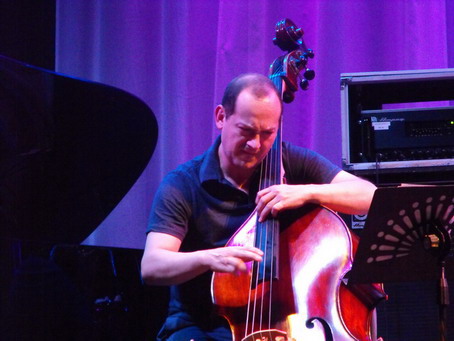
AAJ: You played with some of the very top names in classical music, like Rostropovich and violinist Vadim Repin. You must have some wonderful memories of those experiences, no?
YG: I had a funny experience with Vadim, this was in the early nineties; I had to participate in a chamber music festival in St. Petersburg and Vadim was playing some jazz crossover piece with a pianist in the same concert and he asked me to take a bass and play a line with them.
Well, in fact, normally you remember something that was out of the norm so to speak. Like once the Moscow Soloists had to perform Shostakovich Piano concerto with a young Japanese pianist in Tokyo; we knew the piece thoroughly and were really cool about it. Then there was a rehearsal right off the ten-hour flight and this guy was playing everything upside down! I wish I could remember his name. I mean, he was a very good player, a very interesting musician, but all that he was doing was so unusual that instead of just an hour long rehearsal we had to spend nearly four hours.
AAJ: Growing up in Moscow, what were the facilities like for jazz musicians? Were there many venues, recording studios and record labels?
YG: First of all, one of the main differences between the life of a jazz musician in Russia and here in Europe let's say, is that in Russia the jazz musician would earn his living mainly, or even exclusively from doing private party gigs. There were club gigs but they paid very little and there were very few festivals and they also paid very little, so everybody's aim was just to do private parties.
I can't talk about how the situation is now because I haven't lived there for five years and it would be unfair to judge. But if I think about the '90s and the early '00s, that the jazz community was very mainstream oriented. It was very much American—influenced and not at all European. A number of big European jazz names were completely unknown to the most folks over there. Everybody would say: "He plays like..." and in that sense personality in jazz was not very developed, nor appreciated. Strangely, to be appreciated, you had a choice—play mainstream in the most traditional way, or be an avant-garde free improviser. Almost nothing in between!
AAJ: Does Russian jazz have a recognizable sound?
YG: In Russia for jazz musicians jazz is mainly rhythm, and not only in Russia, and I think that's wrong. As we all know there are three components to music—melody, harmony and rhythm and when one of the components is missing it's like the chocolate cake is missing some chocolate, or it's only chocolate but there is no dough. Everyone is different, some hear jazz more rhythmically, some more harmonically and someone else more melodically. Someone would have all three components and somebody else only two. Thanks God we are all different

AAJ: What was your impression of the standard of jazz which you encountered in Italy?
YG: Obviously before I relocated I knew of people like Enrico Pieranunzi Enrico Rava and Paolo Fresu. About year before I moved here I started checking out the local jazz scene because I wanted to work out if the whole thing would be doable or not and I was surprised to find many really good musicians; some of them are unknown, some little known and others well known but there are some incredibly good musicians.
However, my impression is that in Italy your career depends not so much on your quality but instead on fortune. Perhaps it's not only in Italy but here it's all closed circuits. I know some musicians who career-wise are doing great but who are not so valid musically and I know some extremely valid musicians who nobody knows about.
AAJ: You've mentioned some of the better known Italian musicians but who of the lesser know ones have most impressed you?
YG: That's not easy to answer, but one of the first musicians I got to know was the pianist Glauco Venier. He's an amazing musician, though he's not so well known inside Italy, and in fact most of his gigs are outside Italy. Now he's recorded for ECM with Norma Winstone and Klaus Gesing, plus he's touring a lot and becoming more known.
There's another excellent pianist, Ramberto Ciammarughi, there's Stefano Battaglia and a lot of really amazing guitarists. Another saxophonist I've recorded is Rosario Giuliani, though he's quite a big name. There are so many good musicians like Mauro Negri, Nico Gori and Stefano Cantini. There's a very interesting trumpet player who features on my album Metafore Semplice, Giovanni Falzone, and trumpeter Fabrizio Bosso, who's known internationally. There's an amazing young pianist called Claudio Filippini, from Pescara though living in Rome; I hope to record with him one day. He's only twenty-seven but he's very impressive. Well, there's really a whole bunch of great musicians over here, naming them all is just impossible.
AAJ: You formed one-third of a trio along with Gwilym Simcock and Asaf Sirkis; how did that trio come about?
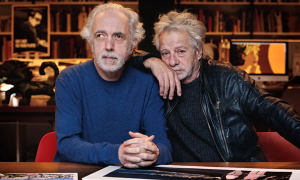
 From left: Gwilym Simcock, Yuri Goloubev
YG: It dates back to the end of 2005 when Asaf and I were recording on a Klaus Gesing album. Glauco Venier couldn't make the recording session and Asaf Sirkis recommended Gwilym to sub for Glauco. I was kind of worried because I didn't know this guy at all. It wasn't a question of whether he was good or bad, just I didn't know him and we only had one rehearsal.
So we got to our first and only rehearsal before recording the album and I said: "Okay, let's play some standards just to warm up." The idea was just to get to know each other. We started to play some standard and within about ten to fifteen seconds I thought of Gwilym: "Oh, this guy is a genius." I have never changed that opinion. After the recording we did several tours with that band.
One day at sound check it was just me and Gwilym and I said: "Why don't we do a duo recording?" I knew he had a working trio with Martin France and Phil Donkin and I didn't want to create any competition. He said: "Good idea, but why don't we do a trio recording with Asaf?" "Wonderful," I thought. "Let's do it."
The idea behind the recording was to play contemporary jazz tunes that are only played by their authors. Over the course of something like eight months we did roughly fifteen concerts in Italy.
AAJ: Is SGS still active and are their plans to record again?
YG: I would love to but SGS had to yield to Gwilym's new trio. He has to participate in projects only of his name now. We had some gigs booked at festivals so I had to take these gigs under the name of Gwilym's new trio. It's a wonderful band, very different from SGS and I really enjoy playing with Gwilym and James Maddren. On the other hand I'd put a lot of energy into promoting SGS, radio shows, interviews, reviews and finally the gigs started to arrive. Right at that point the project had to close and it's a pity.
AAJ: It is a shame, because I'm sure a lot of people recognized how good the SGS CD is, how good that trio is.
YG: I really thank you for your kind words about that album. It was a wonderful pleasure to work in that trio. I don't know, maybe one day Gwilym's obligations will change, and maybe some politics will change. Who knows? You can never know what's going to happen. We've got a gig, the new trio gig in Luxembourg, April 2011, but first you have to arrive alive to 2011. [laughs]
 AAJ: Although SGS is in hibernation let's say, you're still playing with Gwilym in his new trio with drummer James Maddren. This is another quite special trio as anyone who has seen the trio live will affirm; can you tell us about the particular chemistry of this group?
YG: Well, it's really difficult to describe in words. It's very different from the SGS trio. The energy is different. When we started playing together one of the things that I really liked about James is his capacity to build up a solo. He's really creative in building a solo and taking it somewhere. In the first gigs we did together I was just completely astonished; I was captured by his solos from the beginning to the end. He is very creative.
Coming back to your question, it's like, what does this chocolate cake taste of? I can tell you it tastes of good chocolate but it's hard to describe, you know?
AAJ: Now that's a simple metaphor and a good one.
YG: A simple metaphor, right! [laughs]
AAJ: Which brings us to your latest release Metafore Semplici. This is a strong musical statement. Let me begin by asking you about the chorales which appear on this disc; this is not the first time you've recorded chorales and I wondered what the appeal of this musical form is.
YG: That's not such an easy question; I have composed four tunes called chorale so far. One of them is on the pianist Michele Di Toro's album and another is on the Sardinian saxophonist Enzo Favata's album. Nearly all of them have been composed in Germany, strangely. The chorale maybe doesn't enter into the normal jazz idiom. For the opening chorale on Metafore Semplici I could have written a four voices score as if it were a real choir. It could evoke some memories of the church but I didn't really have that in mind.
It's an elaboration of some ancient form of music. I've incorporated more complex harmonies into simple melodies, and more unpredictable harmonic and melodic movements. I don't know, once again it's a question of chocolate cake. [laughs] It's difficult to talk about music. As Gustav Mahler said: "If a composer could say what he had to say in words, he would not bother trying to say it in music."
AAJ: Where would you say you compositional style comes from? Is it more jazz than classical or is it a hybrid of the two genres?
YG: As I mentioned before, my introduction to the music began with composing. My mother was a pianist and when she was practicing at home I would take the scores and try to copy down what was written there. That was when I was a little kid of two or three years old. Then at some point I decided not to copy but to write something of my own, without any knowledge of how to do it and torturing my mother how to play it. In time it gradually became conscious composing.
I nearly graduated in composition but I didn't do it. At the Moscow Conservatory the Dean of composition, Professor Leman, whose lessons I attended for many years, wanted me to graduate in composition but I didn't do it for the simple reason that he wanted me to write a symphony. Back then in '95 I was already full time employed with the orchestra, plus I had a lot of things on the go, and to me writing scores means eight hours a day locked away in a room somewhere for months. That would have meant to drop completely out of everything and I just couldn't afford it. It was too heavy.
I was still composing some smaller classical scores from time to time, and when I did my first album, Toremar Island (Landy Star, 2001), which was released in Russia, one critic said that strangely the boundaries between the jazz music I write and the classical are very defined. That was back in '01 but now I must say that for a number of years I use a lot of principles of classical composing in jazz compositions.
 For example, I use a lot of contemporary classical music techniques in harmony. This is something which is hopefully not so easy to notice. Basically serial technique is based on a series of notes which must not be repeated. So I apply the not-to-be-repeated theory to the harmonic structure; it's not that you can't repeat exactly but it has a lot to do with the logical architecture of the piece. To explain this technique completely would take quite a while.
Nowadays the boundaries between all the genres are becoming thinner and thinner so in the melodic lines of what I write there are not many bebop elements there, so I would include also some phrasing that I would use in contemporary classical music and it fits in quite nicely. So for sure, I do use some components of contemporary classical composing but thinking about it in a modern jazz way.
We have to go forward; it's not so interesting when a musician gets locked into one idiom. I remember a girl some years ago who was trying to write some jazz and she told me her composition was nineteen bars and she was very unhappy because it should have had sixteen as this is the standard of jazz. I was surprised because it can have seventeen, it can have three; whatever you want.
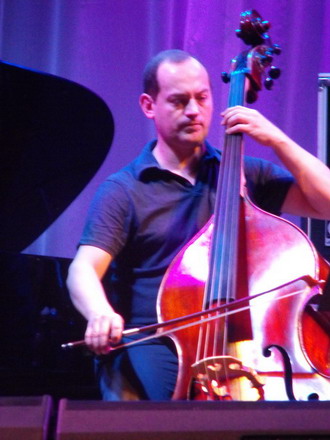 AAJ: How much chocolate do you put in a chocolate cake?
YG: [laughs] Yeah, you can even put some salt.
AAJ: Other than Gwilym, whom you've already talked about, have you played with the other musicians on Metafore Semplici—Klaus Gesing and Giovanni Falzone—for a long time?
YG: I was a member of Giovanni's Open Quartet which unfortunately doesn't exist anymore; I think that was from '05 to '07, and I've played with him in some other bands; for example, there's a very creative, very interesting drummer from Milan called Ferdinando Faraò and we recorded an album of his. Then with Klaus I first played in December '04 and since then I have played in his quartet. Lately he did some gigs with Gwilym's trio and the choir project of Gwilym's composition, "I Prefer the Gorgeous Freedom." We'll still do some concerts with Klaus both with Gwilym's trio and with my "Metafore Semplici" group. Then a new trio might shortly be born with Klaus and a very gifted vibes player from Italy, Francesco Pinetti.
AAJ: You've talked about your approach to harmony and listening to your own music melody seems to be central to your compositions, and that's maybe true of Italian music regardless of genre.
YG: First of all, when I write jazz tunes normally I would think of soprano saxophone; for example Klaus is a marvelous musician and a killing saxophonist so I love involving him, though some of the tunes on Metafore Semplici like "Garde de Lyon" and "Joey Hitchhiker" were written well before I got to know his playing.
AAJ: It's interesting that you compose with a soprano saxophone in mind; many musicians, regardless of their primary instrument often tend to compose from the piano, yet you, who are also a pianist choose to compose from a soprano saxophone. Why is that?
YG: There are three ways to compose music; one is writing with a computer which is something I never do. The two main ways are firstly, you are sitting at a table and you have a pencil and a manuscript paper, or you are sitting at an instrument, piano, bass or trumpet, whatever, and you compose with the instrument. I use both ways though mostly I write at the table.
I prefer it like this because I think you have a purer perception of the outcome of what you are doing; the instrument dictates what you can do, not only by sound but by your technical abilities to play. You have no aural references and hear only what is in your mind.
AAJ: One of the characteristics of Metafore Semplici which impresses is the growling, animalistic sounds which come from Giovanni Falzone's trumpet and I was reminded quite a lot of Duke Ellington whose compositions were usually very melodic but punctuated by growling jungle sounds. You recorded a duo album of Ellington's music with pianist Glauco Venier and I wondered how important an influence Ellington was on you as a composer.
YG: I never thought about that. The idea was Glauco's; it wasn't my project. When I was much younger I listened to quite a bit of Ellington but I'm not sure that his writing or his playing has influenced me. I find this observation very interesting because I have never thought about it. You might not be so wrong; sometimes we musicians have things in the back of our minds which we are not aware of. You never know.
AAJ: Although Asaf Sirkis drummed on a few of the tracks, Hommage a Duke (Caligola, 2007) was essentially a duo album; what were the challenges of that project?
YG: Glauco is a very unusual musician and very creative. He has his own musical world inside of himself, so whatever material he takes he brings it to a different world, so it was very interesting to work on some Ellington tunes. With him it wasn't like one two, one two three four...it was about finding some unexpected colors, maybe using few notes or a lot of sustain, a few notes on the piano, a few notes on the bass and trying not to fall into the usual patterns; once again it's chocolate cake. It was quite a challenge and you just have to stay alert: you never know what's going to be born; his playing depends on what I do and my playing depends on what he does.
AAJ: Had you listened to Ellington's duo recordings with Jimmy Blanton or Ray Brown prior to making Hommage a Duke
 YG: Actually I did not listen to either of them. I heard some after, but not before. This may seem strange or you might think I was ill prepared, but on the other hand maybe it brought some freshness to the way we approached it.
AAJ: Ellington referred to the music he made simply as American music; when you listen to Ellington's music to what extent do you hear a classical influence?
YG: Lately I don't really classify music like this, whether I listen to Ellington or whoever else; it's music. Do you know what I consider real jazz? Wayne Shorter's recordings of the '60s, which I love a lot! It's a purely personal perception. On the other hand, there's an older generation pianist in Italy who says: "I don't play music, I play jazz." I was quite shocked to hear this from a seasoned artist; no comment really!
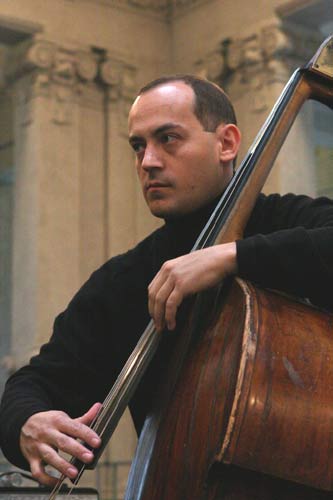 AAJ: It sounds as though you and Gwilym Simcock have a similar outlook on music; I mean, the lack of boundaries.
YG: I'm quite positive we have really similar views. We're every alike from a lot of points of view. It's a great pleasure to work with another person who has the same vision of what music is.
AAJ: Your arco playing on double-bass is very distinctive and sounds a lot like a cello; was that sound always there from the beginning, has somebody influenced you or is it something you have developed independently?
YG: It's hard to say. I don't know where it comes from. Maybe it has changed over the years. I think that the major influence sound-wise was our Moscow Soloist's director, who is an amazing, world renowned viola player, Yuri Bashmet, I think I have taken a lot of his phrasing and his sound, his attitude to the sound. This is quite natural when you work for many years with a very charismatic, top-class musician—you learn something, hopefully.
I think one thing that is underestimated by bass players is the set-up. The instrument has to be set up very precisely. The bass is already very hard to play as an instrument so why should we make our life harder? For example if the different strings sound differently that means something is wrong with the instrument. Perhaps the strings have different tension; maybe you have to change strings to another make or maybe you have to change the bridge, search for a better sound post position, etc. Maybe the fingerboard's angle is slightly wrong. You have to be very precise about everything.
Mother Nature makes her presence felt also. The bass is very susceptible to the climate, the temperature and the humidity and sometimes depending on the current climate conditions you may have to adjust the bridge a little bit. It's really rare that you get a hundred percent satisfaction. It's not always the case that the promoter can get you the amps you prefer and for this I normally have a small equalizer pedal which helps me out.
AAJ: When do you ever find the perfect chocolate cake?
YG: [laughs] Right, exactly!
AAJ: Do you have any nostalgia for the classical music world? Would you like to dip your toes back into that music?
YG: It so happened that I was primarily working in chamber orchestras but I mostly loved the symphony orchestras. When I hear a symphony orchestra I do think it's something I would love to do but you can't do too many things in your life. To do something really well you have to focus on this thing. You cannot be at the same time classical bassist, jazz bassist, teacher, researcher, classical composer, jazz composer, jazz arranger...that's too much. That means that something you will probably not do so well.
Then there is another issue, because playing classical bass is like playing a different instrument. The set up for playing classical bass is completely different to jazz bass; even the fingering is different. The technique is different, the left hand technique, the right hand technique—both pizz and arco. It's a completely different instrument and you would have to practice both basses if you wished to maintain a good level in both genres.
AAJ: Other than playing and recording in the Gwilym Simcock trio and your own recording projects do you have any other ambitions in the foreseeable future?
YG: Well I keep considering working with my own group, be it a trio or a quartet, but to do something at a serious level, I mean nice festivals, concert series, etc. you'd need to be backed up by a good manager that really believes in you, a label ready to invest in what you do, a press agency, etc. I just see how [manager] Christine Allen works with Gwilym (Simcock) and learn how it should be. [laughs] Well, alas, these things aren't easy in the closed circuits of Italy and don't seem to work quite in the same way like, for example, in the U.K., so I am starting to look out into other places in Europe. At the same time, I would be interested to get a teaching position at the conservatory. I have been teaching for two years here in Milan at the mostly rock and pop school CPM, and I find that I am quite interested in teaching music theory; I keep seeing some gaps there. When I was a student I wrote an essay on the theory of Solfeggio and I still have this interest, strangely.
AAJ: Do you feel that theory can sometimes get in the way of inspiration?
YG: Well, any kind of theoretic knowledge is nothing else but a tool to make better music. It is like when you play an instrument; the better you master it, the more you can express. As for the inspiration, I'm not sure that—strangely—this term is really the correct one. I would rather point out some creative input maybe, like when some idea hits you out of nowhere, but then all the work is yours, and it can be a lot of table work, brainwork—whatever you call it.
That's where your composition skills come in—to shape the piece, or your solo, form wise and to be able to express more. By the way, do you know how such an amazing composer as Tchaikovsky worked? He just had his fixed working hours and he used to call inspiration "a rare guest." Anyway, as for the theory and techniques, they are very important, but they shall always serve the music.
Selected Discography
Carlo Morena Trio, Poems (Music Center, 2010)
Yuri Goloubev, Metafore Semplici (Universal, 2009)
Gwilym Simcock Trio, Blues Vignette (Basho Music, 2009)
Claudio Fasoli Quartet, Venice Inside (Blue Serge, 2009)
Glauco Venier, Glauco Venier Suona Frank Zappa (Music Center, 2008)
Simcock, Goloubev, Sirkis, SGS Group, Inc. Presents... (Music Center, 2008)
Glauco Venier Trio, Hommage a Duke (Caligola, 2007)
Klaus Gesing Quartet, Heart Luggage (ATS, 2006)
Michele di Toro Trio, Il Passo del Gatto (Abeat, 2006)
Yuri Goloubev, Andrei Kondakov,The Bridge (Landy Star, 2003)
Yuri Goloubev, Toremar Island (Landy Star, 2001)
Igor Bril, Yuri GoloubevRendering (Cantabile, 1996)
Photo Credits
Page 1: Marco Riagamonti
Pages 2-4: Courtesy of Yuri Goloubev
Page 5: Alvaro Belloni
< Previous
Signature Edition 1
Comments

About Yuri Goloubev
Instrument: Bass, acoustic
Related Articles | Concerts | Albums | Photos | Similar ToTags
For the Love of Jazz
 All About Jazz has been a pillar of jazz since 1995, championing it as an art form and, more importantly, supporting the musicians who create it. Our enduring commitment has made "AAJ" one of the most culturally important websites of its kind, read by hundreds of thousands of fans, musicians and industry figures every month.
You Can Help
To expand our coverage even further and develop new means to foster jazz discovery and connectivity we need your help. You can become a sustaining member for a modest $20 and in return, we'll immediately hide those pesky ads plus provide access to future articles for a full year. This winning combination will vastly improve your AAJ experience and allow us to vigorously build on the pioneering work we first started in 1995. So enjoy an ad-free AAJ experience and help us remain a positive beacon for jazz by making a donation today.

Giveaway

Days remaining: 11