Home » Jazz Articles » Interview » Sam Stephenson: A "Loft-y" Vision of Jazz
Sam Stephenson: A "Loft-y" Vision of Jazz


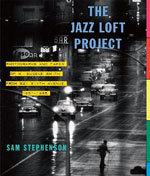
For photography enthusiasts, the value of this project is, of course, inestimable. Smith was one of the greatest of American photographers, legendary for his documentation of the Pacific campaign of World War II for Life Magazine, with whom he had severed ties before he moved from the ease of his home and family in Croton-on-Hudson, N.Y., to live in the dilapidated loft space at 821 Sixth Ave. in mid-Manhattan, in a building he promptly wired with microphones and recorders to capture all the sound that went along with the multitude of photographs that he was to take there for several years.
For jazz aficionados, the particular significance of The Jazz Loft Project is that it shows, in sound and pictures, a microcosm of the intensely creative jazz scene of the time, with luminaries and lesser-known musicians congregating, jamming and talking uninhibitedly before and after their gigs at the many nightclubs that sprung up in New York at that time. Three of the most frequent musical denizens of the loft were Thelonious Monk, his big band arranger Hall Overton, and legendary saxophonist Zoot Sims, joined at various times by Gerry Mulligan, Roy Haynes, Rahsaan Roland Kirk, Pee Wee Russell, Charles Mingus and a multitude of others. Much if not most of jazz is created in the off-stage moments and hours between performances, and The Jazz Loft Project offers an intimate glimpse into how the music comes about in the woodshedding process and the relationships that develop between the musicians.
Whatever his personal and artistic motives were, Smith anticipated the reality television shows and live Internet video websites of today, where cameras and microphones witness the everyday goings on of lives in progress. Such direct witness adds to and qualifies what people do onstage, and when this is applied to jazz musicians who, at that time especially, kept some distance from their public, something a little different—unexpected, even—can be seen that may change perceptions about the jazz scene
- The History and Details of The Jazz Loft Project
- About the Jazz Loft Musicians
- A Digression About W. Eugene Smith
- Monk and Zoot Sims as Central Figures
- The Jazz Loft Exhibition and Website
- Sam Stephenson's Personal Reflections
- About the Jazz Loft Musicians
The History and Details of the Jazz Loft Project
 View from a window in the loft
SS: I have a colleague named Dan Partridge who for the past seven years has put on headphones and listened to these tapes on a daily basis. He was the primary listener; I listen a lot but he listens to everything. The preservation process yielded 5,089 CDs of material.
Dan has listened to about 4,000 of those CDs so far. He's still listening every day. He thinks it'll take him another year and a half to hear everything once. He'll probably be the only person in human history to hear every second of Gene Smith's tapes. Not even Smith heard everything—sometimes he'd be gone while the recorder was still recording.
AAJ: What is Dan's background? Photography, music?
SS: Both. He is a musician in a couple of alt-rock bands and used to teach photography at the School for the Blind in North Carolina. He's a great guy, perfect for that job, because the thing is there's not only jazz on those tapes but also all kinds of conversations and sounds. The jazz is the easy part; it's listening to these conversations and also things that Smith captured from radio and TV that can be very challenging, so you need someone who's just as interested in that as in jazz, and a lot of the jazz historians would fast forward through that and go to the next jam session or whatever. Yet in our view it's this arcane material that really makes this project soar and it puts jazz in almost a cultural anthropological perspective that is unique, and Dan is really tuned into that.
AAJ: So these musicians, some of whom were pioneers at the time, like Zoot Sims, Thelonious Monk, and some who were not so famous, what made them congregate at this loft space? Did Eugene Smith himself have an interest in jazz?

SS: Smith was obsessed with music. He died, he had 25,000 vinyl records in his possession. He often proclaimed that his photography was more influenced by music and theater than by photography as such. You can see that in the drama of his work, and the way he would sequence his photos. He tried to sequence his visual images in a way that had rhythms and lyricism that he found in music.
But the jazz scene started in that building before he moved in. It started in 1954 and Smith located there in 1957. The original quote "jazz loft" tenants were a painter named David X. Young, a photographer named Harold Feinstein, who worked with Smith a lot, and two musicians named Dick Cary and Hall Overton. Also, vibraphonist Teddy Charles sub-let Dave Young's place while Dave was in Provincetown, Cape Cod and Haiti, where he went often.
The reasons that jazz popped up and lasted in this building are complicated but one is geography. It was a commercial, non-residential neighborhood in the dead center of Manhattan. It was also a downtrodden area, so it was cheap and convenient. Musicians could stop by from uptown or downtown, just to see if something was going on. And since it was not residential, no one would complain about noise in the middle of the night. Moreover there were four tuned pianos in the building so they could go and woodshed on a tuned piano. So word spread quickly.
I think that the other key answer to that question is Hall Overton. I've traveled to 19 states and interviewed over 350 people who lived in or came to this loft, and as the interviews started to mount it became clear that Hall Overton was a monumental figure in attracting musicians. Almost across the board, musicians loved him and loved being around him. They loved picking his brains for musical ideas, and he didn't seem to care about getting credit for this kind of work. So people trusted him, including Thelonious Monk and others. Steve Reich, the minimalist classical composer, was in the loft often to work with Overton once a week for two years. A large sweep of American musical history is represented by just Monk and Reich, and Overton was in the middle of it. So, for these reasons, the scene flourished there.
AAJ: There's a whole story here, just about Hall Overton and his influence.
SS: I've got enough material to write a book about him. There are a number of people besides Smith who are of interest to me, and he's one of them. He was a soldier in World War II. He went ashore at Normandy a few days after D-Day and he carried stretchers in Belgium and France. And Smith was a combat photographer in the Pacific for two years. There was something in common about these two men, who were not only in the war, but their duty was almost worse than fighters. Overton was carrying bodies, and Smith was paid to witness everything: he was photographing it.

A Digression About W. Eugene Smith
AAJ: A couple of questions about Smith and then we'll get down to the jazz. I was really intrigued to learn that he had a really nice life in Croton- on-Hudson, a suburb north of New York City, and suddenly gives up a family and kids, in a nice home, and moves into this dilapidated loft space. Then, on a seemingly bizarre impulse, he wires the entire loft with microphones for sound, even the stairwell. These two acts suggest to me that he was going through something—an identity crisis, a trauma, mental illness, or a drug addiction—any or all of the above. What do you think was going on?
SS: He moved into the loft when he was 39 years old. He had recently quit working for Life Magazine, where he had become a legend, and then he attempted the massive Pittsburgh project right after leaving Life. I suspect he was trying to show the world that he was a genius whom Life had been holding back. So the Pittsburgh project was an attempt to create a magnum opus the likes of which photography had never seen. He actually compared the project to Beethoven's symphonies and Joyce's Ulysses.
So his ambitions were unsatisfiable. I think he was desperate at that point, and for someone so feverish and so desperate, routine family life just isn't a very good fit, and everyday duties just didn't fit either. He was at his feverish pitch as an artist at age 39, so a life in the suburbs with a wife, kids, and a housekeeper was just not right for him, and I think this loft, where he could stay up all night and work several nights in a row, was a good match for him. Liked to work in the dark room with music blaring, and that's hard to do when the family is trying to sleep. So I think he loved this loft, and there were people like Overton and Monk there, just very brilliant people, and I think he related to all that better than to a comfortable life in suburbia.
AAJ: Is there a biography of Smith available?
SS: I'm actually writing one myself write now, but there's a biography of him by Jim Hughes [W. Eugene Smith: Shadow and Substance : The Life and Work of an American Photographer (self-published)], which is really good. It covers a lot of the facts well. The one big hole in that biography is that he didn't spend much time on the jazz loft years, which is actually Smith's largest body of photographic work. And if you add the tapes...
AAJ: It completes the story.
SS: Right. That's what my biography will do. It will fill out the story, and fill in that gap. On the tapes, too, you can hear Smith talking about his life and work—such as his father's suicide, he's on the tapes talking about that and the tapes will be enormously helpful to my biography beyond just the jazz loft years, like finding a bunch of unseen letters. But otherwise, Hughes' book is excellent.
AAJ: It would be ironic if many music fans became interested in Smith's photography and biography as a result of The Jazz Loft Project. But why did he wire the whole building with sound recording equipment?
SS: He had microphones all over the place, through walls and ceilings and floors and the stairwell. On some tapes, you can hear someone open the door on Sixth Avenue and walk up five flights.
 Thelonious Monk
AAJ: Do you think it was Smith's idea of an audio version of capturing life itself through photography?
SS: Yes, I think that's right. I think the taping is a natural extension of his photography. And I think all people who feel compelled to be photographers have a little bit of voyeurism in them. They like looking at people when they don't know anyone is looking. And they like rendering life in a way that is true and real and poignant. For example, the jazz sessions he recorded are really hit or miss. Some of it is great and some is really bad. You rarely get to hear bad jazz—especially recorded jazz. In jazz history, what's recorded are the great bands and the great moments but for every one of those great moments, there were so many more when the musicians were just woodshedding, or trying something that didn't work, or where the bassist just couldn't get it. In this project, all that was saved on tape. And I think Smith knew he was capturing something that otherwise would never be captured.
 Thelonious Monk and Zoot Sims as Central Figures
AAJ: You made a video that is shown with the book at amazon.com, and in it you refer to the music on these tapes as mediocre. That made me do a double take—why would anyone be interested in bad jazz? [Laughter]
SS: Let me put it this way: If you release the jazz history angle of what went on in this loft, then the people involved in the story almost become like the characters in a Eugene O'Neill or August Wilson play. So it doesn't matter if the music happens to be good or not, it's a human story. There were some musicians just as dedicated as the icons, but they just weren't as good. But they, too, are part of the human story of jazz. I think that's what Smith was trying to achieve: the human story. And it's not just the mediocre musicians but even the great musicians sometimes play not so well, or are just trying to find something. For example, in these tapes, you get to hear Monk and Overton with the weeks and weeks of work they did to achieve those great big band arrangements, performances and recordings.
AAJ: So it's rare instance where you have recordings of the music being created, being born.
SS: Jazz is often talked about as just an inborn, instinctive thing with the musicians, but the tapes show how much time and dedication is required in order to be good. On these tapes, the musicians are not playing for the money or an audience, they're just playing for the sake of the music.
AAJ: That's interesting because Monk himself was one of very few who would literally woodshed a piece with his group on stage with an audience. He'd sometimes correct or admonish the guys right there in performance, and sometimes he'd stop playing and re-do a particular passage. Most musicians totally choreograph what they perform before an audience or even more so, on a recording. So your tapes give a feeling of the process they go through in shaping up a piece of music. And not just rehearsing, but they're just hanging out trying things together.
When you were listening to these many, many hours of tape, were there particular moments that really grabbed you, that moved you in some way and/or struck you as relevant to the development of jazz during that time?
SS: There are a number of things that stand out. I think I could probably narrow them down to two. One of them is Monk, for example the amount of time he and Overton put into preparing that Town Hall concert music, and also the big band music of 1963-64. Smith recorded a lot of those one-on-one sessions. Just hearing Monk talking about his music with Overton is profound and moving. I love Monk. He was born in eastern North Carolina where I come from; he still has many family members who live in that area and I've gotten to know them. These tapes re- confirmed my love for Thelonious Monk.
The other person who jumps out in these tapes is Zoot Sims. He was a relentless player. He loved to play music and he was insatiable. And he was also a kind of Pied Piper: musicians revered him. I think he was really a musician's musician. He's not given enough credit by historians, perhaps because, to my knowledge, he never really cut an iconic album of his own. He was with Al Cohn at the Half Note all those years. But what you hear on these tapes is a man who lives and breathes this music. He never turns it off. We've got him on some sessions at the loft where he plays with Roy Haynes, Dave McKenna, Pepper Adams,Jimmy Raney, and Henry Grimes. We've got him on some sessions with great musicians. Zoot carries the day; he really influences the other players. In one session in January, 1960, where there are about 15 musicians in the room, Zoot is playing, and Roy Haynes walks in, and you can hear everyone greeting Roy, who has a strong personality as well, probably one of the five greatest drummers of all time. So he walks in, and Zoot's there, and within a half hour, the whole session boils down to Zoot and Roy. They're calling the tunes and they're deciding what happens next. That's got to be one of my favorite reels from our collection.
AAJ: For me and many other fans, Zoot Sims is certainly one of the greatest tenor sax players. I love to listen to him but I wasn't aware of how much he influenced the other players. That's a story in its own right for scholars and historians to take up.
SS: From my interviews and research, there are a handful of people from the loft that I would want to write more about and Zoot Sims is one of them. Roy Haynes, Sonny Clark, and Hall Overton are the other ones. Zoot should be given more recognition among the all time greats and I think the other musicians would agree. He had an easygoing personality but there was a certain relentless fever to him as well that made people love being around him, following him. He made people feel good. He always played great, no matter who he was playing with. He never phoned it in. I'd really like to learn more about him and write a biography or a long magazine article about him.
 AAJ: Jazz is an interpersonal art form. A lot of what makes jazz great is the guys coming together with each other, and also with the audience. It's a mutual creative process, and it happens on a constant basis, even off stage. Your tapes seem to show Zoot not so much as an individual ego, but as someone relating to everyone around him, and in that way he was indeed one of the movers and shakers of jazz.
SS: I agree. He was equally beloved by both African American and white players. Everyone loved and respected him. Although he may never have cut the one recording that everyone considers his masterwork, his music was his whole life. He lived the music; there wasn't any separation. His whole life was his masterwork.
AAJ: It sounds like he didn't have the ambition to be a star, to create an image. By contrast, Monk, for example, deliberately fostered a certain image of himself that caught the attention of the critics and the public.
SS: But the more obvious comparison is with Zoot's peer, Stan Getz. Maybe Stan was a better marketer of himself.
AAJ: Also, Getz chose his music partly with the aim of latching on to a trend and achieving a high degree of popularity. Zoot is certainly considered to be one of the greats like Getz, but never became a legend so to speak.
Now, to get back to the loft project as a whole, do you know if there were any longer-term connections that emerged between the musicians who gathered in that space? Did the loft foster any group formations?
SS: Yes, there's some of that. There are numerous instances of musicians who played in the loft and then did gigs together. Some occurred with lesser known musicians. A high profile example might be Thelonious Monk with Pee Wee Russell. They played together at Newport in 1963 and a couple of interviewees told me that the two of them first met at the loft in 1959.
AAJ: I believe that Gerry Mulligan came to the loft a few times.
SS: Yes, Mulligan was there. From our oral histories, we learned that many musicians were there before Smith moved in. Charles Mingus used to go there a lot; Teddy Charles was there. Mingus used to work with Teddy and with Hall Overton in the loft and some of the guys from the loft show up on some of Mingus' recordings. I think it was Dave Frishberg who told me he met Zoot in the loft, and Dave ended up in Zoot and Al Cohn's band. Some of the others no one ever heard of, but they also ended up getting gigs with one another.
AAJ: What about that fellow Lou Ornstein, who gave you a lot of information about the loft?
SS: The first photo in my book is of the list he gave me in 2000, at the beginning of the project, and it was very influential Lou's list told me that I needed to pay as much attention to the unknown musicians as the stars.
AAJ: Your interest in the lesser-known figures fits with the postmodern understanding of history as having to do as much with everyday life as with the great historical events and individuals.
 Thelonious Monk
SS: In the book's prologue, I quote James Baldwin, who said, and I'm paraphrasing, "History is not a few spectacular moments; history is millions of anonymous moments." That's what the Jazz Loft project is about.
AAJ: Did [noted author] Baldwin ever show up at the jazz loft?
SS: I don't know, I wouldn't be surprised. He shows up on the recordings that Smith made off the radio of the time.
AAJ: The great jazz singer Deborah Brown made a record with Baldwin. But let me ask you an important question that I'm sure will be on readers' minds: How can the average person or perhaps the jazz scholar actually hear some of the tapes?
The Jazz Loft Exhibition and Website
SS: On our website, www.jazzloft.org, we have about three hours of sound. We just put up a new hour. Also, there's a ten-part radio series that you can link to from our site. One day there may be some commercial products but that's not up to me. We don't own any of the recorded material, just our research. But I think the Smith estate will one day work to make this available. Also, at the Exhibition in New York, you can go to a couple of kiosks, put a headset on and listen.
 Self-portrait by W. Eugene Smith
AAJ: Could you give us a brief guided tour of the exhibition, and what folks should look for there?
SS: The major component of the exhibition consists of 200 photographic prints that Eugene Smith made. We use prints he himself made some 50 years ago, they're beautiful. He was one of the great printmakers of all time. He worked very hard, painstakingly, and in an idiosyncratic, very personal way in the dark room. So this is also about the art of photography. I was very taken by a comment that a teacher at the International Center of Photography made to me. In our era of digital photography, there's been a recent uptick in the amount of interest in "analog" dark room photography by young students. So it will be very valuable for young photography students to go see these masterful prints.
We also have some great audio in the show. There are headsets with a touch screen where you can select tracks. There are 40 tracks of audio, some great jazz, and also some things that Smith recorded from radio and TV: Martin Luther King, JFK, Cuban Missile Crisis, UFO, flying saucer and alien sightings, especially during the early days of the space race. There was a late night radio program with Long John Nebel, where people would call in claiming flying saucer sightings and so on. All of that is part of the post-war culture that this show is about in many ways. There's also some video footage that we ourselves shot while interviewing some musicians, including Bill Crow, Joey Masters, Henry Grimes, Ronnie Free. There's an interview with Ruth Fetske who was one of Smith's assistants. I think this project will give people a feeling of what it was like to have been alive in a dilapidated building in the middle of Manhattan in 1960 [laughter]. I think this exhibition will do that.
AAJ: And, importantly for jazz, that dilapidated loft was within easy distance from all the important clubs of the time; the Vanguard, Café Bohemia, Half Note, Five Spot, and many others were all within easy reach by walking or public transportation.
SS: One of the points I want to make about the audio is that, due to storage and movement of the tapes over 50 years and a variety of other issues, the pitch can be off, half a step high or low. Some real hard core aficionados might find themselves frustrated with that. We chose not to correct that because we wanted to represent exactly what we found in those tapes and the sound. We made what is called a flat transfer, so in some audios, the pitch is off, and also affects the speaking voices too, so it complicates part of our detective work of trying to figure out who's talking at any point in time.
AAJ: Well, you're in good company. The best selling jazz album of all time, Miles Davis' Kind of Blue (Columbia, 1959) was actually issued half a step above the actual pitch due to the use of different equipment during the mastering process. That wasn't figured out and fixed until an anniversary CD was produced much later. I suppose there will always be those who prefer scholarly preservation versus those who want only the faithful reality versus those who prefer high-tech augmentation.
Sam Stephenson's Personal Reflections
AAJ: I'd like now to ask how you were personally affected by this project. You listened to hours of tapes, looked at countless photos and other documents, and interviewed many, many individuals around the country. How did you react to all of this? What flashes of insight occurred? Were you personally transformed as a result?
SS: It's been the project of a lifetime. I feel very blessed and grateful to do this. And I'm associated with an institution called the Center for Documentary Studies which encouraged us to pursue this project on so many different levels. For a decade, I was enabled to travel around the country, going to 19 states and interviewing over 350 people. Those interviews were the heart of the project. I went to various homes, where most of the people were senior citizens, over 70 years old, and it was a privilege and an honor to listen to these folks tell their stories. I was very moved, and I realized that there are lots of stories out there and if we don't document them they're going to disappear. Our society has an urgent need to listen to these elderly people and learn from them. They can teach us how to live better lives. Our culture is "push, push, push forward," which is all right, but it's better to push forward while also reflecting on what happened in the past. And that's one of the most important things I learned from the project.
Great artists, like Eugene Smith, like Monk, are constantly mining the past for their material, but they're also pushing forward and doing something new with it. Monk is one of the most profound examples of that. His music is based so much in blues and gospel but he used that base to create something modern. I think that could be a model for all of us. We can look at the past, at different cultures, and try to understand it all, but unfortunately our modern society downplays that. Just last week somebody in New York—a top editor—pointed out to me that if you look at the current high profile, high brow magazines—The New Yorker, Harper's, The Atlantic—you rarely see articles about history anymore. It's all about now, now, now, and the future. I find that frightening.
 Jymie Merritt and Mickey Roker— artists who've been around in the business for decades—and hopefully will be completed well before they've left us. Some of them have such great integrity and are such great role models. Part of the jazz story that needs to be told are the struggles of the musicians, their relationships with each other, and what the music meant to them personally. Your Jazz Loft Project has so much of that aspect in it.
SS: Tom Brokaw termed the WWII generation "The Greatest Generation." I think there is something about the jazz musicians who were born between 1920 and 1940. They are to some extent the same generation but it's a different group of people, and I think the phrase applies just as well to them. There's a certain kind of ethic they have in common. The decision they made to become professional musicians in the 1940s and 1950s—that's hard to understand these days. There weren't schools you could go to then to learn jazz, so by choosing to be a jazz musician you were choosing something very different. Back then, there was no definite path to a career in jazz—you just had to find some people to play with. You had to learn how to relate to others and how to be a team member. And also, these musicians had a robust sense of humor, which I think comes from being relegated to knowing you might not make a lot of money but you're going to enjoy yourself.
AAJ: And also, they were on the road for long periods of time, had a lot of down time, and humor was a way of developing camaraderie. It was a very tough life being a jazz musician back then. And many of them were so bitten by the music that they literally dropped out of the conservatories and society in general.
SS: That's exactly what happened to Hall Overton: he went to Juilliard and taught there as well but preferred to be in this loft doing jazz work.
AAJ: To conclude, could you say a bit more about what's on tap for you?
SS: What's on tap immediately is a biography I'm currently writing on W. Eugene Smith for Farrar, Straus, and Giroux. That'll take me a couple of years. After that, I'm not sure; I'm interested in the health care project I mentioned. I'm almost certain I will write something about Zoot Sims and Sonny Clark. Sonny Clark interests me very much. He grew up in rural western Pennsylvania very close to where my wife came from, a coal mining region, and Clark's father was a coal miner. Of course, Clark died at age 31 from a heroin overdose, and I've gotten to know his two surviving sisters and I'd like to write a story putting a human face on the stereotype of the jazz junkie. I also would like to write about Monk. I've already written something for a magazine called The Oxford American about Monk's connection to North Carolina.
Photo Credits
Photos on Page 1, bottom Page 2: Sam Stephenson
All Other Photos: W. Eugene Smith, Courtesy of Jonathan Pace
Tags
PREVIOUS / NEXT


Become a Sustaining Member

Since 1995, All About Jazz has championed jazz as an art form and supported the musicians who create it. Over three decades, it has grown into one of the world's leading jazz resources, serving hundreds of thousands of readers, musicians, presenters and industry professionals each month.
Help Build the Future of All About Jazz
Your support helps us continue building All About Jazz for the next generation—expanding our editorial coverage, preserving jazz history, developing new community features and creating better ways to discover the music and the people behind it.
Become a sustaining member for as little as $20 per year and you'll immediately enjoy an ad-free experience along with access to subscriber features and future articles for a full year.
Together, we're not simply sustaining All About Jazz—we're building its future. Thank you for being part of the journey.