Home » Jazz Articles » Interview » Christian Scott: Breaking Boundaries, Crossing Lines
Christian Scott: Breaking Boundaries, Crossing Lines


Diplomatic functions do not represent a major part of the group's touring schedule. Maybe Scott was a slightly surprising choice for such an event: on the same evening, it was Russian saxophonist Igor Butman's tight big band which produced a sound more reminiscent of what might, on foreign shores, be expected from the stock phrase "American jazz."
Puzzled faces were certainly in evidence, but it is a tribute to the music's chameleonic quality that, by the end of a short set, appreciation was unanimous. "We've been lucky enough not to have a demographic," Scott explains. "We've played concerts where they'll have 70-year-old blue-haired ladies, or young teenagers. We've played for audiences of kids with Mohawks and black nails, right through to people who are just into hip-hop and gold teeth and all that type of stuff. It ties into the concept: the music is for everyone."
Scott has enjoyed a privileged rite of passage into the jazz world. "I started playing trumpet when I was 11. I'd been around music my entire life; my mother was a classical bassoonist, and my uncle is saxophonist Donald Harrison. So I decided I wanted to play jazz, and I asked Donald if he would teach me, if I could be his protégé. He took me under his wing and let me live with him for a year-and-a-half, and after that, I guess he thought I was good enough to go on the road and start playing. So when I was 13 or 14 I started to tour internationally."
This is clearly the source for a deep well of self-belief. Asked if it was tough to compete with the vast number of musicians coming out of New Orleans and the wider USA, Scott's answer displays unflinching confidence: "No. I know this sounds strange but I think part of it is that I was very fortunate to have my uncle at a young age. Most of the things kids were trying to figure out, I had already learned from being on the bandstand.
"It's like basketball. If you're 12 and you play basketball with 12-year-olds, you're going to play on a 12-13-year-old level. But if you play with 25-year-old men, you're going to understand different things that kids don't know. Kids play basketball and they're just playing the sport, but 25-year-old men know that basketball is really trigonometry—it's angles. You have to know the triangle offense, the zone defense, you know there are angles in the way your body pivots; there are all these different things, but a kid doesn't know the science of it. So when I was growing up, I was always sort of ahead of the curve: my friends would be learning their scales, but I'd be trying to figure out how to interpret, like, Satie! It was different. I never fell into that kind of trap thing by having to compete with my peers. I was always competing with people who were much older than me."
Despite this whirlwind initiation, Scott's feet stayed firmly on the ground. Rather than taking off headfirst into a full-time musical career in his teens, it was parental advice which guided him along a more cautious path. "I started traveling early," he says, "but there was always this thing of my mother saying she wanted us to finish school, as she didn't have a chance to do that because of having us. So, instead of going on the road, I decided I would go to Berklee."
A fundamental philosophical difference influenced this college choice: "I had a full scholarship to go to Juilliard, but the ideology doesn't work for me. I don't have this notion that jazz is more important or valid than any other type of music. That's the sort of doctrine you're given: this is the hardest music in the world, played by the most intelligent musicians, which is bullshit to me. I think that no matter what you do, if you feel you're an artist and you want to create, then your art is just as valid as mine—because I'm no more valid than you are."
 The trumpeter isn't afraid of disagreement. At times, it seems he even enjoys it—but not simply as argument for argument's sake. Scott says what he thinks, but he also thinks carefully about what he's saying, presenting refined and logical views in an articulate manner. And this makes his flair for unorthodoxy all the more compelling.
Take Wynton Marsalis, for example. Everyone in jazz has an opinion, and Scott, a personal friend, is no exception. His debut album, Rewind That (Concord, 2006), received a Grammy nomination and significant critical acclaim—but Marsalis was less complimentary. "I had Wynton tell me my music wasn't jazz because the main rhythm wasn't swing," Scott recalls. "He was like: 'If it's not swing, it's not jazz.' So I said to him: 'Louis Armstrong, Kid Ory, Scott Joplin, Jelly Roll Morton, Papa Joe Oliver—all these guys aren't jazz musicians. All of those early New Orleans guys are not jazz musicians.' He was like, 'no, they're jazz...' And I'm like 'no, they're not, based on what you just said, because swing was invented in Kansas City in the '20s! And jazz predates swing. That rhythm is a perversion of jazz, so how can you say this denotes what the music is when it's a perversion? It's an offset.' That was the first time I ever saw a Negro turn red. He was done."
The issue of Marsalis, Juilliard and the jazz "system" they represent is a hot topic for Scott. Its flaw, in his eyes, lies in the lack of creative dialogue and a prescribed, almost universally accepted set of values which is rarely questioned. The Establishment.

"I feel like the archetype jazz musician now, in the last 25 years, has bought into a type of insincerity for the sake of musical survival: they'll do whatever they have to do to survive musically. The problem with this is that individuality is not paramount anymore—you have all these people who sound the same making records that sound the same. The fact of the matter, in my opinion, is that when you start a healthy dialogue where people disagree with each other, you force them to actually be creative. It's like having an argument: you know how you might have a stance on something but it's not until someone calls you on your stance that your brain starts working. That's basically all it is. My thing is: it's not about me, I would rather the music is better so the next generation of musicians is better. Because what happened is that there's a 10-year gap where the musicians are sadder than their predecessors. That's backwards. You're supposed to be better than them. I know that sounds fucked up, but you understand what I mean."
"Let's go back to basketball. Magic Johnson was a great player, right? He was a great player 25 years ago. Now, do you know who LeBron James is? If you put LeBron James versus Magic Johnson, LeBron James would kill Magic Johnson—he's just better. It's just that during that period of time, Magic was the best. You have to judge it against the context, that's the thing. During that time, Magic was the best in the world but today he'd be mediocre. Just because the guys now had the opportunity to see him and study what he did. So what I'm saying is for jazz musicians, it's like you have Magic Johnson, and then 20 years later you have guys that are worse. It doesn't make any sense. I meet these jazz musicians, they're playing, and I'm like: 'What the fuck have you been listening to? It doesn't even make sense. Go get these 20 records and they'll show you how to connect the dots; they already showed you how to do it, you can't ask for any more!'"
Another eloquent sports metaphor, indeed, but this was one stance which definitely needed calling. Isn't jazz sounding healthy at the moment? Why are there so many people who don't seem able to connect musical dots in the most basic way? And how did this sour phenomenon come into existence? Unsurprisingly, the answers were waiting.
 "The problem is that jazz has turned into an academic thing. And what people don't realize is that it was done on purpose, because there's a horrible structure in jazz right now. Fuck it, you can write this, I'm going to say it. At the top of the hierarchical structure are people like Wynton Marsalis. Now, on a personal level, I love him—I can call him up right now, and we'll talk about basketball—but the fact of the matter is that we disagree on some very fundamental levels.
"He got to this place where he's at the top of the pile, and then he decided he was going to tell everyone else in the country what to listen to and how to play jazz. Let's think about that. Let's say it's kung fu, or whatever. We have the highest master, who is all the way at the top of this pile—he studied all this stuff, everything there is to study. If he then tells everyone else just to study two forms of fighting, when he knows eight, that's going to mean everyone else coming up under him will not be able to take him down because they haven't amassed the knowledge he has. They don't have that wealth of knowledge.
"So the problem with jazz musicians now is they're trying to figure out: 'Why do I still sound like John Coltrane? Or why do I still sound like Charlie Parker?' It's because when you were 10 years old some asshole told you to only listen to Parker and Coltrane and nothing else. So you only studied that, while the asshole who told you to do it was listening to Sonny Stitt, and he was listening to Sonny Rollins, and all this Stanley Turrentine, Gary Bartz and all this shit! And you let him tell you only to listen to these two people. This is why you can't compete with him. You've been bamboozled. He tricked you into buying into his system so you would never be able to take him down."
Scott weaves together threads of thought to construct a strong critique, a net to snare the jazz system, in the same way he creates music. He speaks of being able to freely write notation as if it was text. From the first pulsing guitar riff on "Rewind That," the opening and title track on its namesake album, the atmosphere is enthralling. Throughout the disc, catchy hooks and hypnotic grooves in an R&B or hip-hop vein are developed individually, taken to different levels and mixed around—while elegantly layering up and holding firmly together at the same time. Cutting through it all is the icy, breathy tone of Scott's piercing trumpet. One wants to listen more, rewind and shift the focus of attention.

The release was heralded as a game-changer in critical circles, with Billboard magazine declaring it "arguably the most remarkable premiere the genre has seen in the last decade." Sales were high. An uncharacteristically charismatic debut, Rewind That was a statement of intent—the then 22-year-old Scott had already found a distinctive compositional voice of his own.
It was a notable departure from the quasi-formulaic process expected of freshman jazz players on major labels. Their initiations almost always comprise a fairly predictable standards songbook, with a couple of originals at most. Rewind That was the opposite: the only standard in sight was a jumped-up version of "So What," laid down over a rippling backbeat, with a burning guest solo courtesy of Donald Harrison's snaky alto sax.
"When I signed the record deal, I told them: 'I get to make the music I want to make, and you don't have anything to say about it,'" Scott recollects. "Now, there are pros and cons to that situation, because of course they want some things, and you have to do stuff like paying an extra dollar for a CD—which doesn't bother me because I'm getting to make the music I want to make. But that was the stipulation. I make the music, you put the record out and sell it."
The jazz community saw this move as controversial. "The problem was coming from other musicians. I was getting calls from people I knew, like, 'man, I heard you signed a record deal, you'd need to do a standards album because they put the money on you.' Everyone knows that if you make a standards album with a major label like that, you're going to make a lot of money. But that wasn't important to me, I wanted to make the music I felt was relevant at the time. I would even get into arguments with my uncle about it—he'd be like 'yo, man, you need to do this, we've cleared a path for you and you should take that path.' But I'd rather do whatever I want."
Scott's goal was to find out "if you could make your own record the way you wanted to and win." "You don't have to follow a model," he continues. "People make excuses in those types of situations—they might say 'well, no one's ever done that before...' That sounds like an excuse, and an excuse is just an opportunity in disguise. If no one's done it, then we'll probably succeed, because at least we have one thing on our side: we'll be the first ones to try."
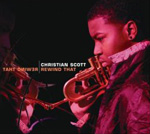 With Rewind That, Scott believes he won—"it changed a lot of people." His next CD, Anthem (Concord, 2007), was eagerly anticipated. Recorded and released in the aftermath of Hurricane Katrina, to many it seemed a moving tribute to the devastation of New Orleans. Darker, broodingly meditative moods and minor themes almost invited such a conclusion.
Scott, however, is quick to dispel this reading of his work. "My album wasn't a Katrina album. Not at all. I think that's callous, and, to be honest with you, when I found out the record company was sort of using that to market it, I had a huge argument with the product manager—like swearing at each other, like pushing. Because the thing is that I have friends—girls I grew up with, who were raped in the Superdome—and people that were murdered, all types of stuff. I didn't live that experience, and that's part of what we do, too; we try to make the music as sincere as possible.
"I wasn't there when the hurricane happened, I was in Boston—so I'm not going to write a song about the hurricane hitting and 'oh, wow, here's me' because I was fuckin' in Boston! You know what I'm saying? I don't think that's OK because I didn't have the negative aspects of that experience so I don't think that's my right to write about it, even though it's about my hometown. I can write a song about losing my home, because that's an experience I had, but the hurricane hitting and the water and being afraid—I didn't experience any of that. So it would be callous of me to write that a song like that. I don't think it would be fair."
This stance led to disagreement with another high profile figure, friend and fellow trumpet player. "I had an argument with Terence Blanchard about it—he didn't like the fact I said what I said, but that's how I felt." Blanchard's album A Tale Of God's Will (A Requiem For Katrina) (Blue Note, 2007) was released around the same time as Anthem. Featuring a full string orchestra, it represented a personal lament on the disaster and won a Grammy for Best Large Jazz Ensemble Album.
"It was like, 'OK man, alright, I know you weren't in New Orleans when it happened, you know, you're very well paid, everything is alright, your house didn't get touched by an inch of water—I know it 'cause I know where you live, I've been to your home!' When that album came out, everyone kinda jumped on the bandwagon, and sort of made my album synonymous with it. And that pissed me off! I was very angry. Anthem was actually about socio-political concerns all over the world. What I'd seen is that everywhere I went, people were vying for a voice and they wanted to be heard. I like to talk to people, share stories, sit down and converse—and I realized there's a lot of pain going on and people wanted to get that out, so I wanted to try and make an album full of small anthems that people from different experiences could relate to. It wasn't about a fuckin' hurricane."
A CD/DVD double set, Live at Newport (Concord, 2008), brought more positive reviews and increased media attention—including towards Scott's dress sense. He's been hailed as "jazz's young style god" by JazzTimes magazine. One publicist at a London gig was overheard saying he'd never worked with a jazz musician who had such an eye for style. However, the man himself is rather baffled by such talk, putting the claim down to popular stereotypes. "People were coming to the conclusion that I'm a 'fashion guy,' and it fucked me up because I never think about that shit—like, at all," Scott elucidates.
 "On a daily level, the funny thing is that my friends laugh when they come to a concert and say 'you're the same on stage as you are in your daily life.' It doesn't change—I'm still a crazy motherfucker, I dress the same. What I wear to gigs is what you'll see me walking around the hotel in. I don't really think about it much, it's just how I dress. I get a lot of hookups because I have a shopping problem; I get given stuff because they know I'm going to talk about it when people ask me what I wear. But I don't think about it: my shoes are dirty, my pants are probably a little too tight, my socks might be dirty, and this jacket's not ironed. I don't give a fuck. But people see it and they say 'well, I'm used to looking at an African-American guy who's got a T-shirt and a chain on, and this guy dresses more closely to the way a European would dress,' so they automatically say, 'he's more fashionable than the others.' It's true! I can contextualize where people are coming from when they see that but I don't think about it at all."
Almost exactly a year since the Moscow gigs, Scott is in London for the launch of Yesterday You Said Tomorrow (Concord, 2010), his first studio album since that dramatic sophomore release. His stock has risen. A month trawling the roads of Europe is underway. Two sell-out concerts at Ronnie Scott's club are talk of the town; a constant stream of interviews, from blogs and the BBC to national newspapers, is on the agenda.

"This album is a totally different animal," says an understandably tired Scott in the bar of his hotel. "I'm waiting to see how it will be received because this is nothing like what came before." But he seems far from concerned at this apparently radical deviation from a successful recipe: "I'm not worried, I think when people hear it—whether or not they conclude they like it—they'll have to at least say 'this is not some shit I've heard before.' And I think it will take more time for people to come to conclusions about how they really feel about it."
The CD was recorded over four days under the attentive ear of legendary engineer Rudy Van Gelder, now in his 80s, who came out of retirement especially for the project. Mixing took "ten times as long," according to Scott, who was writing the music "all day and every day, for nearly three-and-a-half years." He adds that his current sidemen—Matthew Stevens (guitar), Milton Fletcher (piano), Kristopher Funn (bass) and Jamire Williams (drums)—are a group he's been trying to assemble for the last four years.
Conceptually, his vision is clear. "I wanted to create an album that sounded like a hybrid between the way we play now—how we incorporate and blend ideas and textures from this generation—and couple it with the type of depth musicians played with in the '60s. And to marry not just sounds and palettes from this era, but also from that one, to have two different time periods together in the music, so it's more dense."
Dense it is. Scott's trademark ostinatos remain intact, but his new band sounds more unhinged than any of the others. Yet there is control. The first track, "K.K.P.D.," is propelled by waves of frenetic beats from Williams, a source of endless energy at the kit. The quintet follows a recent jazz trend of Radiohead covers with "The Eraser," before intermittently mellowing out and turning up the heat over eight more originals, all but one penned by Scott. He duels with Stevens' alternately luminescent or gritty guitar on several cuts, while Fletcher and Funn provide a shimmering, shifting backdrop. Traces of both Rewind That and Anthem are certainly detectable, but Yesterday You Said Tomorrow represents the next stage of evolution, a powerful, expressive document on the current phase of Scott's artistic growth.
"It sounds like what I hear in my head, which is fucked up," states the trumpeter, with a faint tone of surprise. "It's weird because every album I do I feel like I'm getting closer to that sound. You always hear musicians talk about the fact it never sounds like how it is in their head. It's the only album I've made that I can really listen to. I can listen all day, every day, and I always find something I can hold onto that I didn't notice before. It's incredible. And I made the motherfucker!"
Despite obvious satisfaction at how things are going, certain issues are starting to bother Scott in the midst of his small media circus. "I can tell you what I'm sick of being asked about: I'm not terribly concerned with people doing the whole Miles Davis thing. I couldn't care less about that. Man, Miles Davis is dead. Leave that shit alone. If Miles was here, he wouldn't be thinking about me doing what I'm doing—he'd be like 'man, fuck that dude, Christian Scott can kiss my ass.' And I'd be telling him the same shit back. Yeah. He was known for being a bit of a jerk."
A 2009 tour with Marcus Miller, recreating Davis' classic album Tutu (Warner Bros, 1986), could have done Scott more harm than good in this respect. While in one sense there is no greater compliment, it's easy to see why his relentlessly progressive mindset spares no time for raising ghosts of the past.
Scott also reacts negatively to the frequent assumption that his music contains a political element. "I don't think I'm political, I just speak about my experiences. It's weird. I come all the way over here and people think they know me and understand what I'm talking about. You may be able to fathom it to a certain extent, but unless you've been in 100-degree weather picking cotton or cutting down sugar cane, as far as I'm concerned, you can shut the fuck up about it. That's how I feel about those types of things."
This kind of bold, confident statement has set Christian Scott apart from the day he signed the Concord contract. His emerging position as a leading figure in 21st-century jazz music looks more assured with every release, but he is the first to put things in perspective: "There's been all this hoop-la made about the palette we've been working on," he said in Moscow. "People have been calling me one of the main architects of a new sound of jazz. But I don't see it that way, because all the things I hear relate to stuff I heard before.

"I've had the experience of being around a lot of older musicians. I learned all these different styles and all the old guys said 'amen to what you're doing, if you have a vision.' So I've never bought into 'this is what it is, and if it's not that, then it's wrong,' because most of the older musicians don't feel like that, they just create. I'm not buying into trying to please people, worrying they won't like my music."
Zipping back to the London interview, Scott states that the title Yesterday You Said Tomorrow reflects a palpable sense of urgency throughout the new record. "When you listen to the document," he explains, "it's obvious you're listening to a group of young people who are intent on some type of change."
Scott and his quintet are on a mission to change the way people think about jazz. With an accessible persona, explosive yet thoughtful tirades against a rotten establishment, a democratic message of musical equality, and subtly crafted, thoroughly contemporary and fresh-sounding compositions, he has all the tools to do just that.
Mr. Marsalis, you'd better watch out.
Selected Discography
Christian Scott, Yesterday You Said Tomorrow (Concord Jazz, 2010)
Christian Scott, Live at Newport (Concord Jazz, 2008)
Christian Scott, Anthem (Concord Records, 2007)
Christian Scott, Rewind That (Concord Records, 2006)
Donald Harrison, Real Life Stories (Nagel Hyer, 2002)
Donald Harrison, Kind of New (Candid, 2002)
Photo Credits
Page 1: LastFM
Page 2, Top: Kiel Scott
Page 2, Center: Bruno Tessa
Page 3, Top: Hans Speekenbrink
Page 3, Bottom: Concord Music Group
About Christian Scott aTunde Adjuah

Tags
PREVIOUS / NEXT


Become a Sustaining Member

Since 1995, All About Jazz has championed jazz as an art form and supported the musicians who create it. Over three decades, it has grown into one of the world's leading jazz resources, serving hundreds of thousands of readers, musicians, presenters and industry professionals each month.
Help Build the Future of All About Jazz
Your support helps us continue building All About Jazz for the next generation—expanding our editorial coverage, preserving jazz history, developing new community features and creating better ways to discover the music and the people behind it.
Become a sustaining member for as little as $20 per year and you'll immediately enjoy an ad-free experience along with access to subscriber features and future articles for a full year.
Together, we're not simply sustaining All About Jazz—we're building its future. Thank you for being part of the journey.