Home » Jazz Articles » Interview » Alonzo Holliday: The Archaeology of Out-Bop
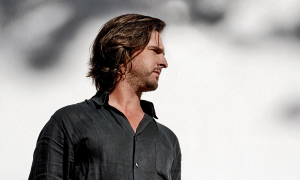
Alonzo Holliday: The Archaeology of Out-Bop


Back to waking life, in the '90s: Frank is making plans to start a band with another Frank, and since there can't be two Franks, Turek decides to adopt the name of his friend from the dream.
The other Frank adopts another name from jazz history, Chico. Together, bassist Kit Demos, tenor saxophonist Holliday and drummer Chico Valentine form the Mystic Out-Bop Review.
The MOR are anything but MOR (as in "middle-of-the-road"): they are decidedly in the fast lane of the avant-garde. That said, a careful listener can always hear nods to the jazz past in their work, going back to the everlasting, ever-hip, original Alonzo Holliday and before.
If you live in Portland, Maine, you may often find the new Holliday in his guise (literally) of Cranky, the Clown School Dropout, busking for small change on his signature straight alto sax and playing hits from the '20s and '30s.
Cranky's sneakers don't match: one is red and one is blue. He wears a plaid shirt. Somehow, everything hangs together and he comes off looking quite dapper. The straight alto is an exquisite, black-nickel plated model.
It is his art school background that gives him this aesthetic sense. With a bachelors in Fine Arts from the University of Southern Maine, he balances another career as an artist of dioramas in the style of Joseph Cornell.
As a boy in Dexter, Maine, Turek had little exposure to culture. He did take drawing lessons, but the nearest large museums were in Portland (The Portland Museum of Art) and Rockland (The Farnsworth Institute), and these were two hours away.
Even his exposure to music was late. But in his early teens, he discovered the world of music on his AM radio. This was in the late '70s, when someone tuning in could find a wealth of variety. Because he was out in the country with no signal obstructions, he could pick up stations from all over the northeast. "At night time," he says, "I could pick up stations in Boston, New York, Buffalo and occasionally pick up a Chicago station...I was always tweaking the dial."
There was much Top 40 pop, but also funk, like Parliament/Funkadelic. "It was kind of wild 'cause I hadn't heard music like that before, the urban music," he continues. The funk element is still strong in the Out-Bop Review, despite its often free-form time structures.
Turek has an older half-brother who moved back in with the family when Holliday was in his late teens. "He studied music at the Boston conservatory," he explains. "He was a singer. He did light opera and show tunes."
One thing his brother, an accomplished pianist, showed him was the piano. "He had a Zen, hands-off approach to teaching and had me do a lot of exploration," Turek says. "I started discovering the piano in an odd way.
"I tried learning how to read music at that time," he says, "but there was too much of a learning curve." So he continued his explorations. At the same time, he had found that he liked the music of French composer Erik Satie. "I had sheet music to 'Gymnopedie,' which is a very basic piece of his, and I remember trying to learn that; and I learned enough just by analyzing it on my own, just seeing how it was constructed. And I would spend hours playing on my own."
 Turek had a number of bands before the Review. "I picked up the alto sax in the late '90s, when I was in my late 20s," he said. "I bought a used alto sax, just a cheap student horn, and just immediately started. It wasn't great, but it was a workhorse. It immediately made sense to me, where I'd struggled for years on the piano.
"I had some friends, two who played guitar and one drummer, and I started listening to surf instrumental like The Ventures and Dick Dale. And a lot of this stuff was real sax oriented, along with R&B. So we started a surf band, Shutdown 66. The name is a reference to the year '66, and 'shutdown' is a racecar term. There's a lot of crossover between hot rod culture and surf. We did that and it ended up being a real popular band. There had just been a surf revival."
Turek has a grasp of the history of surf rock, how it evolved from the demise of the music of the big band era. "There was much popular music in the early days of rock that was entirely instrumental," he says. "We tend to forget that because it got overshadowed by the vocal material.
"Our band didn't play any popular surf songs. We did obscure ones. No originals, but in a way, our choices were original on account of their obscurity, so that was creative.
"After two years I switched to tenor sax, as that was more appropriate to what we were playing. The tenor has a lot more dynamics than the alto, including that 'growl' derived from the R&B bands like Eddie "Cleanhead" Vinson's and Arnett Cobb's. So I really got into all the characterizations you can get from the tenor. All the honking and screaming."

Yes, he can get quite wild in his playing. "My artwork has a lot more control exercised over it, there's more premeditation, whereas the music is about spontaneity. I like that I have those two worlds," he says. Is there any relation between the two? "Well they're both coming out of me. They're part of the same whole."
Many of his artworks are inspired by musicians, including an homage to Ornette Coleman. Pictures from old magazines line a small cardboard box, divided into two levels. Pasted onto the second divider is the text, "Hum Hum, Buzz Buzz," from a children's book. Above that, on the second level, is a toy dinosaur. The piece is titled "The Quietude of a Solitary Soul," a phrase taken from the liner notes of a Coleman album.
There's a photo of two forks sticking into a cork with a nail in it on the back of the box. "With this, I was trying to suggest the balance I find in Ornette's music," he explains.
Turek's music is also intuitive and capricious, though in a different way. A case in point, his solo tribute to Thelonious Monk, Knom (Aria Arts, 2003): all song titles here are anagrams of well- known Monk tunes, e.g. "Little Knerink"; likewise, the songs themselves rework the referenced Monk numbers in unexpected turns and delays of return to theme. After a fashion, you could say he "out-Monks Monk."
In addition to fine arts, he studied 20th century continental philosophy. Martin Heidegger appealed to him the most. A definite part of his message, drawn from Heidegger, is a criticism of a culture that overvalues the technical. Also, he sees in Michel Foucault's role as "archaeologist of culture" a counterpart in what he does. "In my work, I take artifacts. For example, the early jazz I play on the street, and mix it with more recent stuff," he says.
"In Out-Bop music there's a lot of deconstruction going on. You can set up a situation where you're being abstract and you're trying to deny all influences from the past, and on the other end of the spectrum, there's people who play repertoire music and the past is the only thing. My perspective is that the past is an influence whether you want it to be or not, so you might as well take the parts that work for you in making a contemporary statement."
Turek does not use notation but he often has a game plan, sometimes fluxus-derived. "There's one piece we have," he tells us, "it's called 'Conscientious Objector' (from Lagrangian Points (Aria Arts, 2001)), where Kit is playing a standard, walking bass line, and Chico and I are the kids throwing snowballs at the square kid. Doing random things and trying to knock him off."
 The Mystic Out-Bop Review's self-titled debut (Aria Arts, 2001) opens with a 49- minute marathon, "Obliterated Destinies." How does he justify undertaking such a bold enterprise to kick off the band's recording career? "I think the way we've evolved as a trio—it's like a balance of the three of us finding a natural ending, but at the same time, if one of us has a really great idea, two of us may feel like we've finished that statement, but the first guy can be persistent about it and we keep going," he said.
Free jazz, by its very nature, is about freedom, but discipline, however paradoxically, goes with it hand-in-hand. "There's always a listening going on, for one thing," Turek agrees. The listening includes paying attention to the audience when they play live, as on their double-CD Live at Strange Maine (self- released, 2007), their strongest effort to date.
What is it that gives a live performance its magic? "If there's encouragement in a certain direction, that has psychological impact," he answers. "On the other hand, we might react to a hostile person in the audience. You can read a lot into body language...There are some places you play where there are just a handful of people watching you and the rest are at the bar. One of the good things I learned from playing in rock bands over the years, and also playing in bars, and also on the street, you learn to deal with it, and you can take it or leave it. And because of the fine balance of the nature of the performance, anything can push it in certain directions."
Like many musicians, Turek's discovery of public libraries' music collections really opened his ears. "I taught myself the basics of music history from books and records from the library," he says. "I abandoned a lot of the pop I listened to when I was a kid, and focused on classical. I was interested in the more obscure elements of classical music. I would look up the more canonical works of, say, Mozart, and then I would find his lesser-known pieces. Also, I liked the lesser-known composers from that period. And gradually I worked myself up to the 20th century, like Scriabin. His interest in synaesthesia, where you see sounds or hear colors, appealed to me.
 "I got a slot as a DJ at my university radio station. They were having a hard time filling it 'cause it wasn't hip," he added. "I did that for three or four years. In the process of that I got into the downtown stuff, like early John Zorn. I also started work at a record store in Portland, Amadeus, that specialized in jazz and classical.
"When I was growing up, I really didn't like jazz. One day I picked up a record by the Modern Jazz Quartet—I figured 'modern' ... 'jazz' ...sounds good! But it was so boring! But a little later I started to listen to jazz radio, and there were some good DJs. I would always have my radio on. I started hearing people like—the three who first got me into jazz were Sun Ra, Charles Mingus and Archie Shepp. I loved Shepp's big, aggressive sound.
"We had a recording, at the record store, I think it was [Sun Ra's] Nubians of Plutonia (Saturn, 1966). I was into the wild group improvisation. He was more 'out' than Archie Shepp was. Shepp had more of a song construction that he was working from. He was self-expressive, whereas Sun Ra had a group expression. He would have an overarching structure, but within that there was a bigger sound."
The Out-Bop Review has structure, but of a different nature. "I think we kind of just go with whoever, at a given point in time, has the best ideas and best energy behind it," Turek says. "Kit and Chico have a really fundamental communication. Like anyone who plays with a bassist and drummer with that kind of connection, the other guy is in some respects going to feel like a third wheel."
That said, he turns this situation into a window of opportunity. "A lot of times, I'll be like the lead vocalist on top of what they're doing," he asserts. "We like the idea of being an egalitarian-type band. There's no one who really dominates any given performance."
He still likes to play outside of the Out-Bop context on occasion. "In some ways it's a challenge because it's like having a conversation with someone you don't know," he says. "At the same time it often works, in a different way, because you are playing with musicians who are also accomplished."
He will be meeting this challenge later this month [Feb. 27, 2010] when he plays at XFest in Lowell, Mass., in which musician and gallery curator Walter Wright mixes and matches other artists, taking them out of their element. He will be playing with many Boston-based performers, who have a decidedly different sound, more academic, perhaps, quieter and European. Turek is unfazed: "What happens is you find a meeting point. We all come from the avant-garde and we all know how to speak that language. A couple of times I have done this festival, I could tell the people weren't communicating well but the things I did came out really well."
Ethically, many artists say that their role is not to be part of a system, and show the way to having a unique, individual voice. Turek shares this value. "If you have a really expressive voice, then that's your social role," he said. "Like the traditional role of the shaman, someone with this esoteric knowledge that was both a part of the community and not a part of the community. And to maintain that wisdom there has to be that separation to maintain the meditation on the nature of things. Being able to integrate and find some way to express that to the rest of the people- -to me that's the whole reason for being this, an avant-garde performer."
Discography
Mystic Out-Bop Review, Live at Strange Maine (Self Produced, 2007)
Alonzo Holliday, Knom (Aria Arts, 2003)
The Clown School Dropouts, Sweet Petunia Pie (Oy Vey, 2003)
Mystic Out-Bop Review Meets Reverend Crank Sturgeon, ChamberMusic (Aria Arts, 2002)
Mystic Out-Bop Review, Lagrangian Points (Aria Arts, 2001)
Mystic Out-Bop Review, s/t (Aria Arts, 2001)
Photo credits
Page 1: Joe Donnell; Page 2: Ron Harrity
All photos courtesy of Alonzo Holliday
< Previous
Shades
Comments
About Alonzo Holliday
Instrument: Saxophone, tenor
Related Articles | Concerts | Albums | Photos | Similar ToTags
For the Love of Jazz
 All About Jazz has been a pillar of jazz since 1995, championing it as an art form and, more importantly, supporting the musicians who create it. Our enduring commitment has made "AAJ" one of the most culturally important websites of its kind, read by hundreds of thousands of fans, musicians and industry figures every month.
You Can Help
To expand our coverage even further and develop new means to foster jazz discovery and connectivity we need your help. You can become a sustaining member for a modest $20 and in return, we'll immediately hide those pesky ads plus provide access to future articles for a full year. This winning combination will vastly improve your AAJ experience and allow us to vigorously build on the pioneering work we first started in 1995. So enjoy an ad-free AAJ experience and help us remain a positive beacon for jazz by making a donation today.

Giveaway

Days remaining: 5